
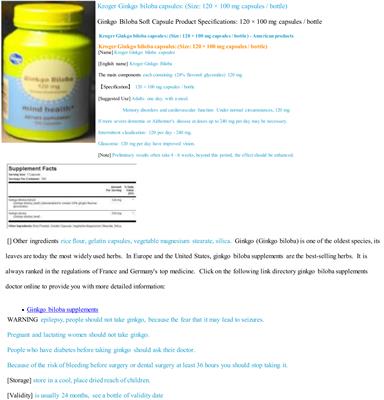
| Ginkgo biloba extract (as standardized to contain Ginkgo Flavone Glycosides)Ginkgo biloba extract (Form: standardized to contain 24% Ginkgo Flavone Glycosides) PlantPart: leaf Genus: Ginkgo Species: biloba | 120 mg | |
| Ginkgo biloba | 150 mg |
Other ingredients: Rice powder, Gelatin Capsule, Vegetable Magnesium Stearate, Silica
% Daily Values for: Adults and children 4 or more years of age.
Where this label comes from
An original label of the NIH's Dietary Supplement Label Database, entered there on 22 December 2017, shown here as it was entered. The NIH's record
General information
- Product name
- Ginkgo Biloba 120 mg
- Brand
- Kroger
- Barcode (UPC)
- Not printed
- Net contents
- 120 Capsule(s)
- Market status
- On market
- DSLD ID
- 82238
Classification
Label statements
Formula: Contains: The main components each containing (24% flavonol glycosides) 120 mg
Directions: [Suggested Use] Adults: one day, with a meal.
Directions: Memory disorders and cardiovascular function: Under normal circumstances, 120 mg. If more severe dementia or Alzheimer's disease at doses up to 240 mg per day may be necessary. Intermittent claudication: 120 per day - 240 mg.
Precautions: All Other: Warning epilepsy, people should not take ginkgo, because the fear that it may lead to seizures.
Precautions: Pregnant or Nursing or Prescription Medications: Pregnant and lactating women should not take ginkgo.
Precautions: All Other: People who have diabetes before taking ginkgo should ask their doctor. Because of the risk of bleeding before surgery or dental surgery at least 36 hours you should stop taking it.
Storage: [Storage] store in a cool, place dried reach of children.
Brand information
Not Present: Kroger
More labels from Kroger
Labels only: each label is shown as printed on the bottle, with no grades, rankings or advice. A label in this database is not an endorsement of the product. Read the label on the bottle you buy: makers change their formulas. Reverse Age Lab is not affiliated with, or endorsed by, the National Institutes of Health or its Office of Dietary Supplements. The original labels come from the NIH’s public-domain data; the labels since are read by us. Search the Dietary Supplement Label Database.