
Dry Eye Support Pack (+ Multivitamin)
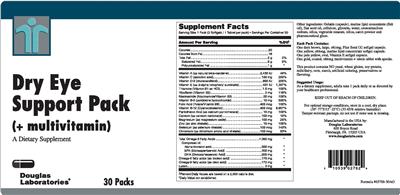
| Calories | 20 {Calories} | |
| Calories from Fat | 19 {Calories} | |
| Total Fat | 2 g | 2% |
| Saturated Fat | 0 g | 0% |
| Polyunsaturated Fat | 1 g | † |
| Vitamin A (as Beta-Carotene)Vitamin A (Form: as natural Beta-Carotene) | 2,430 IU | 49% |
| Vitamin C (as Ascorbic Acid) | 150 mg | 250% |
| Vitamin D3 (as Cholecalciferol) | 800 IU | 200% |
| Vitamin E (as D-Alpha-Tocopheryl Succinate)Vitamin E (Form: as D-Alpha Tocopheryl Succinate) | 401 IU | 1,337% |
| Thiamine (as Thiamine Hydrochloride, Vitamin B1)Thiamine (Form: as Thiamine HCl) (Alt. Name: Vitamin B1) | 1.5 mg | 100% |
| Riboflavin (as Vitamin B2) | 2 mg | 118% |
| Niacinamide (as Niacinamide, Vitamin B3) | 20 mg | 100% |
| Vitamin B6 (as Pyridoxine Hydrochloride) | 10 mg | 500% |
| Folic Acid (as Folate, Vitamin B9) | 400 mcg | 100% |
| Vitamin B12 (as Cyanocobalamin) | 400 mcg | 6,667% |
| Pantothenic Acid (as Calcium Pantothenate)Pantothenic Acid (Form: as Calcium Pantothenate) | 10 mg | 100% |
| Calcium (as Calcium Carbonate)Calcium (Form: as Calcium Carbonate) | 100 mg | 10% |
| Magnesium (as as Magnesium Oxide)Magnesium (Form: as Magnesium Oxide) | 100 mg | 25% |
| Zinc (as Zinc Chelate)Zinc (Form: as Zinc Chelate) | 15 mg | 100% |
| Selenium (as as Selenium Chelate)Selenium (Form: as Selenium Chelate) | 100 mcg | 143% |
| Chromium (as as Chromium Amino Acid Chelate)Chromium (Form: as Chromium Amino Acid Chelate) | 100 mcg | 83% |
| Total Omega-3 Fatty AcidsTotal Omega-3 Fatty Acids Note: Comprised of: | 1,060 mg | † |
| Alpha-Linolenic Acid | 560 mg | † |
| Eicosapentaenoic Acid | 300 mg | † |
| Docosahexaenoic Acid | 200 mg | † |
| Linoleic AcidOmega-6 Fatty Acids (Form: as Linoleic Acid) | 170 mg | † |
| Oleic AcidOmega-9 Fatty Acids (Alt. Name: Oleic Acid) | 172 mg | † |
| Lutein | 3 mg | † |
Other ingredients: Gelatin, marine lipid concentrate, Flax seed Oil, Cellulose, Glycerin, Water, Croscarmellose Sodium, Silica, Vegetable Stearate, Silica, Carob powder, Pharmaceutical Glaze
% Daily Values for: Adults and children 4 or more years of age.
Where this label comes from
An original label of the NIH's Dietary Supplement Label Database, entered there on 1 June 2012, shown here as it was entered. The NIH's record
General information
- Product name
- Dry Eye Support Pack (+ Multivitamin)
- Brand
- Douglas Laboratories
- Barcode (UPC)
- 3 10539 02792 9
- Net contents
- 30 Pack(s)
- Market status
- On market
- DSLD ID
- 9584
Classification
- Supplement form
- Other (e.g. tea bag)
- Product type
- Other Combinations
- Claim types on the label
- All Other
- Intended for
- Adult (18 - 50 Years), Dairy Free
Label statements
Formulation: Does NOT Contain: This product contains NO yeast, wheat gluten, soy protein, milk/dairy, corn, starch, artificial coloring, preservatives or flavoring.
Directions: Suggested Usage: As a dietary supplement, adults take 1 pack daily or as directed by your healthcare professional.
Precautions: Children: KEEP OUT OF REACH OF CHILDREN.
Storage: For optimal storage conditions, store in a cool, dry place. (59(0)-77(0)F/15(0)-25(0)C) (35-65% relative humidity)
Precautions: All Other: Tamper resistant package, do not use if outer seal is missing.
FDA Statement of Identity: A Dietary Supplement
Formula: Contains: Each Pack Contains: One dark brown, large, oblong, Flax Seed Oil softgel capsule. One yellow, oblong, marine lipid concentrate softgel capsule. One pale yellow, oval, Vitamin E softgel capsule. One gold, coated, oblong multivitamin + lutein tablet with specks.
Brand information
Manufactured in the USA by: Douglas Laboratories, Pittsburgh, PA, USA
More labels from Douglas Laboratories
Labels only: each label is shown as printed on the bottle, with no grades, rankings or advice. A label in this database is not an endorsement of the product. Read the label on the bottle you buy: makers change their formulas. Reverse Age Lab is not affiliated with, or endorsed by, the National Institutes of Health or its Office of Dietary Supplements. The original labels come from the NIH’s public-domain data; the labels since are read by us. Search the Dietary Supplement Label Database.