
| Total Carbohydrates | <1 g | <1% |
| Vitamin A (as Beta-Carotene)Vitamin A (Form: as 20% Beta-Carotene) | 2,500 IU | 50% |
| Vitamin C | 60 mg | 100% |
| Vitamin D | 800 IU | 200% |
| Vitamin E | 30 IU | 100% |
| Vitamin K | 25 mcg | 31% |
| Thiamine (as Vitamin B1) | 1.5 mg | 100% |
| Riboflavin (as Vitamin B2) | 1.7 mg | 100% |
| Niacin | 10 mg | 50% |
| Vitamin B6 | 2 mg | 100% |
| Folic Acid | 400 mcg | 100% |
| Vitamin B12 | 6 mcg | 100% |
| Biotin | 30 mcg | 10% |
| Pantothenic Acid | 5 mg | 50% |
| CalciumCalcium Note: elemental | 450 mg | 45% |
| Iron | 18 mg | 100% |
| Magnesium | 50 mg | 13% |
| Zinc | 15 mg | 100% |
| Selenium (as L-Selenomethionine) | 20 mcg | 29% |
| Copper | 2 mg | 100% |
| Manganese | 2 mg | 100% |
| Chromium | 120 mcg | 100% |
Other ingredients: Calcium Carbonate, Cellulose, Magnesium Oxide, Ascorbic Acid, Ferrous Fumarate, Corn Starch, Maltodextrin, DL-Alpha-Tocopheryl Acetate, Acacia, Croscarmellose Sodium, Zinc Oxide, Titanium Dioxide, Dextrin, Hypromellose, Magnesium Stearate, Dicalcium Phosphate, Gelatin, Niacinamide, Silicon Dioxide, Calcium D-Pantothenate, Manganese Sulfate, Polyethylene Glycol, Cupric Sulfate, Dextrose, Pyridoxine Hydrochloride, Glucose, Soy Lecithin, Riboflavin, Thiamine Mononitrate, Vitamin A Acetate, Chromium Chloride, Folic Acid, Beta-Carotene, FD&C Yellow #5 Lake, FD&C Yellow #6 Lake, Sodium Selenate, Biotin, Phytonadione, FD&C Blue #2 Lake, Cholecalciferol, Tricalcium Phosphate, Cyanocobalamin
% Daily Values for: Adults and children 4 or more years of age.
Where this label comes from
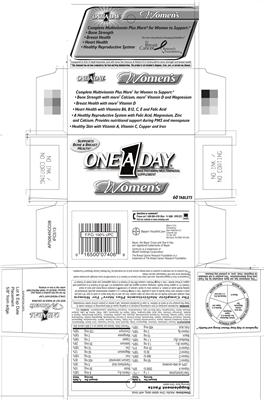
An original label of the NIH's Dietary Supplement Label Database, entered there on 1 June 2012, shown here as it was entered. The NIH's record
General information
- Product name
- Women's
- Brand
- Bayer One A Day
- Barcode (UPC)
- 0 16500 07406 9
- Net contents
- 60 Tablet(s)
- Market status
- Off market
- DSLD ID
- 9778
Classification
- Supplement form
- Tablet or Pill
- Product type
- Multi-Vitamin and Mineral (MVM)
- Claim types on the label
- Nutrient, All Other, Structure/Function
- Intended for
- Adult Female (18 - 50 Years), Menopause
Label statements
Formula: Contains: Complete Multivitamin Plus More for Women to Support: - Bone Strength with more Calcium, more Vitamin D and Magnesium - Breast Health with more Vitamin D - Heart Health with Vitamins B6, B12, C, E and Folic Acid - A Healthy Reproductive System with Folic Acid, Magnesium, Zinc and Calcium. Provides nutritional support during PMS and menopause - Healthy Skin with Vitamin A, Vitamin C, Copper and Iron
FDA Statement of Identity: MULTIVITAMIN/MULTIMINERAL SUPPLEMENT
Formula: Contains: Ingredients To Help Keep Women Strong and Healthy: BONE STRENGTH Calcium, Magnesium, Zinc, Vitamins D, K, Copper, Manganese HEALTHY SKIN Vitamins A, C, Copper, Iron HEART HEALTH Vitamins B6, B12, C, E, Folic Acid BREAST HEALTH Vitamin D REPRODUCTIVE SYSTEM Folic Acid, Calcium, Magnesium, Zinc
Directions: Directions: Adults: One tablet daily, with food.
Formula: Contains: Contains: Soy.
Precautions: Children: WARNING: Accidental overdose of iron-containing products is a leading cause of fatal poisoning in children under 6. Keep this product out of reach of children. In case of accidental overdose, call a doctor or Poison Control Center immediately.
Formula: Contains: One A Day(R) Women's contains 800 IUs of Vitamin D to help supplement your daily intake of Vitamin D.
Precautions: Children: KEEP OUT OF REACH OF CHILDREN CHILD RESISTANT CAP
Precautions: All Other: Do not use this product if safety seal bearing "SEALED for YOUR PROTECTION" under cap is torn or missing.
Brand information
Distributed by: Bayer HealthCare LLC Consumer Care, Morristown, NJ, USA
More labels from Bayer One A Day
Labels only: each label is shown as printed on the bottle, with no grades, rankings or advice. A label in this database is not an endorsement of the product. Read the label on the bottle you buy: makers change their formulas. Reverse Age Lab is not affiliated with, or endorsed by, the National Institutes of Health or its Office of Dietary Supplements. The original labels come from the NIH’s public-domain data; the labels since are read by us. Search the Dietary Supplement Label Database.