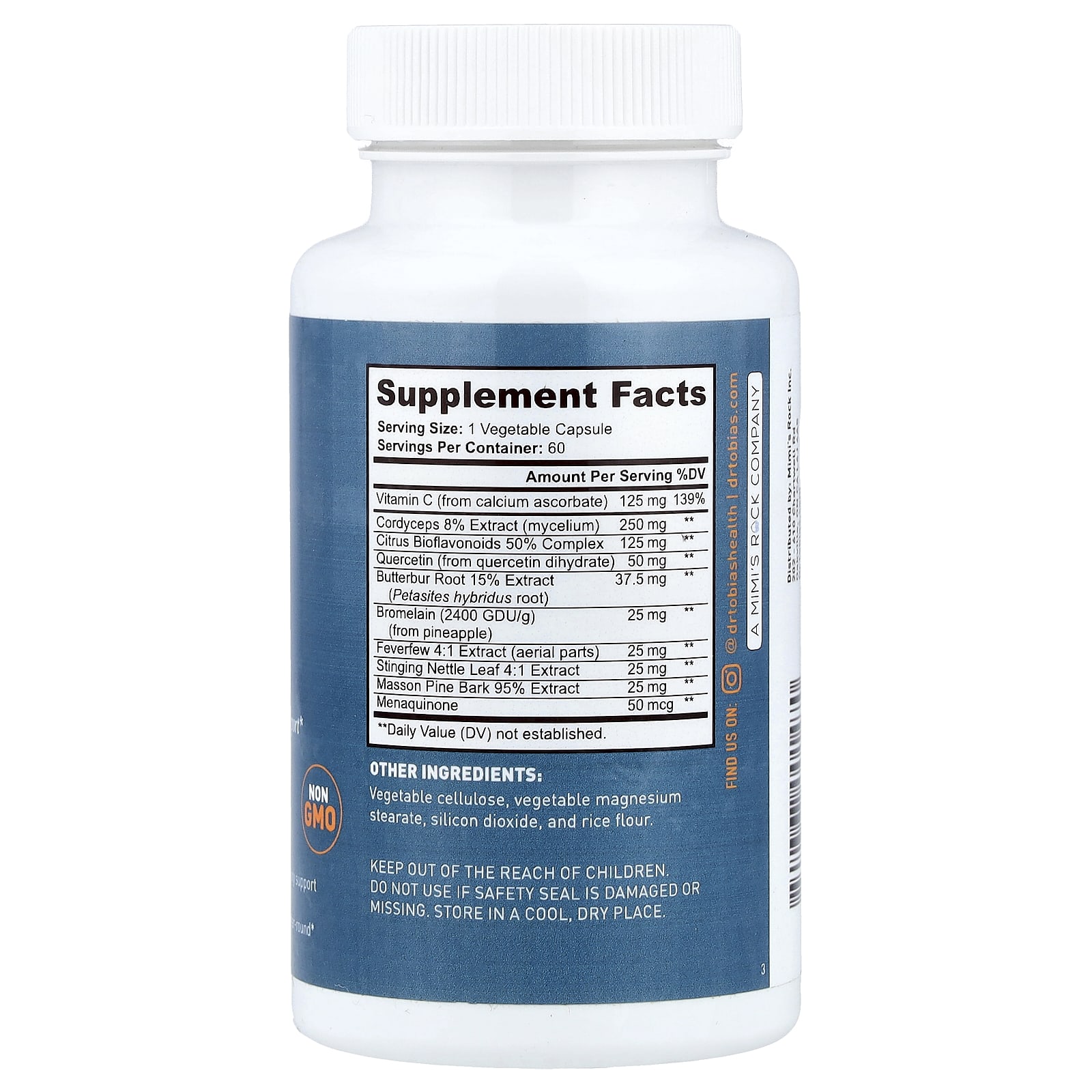
| Vitamin C (as from calcium ascorbate) | 125 mg | 139% |
| Cordyceps 8% Extract (as mycelium) | 250 mg | ** |
| Citrus Bioflavonoids 50% Complex | 125 mg | ** |
| Quercetin (as from quercetin dihydrate) | 50 mg | ** |
| Butterbur Root 15% Extract (as Petasites hybridus root) | 37.5 mg | ** |
| Bromelain (2400 GDU/g) (as from pineapple) | 25 mg | ** |
| Feverfew 4:1 Extract (as aerial parts) | 25 mg | ** |
| Stinging Nettle Leaf 4:1 Extract | 25 mg | ** |
| Masson Pine Bark 95% Extract | 25 mg | ** |
| Menaquinone | 50 mcg | ** |
Other ingredients: Vegetable cellulose, vegetable magnesium stearate, silicon dioxide, and rice flour.
% Daily Values for: Adults and children 4 or more years of age.
Where this label comes from
Read by Reverse Age Lab on 29 October 2026 from iherb.com, after the NIH stopped adding labels.
General information
- Product name
- Inflammation Defence
- Brand
- Dr. Tobias
- Barcode (UPC)
- Not printed
- Net contents
- 60 Capsules (60 Day Supply)
- Market status
- On market
- Label ID
- s43042
Classification
- Supplement form
- Capsule
- Product type
- Botanical with Nutrients
- Claim types on the label
- Structure/Function, All Other
- Claims on the label
- Non-GMO, Advanced Respiratory Support*, Supports the bronchial system*, Helps you breathe comfortably year-round*
Label statements
Storage: Store in a cool, dry place.
Seal: Do not use if safety seal is damaged or missing.
Other: Keep out of the reach of children.
Brand information
Distributed by: Mimi's Rock Inc.
More labels from Dr. Tobias
Labels only: each label is shown as printed on the bottle, with no grades, rankings or advice. A label in this database is not an endorsement of the product. Read the label on the bottle you buy: makers change their formulas. Reverse Age Lab is not affiliated with, or endorsed by, the National Institutes of Health or its Office of Dietary Supplements. The original labels come from the NIH’s public-domain data; the labels since are read by us. Search the Dietary Supplement Label Database.