This label lists no Supplement Facts rows.
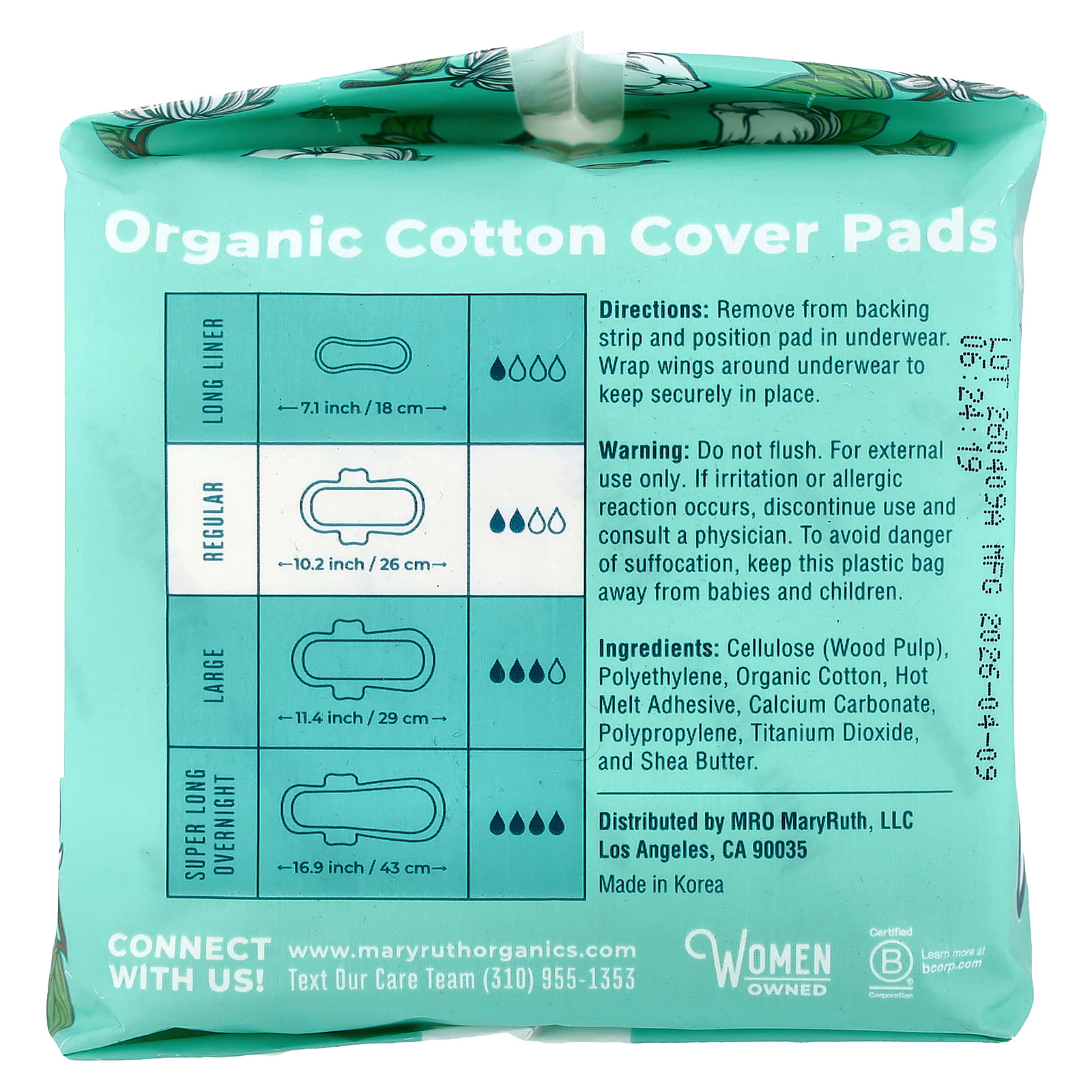
Other ingredients: Cellulose (Wood Pulp), Polyethylene, Organic Cotton, Hot Melt Adhesive, Calcium Carbonate, Polypropylene, Titanium Dioxide, and Shea Butter.
Where this label comes from
Read by Reverse Age Lab on 30 October 2026 from iherb.com, after the NIH stopped adding labels.
General information
- Product name
- Organic Cotton Cover Pads (Regular)
- Brand
- Mary Ruth's
- Barcode (UPC)
- 8 10104 62408 4
- Net contents
- 22 Count
- Market status
- On market
- Label ID
- s54794
Classification
- Supplement form
- Other (e.g. tea bag)
- Claim types on the label
- All Other
- Claims on the label
- Fragrance-free, Sap-free core, Pure comfort, Organic cotton, Skin-friendly material
Label statements
Directions: Remove from backing strip and position pad in underwear. Wrap wings around underwear to keep securely in place.
Precautions: All Other: Do not flush. For external use only. If irritation or allergic reaction occurs, discontinue use and consult a physician. To avoid danger of suffocation, keep this plastic bag away from babies and children.
Seals/Symbols: Dermatest Original Excellent 2026 Skin-friendly material (dermatest.com/material)
Seals/Symbols: Women Owned
Seals/Symbols: Certified B Corporation (bcorp.com)
Other: Made in Korea
Other: Connect with us: www.maryruthorganics.com; Text Our Care Team (310) 955-1353
Product Specific Information: Regular with wings, Regular flow
Brand information
Distributed by: MRO MaryRuth, LLC, Los Angeles, CA 90035
More labels from Mary Ruth's
Labels only: each label is shown as printed on the bottle, with no grades, rankings or advice. A label in this database is not an endorsement of the product. Read the label on the bottle you buy: makers change their formulas. Reverse Age Lab is not affiliated with, or endorsed by, the National Institutes of Health or its Office of Dietary Supplements. The original labels come from the NIH’s public-domain data; the labels since are read by us. Search the Dietary Supplement Label Database.