
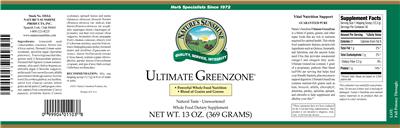
| Calories | 31 {Calories} | |
| Calories from Fat | 9 {Calories} | |
| Total Fat | 1 g | 2% |
| Total Carbohydrates | 7 g | 2% |
| Dietary Fiber | 2.3 g | 9% |
| Protein | 7 g | 14% |
Other ingredients: Amaranth, Brown Rice, flaxseed, spirulina algae, fructooligosaccharides, Quinoa, flaxseed hull lignans, chia, chlorella algae, millet, alfalfa juice extract, licorice, Soy Lecithin, carrot, Lemon Grass, papaya fruit concentrate, Artichoke, spinach, Broccoli, kale, Asparagus, red beet root extract, Bromelain, Chicory, Acerola fruit extract, Horsetail, Lemon Bioflavonoid extract, Sodium Copper Chlorophyllins, Parsley, Pau d'Arco bark extract
% Daily Values for: Adults and children 4 or more years of age.
Where this label comes from
An original label of the NIH's Dietary Supplement Label Database, entered there on 25 January 2013, shown here as it was entered. The NIH's record
General information
- Product name
- Ultimate Greenzone
- Brand
- Nature's Sunshine
- Barcode (UPC)
- 0 99904 01103 8
- Net contents
- 13 oz.; 369 g
- Market status
- Off market
- DSLD ID
- 17827
Classification
- Supplement form
- Powder
- Product type
- Fiber and Other Nutrients
- Claim types on the label
- All Other, Structure/Function
- Intended for
- Adult (18 - 50 Years)
Label statements
FDA Statement of Identity: Whole Food Dietary Supplement
Precautions: All Other: This container was sealed for your protection. Do not use if inner seal is missing or damaged.
Directions: RECOMMENDATION: Mix one heaping scoop (12.3 g) in 8 oz of water or juice.
Brand information
Stock No. 1103-6: Nature's Sunshine Products, Inc, Spanish Fork, Utah
More labels from Nature's Sunshine
Labels only: each label is shown as printed on the bottle, with no grades, rankings or advice. A label in this database is not an endorsement of the product. Read the label on the bottle you buy: makers change their formulas. Reverse Age Lab is not affiliated with, or endorsed by, the National Institutes of Health or its Office of Dietary Supplements. The original labels come from the NIH’s public-domain data; the labels since are read by us. Search the Dietary Supplement Label Database.