
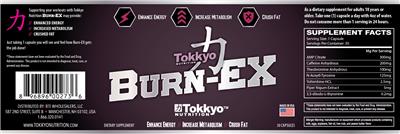
| AMP Citrate | 300 mg | |
| Caffeine Anhydrous | 200 mg | |
| Theobromine Anhydrous | 100 mg | |
| N-Acetyl-Tyrosine | 125 mg | |
| Yohimbine HCl | 2.5 mg | |
| Piper nigrum extract | 5 mg | |
| 3,5-Diiodo-L-Thyronine | 0.2 mg |
% Daily Values for: Adults and children 4 or more years of age.
Where this label comes from
An original label of the NIH's Dietary Supplement Label Database, entered there on 21 September 2018, shown here as it was entered. The NIH's record
General information
- Product name
- Burn-Ex
- Brand
- Tokkyo Nutrition
- Barcode (UPC)
- 8 96896 00273 6
- Net contents
- 30 Capsule(s)
- Market status
- On market
- DSLD ID
- 180491
Classification
- Supplement form
- Capsule
- Product type
- Other Combinations
- Claim types on the label
- All Other, Structure/Function
- Intended for
- Adult (18 - 50 Years)
Label statements
Directions: Just taking 1 capsule you will see and feel how Burn-Ex gets the job done!
FDA Statement of Identity: Dietary Supplement
Directions: As a dietary supplement for adults 18 years or older. Take one (1) capsule a day with 4oz of water. Do not consume more than 1 serving in 24 hours.
Precautions: All Other: Do not consume more than 1 serving in 24 hours.
Precautions: Allergies: Allergen Warning: Manufactured on equipment which processes products containing milk, eggs, soybeans, fish oil, tree nuts, and peanut butter flavor
Brand information
Distributed by:: BTE Wholesalers, LLC, Manchester, NH, USA
More labels from Tokkyo Nutrition
Labels only: each label is shown as printed on the bottle, with no grades, rankings or advice. A label in this database is not an endorsement of the product. Read the label on the bottle you buy: makers change their formulas. Reverse Age Lab is not affiliated with, or endorsed by, the National Institutes of Health or its Office of Dietary Supplements. The original labels come from the NIH’s public-domain data; the labels since are read by us. Search the Dietary Supplement Label Database.