
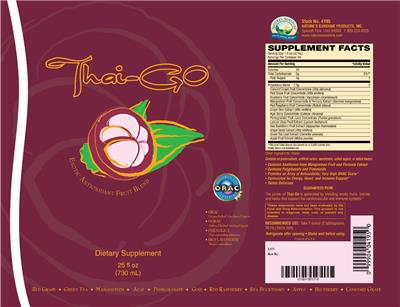
| Calories | 20 | |
| Total Carbohydrates | 5 g | 2% |
| Total Sugars | 4 g | † |
| Proprietary Blend | 7.5 g | † |
| Concord Grape fruit concentrate | ||
| Red Grape fruit concentrate | ||
| Blueberry fruit concentrate | ||
| Mangosteen fruit concentrate & pericarp extract | ||
| Red Raspberry fruit concentrate | ||
| Grape skin extract | ||
| Acai berry concentrate | ||
| Pomegranate fruit juice concentrate | ||
| Lycium (Goji) fruit extract | ||
| Sea Buckthorn fruit extract | ||
| Grape Seed Extract (as Polyphenols) | ||
| Green Tea leaf extract | ||
| Apple Fruit Extract |
Other ingredients: Water
% Daily Values for: Adults and children 4 or more years of age.
Where this label comes from
An original label of the NIH's Dietary Supplement Label Database, entered there on 23 October 2019, shown here as it was entered. The NIH's record
General information
- Product name
- Thai-Go
- Brand
- Nature's Sunshine
- Barcode (UPC)
- 0 99904 04195 0
- Net contents
- 25 fl. Oz.; 730 mL
- Market status
- Off market
- DSLD ID
- 208311
Classification
Label statements
FDA Statement of Identity: Dietary Supplement
Formula: Contains: Red Grap Green Tea Mangosteen Acai Pomegranate Goji Red Raspberry Sea Buckthorn Apple Blueberry Concord Grape
Formulation: Does NOT Contain: Contains no preservatives, artificial colors, sweeteners, added sugars, or added flavors.
Formula: Contains: Contains Xanthoes from Mangosteen fruit and Pericarp extract Contains Polyphenol and Flavonoids
Directions: Recommended use: Take 1 ounce (2 tablespoons, 30 mL) twice daily.
Storage: Refrigerate after opening
Directions: Shake well before using
Brand information
Manufacturer: Nature's Sunshine Products, Inc., Spanish Fork, UT
More labels from Nature's Sunshine
Labels only: each label is shown as printed on the bottle, with no grades, rankings or advice. A label in this database is not an endorsement of the product. Read the label on the bottle you buy: makers change their formulas. Reverse Age Lab is not affiliated with, or endorsed by, the National Institutes of Health or its Office of Dietary Supplements. The original labels come from the NIH’s public-domain data; the labels since are read by us. Search the Dietary Supplement Label Database.