
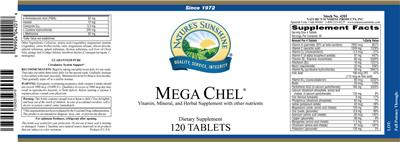
| Vitamin A (as Beta-Carotene, Vitamin A Palmitate)Vitamin A (Form: Vitamin A Palmitate, as 80% Beta-Carotene) | 7,800 mcg | 867% |
| Vitamin C (as Ascorbic Acid) | 1,240 mg | 1,378% |
| Vitamin D3 (as Cholecalciferol) | 5.4 mcg | 27% |
| Vitamin E (as D-Alpha-Tocopheryl Acetate) | 97 mg | 647% |
| Thiamine (as Thiamine Mononitrate, Vitamin B1) | 66 mg | 5,500% |
| Riboflavin (as Vitamin B2) | 16 mg | 1,231% |
| Niacin (as Niacinamide) | 33 mg | 206% |
| Vitamin B6 (as Pyridoxine Hydrochloride) | 50 mg | 2,941% |
| Folic Acid | 186 mcg DFE | 47% |
| Folic Acid | 112 mcg | |
| Vitamin B12 (as Cyanocobalamin) | 80 mcg | 3,333% |
| Biotin | 33 mcg | 110% |
| Pantothenic Acid (as D-Calcium Pantothenate) | 166 mg | 3,320% |
| Calcium (as Calcium Amino Acid Chelate, Calcium D-Pantothenate, Dicalcium Phosphate) | 120 mg | 9% |
| Iron (as Ferrous Fumarate) | 3 mg | 17% |
| Phosphorus (as Dicalcium Phosphate) | 84 mg | 7% |
| Iodine (as Potassium Iodide) | 42 mcg | 28% |
| Magnesium (as Magnesium Amino Acid Chelate, Magnesium Oxide) | 128 mg | 30% |
| Zinc (as Zinc Gluconate, Zinc Oxide) | 8.8 mg | 80% |
| Selenium (as Selenium Amino Acid Chelate)Selenium (Form: as Selenium Amino Acid Chelate) | 80 mcg | 145% |
| Copper (as Copper Gluconate) | 0.08 mg | 9% |
| Manganese (as Manganese Amino Acid Chelate) | 1.4 mg | 61% |
| Chromium (as Chromium Amino Acid Chelate) | 67 mcg | 191% |
| Potassium (as Potassium Gluconate) | 128 mg | 3% |
| P-Aminobenzoic Acid | 83 mg | † |
| Inositol | 12 mg | † |
| Coenzyme Q10 | 3.3 mg | † |
| L-Cysteine Hydrochloride | 240 mg | † |
| L-Methionine | 56 mg | † |
Other ingredients: Cellulose, Stearic Acid, Magnesium Stearate, Citrus Bioflavonoids, Rutin, Magnesium Silicate, Silicon Dioxide, Adrenal Substance, Spleen Substance, Thymus Substance, Cod Liver Oil, Ginkgo, Hawthorn
% Daily Values for: Adults and children 4 or more years of age.
Where this label comes from
An original label of the NIH's Dietary Supplement Label Database, entered there on 21 November 2019, shown here as it was entered. The NIH's record
General information
- Product name
- Mega Chel
- Brand
- Nature's Sunshine
- Barcode (UPC)
- 0 99904 04201 8
- Net contents
- 120 Tablet(s)
- Market status
- Off market
- DSLD ID
- 208335
Classification
- Supplement form
- Tablet or Pill
- Product type
- Other Combinations
- Claim types on the label
- Nutrient, All Other, Structure/Function
- Intended for
- Adult (18 - 50 Years)
Label statements
Directions: Recommendation: Begin by taking one tablet twice daily for one week. Then take one tablet three times daily for the second week. Gradually increase to four tablets with meal once daily. Maintain this level for three to four months. Then gradually taper off in a similar manner.
Precautions: Pregnant or Nursing or Prescription Medications: Warning: If pregnant, or planning pregnancy, daily vitamin A intake should not exceed 3000 mcg (10,000 IU). Quantities in excess of 3000 mcg/day may result in reproductive hazards, or birth defects. Before starting a vitamin A regimen please consult your physician.
Precautions: Children: Warning: This bottle contains enough iron to harm a child. Close lid tightly and keep ot of the reach of children. In case of accidental overdose, call a doctor or poison control center immediately.
Formula: Contains: Warning: This bottle contains enough iron to harm a child.
Storage: For optimum freshness, refrigerate after opening.
Precautions: All Other: This bottle was sealed for your protection. Do not use if inner seal is missing or damaged.
FDA Statement of Identity: Dietary Supplement
Brand information
Manufacturer: Nature's Sunshine Products, Inc., Spanish Fork, UT
More labels from Nature's Sunshine
Labels only: each label is shown as printed on the bottle, with no grades, rankings or advice. A label in this database is not an endorsement of the product. Read the label on the bottle you buy: makers change their formulas. Reverse Age Lab is not affiliated with, or endorsed by, the National Institutes of Health or its Office of Dietary Supplements. The original labels come from the NIH’s public-domain data; the labels since are read by us. Search the Dietary Supplement Label Database.