
| Calories | 10 | |
| Total Carbohydrates | 3 g | 1% |
| Total Sugars | 3 g | † |
| Added Sugars | 2 g | 4% |
| Proprietary Blend | 31 g | † |
| Reconstituted Morinda | ||
| Grape fruit juice concentrate | ||
| Pear fruit juice concentrate | ||
| Grape skin extract |
Other ingredients: Malic Acid, Tartaric Acid, Citric Acid, Ascorbic Acid
% Daily Values for: Adults and children 4 or more years of age.
Where this label comes from
An original label of the NIH's Dietary Supplement Label Database, entered there on 22 May 2020, shown here as it was entered. The NIH's record
General information
- Product name
- Nature's Noni Juice
- Brand
- Nature's Sunshine
- Barcode (UPC)
- 0 99904 04066 3
- Net contents
- 16 fl. Oz.; 473 mL
- Market status
- Off market
- DSLD ID
- 221498
Classification
Label statements
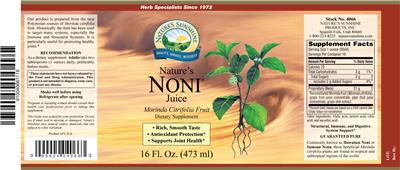
Formula: Contains: Our product is prepared from the nest Polynesian sources of Morinda citrifolia fruit.
Directions: Recommendation As a dietary supplement: Adults take two tablespoons (1 ounce) daily, preferably before meals.
Directions: Shake well before using
Storage: Refrigerate after opening
Precautions: Pregnant or Nursing or Prescription Medications: Pregnant or lactating women should consult their health care professional prior to taking this supplement.
Precautions: All Other: This bottle was sealed for your protection. Do not use if inner seal is missing or damaged.
Formula: Contains: Morinda Citrifolia Fruit
FDA Statement of Identity: Dietary Supplement
Formula: Contains: Commonly known as Hawaiian Noni or Samoan Nonu, these beneficial Morinda citrifolia plants are found in tropical and subtropical regions of the world.
Brand information
Manufacturer: Nature's Sunshine Products, Inc., Spanish Fork, UT
More labels from Nature's Sunshine
Labels only: each label is shown as printed on the bottle, with no grades, rankings or advice. A label in this database is not an endorsement of the product. Read the label on the bottle you buy: makers change their formulas. Reverse Age Lab is not affiliated with, or endorsed by, the National Institutes of Health or its Office of Dietary Supplements. The original labels come from the NIH’s public-domain data; the labels since are read by us. Search the Dietary Supplement Label Database.