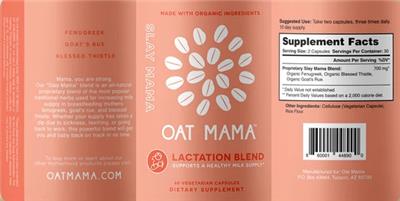
| Proprietary Slay Mama Blend | 700 mg | † |
| organic Fenugreek | ||
| organic Blessed Thistle | ||
| organic Goat's Rue |
Other ingredients: Cellulose, Rice Flour
% Daily Values for: Pregnant and Lactating.
Where this label comes from
An original label of the NIH's Dietary Supplement Label Database, entered there on 25 February 2021, shown here as it was entered. The NIH's record
General information
- Product name
- Slay Mama Lactation Blend
- Brand
- Oat Mama
- Barcode (UPC)
- 8 60001 44890 0
- Net contents
- 60 Vegetarian Capsule(s)
- Market status
- Off market
- DSLD ID
- 242447
Classification
Label statements
Precautions: All Other: Do not exceed recommended dosage.
Precautions: Children: Keep out of reach of children.
Precautions: All Other: Do not use if safety seal is damaged or missing.
Precautions: Pregnant or Nursing or Prescription Medications: Pregnant or nursing mothers, children under the age of 18, and individuals with a known medical condition should consult a physician before use.
Precautions: Children: Pregnant or nursing mothers, children under the age of 18, and individuals with a known medical condition should consult a physician before use.
Formula: Contains: Fenugreek Goat's Rue Blessed Thistle
Formula: Contains: Mama, you are strong Our "Slay Mama" blend is an all-natural proprietary blend of the most popular traditional herbs used for increasing milk supply in breastfeeding mothers; fenugreek, goat's rue, and blessed thistle.
FDA Statement of Identity: Dietary Supplement
Directions: Suggested use: Take two capsules, three times daily.
Brand information
Manufacturer: Oat Mama, Tucson, AZ
More labels from Oat Mama
Labels only: each label is shown as printed on the bottle, with no grades, rankings or advice. A label in this database is not an endorsement of the product. Read the label on the bottle you buy: makers change their formulas. Reverse Age Lab is not affiliated with, or endorsed by, the National Institutes of Health or its Office of Dietary Supplements. The original labels come from the NIH’s public-domain data; the labels since are read by us. Search the Dietary Supplement Label Database.