
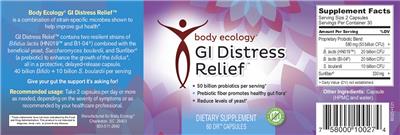
| Proprietary Probiotic Blend50 Billion CFU | 580 mg | † |
| B. lactis (HN019)20 billion CFU | ||
| B. lactis (Bl-04)20 billion CFU | ||
| S. boulardii10 Billion CFU | ||
| Sunfiber | 330 mg | † |
Other ingredients: Capsule
% Daily Values for: Adults and children 4 or more years of age.
Where this label comes from
An original label of the NIH's Dietary Supplement Label Database, entered there on 23 February 2022, shown here as it was entered. The NIH's record · picture of the label (PDF)
General information
- Product name
- GI Distress Relief
- Brand
- Body Ecology
- Barcode (UPC)
- 7 58000 10027 4
- Net contents
- 60 DR Capsule(s)
- Market status
- On market
- DSLD ID
- 261634
Classification
- Supplement form
- Capsule
- Product type
- Other Combinations
- Claim types on the label
- Nutrient, All Other, Structure/Function
- Intended for
- Adult (18 - 50 Years), Gluten Free
Label statements
Formula: Contains: Body Ecology GI Distress Relief is a combination of strain-specific microbes shown to help improve gut health GI Distress Relief contains two resilient strains of Bifidus lactis (HN019 and B1-04) combined with the beneficial yeast, Saccharomyces boulardii, and Sunfiber (a prebiotic) to enhance the growth of bifidus, all in a protective, delayed-release capsule. 40 billion Bifido + 10 billion S. boulardii per serving.
Directions: Recommended usage: Take 2 capsules per day or more as needed, depending on the severity of symptoms or as recommended by your healthcare professional.
Formula: Contains: 50 billion probiotics per serving Prebiotic fiber promotes healthy gut flora
FDA Statement of Identity: Dietary Supplement
Formulation: Does NOT Contain: Gluten Free
Brand information
Manufactured for: Body Ecology, Charleston, SC
More labels from Body Ecology
Labels only: each label is shown as printed on the bottle, with no grades, rankings or advice. A label in this database is not an endorsement of the product. Read the label on the bottle you buy: makers change their formulas. Reverse Age Lab is not affiliated with, or endorsed by, the National Institutes of Health or its Office of Dietary Supplements. The original labels come from the NIH’s public-domain data; the labels since are read by us. Search the Dietary Supplement Label Database.