
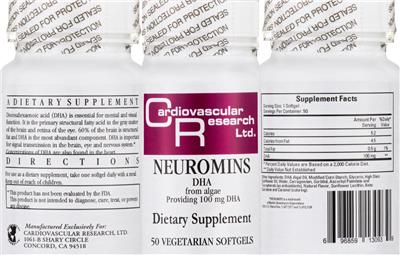
| Calories | 5.2 | |
| Calories from Fat | 4.5 | |
| Total Fat | 0.5 g | 1% |
| DHA | 100 mg | † |
Other ingredients: DHA Algal Oil, Modified Corn Starch, Glycerin, high Oleic Sunflower Oil, Carrageenan, Sorbitol, Ascorbyl Palmitate, Tocopherols, Natural flavor, Sunflower Lecithin, Beta Carotene, Caramel
% Daily Values for: Adults and children 4 or more years of age.
Where this label comes from
An original label of the NIH's Dietary Supplement Label Database, entered there on 23 August 2022, shown here as it was entered. The NIH's record · picture of the label (PDF)
General information
- Product name
- Neuromins DHA
- Brand
- Cardiovascular Research
- Barcode (UPC)
- 6 96859 13093 9
- Net contents
- 50 Vegetarian Softgel(s)
- Market status
- Off market
- DSLD ID
- 271467
Classification
- Supplement form
- Softgel Capsule
- Product type
- Fat/Fatty Acid
- Claim types on the label
- Nutrient, All Other, Structure/Function
- Intended for
- Adult (18 - 50 Years)
Label statements
FDA Statement of Identity: A Dietary Supplement
Formula: Contains: Docosahexaenoic acid (DHA) is essential for mental and visual function. It is the primary structural fatty acid in the gray matter of the brain and retina of the eye. 60% of the brain is structural fat and DHA is the most abundant component. DHA is important for signal transmission in the brain, eye and nervous system. Concentrations of DHA are also found in the heart.
Directions: Directions For use as a dietary supplement, take one softgel daily with a meal.
Precautions: Children: Keep out of reach of children.
Formula: Contains: Neuromins DHA from algae providing 100 mg DHA
Brand information
Manufactured exclusively for: Cardiovascular Research, LTD., Concord, CA
More labels from Cardiovascular Research
Labels only: each label is shown as printed on the bottle, with no grades, rankings or advice. A label in this database is not an endorsement of the product. Read the label on the bottle you buy: makers change their formulas. Reverse Age Lab is not affiliated with, or endorsed by, the National Institutes of Health or its Office of Dietary Supplements. The original labels come from the NIH’s public-domain data; the labels since are read by us. Search the Dietary Supplement Label Database.