
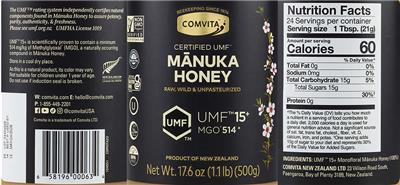
| Calories | 60 | |
| Total Fat | 0 g | 0% |
| Sodium | 0 mg | 0% |
| Total Carbohydrates | 15 g | 5% |
| Total Sugars | 15 g | 30% |
| Protein | 0 g |
Other ingredients: UMF 15+
% Daily Values for: Adults and children 4 or more years of age.
Where this label comes from
An original label of the NIH's Dietary Supplement Label Database, entered there on 22 November 2024, shown here as it was entered. The NIH's record · picture of the label (PDF)
General information
- Product name
- Manuka Honey UMF 15+ MGO 514+
- Brand
- Comvita
- Barcode (UPC)
- 6 58196 00063 4
- Net contents
- 17.6 Ounce(s); 1.1 Pound(s); 500 Gram(s)
- Market status
- On market
- DSLD ID
- 319408
Classification
- Supplement form
- Liquid
- Product type
- Non-Nutrient/Non-Botanical
- Claim types on the label
- All Other
- Intended for
- Children 4 or More Years of Age, Adult (18 - 50 Years), Kosher, Halal, Gluten Free, Children more than 1 but less than 4
Label statements
Formula: Contains: UMF 15+ is scientifically proven to contain a minimum 514 mg/kg of Methylglyoxal (MGO), a naturally occurring compound in Manuka Honey.
Storage: Store in a cool dry place.
Precautions: Children: Not suitable for children under 1 year of age.
Precautions: All Other: Do not use if induction seal is broken.
Formulation: Does NOT Contain: Non GMO Project Verified nongmoproject.com Glyphosate Residue free detoxproject.org GFCO.org (Gluten-Free Certification Organization)
Formulation: Does NOT Contain: Our jars are BPA Free
Formula: Contains: One serving adds 15g of sugar to your diet and represents 30% of the daily value for added sugars.
Brand information
Manufacturer: Comvita New Zealand LTD, Paengaroa, Bay of Plenty, New Zealand
More labels from Comvita
Labels only: each label is shown as printed on the bottle, with no grades, rankings or advice. A label in this database is not an endorsement of the product. Read the label on the bottle you buy: makers change their formulas. Reverse Age Lab is not affiliated with, or endorsed by, the National Institutes of Health or its Office of Dietary Supplements. The original labels come from the NIH’s public-domain data; the labels since are read by us. Search the Dietary Supplement Label Database.