
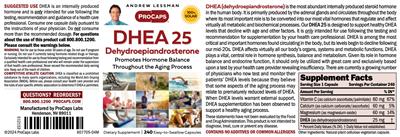
| Vitamin C (as Calcium Ascorbate, Calcium Palmitate) | 60 mg | 67% |
| Calcium (as Calcium Ascorbate, Calcium Carbonate) | 60 mg | 5% |
| Magnesium (as Magnesium Oxide) | 60 mg | 14% |
| Dehydroepiandrosterone | 25 mg | † |
Other ingredients: Plant Cellulose, Natural
% Daily Values for: Adults and children 4 or more years of age.
Where this label comes from
An original label of the NIH's Dietary Supplement Label Database, entered there on 25 June 2025, shown here as it was entered. The NIH's record · picture of the label (PDF)
General information
- Product name
- DHEA 25
- Brand
- ProCaps
- Barcode (UPC)
- 512153
- Net contents
- 240 Easy-To-Swallow Capsule(s)
- Market status
- On market
- DSLD ID
- 331541
Classification
- Supplement form
- Capsule
- Product type
- Other Combinations
- Claim types on the label
- All Other, Structure/Function
- Intended for
- Adult (18 - 50 Years), Women (not pregnant or lactating), No Allergies, Seniors/Mature (>50 Years)
Label statements
Directions: Suggested use DHEA is an internally produced hormone and is only intended for use following the testing, recommendation and guidance of a health care professional. Consume one capsule daily pursuant to the instructions of your physician.
Precautions: All Other: Do not consume more than the recommended dosage. Please consult the warnings below. Warning. Not for use by those under 30 years of age. Exclusively intended for use by those following testing and recommendation from a qualified health care professional and who will remain under the supervision of that health care professional. Never exceed the recommended daily serving size.
Precautions: Pregnant or Nursing or Prescription Medications: Do not use if pregnant or nursing. Do not use if currently taking hormone-related drugs or therapy.
Precautions: Children: Keep out of the reach of children.
Precautions: All Other: Competitive athlete caution. DHEA is classified as a prohibited substance by many sports organizations, including the World Anti-Doping Association (WADA). Before use, please consult your health care provider and the rules of your specific athletic association to determine if DHEA is permitted.
Formula: Contains: Dehydroepiandrosterone
FDA Statement of Identity: Dietary Supplement
Formula: Contains: DHEA (dehydroepiandrosterone) is the most abundant internally produced steroid hormone in the human body. It is primarily produced by the adrenal glands and circulates throughout the body where its most important role is to be converted into our most vital hormones that regulate and affect virtually all metabolic and biochemical processes. Our DHEA 25 is designed to support healthy DHEA levels that decline with age and other factors. It is only intended for use following the testing and recommendation for supplementation by your health care professional. DHEA is among the most critical and important hormones found circulating in the body, but its levels begin to decline following our mid-20s. DHEA affects virtually all our body's organs, systems and metabolic functions. DHEA plays a vital, central role in hormone synthesis, balance and metabolism. Given its role in hormone balance and endocrine function, it should only be utilized with great care and exclusively based upon a test by your health care provider revealing insufficiency. There are currently a growing number of physicians who now test and monitor their patients' DHEA levels because they believe that some aspects of the aging process may relate to prematurely reduced levels of DHEA. When DHEA levels warrant external support, DHEA supplementation has been observed to support a healthy aging process.
Formulation: Does NOT Contain: Contains no additives or common allergens
Brand information
Manufactured by: ProCaps Labs, Henderson, NV
More labels from ProCaps
Labels only: each label is shown as printed on the bottle, with no grades, rankings or advice. A label in this database is not an endorsement of the product. Read the label on the bottle you buy: makers change their formulas. Reverse Age Lab is not affiliated with, or endorsed by, the National Institutes of Health or its Office of Dietary Supplements. The original labels come from the NIH’s public-domain data; the labels since are read by us. Search the Dietary Supplement Label Database.