
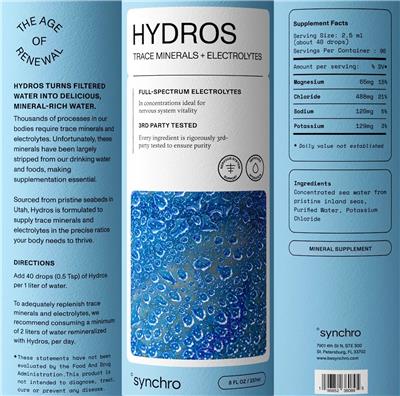
| Magnesium | 65 mg | 15% |
| Chloride | 488 mg | 21% |
| Sodium | 120 mg | 5% |
| Potassium | 129 mg | 3% |
| Concentrated Sea Waterfrom pristine inland seas | ||
| Water, Purified | ||
| Potassium Chloride |
% Daily Values for: Adults and children 4 or more years of age.
Where this label comes from
An original label of the NIH's Dietary Supplement Label Database, entered there on 24 July 2025, shown here as it was entered. The NIH's record · picture of the label (PDF)
General information
- Product name
- Hydros
- Brand
- Synchro
- Barcode (UPC)
- 1 96852 36089 5
- Net contents
- 8 Fluid Ounce(s); 237 mL
- Market status
- On market
- DSLD ID
- 336403
Classification
- Supplement form
- Liquid
- Product type
- Other Combinations
- Claim types on the label
- Nutrient, All Other, Structure/Function
- Intended for
- Adult (18 - 50 Years)
Label statements
Formula: Contains: Hydros turns filtered water into delicious, mineral-rich water. Thousands of processes in our bodies require trace minerals and electrolytes. Unfortunately, these minerals have been largely stripped from our drinking water and foods, making supplementation essential. Sourced from pristine seabeds in Utah, Hydros is formulated to supply trace minerals and electrolytes in the precise ratios your body needs to thrive.
Directions: Directions Add 40 drops (0.5 Tsp) of Hydros per 1 liter of water. To adequately replenish trace minerals and electrolytes, we recommend consuming a minimum of 2 liters of water remineralized with Hydros, per day.
Formula: Contains: Trace minerals + Electrolytes
FDA Statement of Identity: Mineral Supplement
Brand information
Manufacturer: Synchro, St. Petersburg, FL
More labels from Synchro
Labels only: each label is shown as printed on the bottle, with no grades, rankings or advice. A label in this database is not an endorsement of the product. Read the label on the bottle you buy: makers change their formulas. Reverse Age Lab is not affiliated with, or endorsed by, the National Institutes of Health or its Office of Dietary Supplements. The original labels come from the NIH’s public-domain data; the labels since are read by us. Search the Dietary Supplement Label Database.