
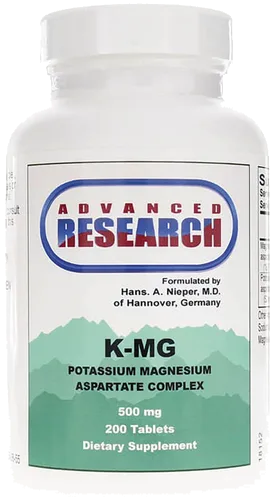
Advanced Research K-MG Review
We don’t sell supplements. We help you make decisions and get the best price.
Lowest prices
We may earn a commission from some store links. How we choose.
Finding the lowest prices at the stores now. This takes a few seconds.
Products with nearly the same formula (Matched on the main ingredients)
Study, Trial or Testing Result Summary
Members Only31 human studies · 13 improved
This product gives magnesium and potassium, each at 750 milligrams a day across three servings. That magnesium dose is above the daily recommended limit, so members can take less. For magnesium, the strongest studies tested it only in a mix. A large pooled review of people with an underactive thyroid found that zinc, magnesium and vitamin A added to meds raised thyroid hormone, but magnesium was not tested on its own [1]. A trial of 86 adults using magnesium 250 milligrams with zinc and vitamin A found the same rise in thyroid hormone and less inflammation [2]. Only one small study tested magnesium alone, and it raised active thyroid hormone in athletes and inactive people [3]. Magnesium did not clearly help before thyroid surgery [4], and magnesium in the diet was not linked to thyroid cancer risk [5]. Magnesium taken with a thyroid hormone tablet lowered how much of the tablet was absorbed, so take them apart [6]. For potassium, the thyroid benefits in studies came from iodine or bromide carried with it, not from potassium itself [7][8][9]. This product has no iodine or bromide. Animal and cell studies are never counted.
See all 31 studies →Hide the studies
- Across 35 trials of 3,508 people with underan underactive thyroid, adding zinc, magnesium and vitamin A to a med raised free thyroxine compared with placebo, but magnesium was not tested on its own.Additional treatment strategies for hypothyroidism: a network meta-analysis.
- In a pooled analysis of 21 trials in people with Graves hyperthyroidism, adding potassium bromide to methimazole ranked best for lowering thyroid hormones at 1 month, though this was a ranking and not a direct comparison.THERAPEUTIC EFFECTS OF COMBINATION REGIMENS INCLUDING METHIMAZOLE ON GRAVES HYPERTHYROIDISM: A NETWORK META-ANALYSIS OF …
- A review of 11 studies found inconsistent results for magnesium and other vitamin and mineral supplements and thyroid cancer risk, so no protective or harmful effect could be concluded.Vitamin and mineral supplements and thyroid cancer: a systematic review.
- In 377 iodine-deficient Moroccan schoolchildren given salt with iodine as potassium iodide plus iron for 9 months, thyroid size and urinary iodine improved in both the iron-added and iodine-only salt groups, so the iron did not change the thyroid benefit.Dual fortification of salt with iodine and microencapsulated iron: a randomized, double-blind, controlled trial in Moroc…
- In 180 pregnant women with mild iodine deficiency, 100 mcg of potassium iodide daily until term reduced thyroid stimulation and limited thyroid growth compared with placebo, and newborns had normal thyroid volume.A randomized trial for the treatment of mild iodine deficiency during pregnancy: maternal and neonatal effects.
- In 158 iodine-deficient children given salt with iodine as potassium iodate plus iron for 10 months, thyroid volume and urinary iodine improved in both groups, so adding iron made no difference to the thyroid result.Dual fortification of salt with iodine and micronized ferric pyrophosphate: a randomized, double-blind, controlled trial…
- In 112 mildly iodine-deficient adults, 150 mcg of iodine as potassium iodate daily for 24 weeks lowered thyroglobulin by 27% compared with placebo, with no change in thyroid-stimulating hormone or free thyroxine.Iodine Supplementation of Mildly Iodine-Deficient Adults Lowers Thyroglobulin: A Randomized Controlled Trial.
- In 90 pregnant women, 225 mcg of potassium iodide daily from early pregnancy to 8 weeks after delivery lowered thyroglobulin late in pregnancy and thyroid-stimulating hormone after delivery, and caused no harm to thyroid function, though thyroid growth differences were small.The Effects of Iodine Supplementation in Pregnancy on Iodine Status, Thyroglobulin Levels and Thyroid Function Parameter…
- In 86 adults with an underactive thyroid, 10 weeks of daily magnesium 250 mg combined with zinc and vitamin A raised free thyroxine and lowered a blood marker of inflammation versus placebo, with no change in thyroid-stimulating hormone.Randomized Study of the Effects of Zinc, Vitamin A, and Magnesium Co-supplementation on Thyroid Function, Oxidative Stre…
- In 80 adults with benign cold thyroid nodules, potassium iodide at 2 mg every 2 weeks for 1 year shrank nodules by 23% on average (not clearly significant), and 5 of 25 had a 50% or greater reduction, whereas untreated nodules grew slightly.Read the study on PubMed (7985890) →
- In 62 very low birth weight infants fed fortified human milk for 6 weeks, higher trace element and magnesium intake did not show a reported thyroid benefit; thyroid results were not described as different.Nutrition of very low birth weight infants fed human milk with or without supplemental trace elements: a randomized cont…
- In 62 people having thyroid surgery, 2 weeks of magnesium 300 mg plus calcium before surgery gave somewhat higher calcium levels and fewer low-calcium symptoms than no supplements, but the differences were not statistically significant.Impact of Preoperative Calcium and Magnesium Supplementation on Quality of Life and Hypocalcemia Post-Thyroidectomy.
- In 60 people with Graves' disease, adding potassium bromide (3 g a day) to methimazole for one month brought thyroid hormones back to normal in 93% (28 of 30) versus 37% (5 of 30) with methimazole alone, and symptoms improved about 10 days sooner.Short-term effects of combined treatment with potassium bromide and methimazole in patients with Graves' disease.
- In 50 healthy volunteers, 10 potassium iodide iontophoresis treatments of the throat did not change thyroid hormone levels compared with galvanization alone over 2 weeks to 6 months, and levels stayed normal.The effect of galvanization and potassium iodide iontophoresis of the throat and larynx on thyroid parameters: a randomi…
- In a 4-week randomized trial of 40 adults, a hydration drink containing electrolytes and amino acids showed no meaningful change in thyroid hormone levels compared with placebo; it was designed to test safety, not thyroid health.Randomized Trial to Assess the Safety and Tolerability of Daily Intake of an Allulose Amino Acid-Based Hydration Beverag…
- In 30 overweight women on a low-calorie diet for 8 weeks, mineral tablets containing potassium and other phosphates kept blood triiodothyronine levels from dropping compared with placebo, and raised resting metabolic rate.Phosphate supplementation prevents a decrease of triiodothyronine and increases resting metabolic rate during low energy…
- In 14 patients with overactive thyroid goiter, potassium iodide solution or iopanoic acid for 7 to 15 days lowered thyroid hormone levels before surgery, with iodine reducing thyroid enzyme activity.Effect of iodine or iopanoic acid on thyroid Ca2+/NADPH-dependent H2O2-generating activity and thyroperoxidase in toxic …
- In 13 healthy volunteers, six months of daily potassium perchlorate at 0.5 or 3 mg had no effect on thyroid hormones, thyroid iodine uptake, or thyroglobulin compared with placebo.Effects of six months of daily low-dose perchlorate exposure on thyroid function in healthy volunteers.
- In a randomized trial of premature newborns born before 28 weeks, potassium iodide at 30 micrograms per kg daily for 42 days did not raise thyroid hormone levels, unlike the thyroid hormone treatment arms.Phase 1 trial of 4 thyroid hormone regimens for transient hypothyroxinemia in neonates of <28 weeks' gestation.
- In 108 people with endemic goitre, goitre size shrank over 6 months in all active treatment groups including potassium iodide but not with placebo, though 8 of 30 people given potassium iodide developed thyroid antibodies versus 1 of 22 not given it.Treatment of endemic goitre with iodine and thyroid hormones, alone or in combination. (Preliminary report).
- In 40 people with Hashimoto's thyroiditis given 250 mcg of potassium iodide daily for about 4 months, 8 developed an underactive thyroid (7 mild) and 1 an overactive thyroid, compared with 1 of 43 untreated controls.Effect of small doses of iodine on thyroid function in patients with Hashimoto's thyroiditis residing in an area of mild…
- In 68 treatments of patients receiving radioactive iodine-lipiodol for liver cancer, 100 mg a day of potassium iodide from 2 days before to 2 weeks after lowered thyroid radioactive iodine uptake (0.23% vs 0.42%) and thyroid radiation dose (5.5 vs 11.9 Gy) compared with no potassium iodide.Thyroid uptake and radiation dose after (131)I-lipiodol treatment: is thyroid blocking by potassium iodide necessary?
- In a 4-week study of sedentary people and Tae-Kwon-Do athletes, 10 mg/kg daily of magnesium raised free T3 and prevented the exercise-related drop in thyroid hormone activity.The effects of magnesium supplementation on thyroid hormones of sedentars and Tae-Kwon-Do sportsperson at resting and ex…
- In 122 adults newly diagnosed with mild Graves disease, potassium iodide at 50 to 100 mg per day brought thyroid levels under control in about 58 percent of patients, and was judged safe.Therapeutic efficacy and limitations of potassium iodide for patients newly diagnosed with Graves' disease.
- In 20 patients with amiodarone-induced thyrotoxicosis, 1000 mg per day of potassium perchlorate with methimazole for a month brought thyroid hormones to normal or significantly lower in 12 patients, and adding prednisolone helped the rest.A stepwise approach to the treatment of amiodarone-induced thyrotoxicosis.
- In a crossover study of 15 healthy adults, taking magnesium aspartate with a med tablet reduced a med absorption by 12%, and magnesium citrate reduced it by 7% without statistical significance, so the two should be taken apart.Read the study on PubMed (41221788) →
- In 9 healthy adults given potassium bicarbonate for 7 days in place of potassium chloride to neutralize dietary acid, thyroid hormone levels did not change significantly.Neutralization of Western diet inhibits bone resorption independently of K intake and reduces cortisol secretion in huma…
- In a large cohort of 566,398 adults followed for years, dietary magnesium intake was not associated with thyroid cancer risk.The association between selenium and other micronutrients and thyroid cancer incidence in the NIH-AARP Diet and Health S…
- In 55 patients with amiodarone-induced overactive thyroid, a color ultrasound of the thyroid distinguished the two subtypes, but this diagnostic study did not test potassium treatment effects.Thyroid color flow doppler sonography and radioiodine uptake in 55 consecutive patients with amiodarone-induced thyrotox…
- In a 1953 study of people from an area with endemic goitre in Argentina, one patient taking 1,500 micrograms of iodide daily developed an overactive thyroid after 32 days; this study concerned iodide, not potassium.Preliminary studies of iodine metabolism in patients from an area of endemic goitre.
- In a study of how fast the thyroid hormone thyroxine is broken down in healthy adults, potassium iodide given as a single dose produced no detectable change in that rate.A new method for the measurement of acute alterations in thyroxine deiodination rate in man.
Review Totals and Summary
Members Only1,200 reviews · 93% positive
Extensive customer reviews and qualitative feedback are currently being aggregated for this product. Check back soon for a detailed sentiment analysis.
Biohacker Summary
Members Only0 of 10 recommend it
Magnesium is the main ingredient here, and nearly the whole panel speaks about it, with most recommending it and the rest saying they use it. The most common reason is sleep, often taken before bed, with several naming glycinate or threonate as preferred forms, and three panelists describe 400 mg of threonate at night. Others cite muscle cramps, blood pressure, bone health, vitamin D function and recovery, with daily targets given between 300 and 600 mg, and some take it in electrolyte drinks alongside sodium and potassium. One panelist says it does not fix waking up during the night, and another says restless legs have other causes beyond low magnesium. Potassium, also listed as a main ingredient, got less attention: a few recommend it as an electrolyte, one prefers getting it from foods like bananas and potatoes over supplements for blood pressure, and another flags a bread additive containing potassium.
See all 10 biohackers →Hide the biohackers
Dr. Rhonda Patrick · Magnesium · recommends
- Explains that magnesium helps the body activate and metabolize vitamin D, and that magnesium intake has been associated with lower odds of vitamin D deficiency and insufficiency.
- Mentions that getting too little magnesium may play a role in declining testosterone levels.
- Recommends getting enough magnesium, around 300–400 mg daily from diet and supplements, as it is an essential cofactor for vitamin D metabolism. Magnesium glycinate is a good form.
- Mentions magnesium as one of the micronutrients found in multivitamins that people often don't get enough of from their diets.
- Explains that magnesium helps control blood pressure by boosting the production of substances that relax blood vessels and improve cardiovascular health, citing a meta-analysis that found magnesium supplementation at an average dose of 368 mg per day notably lowers both systolic and diastolic blood pressure.
- Magnesium supplementation has lowered blood pressure in randomized controlled trials. An analysis of 34 trials involving over 2,000 participants found modest reductions in both systolic and diastolic pressure, with a median dose of 368 mg/day.
- Warns that some magnesium supplements make the dose look much larger than it really is and that labels can fool people.
- Mentions magnesium as an important nutrient component for testosterone.
- Warns that some supplement companies mislead consumers by listing the total compound weight of magnesium citrate as the elemental magnesium dose, when the actual elemental magnesium content is much lower, potentially around 44-66 milligrams.
- States there is not yet strong, consistent evidence that magnesium supplementation reliably improves sleep, noting that while some meta-analyses suggest it can improve sleep quality scores, sleep efficiency, and sleep duration, individual studies are inconsistent and several have found no meaningful effect.
- Recommends getting enough potassium, noting that most people get too much sodium and not enough potassium.
- States that maintaining a high potassium intake is important for hypertension.
- Recommends getting enough potassium from veggies, bananas, and fruit because the body cares about the sodium-potassium ratio.
- Dr. Patrick states that her smoothie, containing avocado and banana, has around 5,800 milligrams of potassium, which meets the adequate intake requirement for maintaining normal blood pressure and decreasing the risk of kidney stones.
Dr. Eric Berg · Potassium · recommends
- Recommends potassium as an important electrolyte, noting that most people get less than half of the 4700 mg RDA.
- Recommends Magnesium glycinate, noting its high absorption rate compared to magnesium oxide, and its support for energy, sleep, muscle relaxation, and vitamin D function.
- Dr. Berg states that when nutrients like magnesium are too low, fatigue and weakness can follow.
- Recommends focusing on magnesium to support stronger bones if a neck hump is associated with osteoporosis.
- Explains that leg and calf cramps are most often caused by low magnesium, with leafy greens being a top source.
- States that magnesium is a cofactor that allows B1 to work more efficiently.
- States that magnesium is the most important mineral for energy production, as one cannot make energy without it.
- Magnesium is involved in 300 to 600 enzyme reactions, acts as a biological brake pedal, is the master controller over calcium, and is involved in making ATP, the energy currency of the body. It takes energy to go to sleep, and magnesium is required for relaxation and good sleep. Magnesium also helps balance cortisol levels and calm you.
- Dr. Eric Berg states that magnesium supports energy, muscle function, and sleep, and that most of it is stored inside cells, making deficiencies harder to detect with a standard blood test.
- States that people need more potassium than any other mineral, yet most people aren’t getting enough.
- Explains that potassium is essential for peristalsis, the pumping action through the colon, and without it, things can sit there, leading to constipation.
- Notes that magnesium could also be a factor in preventing muscle cramps.
- Explains that the normal requirements for potassium are 4,700 mg every single day, and that very few people get half of that amount. They describe potassium's role in the sodium potassium pump, which is essential for cellular electricity, muscle contraction, and heart function. Deficiency can lead to tiredness, muscle cramps, heart palpitations, or rising blood pressure.
- Recommends increasing potassium to restore balance and support healthy blood pressure.
Thomas DeLauer · Magnesium · recommends
- Recommends taking magnesium glycinate and threonate at night to act as a brake on the nervous system, block excitatory signaling, help wind down, and support serotonin and melatonin production for better sleep.
- Mentions that magnesium glycinate also helps a lot with sleep.
- Mentions that restless leg syndrome is often treated with magnesium, but states that the sensation is actually coming from three other issues.
- Recommends Element electrolytes, noting they are focused on sodium first, then potassium, then magnesium, helping with sending signals and hydrating tissue.
- Uses Element's cans which contain 30 milligram magnesium, finding that electrolytes help his workout performance.
- Uses Element's cans which contain 100 milligram potassium, finding that electrolytes help his workout performance.
- Uses Element's 30 mg magnesium cans first thing in the morning to prime his day and help with workout performance.
- Uses Element's 100 mg potassium cans first thing in the morning to prime his day and help with workout performance.
- Recommends magnesium around the time one would normally break a fast to calm the brain and dull feelings of conditioned hunger.
- Recommends magnesium, noting it is a cofactor for enzymes that build neurotransmitters, and deficiency can affect mood, happiness, and motivation.
- Notes that modern agricultural practices have led to soils depleted of trace minerals like magnesium, resulting in widespread magnesium deficiency.
- Recommends taking some magnesium glycinate tonight to help calm down and sleep.
- Mentions that magnesium in pumpkin seeds relaxes bronchial smooth muscle.
- Recommends Element's ready-to-drink sparkling electrolyte drinks as a low or zero-calorie soda replacement that provides 1,000 milligrams of sodium, 200 milligrams of potassium, and 60 milligrams of magnesium.
Andrew Huberman · Magnesium · recommends
- Notes that Les Spellman's team includes 'Magnesium timed right' as part of their game plan to optimize recovery in unfavorable conditions.
- Discusses Magnesium Threonate as a tool for falling asleep.
- Takes 400 mg of Magnesium Threonate before bed for sleep.
- Uses Element, an electrolyte drink with sodium, magnesium, and potassium in correct ratios and no sugar, to ensure adequate hydration and electrolytes, especially when starting days fast or during physical exercise.
- Uses Element, an electrolyte drink with sodium, magnesium, and potassium in correct ratios and no sugar, to ensure adequate hydration and electrolytes, especially when starting days fast or during physical exercise.
- Takes 400 mg of Magnesium L-Threonate before bed for sleep.
- Confirms that magnesium is absolutely important for cognitive function, noting studies show those with lower magnesium intakes tend to perform less well on cognitive function tests, and it's related to brain changes over time and dementia risk.
- Takes 400 mg of Double Wood Magnesium L-Threonate before bed for sleep.
- He takes 400 mg of Magnesium L-Threonate from Double Wood before bed for sleep.
- Takes 400 mg of Double Wood Magnesium L-Threonate before bed for sleep.
- Takes 400 mg of magnesium L-threonate before bed for sleep.
- Uses Element, which contains potassium in the correct ratios, to ensure proper hydration and electrolyte intake for brain and body function.
- Mentions potassium as an electrolyte.
- Uses Element, an electrolyte drink with sodium, magnesium, and potassium in correct ratios and no sugar, to ensure adequate hydration and electrolytes, drinking it first thing in the morning and during physical exercise.
Dr. Mark Hyman · Magnesium · recommends
- Recommends magnesium breakthrough advanced ten from Biooptimizers, which is their most complete magnesium formula with 10 bioavailable forms and 550 milligrams of elemental magnesium, designed to support restful restorative sleep, muscle recovery, stress resilience, and metabolic health.
- Recommends considering magnesium glycinate before bed for nervous system support, deeper sleep quality, and to help the body transition into rest, and states that they take it every night.
- Explains that a lack of magnesium can cause muscles and nerves to malfunction, resulting in muscle weakness, twitching, and cramps.
- Recommends Magnesium Breakthrough Advanced 10 from Bioptimizers for restful sleep, muscle recovery, stress resilience, and metabolic health, especially during stressful times of the year.
- Warns that potassium bromate, a dough conditioner banned in the EU, UK, and Canada, is still allowed in U.S. bread.
- Recommends magnesium because it is involved in over 600 reactions in the body and up to 80% of people may have low levels that never get flagged on a standard blood test.
- Recommends magnesium as a basic supplement during detoxification to support pathways, help with constipation, and provide electrolytes.
- Recommends Magnesium Breakthrough Advanced 10 from Biooptimizers, which contains 10 bioavailable forms and 550 mg of elemental magnesium, to support restful sleep, restorative sleep, muscle recovery, stress resilience, and metabolic health.
- Has recommended magnesium breakthrough from bioptimizers for years and now uses Magnesium Breakthrough Advanced 10 as part of his evening routine, especially during periods of travel, training, and higher stress, to support sleep, muscle recovery, and metabolic health.
- Recommends correcting nutrient deficiencies with magnesium.
- Recommends Magnesium Breakthrough Advance 10 from BiOptimizers, which has 10 bioavailable forms of magnesium and more elemental magnesium, as part of his evening routine for sleep, muscle recovery, and metabolic health.
- States that potassium plays a critical role in nerve signaling and muscle contraction, especially in the heart, and low levels can lead to dangerous irregular heart rhythms.
- Notes that meds flush out potassium.
- States that with potassium, water can fully cross the cell membrane and get inside where it's needed for intracellular hydration.
Dave Asprey · Magnesium · uses
- Looks at magnesium alongside protein to keep muscle for the long run.
- Suggests adding magnesium to help keep potassium in the system longer, as they work hand in hand.
- Explains that potassium helps open a gate, allowing creatine to slip through and cross the blood-brain barrier more effectively.
- Mentions magnesium in the context of sleep but states that it doesn't address the core issue of waking up during the night.
- Suggests that magnesium may help slow aging, support cellular repair, and improve sleep.
- States that magnesium can affect how the body responds to a supplement.
- Recommends fixing sleep with 300mg of Magnesium 101 before bed if diet and exercise aren't melting stubborn belly fat.
- Dave Asprey says his daily routine includes magnesium as part of a carefully developed combination for longevity.
- Recommends magnesium glycinate for sleep, stating that trials show it helps people fall asleep about 17 minutes faster and that he finds it incredibly effective.
- Mentions magnesium glycinate as one of the five gut-friendly, extensively researched ingredients in Kill Switch that helps with natural sleep.
- Dave Asprey recommends Magnesium Glycinate for sleep, noting human studies show it helps people fall asleep faster, is safe, and works on a fundamental aspect of health, unlike magnesium oxide which acts as a laxative.
- Recommends having more potassium during a fast to increase mineral intake.
- States that people who are salt-sensitive hypertensives usually need more potassium.
- Explains why electrolytes, especially sodium, potassium, and magnesium, are foundational for recovery.
Ben Greenfield · Magnesium · uses
- Uses magnesium during surgery because it is neuroprotective.
- Says he is drinking LMNT, which contains sodium, potassium, and magnesium, and states that he actually drinks this stuff.
- Says he is drinking LMNT, which contains sodium, potassium, and magnesium, and states that he actually drinks this stuff.
- Mentions magnesium as part of a bare-minimum protocol.
- Advises getting red blood cell magnesium levels to the high end of the range as a minimum step for overall health and to slow down heart disease.
- Recommends supplementing with magnesium threonate if one is low in magnesium, as it crosses the blood-brain barrier and is demonstrated to increase hippocampus plasticity, theoretically making one smarter and improving memories.
- Uses Magnesium Breakthrough from BIOptimizers as part of their daily stack, taking four capsules in the evening to support relaxation, recovery, and a good night of sleep.
- Recommends Celtic Sea Salt's new electrolyte drink "Hydrate" for replacing electrolytes and trace minerals lost through sweat, noting it contains 70 naturally occurring trace minerals, plus magnesium, taurine, and potassium.
- Recommends Celtic Sea Salt's new electrolyte drink 'Hydrate' for replenishing electrolytes and trace minerals lost through sweat, noting it contains 70 naturally occurring trace minerals, magnesium, taurine, and potassium, with no added sugar, artificial colors, or synthetic ingredients.
- Had heart palpitations when he was really overdoing magnesium, not knowing what he was taking.
- Recommends taking magnesium as a co-factor to increase vitamin D absorption.
- Notes a new study indicating that magnesium is a core dietary antioxidant closely associated with a reduced risk of accelerated biological aging.
- Recommends adding potassium sulfate to a Morasco cold plunge.
- Mentions that potassium can be helpful for blood pressure but also risky for people with kidney disease or other conditions prone to elevated potassium levels, advising consultation with a physician.
Siim Land · Magnesium · recommends
- States that Magnesium can be a useful addition for some people for sleep.
- Recommends magnesium for sleep, especially deep sleep, and suggests trying better types like Threonate, Biscinate, or Torate, referencing a study where magnesium supplementation improved deep sleep.
- Recommends Magnesium for blood pressure, migraines and deficiency, based primarily on human research, especially randomized controlled trials showing measurable benefits.
- Lists Magnesium as one of 15 supplements backed by human studies.
- States that magnesium is a fundamental mineral governing over 600 enzymes and metabolic reactions, and recommends that most people need at least 400-500 mg/d for health, with some needing up to 600 mg/d.
- Lists seafood and pumpkin seeds as sources of Magnesium.
- Lists potatoes and fruit as sources of Potassium.
- Thinks magnesium has some of the strongest evidence and is worth considering.
- Recommends taking magnesium, specifically glycinate and threonate forms, 1 to 2 hours before bed for sleep benefits, noting that glycinate promotes relaxation and threonate crosses the blood-brain barrier for sleep quality and cognitive function.
- Notes that Boron reduces calcium/magnesium loss.
- Notes that magnesium is important for activating thiamine into its more biologically active form, and a magnesium deficiency can impair blood sugar regulation even with adequate thiamine intake.
- Notes that bananas have potassium but there are at least 8 other foods with more potassium than bananas.
- States that potassium is the most abundant intracellular cation that helps to maintain intracellular fluid volume and that without it, one greatly increases the risk of hypertension, cardiovascular disease, diabetes, and stroke.
- States that potassium lowers blood pressure.
Bryan Johnson · Magnesium · uses
- Takes 400 mg of Magnesium Threonate before bed for sleep.
- Takes 400 mg of Magnesium L-Threonate before bed for sleep.
- Takes 400 mg of Magnesium Threonate before bed for sleep.
- He takes 400 mg of Double Wood Magnesium L-Threonate before bed for sleep.
- Takes 400 mg of Magnesium L-Threonate before bed for sleep.
- Takes 400 mg of Magnesium Threonate before bed for sleep.
- Takes 400 mg of Magnesium L-Threonate before bed for sleep.
- Takes 400 mg of magnesium L-threonate before bed for sleep.
- He takes 400 mg of Magnesium L-Threonate before bed for sleep.
- Takes 400 mg of magnesium threonate before bed for sleep.
- Recommends potassium at 200 to 400 mg daily for women during the luteal phase.
Peter Attia · Potassium · recommends
- States there is some evidence that increasing dietary potassium through potassium-rich foods like bananas and potatoes, rather than supplements, can lower blood pressure.
- Peter reviews the evidence for select off-label medications and supplements commonly used for sleep, including glycine, magnesium, ashwagandha, and phosphatidylserine.
- Suggests that zinc and magnesium could potentially help with vasodilation and sleep, particularly for women experiencing severe symptoms in the luteal phase.
- Peter discusses electrolytes and fiber and the ketogenic diet, specifically preventing magnesium loss.
- Recommends magnesium as one of the 'big three' micronutrients for bone health, suggesting a daily intake of 300 to 500 milligrams as a minimum, and personally aims for about a gram of supplemental magnesium.
- Recommends magnesium for optimizing bone mineral density, suggesting a daily intake of 300 to 500 milligrams as a minimum, but personally aims for about a gram.
- Takes a hardline view that most people do not have adequate or optimal levels of magnesium, and suboptimal levels will impede the metabolism of vitamin D because magnesium is a cofactor in its enzymatic conversion.
- Takes a hardline view that most people do not have adequate or optimal levels of magnesium, and suboptimal levels will impede vitamin D metabolism because magnesium is a co-factor in the enzymatic conversion of vitamin D.
- Takes magnesium as a straightforward supplement.
- Mentions that magnesium intake is often super low and impactful on testosterone levels.
- Discusses the important roles of magnesium in the body, how to determine if one might be deficient, the prevalence of magnesium deficiency, and its potential cognitive benefits.
- Notes that evolutionary ancestors consumed much more potassium than modern humans and suggests adding it back to the diet, ideally through whole foods.
- Mentions taking magnesium and potassium in addition to salt for minerals and electrolytes.
RAL Summary
Members OnlyTier 4 for Thyroid Health
The tier rests on a pooled analysis where magnesium was only given together with zinc and vitamin A and never tested alone, and the potassium studies tested iodine or bromide carried by potassium rather than potassium itself, so the evidence for this product's own ingredients is thin and mixed. So it is graded Tier 4, lower than the rules alone gave.
- Emerging: not enough evidence to rank higher yet.
Where the evidence disagrees: 16 of the 31 human studies found no effect.
More Details
Members OnlyBody systems · Combine with · Possible side effects
Body systems: Endocrine system
Combine with: Combine with a healthy diet and lifestyle.
Possible side effects: Magnesium can reduce absorption of thyroid hormone tablets if taken at the same time. Potassium iodide caused an underactive thyroid in some people with an autoimmune thyroid condition, though this product contains no iodide.
Supplement Facts
Magnesium 250 mg · Potassium 250 mg
| Magnesium | 250 mg | |
| Potassium | 250 mg |
Other ingredients: Microcrystalline Cellulose, Povidone, Sodium Starch Glycolate, Cellulose Gum, Magnesium Stearate.
Directions: Directions: As an addition to the daily diet, take one tablet three times a day with meals or as directed by your health care professional.
Barcode (UPC) 605164343132 · Label source: NIH label database · Report a label change
Show entire label
More thyroid health products
Members OnlyThe highest ranked for the same goal
Read more
Our articles on this subject
- Magnesium Glycinate vs Citrate: What the Studies ShowArticle · Oct 30, 2026
- Magnesium Glycinate vs Threonate: Which Form Is Right for You?Article · Nov 6, 2026
Graded November 10, 2026 by the Reverse Age Lab evidence engine, from human studies, real reviews and our biohacker panel. How we grade. Is this medical advice? No. Rala organizes the published evidence; go over any change with your doctor, especially if you take meds.
Privacy policyConsumer health dataAffiliate disclosureTermsDo Not Sell or Share My Personal InformationCookie settings