
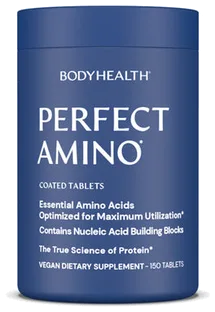
BodyHealth Perfect Amino Review
PERFECT AMINO is presented on this page as essential amino acids, the building blocks of protein, in a precise form and ratio that the page says is up to 99% utilized by the body to build new protein, muscle and collagen. The page states that it provides these amino acids without the caloric impact of protein foods and without breaking a fast. The product is said to be absorbed into the bloodstream within an average of 23-30 minutes. The page explains that the amino acids are the same ones that the body breaks protein down into, and that the body needs all essential amino acids in a precise ratio to make new protein. It claims that excess amino acids cannot be used and are converted to glucose or body fat, which the page presents as the source of calories in dietary protein. The page includes a comparison chart of amino acid utilization. It gives BCAAs about 1% utilization, whey, pea and soy about 16-18%, meat, fish and poultry about 32%, and whole eggs about 48%. PERFECT AMINO is said to be 100% vegan and free of gluten, soy and dairy. The product is also described as enhanced with Nucleic Acid Building Blocks, the nucleosides and nucleotides that DNA and RNA are made of. The page says these support the process of protein synthesis and genetic health and performance. The page says that taking the product 20-30 minutes before a workout lets it be absorbed before training, and that it may help repair micro-tears in muscle and improve endurance and recovery. The page lists uses such as faster recovery, building lean muscle, assisting fat loss, preventing muscle and bone deterioration and improving overall health. It refers buyers to a usage and dosage guide. The FAQ says one scoop or five tablets provides 5 grams. It states that the amino acids are plant-derived, pharmaceutical grade and produced in FDA registered, cGMP certified facilities. The page notes that the coated tablets use a vegan coating and that the uncoated tablets contain no binders, fillers, stearates or dyes. Sizes shown are 150, 300 and 600 count tablets, with 30, 60 and 120 servings. The page also offers a one-time price and a subscription price with a 15 percent saving. The statements on the page have not been evaluated by the Food and Drug Administration, and the page says the product is not intended to diagnose, treat, cure or prevent any disease.
We don’t sell supplements. We help you make decisions and get the best price.
Lowest prices
We may earn a commission from some store links. How we choose.
Lowest cost per month first, in stock, at 15 tablets a day. Checked Nov 16.
- BodyHealthLowest$29.95 a bottle$89.85/moBuy at BodyHealth (opens in a new tab)
- Vitacost$50.55 a bottle$151.65/moBuy at Vitacost (opens in a new tab)
- AmazonPrice at AmazonCheck price at Amazon (opens in a new tab)
Some links earn us a commission; price comes first, and a commission only decides the order of prices within 2%. As an Amazon Associate we earn from qualifying purchases.
Study, Trial or Testing Result Summary
Members Only54 human studies · 27 improved
Perfect Amino is mainly a blend of essential amino acids, taken at 15 g a day, well above the 3 g that worked in studies. The blend also contains nucleic acid building blocks, and the studies below did not test those. A review of 18 trials in 1,341 older adults found that protein-type supplements, including essential amino acids, added to exercise improved grip strength and muscle mass, though the certainty was very low [1]. In 88 adults with severe lung disease, 12 weeks of essential amino acids improved strength and lean mass compared with placebo [2]. A smaller trial of 32 similar patients found more lean mass and more daily steps [3]. Taking 3 g after resistance exercise for 24 weeks increased muscle mass in older adults [4]. Adding tea catechins to the amino acids also helped [5]. In 130 older adults with muscle loss, essential amino acids combined with whey and vitamin D plus exercise added 1.7 kg of lean mass [6]. Not every trial agrees. Of 54 human studies, 27 showed improvement and 10 showed no effect. Most studies were in older or ill adults, not young people who train. Animal and cell studies are never counted.
See all 54 studies →Hide the studies
- Across 18 trials of 1,341 older adults with or at risk of sarcopenia, adding protein-type supplements to exercise improved grip strength and muscle mass index but not walking mobility, though the certainty of evidence was very low.Comparative effectiveness of protein or protein-related supplementation combined with resistance or functional exercise …
- In 16 trials of 910 dialysis patients, macronutrient mixtures and 48-week use increased lean body mass, but supplements did not improve muscle strength or physical performance.The effect of oral nutritional supplement on muscle fitness of patients undergoing dialysis: A systematic review and met…
- In 19 studies of 903 joint replacement patients followed about 55 days, essential amino acids reduced thigh muscle loss but had no significant effect on leg or handgrip strength.Peri-operative protein or amino acid supplementation for total joint arthroplasty: a systematic review and meta-analysis…
- In nine trials of older people, leucine raised the rate of muscle protein building but did not change lean body mass or leg lean mass compared with controls.The effectiveness of leucine on muscle protein synthesis, lean body mass and leg lean mass accretion in older people: a …
- In 15 controlled trials of 917 older adults (average age 77), protein or essential amino acids added to resistance training did not significantly boost muscle outcomes, apart from a few strength and body composition measures.Protein Supplementation Does Not Significantly Augment the Effects of Resistance Exercise Training in Older Adults: A Sy…
- A review of 22 varied studies in critically ill and muscle-wasting patients found essential amino acids improved body composition and nutritional status in some groups, but study quality was too varied to draw firm conclusions.Impact of supplementation with amino acids or their metabolites on muscle wasting in patients with critical illness or o…
- In 37 trials in adults 60 and older, exercise improved muscle, but supplements added extra benefit in only about 23% of trials for muscle mass and strength and 14% for physical performance.Nutrition and physical activity in the prevention and treatment of sarcopenia: systematic review.
- A review of 23 trials in people 60 and older found limited effects on muscle overall, though 3 of 4 trials of essential amino acids found better physical performance; evidence quality was low or very low.Effects of Protein, Essential Amino Acids, B-Hydroxy B-Methylbutyrate, Creatine, Dehydroepiandrosterone and Fatty Acid S…
- A review of 15 systematic reviews in adults 65 and older found leucine improved muscle mass in sarcopenia and protein on top of resistance training raised muscle mass and strength, with low to moderate evidence quality.Nutritional interventions to improve muscle mass, muscle strength, and physical performance in older people: an umbrella…
- A review of nine trials in adults 50 and older found beef and nutrients such as protein and essential amino acids had an overall positive effect on wellbeing, including physical function, though arginine, vitamin B12, leucine and zinc showed no effect.The potential role of beef and nutrients found in beef on outcomes of wellbeing in healthy adults 50 years of age and ol…
- In 16 studies of older adults with sarcopenia, resistance exercise with daily essential amino acids or whey protein and vitamin D improved muscle mass and lean mass, with possible gains in strength and speed.Exercise Programs Combined with Diet Supplementation Improve Body Composition and Physical Function in Older Adults with…
- A review of 23 trials in stroke patients found mixed results for nutrition supplements, with protein-based supplements suggested to improve function when combined with exercise including resistance training.Oral Nutritional Interventions for Stroke Recovery: A Systematic Review.
- In a 12-week placebo-controlled trial of 130 sarcopenic older adults, whey protein, essential amino acids and vitamin D plus supervised exercise increased fat-free mass by 1.7 kg, improved handgrip strength and physical function, and lowered C-reactive protein more than exercise with placebo.Whey protein, amino acids, and vitamin D supplementation with physical activity increases fat-free mass and strength, fu…
- In 88 adults with severe chronic obstructive pulmonary disease who could not join rehabilitation, taking essential amino acids for 12 weeks improved muscle strength, fat-free mass and cognitive function compared with placebo.Essential amino acid supplementation in patients with severe COPD: a step towards home rehabilitation.
- In a triple-blind, placebo-controlled trial of 69 adults aged 60 to 75, nucleotide supplements taken for 10 weeks improved cognition, lowered inflammation and oxidative stress markers, and improved physical performance compared with placebo.Dietary Nucleotides Enhance Neurogenesis, Cognitive Capacity, Muscle Function, and Body Composition in Older Adults: A R…
- In 66 overweight or obese adults over 8 weeks, 3.6 g of essential amino acids twice daily raised muscle protein turnover, and high-intensity interval training with or without it increased thigh lean mass.High-intensity interval training and essential amino acid supplementation: Effects on muscle characteristics and whole-b…
- In 50 healthy older adults over 24 weeks, 15 g daily of essential amino acids increased muscle strength only when combined with aerobic exercise, and did not change lean body mass.Effect of Aerobic Exercise Training and Essential Amino Acid Supplementation for 24 Weeks on Physical Function, Body Com…
- In 48 men over 60 with sarcopenic obesity, adding electrical acupuncture to essential amino acids for 12 weeks lowered body fat and increased muscle mass more than essential amino acids alone over 28 weeks.The Effects of Electrical Acupuncture and Essential Amino Acid Supplementation on Sarcopenic Obesity in Male Older Adult…
- In 48 older adults with obesity and low grip strength, adding essential amino acids to a calorie-reduced diet and resistance training over 5 months produced the same fat loss and strength gains as the training and diet alone.Effects of a Hypocaloric Diet Plus Resistance Training with and Without Amino Acids in Older Participants with Dynapenic…
- In 41 institutionalized elderly patients taking 4 g of essential amino acids twice daily for 8 weeks, nutrition, depressive symptoms, grip strength and quality of life improved more than with placebo.Effect of essential amino acid supplementation on quality of life, amino acid profile and strength in institutionalized …
- In 41 people, 6 grams a day of leucine for 4 weeks modestly increased muscle mass in older adults without cancer compared with a comparator, but did not improve muscle mass or function in head and neck cancer patients.Short-term isolated leucine supplementation was not associated with improvements in muscle mass or function in patients …
- In 38 frail nursing home residents averaging 86 years old, a daily leucine, vitamin D and 6 g medium-chain triglyceride supplement for 3 months increased grip strength, walking speed and leg test performance compared with no supplement.Medium-Chain Triglycerides in Combination with Leucine and Vitamin D Increase Muscle Strength and Function in Frail Elde…
- In 38 healthy older adults, twice-daily use of an essential amino acid based supplement for 12 weeks increased muscle mass, strength and power more than placebo, but did not change muscle fatigue.Effects of 12 Weeks of Essential Amino Acids (EAA)-Based Multi-Ingredient Nutritional Supplementation on Muscle Mass, Mu…
- In a 4-week trial of 34 young men, combining resistance exercise with essential amino acids increased lean body mass, while the exercise plus amino acid group also improved left-hand grip strength and leg strength, and lowered TNF-alpha levels.Effects of Resistance Exercise and Essential Amino Acid Intake on Muscle Quality, Myokine, and Inflammation Factors in Y…
- In 32 older adults with severe chronic obstructive pulmonary disease and muscle loss, 12 weeks of essential amino acids (4 g twice daily) increased fat-free mass and daily steps compared with placebo.Comprehensive effects of supplemented essential amino acids in patients with severe COPD and sarcopenia.
- In a small pilot trial of 32 adults aged over 65 recovering from hip fracture, those who took essential amino acids alongside exercise and diet advice improved on grip strength, walking test and daily assistance scores over 2 months, with the clearest gains in people with sarcopenia.Effects of essential amino acid supplementation and rehabilitation on functioning in hip fracture patients: a pilot rand…
- In 31 men on 28 days of bed rest with reduced calories, essential amino acids alone did not prevent muscle and strength loss as well as resistance training combined with amino acids, with the amino acid only group losing the most muscle strength.Resistance training and timed essential amino acids protect against the loss of muscle mass and strength during 28 days …
- In a 3-month randomized trial of 30 hemodialysis patients over 70, an amino acid mixture of 5.4 g given after dialysis on non-dialysis days raised protein intake and blood hemoglobin in the treatment group, but muscle mass was not reported as improved.Replacement of the massive amino acid losses induced by hemodialysis: A new treatment option proposal for a largely unde…
- In 29 young men doing 12 weeks of heavy-load training, essential amino acids produced greater changes in calf muscle structure than placebo, and both groups gained muscle mass and strength.Effects of a combined essential amino acids/carbohydrate supplementation on muscle mass, architecture and maximal streng…
- In a placebo-controlled trial of 28 older adults having knee replacement, taking 20 g of essential amino acids twice daily from 1 week before to 2 weeks after surgery reduced thigh muscle loss and improved mobility compared with placebo, with benefits still present at 6 weeks.Essential amino acid supplementation in patients following total knee arthroplasty.
- In 26 sarcopenic older men doing resistance training, protein drinks containing 7 g of essential amino acids from milk, soy or rice gave no extra gain in muscle mass or strength beyond training alone.The Effect of Resistance Training and Different Sources of Postexercise Protein Supplementation on Muscle Mass and Physi…
- In 18 preterm infants, giving amino acids from the first day of life improved nitrogen retention and leucine balance compared with glucose alone, and prevented loss of protein mass.Immediate commencement of amino acid supplementation in preterm infants: effect on serum amino acid concentrations and p…
- In 17 healthy young men training for 12 weeks, an essential amino acid formula with HMB produced greater gains in lean mass, strength and power than placebo and lowered a muscle damage marker.Effects of amino acids supplement on physiological adaptations to resistance training.
- In 16 older women, a single 3 g dose of leucine-enriched essential amino acids stimulated muscle protein synthesis as much as 20 g of whey protein, both at rest and after exercise.Intake of low-dose leucine-rich essential amino acids stimulates muscle anabolism equivalently to bolus whey protein in …
- In 12 older adults with obesity on a calorie-restricted diet for 8 weeks, a whey and essential amino acid meal replacement reduced more fat than a competitor meal replacement but did not significantly preserve lean tissue.Whey protein and essential amino acids promote the reduction of adipose tissue and increased muscle protein synthesis du…
- In 12 young adults, a dileucine-containing essential amino acid drink after resistance exercise increased whole-body leucine retention, a marker of anabolism, more than collagen protein, and performed similarly to branched-chain amino acids.Dileucine-supplemented essential amino acids support whole-body anabolism after resistance exercise and serum-stimulated…
- In a small feasibility trial of 8 mechanically ventilated trauma patients given 5 g of leucine-enriched essential amino acids five times daily for up to 14 days, the supplement was practical to give, but the Katz and Barthel functional indices did not change and muscle outcomes could not be reliably measured.Leucine-enriched essential amino acid supplementation in mechanically ventilated trauma patients: a feasibility study.
- During 28 days of bed rest, adding essential amino acids and carbohydrate kept leg lean mass steady and reduced strength loss compared with a control diet.Essential amino acid and carbohydrate supplementation ameliorates muscle protein loss in humans during 28 days bedrest.
- Older adults with low physical function who took an essential amino acid supplement had better muscle strength and physical function than those taking whey protein, with distinct changes in blood proteins.Differential plasma protein expression after ingestion of essential amino acid-based dietary supplement verses whey prot…
- In 41 adults aged 53 to 76 having knee replacement, taking 20 g of essential amino acids twice daily for about 7 weeks around surgery raised muscle stem cells before surgery and lowered the inflammatory marker TNF-alpha by 2 weeks after surgery compared with placebo.Cellular and morphological changes with EAA supplementation before and after total knee arthroplasty.
- In 28 adults with advanced chronic kidney failure on a very low protein diet, adding essential amino acids and ketoacids did not change muscle strength, muscle electrical measures, or body composition compared with a conventional low protein diet, and both groups had weaker leg muscles than healthy controls.Skeletal muscle and nutritional assessment in chronic renal failure patients on a protein-restricted diet.
- In 14 healthy older adults, 18 grams of essential amino acids given over 3 hours increased muscle protein synthesis as much as a full balanced amino acid mix containing non-essential amino acids.Essential amino acids are primarily responsible for the amino acid stimulation of muscle protein anabolism in healthy el…
- In 8 adults with advanced chronic kidney failure on a very low protein diet (0.28 g protein per kg per day), essential amino acids and ketoacids produced the same nitrogen balance and protein turnover, and these results held over at least one year of outpatient follow-up.How is lean body mass conserved with the very-low protein diet regimen?
- After resistance exercise plus a 20 g leucine-enriched essential amino acid drink, young men altered muscle microRNA expression in a way that older men did not, showing aging changes the muscle response.Aging differentially affects human skeletal muscle microRNA expression at rest and after an anabolic stimulus of resista…
- In 84 healthy adults aged 65 and over, 78 of whom finished, taking 3 g of essential amino acids after resistance exercise for 24 weeks increased skeletal muscle mass index and quality of life, while exercise alone did not increase muscle mass.Effect of ingestion of essential amino acids and tea catechins after resistance exercise on the muscle mass, physical pe…
- In 66 older adults over 6 months, daily leucine-enriched essential amino acids with resistance training did not increase appendicular muscle mass compared with the control exercise group.Effect of leucine-enriched essential amino acid supplementation combined with different exercise regimen on appendicular…
- In older adults with sarcopenia, adding essential amino acids and tea catechins to 24 weeks of resistance exercise increased skeletal muscle mass more than resistance exercise alone.Essential Amino Acid and Tea Catechin Supplementation after Resistance Exercise Improves Skeletal Muscle Mass in Older A…
- In 10 stomach-surgery patients, 15 days of resistance exercise with 3 g of leucine-enriched essential amino acids twice daily improved muscle strength and quality of life but did not produce a significant difference in muscle mass compared with standard care.The effects of resistance exercise and leucine-enriched essential amino acid supplementation on muscle mass and physical…
- In over 10,000 US adults aged 65 and older, usual essential amino acid intake was not associated with muscle strength, physical function, or lean mass, though higher intake was linked to larger waist size in women.Associations between Essential Amino Acid Intake and Functional Health Outcomes in Older Adults: Analysis of the Nationa…
- In nearly 6,000 Korean adults aged 65 and older, eating more essential amino acids from food, especially animal foods, was linked to higher odds of high grip strength.Dietary Essential Amino Acid Intake Is Associated with High Muscle Strength in Korean Older Adults.
- In 294 middle-aged adults, higher habitual alcohol intake was linked to more fat within muscle, while higher protein and leucine intake showed only weak, non-significant links to less muscle fat.Association of habitual diet with skeletal muscle composition in a cross-sectional, population-based imaging study.
- In 234 elite male Lithuanian athletes, adequate protein intake was linked to more muscle mass only in anaerobic athletes, isoleucine and histidine intake was linked to muscle gain, and higher valine intake was linked to less muscle mass.Dietary Intake of Protein and Essential Amino Acids for Sustainable Muscle Development in Elite Male Athletes.
- In 60 older people with heart failure and muscle wasting, 6 months of free-form essential amino acid supplementation alongside standard heart treatment improved muscle measures, lowered inflammation and oxidative stress markers, and improved heart pumping function.Early Effect of Supplementation with Essential Amino Acids on Cardiac Performance in Elderly Patients with Heart Failure…
- In older adults, a single 3.6 g dose of a high-leucine essential amino acid and arginine mix increased muscle protein synthesis by about 0.058% per hour over 3 hours after intake.Stimulation of muscle protein synthesis with low-dose amino acid composition in older individuals.
Review Totals and Summary
Members Only18,643 reviews · 96% positive
Across the two stores there are 18,637 ratings (14,615 on BodyHealth.com and 12 on Walmart), and the themes below come from the written reviews that could be read on those pages: five on BodyHealth.com and three on Walmart. Reviews of other forms, such as the powder, were left out, and only the tablets are covered here. What buyers praise most is convenience. One BodyHealth.com reviewer calls Perfect Amino an easy way to get the amino acids normally found in protein foods or supplements, without the bloat, calories or waste. They say it suits almost anyone, especially people who struggle to get enough protein. Another says it is an exact fit for their daily protein goals. Several describe it as a regular habit. One says it is the only supplement they and their husband take regularly and that it is well worth the money. Another calls it a daily staple and says it has helped with recovery and with keeping lean muscle. Recovery and training are the benefits mentioned most. One buyer says they have seen a difference in their workouts and recovery, and another credits the product with helping their recovery process. Reviewers also describe it as a useful addition to a supplement stack. All five BodyHealth.com reviews are verified-buyer 5-star ratings, and they are short. The praise therefore centres on convenience, protein goals, recovery and value rather than on specific measured results. Several of those reviews mention different sizes and coated or uncoated versions, which suggests buyers purchase more than one variant. On Walmart, the feedback is brief and mostly positive. One verified buyer calls it a great product and likes the free shipping. Another verified buyer says their doctor recommended it and that ordering from Walmart felt comfortable. Walmart has only three written reviews against twelve ratings, so this picture rests mostly on shipping, a doctor's recommendation and one lukewarm experience. The only critical note is a 4-star Walmart review titled "So-So For Now." The reviewer noticed no effect and was unsure whether they had taken it correctly. They said they seem healthy regarding amino acids, so the supplement did not seem to matter to them. This hints that people who already feel well or eat enough protein may notice little. Who it seems to suit: people trying to hit daily protein goals, people who train and care about recovery and lean muscle, people who want a simple daily routine, and a couple taking it together. A doctor's recommendation led at least one buyer to it. Those who already feel healthy may see less benefit. On taste, form and value, there is little to report. No reviewer on either page complains about taste, pill size, price, digestion or results, but none of the written reviews describe taste, tablet size, mixing or detailed results either. On value, one reviewer says it is well worth the money, and a Walmart buyer appreciates the free shipping.
Biohacker Summary
Members Only10 of 10 recommend it
The main ingredient is leucine, and most of the panel backs it: seven of ten recommend it, mainly because it acts as the switch that starts muscle building, and one of them warns about it. Doses vary: about 1 gram in a capsule with a meal, 2.5 to 3 grams per meal, 3 to 5 grams with meals for older people, and 8 to 9 grams a day, with one person preferring a blend of essential amino acids that is about 40% leucine and another liking a newer two-leucine form. Several say you can get it from animal foods like beef, whey and eggs, and two say there is no need to supplement if you already eat enough high quality protein. Cautions come from three people: leucine may speed aging by switching on the growth pathway, very high levels could raise disease risk, and one noted it tastes horrible. L-lysine, which only two or three of them mention, is recommended for shingles and viral flare-ups, one pairs it with high dose vitamin C, and one simply uses it, while phenylalanine drew only neutral comments about dopamine.
See all 10 biohackers →Hide the biohackers
Dr. Eric Berg · L-Lysine · recommends
- Recommends L-lysine for shingles pain relief.
- Recommends L-lysine because it competes with L-arginine, which the virus needs to reproduce, thus blocking the virus from getting arginine and starving it off.
- The amino acid leucine is important for muscle growth, but getting sufficient protein is just as essential for maintaining muscle mass.
- Mentions that animal protein provides leucine, an amino acid beneficial for muscle building.
- Recommends getting enough leucine, a key amino acid for muscle growth, to help prevent and correct muscle loss.
- Explains that leucine is an essential amino acid that signals muscles to grow, and its requirements increase with age, making it important for maintaining muscle after menopause.
- Mentions that eggs contain all essential amino acids, including leucine, which is a key amino acid for building muscle.
- Notes that the amino acid leucine, found in animal protein, stimulates insulin.
- Notes that red meat contains leucine, an amino acid that triggers the synthesis of muscle.
- Recommends taking an L-lysine supplement or consuming foods high in L-lysine for thicker hair.
- Explains that leucine is essential for muscle growth and that plant-based proteins often lack sufficient amounts of it.
- Notes that leucine is a potent stimulus for muscle production and is often low in plant-based foods.
- Highlights leucine as an essential amino acid that has been found to stimulate muscle growth and prevent muscle loss, making it good for muscle atrophy.
- Recommends L-lysine for shingles.
Ben Greenfield · Leucine · recommends
- Describes leucine as the 'ignition' that turns on the signal for muscle protein synthesis, and that a sufficient dose is needed to hit the dose response and then have other essential amino acids to maintain the signal.
- States that leucine is the primary trigger for muscle protein synthesis and recommends an essential amino acid blend with about 40% leucine for maximum stimulation.
- Recommends pulsing with compounds like leucine for maintaining and building muscle and maximizing muscle protein synthesis.
- Mentions that simple amino acids like tryptophan and phenylalanine are methylated into neurotransmitters.
- Recommends Dileucine as a next-generation supplement for muscle recovery and protein synthesis, stating it delivers 86% more leucine to muscles and triggers 60% more protein synthesis than regular leucine, especially when paired with exercise.
- Dave Pascoe mixes up a concoction of different protein powders, leucine, and L-citrulline as a pre-workout drink.
- Discusses the role of leucine in boosting muscle protein synthesis on plant-based diets.
- Warns that people with Phenylketonuria (PKU), a rare genetic disorder, cannot metabolize phenylalanine properly and should avoid aspartame.
- Mixes leucine into a concoction of protein powders before his workout.
- Discusses a study that claimed escalating doses of leucine from animal-based protein could cause issues with monocytes and macrophages, potentially leading to atherosclerosis, but he refutes the generalizability of these findings to humans.
- Ben recommends DL-phenylalanine (DLPA) at 500 milligrams twice a day, noting it's a synthetically made amino acid that slows the destruction of feel-good endorphins, thereby increasing their levels and potentially replacing the need for opiates; he also mentions it can naturally enhance mood.
- Warns against using only leucine, as it induces only a short, transient response in muscle protein synthesis, which is not enough for long-term gains in muscle mass and function.
- Suggests that Urolithin A blends well with branched-chain amino acids like leucine and isoleucine, making them top things to stack with.
- Suggests that Urolithin A blends well with branched-chain amino acids like leucine and isoleucine, making them top things to stack with.
Thomas DeLauer · Leucine · recommends
- Identifies leucine as the primary trigger for the mtorc1 pathway, which is the master switch for muscle protein synthesis, and recommends 2 to 3 grams per meal for those under 40, and 3 to 4 grams for those over 40.
- Explains that leucine is important for muscle, with beef, whey, milk, and sardines clearing the 2-3g leucine threshold per meal, and that the threshold increases with age.
- States that leucine is what flips the switch for muscle protein synthesis, and that adding leucine and essential amino acids to a small dose of whey can match the effect of a full 25-gram dose of protein.
- Notes that leucine, an important amino acid for muscle growth, activates mTOR signaling after exercise, triggering the first step in building new muscle, and that leucine plus carbs together have the strongest signaling effect.
- Recommends taking 3 to 5 grams of leucine with meals, especially for older individuals who may struggle to meet minimum protein requirements, as it can help preserve muscle and increase muscle protein synthesis.
- Recommends protein sources that are high in leucine as a '401k of your fat burner' because they lead to more metabolically active lean tissue, especially for people dropping weight.
- Explains that leucine skyrockets mTor and phosphorylates P7S6K, which is exactly what one wants to be activating, especially post-workout but throughout the day if trying to build muscle and recover.
- Mentions that some people believe avoiding isoleucine is key to the sugar diet, potentially increasing FGF-21.
- Notes that leucine, found in whey protein, is highly anabolic and can help add muscle even without significant resistance training, which takes stress off the liver.
- Advises considering the leucine content of proteins and the ileal digestibility to maximize protein absorption for muscle growth.
- Notes that mTor is activated by branch chain amino acids, particularly leucine, and that higher circulating leucine generally leads to higher mTor activity.
- Mentions isoleucine as one of the best amino acids for stimulating GLP-1 and thus hunger suppression.
- Mentions valine as one of the best amino acids for stimulating GLP-1 and thus hunger suppression.
- Notes that increased levels of isoleucine in the blood, observed during fasting, are a strong indicator that fasting could have powerful rejuvenation effects that improve aging by preserving muscle and combating sarcopenia.
Dr. Rhonda Patrick · Leucine · recommends
- Notes that foods high in leucine are going to really support muscle protein synthesis.
- Explains that Leucine is the critical signal driving robust activation of mTOR, which plays key roles in skeletal muscle growth by driving muscle protein synthesis and recovery, but also notes a study suggesting Leucine might activate mTOR in the vascular system, promoting plaque buildup.
- Highlights that leucine is an amino acid with strong signaling properties, stimulating the mTOR pathway and setting off the anabolic cascade for muscle protein synthesis.
- Mentions that leucine, a branched-chain amino acid, and other essential amino acids may be partially protective against declines in muscle mass, but not entirely effective against strength declines.
- Discusses leucine as an amino acid that kick-starts the muscle-growth process, noting that 2 to 3 grams may be important for older individuals to kick-start that process, but does not recommend it as a supplement if consuming high-quality animal-based protein sources.
- Warns that leucine is extraordinarily bitter and requires food science to mask its taste. He also states that leucine supplementation should be a last resort, advocating for a food-first approach.
- Identifies leucine as a major activator of mTORC1, which is critical for muscle protein synthesis.
- Notes that leucine is the highest affinity amino acid sensor for mTORC1, explaining why branched-chain amino acids, particularly leucine, are used to enhance muscle growth or prevent degradation during exercise. He believes 5 grams during a workout is probably not harmful.
Dr. Mark Hyman · Leucine · recommends
- Dr. Mark Hyman, agreeing with the guest, highlights leucine as a primary amino acid important for muscle protein synthesis.
- States that leucine is important for muscle health and is the rate-limiting amino acid for turning on the switch that starts muscle building.
- Recommends leucine, an amino acid, for making muscle.
- Highlights leucine as an essential amino acid that is nearly highest in protein sources and acts as a unique amino acid for metabolic signaling, like a switch that turns on muscle building.
- Recommends pairing high-dose IV vitamin C with L-lysine, an amino acid with an antiviral component, for viral reactivation.
- Sometimes increases the dose of phenylalanine in conjunction with essential amino acids for depression.
- States that high amounts of leucine, an amino acid mostly found in animal protein, are needed to activate the switch to turn on muscle building, specifically about 2.5 grams per serving.
- Warns that leucine, which is much higher in animal protein, is the rate-limiting step for building muscle, and without 2.5 grams in a protein meal, the switch to build muscle won't be turned on.
- Explains that leucine is very low in plant proteins and is necessary to trigger protein synthesis, which is critical for building muscle.
- Mentions that leucine is important for building muscle and that some plant proteins are 'jacked up' with extra amino acids and leucine, citing an example of a plant protein with 2.5 grams of leucine.
- Recommends supplementing with leucine, an amino acid critical for activating muscle synthesis, especially for those on a vegan diet, as plant proteins are typically low in it.
- Recommends eating for leucine, an amino acid that comes in the right amounts to feed skeletal muscle.
- Recommends eating for valine, an amino acid that comes in the right amounts to feed skeletal muscle.
- Recommends eating for isoleucine, an amino acid that comes in the right amounts to feed skeletal muscle.
Andrew Huberman · Leucine · recommends
- Suggests that adding free leucine, perhaps one gram in a capsule with a normal meal, can significantly boost protein synthetic response, especially for plant-based individuals.
- Suggests that leucine, because it triggers cellular growth by activating the mTOR pathway, is actually pro-aging, similar to growth hormone and testosterone, offering immediate benefits at the expense of long-term health.
- Andrew Huberman explains that leucine is an essential amino acid important for inducing muscle protein synthesis, and it is found in high levels in sources like whey protein, beef, chicken, and eggs.
- Discusses leucine.
- States that leucine is uniquely stimulating to skeletal muscle and recommends consuming closer to 9 grams of leucine per day, which is two to three times the RDA, for optimal muscle health.
- Notes that leucine, isoleucine, and valine, which are branch chain amino acids, make insulin go up.
- Notes that leucine, isoleucine, and valine, which are branch chain amino acids, make insulin go up.
- Notes that leucine, isoleucine, and valine, which are branch chain amino acids, make insulin go up.
- Mentions phenylalanine as a dietary amino acid that individuals with PKU are unable to metabolize, highlighting how its consumption interacts with a genetic predisposition.
- Explains that leucine is almost exclusively responsible for increasing muscle protein synthesis when protein is consumed, but supplementing with leucine does not make people more muscular because muscle building involves both synthesis and degradation.
- Suggests that leucine, by triggering cellular growth through the mTOR pathway, could be pro-aging, and that maximizing muscle growth through such supplements might come at the expense of long-term health.
- Huberman states that the amino acid leucine is vital for cell growth, including muscle growth, due to its relationship with the mTOR pathway, and suggests ingesting it early in the day for maintaining or increasing muscle mass.
- Mentions L-Phenylalanine as a precursor to Tyrosine in the context of a protocol related to pleasure.
- Clarifies that Leucine, an amino acid, is important for muscle building, muscle growth, and strength, distinguishing it from Lutein.
Dave Asprey · Leucine · warns
- States that very low levels of leucine are probably promoting high levels of protection against aging and diseases, but also promoting frailty, and high levels of this amino acid could be a risk for developing a number of diseases.
- Mentions phenylalanine as a precursor and building block for dopamine, and that the brain synthesizes dopamine from precursors like phenylalanine.
- Recommends ensuring enough Leucine, specifically two and a half grams, to activate muscle protein synthesis, otherwise consumed protein may not be effective.
- States that 2.5 grams of leucine are needed in a meal to activate mTOR and stimulate muscle synthesis.
- Recommends consuming leucine, which preserves body muscle and is found in higher amounts in animal foods.
Peter Attia · Leucine · recommends
- States that leucine is critical for muscle protein synthesis and recommends around 8 or 9 grams a day for optimal muscle health.
- Recommends two to three grams of leucine a day for muscle health, with optimal health probably around eight or nine grams.
- Recounts a story where a vegan doctor chastised him for suggesting ingesting five grams of leucine during a workout due to its negative effect on mTOR and potential link to cancer, which Peter Attia found amusing.
- Warns that there is no benefit to supplementing leucine specifically if one is already consuming enough high-quality protein, and notes that leucine tastes horrible.
- Mentions that estimations suggest two to three grams of Leucine in a meal will induce a rapid increase in circulating Leucine, stimulating muscle protein synthesis.
- Highlights that leucine content is an important factor in the anabolic response, and adding free leucine to casein can increase its anabolic effect.
- Recommends tracking amino acids and ensuring 2 to 4 grams per serving of leucine for muscle mass.
- Discusses experiments on Leucine and its effect on muscle protein turnover and fat metabolism.
- Mentions Leucine as one of the four signals that regulate mTOR, which is involved in protein synthesis.
- Explains that leucine binds to a protein called sestrin, which acts as its receptor, and the crystal structure shows how leucine is nestled in a small pocket, making it difficult to mimic its anabolic effects with other molecules.
Siim Land · Phenylalanine · neutral
- Notes that L-phenylalanine can boost dopamine, with many articles available on PubMed.
- Noticed that his phenylalanine levels go up if he generally eats more protein, as it is not heavily utilized by exercise.
- Notes that his isoleucine levels went down because he is taking leucine, which is a branch chain amino acid.
- Despite high protein and whey intake, Siim Land's leucine levels remain low, hovering around 70, which he attributes to increased muscle mass and the body fighting infection.
- Mentions that there is contradicting evidence for phenylalanine regarding longevity, and it's an essential amino acid that should be in the normal range.
- States that leucine is associated with longevity, and most studies indicate that higher levels are important for longevity.
- Suggests supplementing with valine because studies show that higher levels are related to longevity, and his own levels tend to be lower.
- Mentions that leucine, an essential amino acid, acts as a signal for muscle protein synthesis, though not as strong as resistance training.
- Siim Land, agreeing with the guest, states that 2.5 grams of Leucine per meal maximizes anabolic protein synthesis in the muscle, ensuring muscle tissue maintenance.
- Identifies leucine as an essential amino acid that is most responsible for increasing mTOR activation and muscle protein synthesis, linking it to protein intake, aging, and cancer.
- Recommends consuming at least 2.5 grams of leucine to reach the optimal intake for muscle protein synthesis.
- Explains that leucine is a critical amino acid for turning on MTOR and promoting protein synthesis, and while it is pro-growth, its impact on aging is complex.
- Explains that leucine is the most anabolic amino acid responsible for mTOR activation, with a threshold of around 2 to 3 grams.
- States that leucine-rich foods like eggs and dairy are the highest sources of leucine, which activates mTOR.
Bryan Johnson · L-Lysine · uses
- Bryan Johnson uses L-Lysine (as HCI), an essential amino acid involved in protein and collagen formation, and supports metabolic energy.
RAL Summary
Members OnlyTier 2 for Muscle and Strength
More Details
Members OnlyBody systems · Combine with · Possible side effects
Body systems: Musculoskeletal system
Combine with: To support muscle building, pair it with whey or a complete protein, creatine monohydrate (3-5 g daily) for strength and power output, and vitamin D3 with magnesium for muscle function and recovery. L-Valine is the third BCAA and completes the profile if not already included. HMB can further reduce muscle breakdown, and electrolytes with omega-3 fatty acids can help with hydration and recovery from training. If the real goal is energy, consider adding B-complex vitamins (B12, B6), CoQ10, and iron only if deficiency is confirmed, or rhodiola and green tea extract (L-theanine plus caffeine) for mental and physical energy.
Possible side effects: No major side effects reported.
Supplement Facts
PERFECT AMINO® EAA & NA Proprietary Blend 5 g
Other ingredients: NutraPure™, Certified Organic Coating.
Directions: Take 5 tablets, 1-3 times daily.
Label source: Bodyhealth · Report a label change
Sizes and barcodes: 150 Tablet(s), UPC 8 50039 65553 1 (found for sale); 150 Tablet(s), UPC 8 50039 65554 8 (found for sale); 150 Tablet(s), UPC 0 40232 16322 7 (replaced by a newer label); 150 Tablet(s), UPC 0 40232 16320 3 (replaced by a newer label)
Show entire label
More muscle and strength products
Members OnlyThe highest ranked for the same goal
Read more
Our articles on this subject
- Collagen vs Protein Powder: What the Human Studies ShowArticle · Nov 21, 2026
- Peter Attia's Supplement List: What He Takes and What the Trials SayArticle · Sep 20, 2026
Graded November 19, 2026 by the Reverse Age Lab evidence engine, from human studies, real reviews and our biohacker panel. How we grade. Is this medical advice? No. Rala organizes the published evidence; go over any change with your doctor, especially if you take meds.
Privacy policyConsumer health dataAffiliate disclosureTermsBrand and legal noticesDo Not Sell or Share My Personal InformationCookie settings