
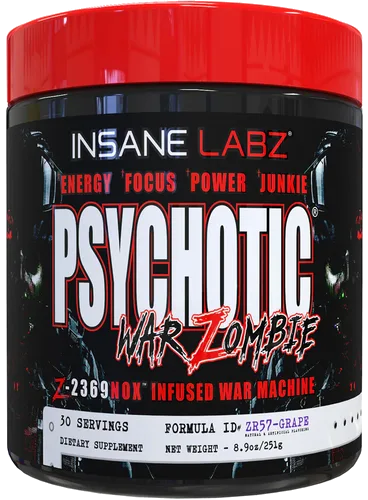
Insane Labz Psychotic War Zombie ZR57-Grape Review
Psychotic War Zombie ZR57-Grape by Insane Labz is a powder dietary supplement listed on this page with 14 active ingredients in each serving of 8.4 g. The label presents it for energy, focus, and power. Its product facts list a barcode of 051497273965, a net content of 8.9 ounces (251 g), and 30 servings per container. The label scan on file at the NIH Dietary Supplement Label Database is dated May 21, 2025, and the product is marked as on market. The supplement type is recorded as Other Combinations, with structure and function claims listed as the dietary claim category, and the intended target group is adults aged 18 to 50 years. The label directions say to take one serving in 8 to 10 oz of water once daily, 30 minutes before activity, and never consume more than one serving in a 24 hour period. It also says not to take it within four hours of bedtime. The label states it is made in the USA and certified cGMP, and carries the FDA disclaimer that the statements have not been evaluated by the Food and Drug Administration and that the product is not intended to diagnose, treat, cure, or prevent any disease. The ingredients include chloride 73 mg, sodium 41 mg, and potassium 30 mg, along with Z-2369NOX at 6.2 g in total, which contains five ingredients without individual amounts, and Z-STIM405 at 405 mg in total, which contains six ingredients without individual amounts. Other named actives include L-citrulline malate, beta-alanine, L-arginine hydrochloride, betaine anhydrous, Russian tarragon leaf extract, Infinergy, green tea leaf extract, caffeine anhydrous, AMPiberry, yohimbine HCl, and Rauwolfia vomitoria extract. The inactive ingredients are citric acid, natural and artificial flavors, silica, sucralose, calcium silicate, FD&C Blue #1, and FD&C Red #40. The page rates ingredient transparency as low, with one of three points, because the label gives exact amounts for only three of the fourteen active ingredients. The other eleven sit inside two proprietary blends. The page notes that the label does not name any major food allergen in its ingredient names, though it is not a test of the product. On the page, the safety information rating is three of three and is described as well documented. The research section says there is no graded research for the stated use on the label, while the potassium ingredient is rated effective for hypokalemia. The interaction section lists 1,518 drugs with a documented interaction, and the most serious rating is major. The page names monoamine oxidase inhibitors, ephedrine, a med, and nadolol among the most common categories, and notes that caffeine, green tea, and Infinergy can combine with ephedrine to raise the risk of stimulant side effects. Side effects most often reported across the ingredients include stomach upset, nausea, diarrhea, headache, anxiety, and bloating. The page does not show a price or a review count, so no cost per month and no customer rating breakdown can be taken from it.
We don’t sell supplements. We help you make decisions and get the best price.
Lowest prices
We may earn a commission from some store links. How we choose.
Finding the lowest prices at the stores now. This takes a few seconds.
Study, Trial or Testing Result Summary
Members Only22 human studies · 5 improved
1 of these 22 human studies gave the ingredient by drip, not by mouth.
Nearly all of each serving is two proprietary blends: a 6.2 gram pump blend and a 405 milligram stimulant blend. The listing says the stimulant blend includes caffeine, green tea, yohimbine and rauwolfia, but no studies of either blend, or of the individual amounts inside them, were provided, so their effect on energy cannot be judged here. The only ingredients with studies are trace electrolytes, both well below studied doses. Chloride is 73 milligrams, far below the 1200 milligrams of slow-release salt given to people with chronic fatigue syndrome, where 11 of 22 reported better symptoms without a comparison group [1]. A salt water mouth rinse helped preserve muscle force in cyclists [2], and a salt water drip into a vein extended hard cycling [3]. Other small trials found no gain in endurance [4][5][6]. Potassium is only 30 milligrams, and no study tested a potassium supplement on its own. A low-salt, high-potassium diet improved vigour and mood [7], but a larger trial linked such a diet to more fatigue [8]. A homeopathic potassium dose did no better than placebo [9], and lowering blood potassium did not change fatigue [10]. Animal and cell studies are never counted.
See all 22 studies →Hide the studies
- In 697 adults with mild high blood pressure, a low-sodium, high-potassium diet with placebo for 6 months was linked to more fatigue (34%) than the usual diet (18%) or a weight loss diet (15%).Effect of antihypertensives on sexual function and quality of life: the TAIM Study.
- In a crossover trial of 94 adults, 4 weeks on a low-sodium, high-potassium diet improved vigour, depression, tension and overall mood more than a moderate-sodium DASH-type diet, but fatigue was not shown to improve.Dietary electrolytes are related to mood.
- In 86 people with mental fatigue, a single dose of homeopathic potassium phosphate taken before an attention test did not work better than placebo, though the test's ceiling effect limits the result.Homeopathy for mental fatigue: lessons from a randomized, triple blind, placebo-controlled cross-over clinical trial.
- In 44 healthy people, asthma patients and COPD patients, a single dose of ammonium chloride that made the blood more acidic did not change muscle strength or muscle endurance compared with placebo.Respiratory muscle strength and muscle endurance are not affected by acute metabolic acidemia.
- In 18 young men, a single dose of ammonium chloride (0.3 g per kg body weight) did not change the cycling power at which fatigue began compared with sodium bicarbonate.The effect of ammonium chloride and sodium bicarbonate ingestion on the physical working capacity at the fatigue thresho…
- In 14 trained men, sodium chloride was used only as the placebo; sodium bicarbonate improved sprint power and fatigue compared with it, so chloride itself showed no benefit.Effects of sodium bicarbonate and carbohydrate intake after 14-h fasting on anaerobic performance and muscular endurance…
- In 13 men exercising in heat, drinks containing sodium with glycerol did not improve time to exhaustion compared with water.Hyperhydration with Glycerol, Sodium, and Isomaltulose or Sucrose on Fluid Balance, Thermoregulation, and Exercise Capac…
- In 11 active people, sodium chloride was the placebo; sodium bicarbonate lengthened exercise time in low oxygen compared with it, so chloride itself showed no benefit.Sodium bicarbonate supplementation improves severe-intensity intermittent exercise under moderate acute hypoxic conditio…
- In 10 male endurance-trained subjects, rinsing the mouth with a 6% salt solution during 30 minutes of cycling helped preserve muscle force after exercise compared with water rinsing.Effect of glucose and sodium chloride mouth rinses on neuromuscular fatigue: a preliminary study.
- In 8 men dehydrated by exercise, drinks with more sodium chloride improved rehydration but did not change time to exhaustion 4 hours later.Rehydration with drinks differing in sodium concentration and recovery from moderate exercise-induced hypohydration in m…
- In 8 healthy men, sodium chloride was used as the placebo; running time to exhaustion after repeated sprints was similar with sodium bicarbonate (78 seconds) and sodium chloride (75 seconds), so chloride itself showed no energy effect.The effect of sodium bicarbonate ingestion on high-intensity intermittent running and subsequent performance.
- In 8 men, ammonium chloride (0.2 g per kg body weight) did not change time to calf muscle fatigue compared with placebo or sodium bicarbonate.The effect of pH on fatigue during submaximal isometric contractions of the human calf muscle.
- In 8 active young men, a single dose of sodium chloride given with fizzy water and a script suggesting it would help performance increased time to exhaustion in hard cycling by 9.5% compared with the same salt given with a neutral script.Expectancy of ergogenicity from sodium bicarbonate ingestion increases high-intensity cycling capacity.
- In eight men, a glucose drink lowered blood potassium during and after intense cycling, but it did not delay fatigue compared with placebo.A single oral glucose load decreases arterial plasma [K+ ] during exercise and recovery.
- In 7 well-trained runners, drinking a prescribed volume of a potassium-containing carbohydrate-electrolyte drink during 4 hours of recovery from a long run let them keep running about 16% longer later than drinking as much as they wanted.Influence of fluid intake pattern on short-term recovery from prolonged, submaximal running and subsequent exercise capa…
- In fibromyalgia patients, 100 mg of magnesium chloride formula daily for one month did not significantly change overall stress compared with placebo, but it reduced stress in the mild-to-moderate stress subgroup and lessened pain.Short-Term Magnesium Therapy Alleviates Moderate Stress in Patients with Fibromyalgia: A Randomized Double-Blind Clinica…
- In 218 men and women with early coronary ischemia, salt baths improved exercise endurance only in those with moderate muscle power, while underwater massage showers improved it in everyone.[Cardiovascular effects of sodium chloride bath and underwater shower in coronary ischemia].
- Nine trained cyclists exercising to fatigue at high intensity did not perform significantly differently on a glucose and electrolyte drink or an electrolyte-only drink than on a non-electrolyte placebo drink, although seven of nine rode longer on the active drinks.Fluid replacement drinks during high intensity exercise: effects on minimizing exercise-induced disturbances in homeosta…
- In 8 men, an intravenous salt water infusion during hard cycling extended time to exhaustion to about 32 minutes versus 19 minutes with no infusion.Intravenous bicarbonate and sodium chloride both prolong endurance during intense cycle ergometer exercise.
- In six healthy people, ammonium chloride that made the blood more acidic did not significantly change peak power or total work in a 30-second all-out cycling test compared with placebo.Effects of pH on maximal power output and fatigue during short-term dynamic exercise.
- In 24 women with fibromyalgia who completed a 4-week feasibility study, sprays of magnesium chloride on the arms and legs twice daily improved fibromyalgia impact and quality-of-life scores, though energy itself was not measured.Effects of transdermal magnesium chloride on quality of life for patients with fibromyalgia: a feasibility study.
- In 78 people with chronic fatigue syndrome, 1200 mg of sustained-release sodium chloride for 3 weeks was given to 22 with low blood pressure on standing; 11 of these 22 reported improved symptoms over 8 weeks, while 10 still had the blood pressure drop.Pathogenesis and management of delayed orthostatic hypotension in patients with chronic fatigue syndrome.
Review Totals and Summary
Members Only2,906 reviews · 100% positive
Buyers are strongly positive about this pre-workout powder. Across the stores it carries about 267 ratings, and the written feedback contains no complaints. **What it did for buyers:** Energy is the main benefit. One reviewer calls it "Insane energy!! Hours of energy! No crash, You level out!" Another says it is "always reliable to get you in a great mood to hit the weights." A store-page summary adds that one buyer noticed very good sweating during training. Several reviewers describe it simply as getting the job done. **Complaints:** There are almost none. The only mild note is from a long-time user who was sent a flavor they did not order. They said it was "Not one I especially care for but it still works." That is a fulfilment mix-up, not a problem with the powder. The store-page summary also says no critical comments or side effects appear on that page. **Taste and form:** Flavor gets praise. One reviewer says "My favorite flavor!" and another enjoys the "veinz" flavor. A store summary says taste is the quality praised most often and that the drink was easier to get down than one buyer expected. The reviews give little detail on Grape specifically, and nothing on texture or serving count. One reviewer passes on the lid's advice: start with half a scoop. **Value for money:** Price is not discussed in the reviews or the store summaries, so there is nothing to report here. Long-term loyalty may count as a sign of satisfaction. One buyer has used it "for over 2years," and another for "atleast 10yrs." A store summary also notes that a buyer wants to purchase it again. **Who it suits:** It seems to suit regular gym-goers who want strong, lasting pre-workout energy. Experienced users of the original Psychotic formula are especially enthusiastic. One says it is "still the best even better than most other brands." The advice to begin with half a scoop suggests newer or more caffeine-sensitive users may want to ease in. No reviewer says it did not suit them. The reviews do not say who should avoid it. **Scope note:** Only the powder is covered here. Reviews of other forms of the product, such as gummies or capsules, were left out. The written feedback is also thin. Many reviews are only a line or two, and the store-page summary covers just a few reviews from 2021. It is best read as a consistently positive but limited picture.
Biohacker Summary
Members Only8 of 10 recommend it
All ten panelists spoke about potassium, the main ingredient, and most of them recommend or use it. Four of them drink electrolyte mixes with sodium, magnesium and potassium, often first thing in the morning, during exercise or on a fast, to stay hydrated; one gives a dose of 200 milligrams per serving. Others recommend it for healthy blood pressure, with one citing 4,700 milligrams a day as the need and saying most people fall short, and three of them prefer getting it from foods like bananas, potatoes and avocado over supplements. Other forms and uses mentioned include potassium citrate for urinary citrate, pairing it with magnesium and salt, and taking it during the luteal phase for water retention. One panelist cautions that it is risky for people with kidney disease or conditions that raise potassium levels and advises checking with a physician, and another notes that meds can flush potassium out; chloride is a smaller ingredient in this product, described as working with sodium to keep fluid in balance.
See all 10 biohackers →Hide the biohackers
Dr. Eric Berg · Potassium · recommends
- States that people need more potassium than any other mineral, yet most people aren’t getting enough.
- Explains that potassium is essential for peristalsis, the pumping action through the colon, and without it, things can sit there, leading to constipation.
- Explains that the normal requirements for potassium are 4,700 mg every single day, and that very few people get half of that amount. They describe potassium's role in the sodium potassium pump, which is essential for cellular electricity, muscle contraction, and heart function. Deficiency can lead to tiredness, muscle cramps, heart palpitations, or rising blood pressure.
- Recommends increasing potassium to restore balance and support healthy blood pressure.
- States that potassium is the most important electrolyte and that most people are not getting enough of it, needing around 4,700 mg daily, or even more, to avoid issues like fatigue, muscle cramps, heart palpitations, high blood pressure, and fluid retention.
- Dr. Eric Berg states that potassium is essential for health, supporting healthy muscles, nerves, and heart function, but warns that getting too much, especially from supplements, can be dangerous.
- Dr. Eric Berg states that most people are getting nowhere near enough potassium to balance the amount of sodium they’re already eating, implying a recommendation for increased potassium intake.
- Explains that potassium relaxes blood vessels, keeps elasticity in arteries, lowers adrenaline, supports the sympathetic nervous system, protects the endothelial layer of arteries, increases nitric oxide, and keeps insulin receptors sensitive.
- Was very successful in practice using potassium for hypertension, noting that bodies need 4700 mg of potassium every single day.
- States that low potassium can lead to constipation because potassium controls the smooth muscles of the body, affecting the contraction and relaxation of muscles in the colon.
- Mentions that chlorides are building blocks needed to produce hydrochloric acid.
- Recommends Dr. Berg's regular electrolyte powder for daily use when not exercising, noting it has high levels of potassium, calcium, and chlorides, with low sodium, no sugar, organic stevia, and natural flavoring without maltodextrin.
- Recommends adding an electrolyte powder or more electrolytes, including potassium, magnesium, calcium, chlorides, and sodium, for stronger muscles and better hydration.
- Recommends ensuring sufficient chlorides, such as from sea salt, as they are raw materials needed to make hydrochloric acid.
Thomas DeLauer · Potassium · uses
- Uses Element's cans which contain 100 milligram potassium, finding that electrolytes help his workout performance.
- Uses Element's 100 mg potassium cans first thing in the morning to prime his day and help with workout performance.
- Recommends Element's ready-to-drink sparkling electrolyte drinks as a low or zero-calorie soda replacement that provides 1,000 milligrams of sodium, 200 milligrams of potassium, and 60 milligrams of magnesium.
- Uses Element Electrolytes for about eight years, noting they contain 1000 mg sodium, 200 mg potassium, and 60 mg magnesium, and help curb appetite without adding many calories.
- Personally drinks Element's pink lemonade or sparkling drinks, which contain 1,000 mg sodium, 200 potassium, and 60 magnesium, to hydrate and feel satiated, curbing hunger without stopping the ghrelin response.
- Sometimes pivots to straight potassium supplementation when generally depleted.
- Uses Element ready-to-drinks as a perfect electrolyte blend to start his day, noting that they contain 500 mg of sodium, 100 mg of potassium, and 30 mg of magnesium, and are slightly carbonated.
- Mentions potassium as an important electrolyte but suggests there's another layer to performance beyond just focusing on it.
- States that potassium is important for hydration, skin repair, and fluid balance in the skin, and recommends countering sodium intake with potassium.
- Sips on LMNT Recharge cans throughout the day, especially when fasting, noting they are a new smaller can with 500 mg sodium, 100 mg potassium, and 30 mg magnesium.
- Explains that chloride is an essential nutrient and its ratio to potassium and sodium is important for balancing things out, though most people get enough chloride.
- Warns that electrolyte waters are usually a waste of money because they contain very small amounts of electrolytes and often use potassium chloride as a stabilizer.
Ben Greenfield · Potassium · uses
- Says he is drinking LMNT, which contains sodium, potassium, and magnesium, and states that he actually drinks this stuff.
- Recommends Celtic Sea Salt's new electrolyte drink 'Hydrate' for replenishing electrolytes and trace minerals lost through sweat, noting it contains 70 naturally occurring trace minerals, magnesium, taurine, and potassium, with no added sugar, artificial colors, or synthetic ingredients.
- Recommends adding potassium sulfate to a Morasco cold plunge.
- Mentions that potassium can be helpful for blood pressure but also risky for people with kidney disease or other conditions prone to elevated potassium levels, advising consultation with a physician.
- Warns of potassium deficiency on a carnivore diet if a lot of octopus and salmon are not consumed.
- Highlights the importance of potassium for numerous body benefits, noting that Vascanox is a good source of potassium nitrite.
- Anthony plans to do half sodium citrate and half potassium citrate to get the citrate for pH balancing and add more potassium.
- Recommends ensuring sufficient potassium intake, along with calcium and magnesium, to balance the acid load from protein on a carnivore diet and normalize urinary pH.
- Mentions Kali Phos (potassium phosphate) as another example of a tissue salt.
- Suggests using potassium as a supplement for fasted workouts.
Dr. Mark Hyman · Potassium · warns
- Warns that potassium bromate, a dough conditioner banned in the EU, UK, and Canada, is still allowed in U.S. bread.
- States that potassium plays a critical role in nerve signaling and muscle contraction, especially in the heart, and low levels can lead to dangerous irregular heart rhythms.
- Explains that chloride works with sodium to maintain fluid balance and supports digestion.
- Notes that meds flush out potassium.
- States that with potassium, water can fully cross the cell membrane and get inside where it's needed for intracellular hydration.
- Recommends using targeted electrolyte support, advising to look for products with meaningful amounts of sodium, potassium, and magnesium, low sugar content, and avoidance of artificial colors, flavors, and sweeteners.
- Warns that potassium bromate, a chemical dough conditioner, has been linked to cancer, oxidative stress, DNA damage, and reproductive harm in animal studies.
- Warns that electrolyte drinks, while marketed for hydration, are loaded with high-glycemic sugars, synthetic potassium salts, and artificial dyes that can trigger insulin resistance, blood sugar crashes, and inflammation.
- Recommends promoting potassium enriched low sodium salts as a great life hack, stating that changing the brand of salt used at home can reduce the risk of heart attack, stroke, or early death.
- Warns that if potassium is trailing high, it's not necessarily about needing a banana, but rather a systematic marker indicating acute or chronic fatigue, overtraining, or sympathetic overdrive.
- Notes that 96% of the US population does not meet the adequate intake for potassium, and that the ideal ratio of potassium to sodium should be 10 to 1, but it's currently the other way around. They explain that potassium plays an important role in regulating blood pressure.
Siim Land · Potassium · neutral
- Lists potatoes and fruit as sources of Potassium.
- Notes that bananas have potassium but there are at least 8 other foods with more potassium than bananas.
- States that potassium is the most abundant intracellular cation that helps to maintain intracellular fluid volume and that without it, one greatly increases the risk of hypertension, cardiovascular disease, diabetes, and stroke.
- States that potassium lowers blood pressure.
- Travels with Upgraded Formulas' potassium, manganese, boron, and zinc, considering them fundamental minerals he is usually deficient in.
- Notes that potassium bromate is banned in the EU due to being a possible carcinogen, while it is allowed in the US as a whitening and raising agent in bread products.
- Found that adding 198 MGS of potassium to his diet within 24 hours stopped his frequent urination, which had been occurring 30 to 50 times a day.
- Recommends potassium for muscle cramps, noting that a Carnivore diet may lack it, and suggests adding fruit or mineral waters.
- Mentions potassium as an electrolyte needed to help with insulin sensitivity, alongside magnesium and sodium.
- Notes Bryan Johnson uses New Salt, a low sodium, high potassium salt, but questions its necessity given Johnson's diet and low blood pressure, suggesting it may not have longevity effects unless one has actual high blood pressure.
Peter Attia · Potassium · recommends
- States there is some evidence that increasing dietary potassium through potassium-rich foods like bananas and potatoes, rather than supplements, can lower blood pressure.
- Notes that evolutionary ancestors consumed much more potassium than modern humans and suggests adding it back to the diet, ideally through whole foods.
- Mentions taking magnesium and potassium in addition to salt for minerals and electrolytes.
Andrew Huberman · Potassium · uses
- Uses Element, an electrolyte drink with sodium, magnesium, and potassium in correct ratios and no sugar, to ensure adequate hydration and electrolytes, especially when starting days fast or during physical exercise.
- Uses Element, which contains potassium in the correct ratios, to ensure proper hydration and electrolyte intake for brain and body function.
- Mentions potassium as an electrolyte.
- Uses Element, an electrolyte drink with sodium, magnesium, and potassium in correct ratios and no sugar, to ensure adequate hydration and electrolytes, drinking it first thing in the morning and during physical exercise.
- Uses Element, an electrolyte drink with sodium, magnesium, and potassium in correct ratios and no sugar, to ensure he is hydrated and has sufficient electrolytes. He drinks it first thing in the morning and during physical exercise, especially on hot days.
- Uses Element, an electrolyte drink with sodium, magnesium, and potassium but no sugar, to ensure adequate hydration and electrolytes, especially when waking up and during exercise.
- Uses LMNT, an electrolyte drink with sodium, magnesium, and potassium in correct ratios and no sugar, to ensure adequate hydration and electrolytes for brain and body function, especially when starting his day fast or during physical exercise.
- Uses Element, which contains potassium, for proper hydration and electrolyte balance.
- Ensures adequate intake of sodium, magnesium, and potassium, which are vital electrolytes for the functioning of all body cells, especially neurons, by drinking Element.
- Uses Element, an electrolyte drink with sodium, magnesium, and potassium, to ensure adequate hydration and electrolytes for optimal brain and body function, especially when waking up and during physical exercise.
Dr. Rhonda Patrick · Potassium · recommends
- Recommends getting enough potassium, noting that most people get too much sodium and not enough potassium.
- States that maintaining a high potassium intake is important for hypertension.
- Recommends getting enough potassium from veggies, bananas, and fruit because the body cares about the sodium-potassium ratio.
- Dr. Patrick states that her smoothie, containing avocado and banana, has around 5,800 milligrams of potassium, which meets the adequate intake requirement for maintaining normal blood pressure and decreasing the risk of kidney stones.
- Dr. Rhonda Patrick states that eating more potassium, not less sodium, is the key to healthy blood pressure.
Dave Asprey · Potassium · recommends
- Recommends having more potassium during a fast to increase mineral intake.
- States that people who are salt-sensitive hypertensives usually need more potassium.
- Explains why electrolytes, especially sodium, potassium, and magnesium, are foundational for recovery.
- States that potassium is a really important electrolyte for everyone, but the demand is significantly higher for people with nervous system, immune system, and endocrine system dysregulation.
- Recommends using potassium citrate, if tolerated, to raise urinary citrate and block crystal formation.
- Notes that the potassium in the Vineia blood flow hydration product is from coconut water.
- Mentions that atrial fibrillation has to do with mineral status, including potassium.
- Takes a lot of potassium.
- Recommends lots of potassium citrate to help remove oxalates from the body.
- Dave Asprey, who is salt-sensitive, balances out sodium intake with potassium, taking potassium citrate capsules from Designs for Health and carrying them all the time.
Bryan Johnson · Potassium · recommends
- Recommends potassium during the luteal phase to help reduce water retention and bloating.
RAL Summary
Members OnlyTier 4 for Energy
The tier 5 grade rests on potassium, a trace 30 mg electrolyte that no study tested as a supplement, while the two main blends that make up nearly the whole serving have no human studies given, so the evidence is thin rather than negative. So it is graded Tier 4, as the studies disagree.
- Emerging: not enough evidence to rank higher yet.
Where the evidence disagrees: 13 of the 22 human studies found no effect.
More Details
Members OnlyBody systems · Combine with · Possible side effects
Body systems: Nervous system, Cardiovascular system, Muscular system
Combine with: For performance use, this product pairs well with creatine monohydrate for strength and power, L-citrulline or citrulline malate for pump and blood flow, and electrolytes (sodium, potassium, magnesium) for hydration during training. L-theanine (100-200 mg) can smooth caffeine's jittery effects and may reduce stimulant-induced tension. If heart and blood pressure support is the actual goal, look instead at non-stimulant options such as magnesium, potassium-rich foods, CoQ10, omega-3 fish oil, hibiscus extract, and garlic extract, and consult a healthcare provider, especially if taking meds, before using high-caffeine pre-workouts.
Possible side effects: No major side effects reported in reviews, though one reviewer passes on the label advice to start with half a scoop. In one diet study, a low-salt, high-potassium diet was linked to more fatigue.
Supplement Facts
Chloride 73 mg · Potassium 30 mg · Z-2369NOX 6.2 g
| Chloride | 73 mg | |
| Sodium | 41 mg | |
| Potassium | 30 mg | |
| Z-2369NOX | 6.2 g | † |
| Z-STIM405 | 405 mg | † |
Other ingredients: Citric Acid, Natural & Artificial Flavors, Silica, Sucralose, Calcium Silicate, FD&C Blue #1, FD&C Red #40.
Directions: Directions for use: As a dietary supplement for adults, take 1 serving in 8-10 oz. of water once daily, 30 minutes before activity. Never consume more than 1 serving in a 24 hour period. Do not take within 4 hours of bedtime. Read warnings and only use as directed.
Barcode (UPC) 051497273965 · Label source: NIH label database · Report a label change
Show entire label

More energy products
Members OnlyThe highest ranked for the same goal
Read more
Our articles on this subject
Graded November 6, 2026 by the Reverse Age Lab evidence engine, from human studies, real reviews and our biohacker panel. How we grade. Is this medical advice? No. Rala organizes the published evidence; go over any change with your doctor, especially if you take meds.
Privacy policyConsumer health dataAffiliate disclosureTermsDo Not Sell or Share My Personal InformationCookie settings