
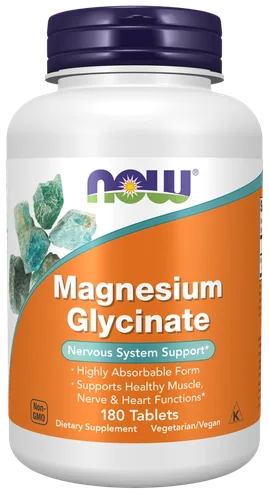
now foods Magnesium Glycinate Tablets Review
This is Magnesium Glycinate in tablet form from NOW Foods. Each container holds 45 servings, and a serving is 2 tablets. The Supplement Facts panel lists one active ingredient: magnesium (elemental) at 200 mg per serving. The other ingredients printed on the label are citric acid, hydroxypropyl cellulose, stearic acid (vegetable source) and silicon dioxide. The tablets also carry a vegetarian coating made of hypromellose (cellulose), stearic acid (vegetable source), sunflower lecithin, triethyl citrate and sunflower oil. The directions as printed read: take 2 tablets 1 to 2 times daily with food. Buyers most often say they use it for sleep, and many call it gentle on the stomach. A smaller group report stomach upset, and some find the tablets large while others find them easy to swallow.
We don’t sell supplements. We help you make decisions and get the best price.
Lowest prices
We may earn a commission from some store links. How we choose.
Finding the lowest prices at the stores now. This takes a few seconds.
Study, Trial or Testing Result Summary
Members Only52 human studies · 32 improved
14 of these 52 human studies gave magnesium by drip, not by mouth.
This product gives magnesium at 400 milligrams a day, a full dose compared with the 360 milligrams that worked in studies. That is above the daily recommended limit, so members can take less if they prefer. Across 17 trials in 889 adults, oral magnesium raised nitric oxide, a natural signal that widens blood vessels, and lowered a blood marker of inflammation compared with placebo [1]. A pooled look at 12 trials in 665 adults found that magnesium thinned the walls of the neck arteries and improved how well blood vessels widen, mostly at doses above 400 milligrams a day, which is slightly more than this product gives [2]. In adults with heart artery disease, six months of oral magnesium improved blood vessel function and exercise tolerance [3], and in men with the same condition it improved heart pumping strength and peak oxygen use [4]. The benefit is not seen everywhere. Magnesium did not lower blood pressure or artery stiffness in the pooled trials [2]. It also did not ease artery stiffness after 24 weeks in overweight older adults [5] or after six months in older adults with diabetes [6]. Animal and cell studies are never counted.
See all 52 studies →Hide the studies
- Across 17 randomized trials of 889 adults, oral magnesium supplementation significantly increased nitric oxide levels and lowered inflammatory markers like C-reactive protein compared with placebo.Effect of Magnesium Supplementation on Inflammatory Parameters: A Meta-Analysis of Randomized Controlled Trials.
- Across 12 trials of 665 adults, oral magnesium supplementation reduced carotid artery wall thickness and improved blood vessel dilation at doses above 400 mg per day, though it had no overall effect on arterial stiffness or blood pressure.The effects of oral magnesium supplements on vascular and endothelial function: an updated systematic review and meta-an…
- Across 10 trials of 504 women with polycystic ovary syndrome, vitamin E supplementation alone or combined with omega-3 or magnesium significantly increased nitric oxide levels and reduced C-reactive protein and cholesterol compared with placebo.A meta-analysis of effects of vitamin E supplementation alone and in combination with omega-3 or magnesium on polycystic…
- In 194 pregnant women with high blood pressure, combining a daily multivitamin with intravenous magnesium sulfate for two weeks improved placental blood flow and blood clotting function more than magnesium sulfate alone.Effects of multivitamin combined with magnesium sulfate versus magnesium sulfate alone on hemodynamics, coagulation, and…
- In 164 overweight or slightly obese older adults, taking 450 mg daily of magnesium citrate, oxide, or sulfate for 24 weeks did not change arterial stiffness or blood pressure compared with placebo.Effects of Magnesium Citrate, Magnesium Oxide, and Magnesium Sulfate Supplementation on Arterial Stiffness: A Randomized…
- In 156 hospitalized patients experiencing cardiac arrest, receiving 10 g of intravenous magnesium over 24 hours did not improve the return of spontaneous blood circulation or survival compared with placebo.Randomised trial of magnesium in in-hospital cardiac arrest. Duke Internal Medicine Housestaff.
- In 105 cardiac arrest patients with persistent irregular heart rhythms, a single intravenous dose of 2 to 4 g of magnesium sulphate did not significantly improve the return of spontaneous blood circulation or survival to hospital discharge compared with placebo.A randomised trial to investigate the efficacy of magnesium sulphate for refractory ventricular fibrillation.
- In 103 pregnant women with severe high blood pressure, adding low molecular weight heparin sodium to magnesium sulfate for 7 days significantly increased nitric oxide levels and improved blood vessel function compared with magnesium sulfate alone.Clinical Effect of Low Molecular Weight Heparin Sodium Combined with Magnesium Sulfate in the Treatment of Patients with…
- In 100 patients with pregnancy-induced hypertension, adding labetalol to nifedipine and magnesium sulfate improved blood pressure control, blood coagulation, and vascular endothelial function more than nifedipine and magnesium sulfate alone.Effects of Nifedipine and Labetalol Combined with Magnesium Sulfate on Blood Pressure Control, Blood Coagulation Functio…
- In 96 patients with pregnancy-induced hypertension, combining nimodipine with magnesium sulfate reduced blood pressure and vascular endothelial damage more than magnesium sulfate alone.Clinical Effect of Nimodipine Combined with Magnesium Sulfate on Pregnancy-Induced Hypertension Syndrome.
- In 90 patients with aneurysmal subarachnoid hemorrhage, an infusion of 500 mg daily of magnesium sulphate for 21 days lowered the incidence of cerebral vasospasm and cerebral blood flow velocity more effectively than milrinone.[Effect of magnesium sulphate and milrinone on cerebral vasospasm after aneurysmal subarachnoid hemorrhage: a randomized…
- In 87 preterm infants born to mothers given antenatal magnesium sulfate or saline placebo, magnesium sulfate did not consistently improve neonatal systemic blood flow in the first 24 hours.Randomized controlled trial of magnesium sulfate in women at risk of preterm delivery-neonatal cardiovascular effects.
- In 74 older adults with type 2 diabetes and arterial calcification, taking 350 mg daily of magnesium citrate for 6 months did not reduce arterial stiffness compared with placebo.Magnesium supplementation did not reduce serum calciprotein crystallization and arterial stiffness in individuals with t…
- In 67 patients experiencing out-of-hospital cardiac arrest, a single 5 g dose of magnesium sulfate did not improve the return of spontaneous circulation or survival compared to placebo.Magnesium in cardiac arrest (the magic trial).
- In 60 women with polycystic ovary syndrome, taking 250 mg of magnesium plus 400 mg of vitamin E daily for 12 weeks increased plasma nitric oxide and antioxidant capacity while reducing inflammation.The Effects of Magnesium and Vitamin E Co-Supplementation on Hormonal Status and Biomarkers of Inflammation and Oxidativ…
- In 60 pregnant women with severe preeclampsia, intravenous magnesium sulfate significantly reduced the middle cerebral artery pulsatility index and cerebral perfusion pressure while maintaining cerebral blood flow over 6 hours, similar to labetalol.Evaluation of intravenous infusion of labetalol versus magnesium sulfate on cerebral hemodynamics of preeclampsia patien…
- In 53 men with stable coronary artery disease, taking 15 millimoles of oral magnesium twice daily for 6 months improved left ventricular ejection fraction and maximal oxygen uptake compared to placebo.Oral magnesium therapy, exercise heart rate, exercise tolerance, and myocardial function in coronary artery disease pati…
- In 52 overweight and obese older adults taking 350 mg of magnesium daily for 24 weeks, there was no improvement in brachial artery flow-mediated vasodilation or microvascular endothelial function compared with placebo.Effects of long-term magnesium supplementation on endothelial function and cardiometabolic risk markers: A randomized co…
- In 50 adults with stable coronary artery disease, taking oral magnesium daily for 6 months improved blood vessel function and exercise tolerance compared with placebo.Oral magnesium therapy improves endothelial function in patients with coronary artery disease.
- In 48 overweight and obese children and teenagers, taking a combination of magnesium, curcumin, resveratrol, zinc, selenium, and vitamin D for 6 months improved endothelial blood flow response compared with placebo.Supportive treatment of vascular dysfunction in pediatric subjects with obesity: the OBELIX study.
- In 47 people ascending to high altitude, taking oral magnesium citrate significantly increased blood flow velocity in the middle cerebral artery compared to placebo.Effect of magnesium, high altitude and acute mountain sickness on blood flow velocity in the middle cerebral artery.
- In 40 adults undergoing eye tumor surgery, intraoperative magnesium sulphate successfully induced controlled hypotension and reduced choroidal blood flow by 24% to provide good surgical conditions, comparable to sodium nitroprusside.Controlled hypotension in adults undergoing choroidal melanoma resection: comparison between the efficacy of nitroprussi…
- In 40 adults with migraine without aura taking 600 mg of oral magnesium citrate daily for 3 months, cortical blood flow in several brain regions increased significantly and migraine attacks decreased compared with placebo.The effects of magnesium prophylaxis in migraine without aura.
- In 40 patients undergoing heart surgery, an injection of 50 mg per kilogram of magnesium sulfate relaxed smooth vascular muscles and reduced vascular resistance and arterial pressure.[Comparison of vascular effects of magnesium sulfate and nicardipine during extracorporeal circulation].
- In 39 hemodialysis patients, increasing dialysate magnesium levels for 4 weeks significantly improved arterial stiffness and reduced systolic blood pressure and pulse pressure.Consequences of Supraphysiological Dialysate Magnesium on Arterial Stiffness, Hemodynamic Profile, and Endothelial Funct…
- In 36 patients with pre-hypertension or mild hypertension taking a supplement containing a nitric oxide donor, magnesium, and vitamins for 16 weeks, morning blood pressure and evening systolic blood pressure decreased significantly compared with placebo.Is it Possible to Significantly Modify Blood Pressure with a Combined Nutraceutical on Top of a Healthy Diet? The Result…
- In 30 obese hypertensive and lean normotensive adults, 3 weeks of a usual diet supplemented with magnesium, potassium, and fiber did not significantly lower blood pressure or improve small artery elasticity compared to the usual diet alone.DASH lowers blood pressure in obese hypertensives beyond potassium, magnesium and fibre.
- In 30 patients with normotensive glaucoma, taking 300 mg of oral magnesium citrate daily for 1 month improved visual field indices but did not change ocular blood flow.The effect of oral magnesium therapy on visual field and ocular blood flow in normotensive glaucoma.
- In 28 newborns with severe persistent pulmonary hypertension treated for 24 hours, nebulized magnesium sulfate at 1024 mg per hour improved oxygenation and mean arterial blood pressure more than intravenous magnesium sulfate.Nebulized Magnesium Sulfate for Treatment of Persistent Pulmonary Hypertension of Newborn: A Pilot Randomized Controlled…
- In 25 newborns with persistent pulmonary hypertension, intravenous magnesium sulfate produced a similar initial response rate to inhaled nitric oxide, though fewer infants recovered when switched to magnesium sulfate after nitric oxide failed.Inhaled nitric oxide and intravenous magnesium sulphate for the treatment of persistent pulmonary hypertension of the ne…
- In 22 patients with preeclampsia, a 6 g intravenous dose of magnesium sulfate significantly dilated blood vessels in the retina and improved retinal blood flow waveforms compared to placebo.The effect of magnesium sulfate on maternal retinal blood flow in preeclampsia: a randomized placebo-controlled study.
- In 19 healthy adults, a single dose of 450 mg for men or 300 mg for women of an over-the-counter magnesium supplement did not produce a significant overall difference in blood vessel dilation over 2 hours compared with water.The Acute Effect of Magnesium Supplementation on Endothelial Function: A Randomized Cross-Over Pilot Study.
- In 19 healthy adults, taking an over-the-counter magnesium supplement for 1 week did not improve blood vessel dilation or blood pressure compared with their usual diet.The Effect of Magnesium Supplementation on Endothelial Function: A Randomised Cross-Over Pilot Study.
- In 14 patients recovering from brain hemorrhage, a 5 g intravenous bolus of magnesium sulfate slightly lowered blood pressure and systemic vascular resistance compared to saline placebo, but did not change brain blood flow velocity.Cerebral blood flow velocity response to magnesium sulfate in patients after subarachnoid hemorrhage.
- In 14 adults with mild to moderate high blood pressure taking 15 millimoles of magnesium pidolate daily for 6 months, there was no significant effect on resting blood pressure or forearm peripheral vascular resistance compared with placebo.Long-term magnesium supplementation in essential hypertension.
- In 14 healthy young men with a family history of metabolic syndrome or diabetes, taking 8.1 millimoles of magnesium-pidolate twice daily for 8 weeks had no effect on blood pressure, endothelial function, or arterial stiffness.Effects of magnesium supplements on blood pressure, endothelial function and metabolic parameters in healthy young men w…
- In 14 healthy male volunteers, an intravenous infusion of magnesium sulphate reduced platelet clumping, increased bleeding time by 48%, and caused a temporary drop in blood pressure compared to placebo.Magnesium inhibits platelet activity--an infusion study in healthy volunteers.
- In 12 pregnant patients with preeclampsia, a 6 g intravenous dose of magnesium sulfate significantly dilated smaller blood vessels in the brain and improved cerebral blood flow waveforms compared to placebo.Effect of magnesium sulfate on maternal brain blood flow in preeclampsia: a randomized, placebo-controlled study.
- In 11 patients with well-regulated type 2 diabetes, taking 360 mg of magnesium daily for 8 weeks raised intracellular magnesium levels but had no effect on endothelial function, platelet reactivity, or diabetic control compared with placebo.[Magnesium supplementation to patients with type II diabetes].
- In pregnant women with premature contractions, 2 grams per hour of intravenous magnesium over 24 hours significantly increased red blood cell flexibility for microcirculation compared with placebo.Effect of magnesium on red blood cell deformability in pregnancy.
- In women with high blood pressure taking a thiazide a med, 600 mg daily of magnesium chelate for 6 months improved blood vessel dilation and lowered blood pressure compared with placebo.Oral magnesium supplementation improves endothelial function and attenuates subclinical atherosclerosis in thiazide-trea…
- In 85 pregnant women with hypertension or pre-eclampsia, magnesium sulfate therapy favorably modulated circulating blood markers of vascular endothelial function.Maternal plasma levels of endothelial dysfunction mediators including AM, CGRP, sICAM-1 and tHcy in pre-eclampsia.
- In 17 women with preeclampsia, magnesium sulfate therapy significantly increased maternal circulating levels of the vasodilator calcitonin gene-related peptide.Calcitonin gene- and parathyroid hormone-related peptides in preeclampsia: effects of magnesium sulfate.
- In 34 pregnant women with moderate to severe hypertension, magnesium sulfate alone was less effective than nitroglycerin at reducing blood pressure, umbilical artery resistance, and platelet aggregation.[Therapeutic effects of nitroglycerin on pregnancy induced hypertension].
- In 41 chronic migraine patients, an intravenous infusion of magnesium sulfate produced a short-lived widening of blood vessels and increased cortical blood volume.Cerebral reactivity in migraine patients measured with functional near-infrared spectroscopy.
- In 9 healthy young students, an intra-arterial magnesium infusion significantly increased resting forearm blood flow and improved blood vessel dilation without changing systemic blood pressure.Magnesium infusion improves endothelium-dependent vasodilation in the human forearm.
- Pregnant women taking 360 mg daily of oral magnesium pyrrolidone carboxylic acid alongside ritodrine had decreased vessel resistance in the umbilical and fetal middle cerebral arteries compared to ritodrine plus placebo.Oral magnesium supplementation improves fetal circulation.
- In 16 pregnant women with preeclampsia, magnesium sulfate treatment significantly decreased systolic and diastolic blood pressure and malondialdehyde levels while increasing calcitonin gene-related peptide levels.Effects of magnesium sulfate on lipid peroxidation and blood pressure regulators in preeclampsia.
- In 15 healthy volunteers, a 45-minute intravenous infusion of magnesium sulphate doubled blood magnesium levels but had no effect on brain blood flow velocity or blood vessel reactivity.Effects of magnesium sulphate on cerebral haemodynamics in healthy volunteers: a transcranial Doppler study.
- In a retrospective review of 110 pregnant women with hypertensive disorders managed with meds and magnesium sulfate for seizure prevention, pregnancy was prolonged under monitoring, without reporting specific blood flow changes from magnesium.Hypertensive disorders in pregnancy: analysis of 110 cases.
- In 53 preterm infants, prenatal exposure to magnesium sulfate was associated with significantly increased cerebral blood flow velocities during the first five days of life compared to unexposed infants.Effects of antenatal magnesium sulfate treatment on cerebral blood flow velocities in preterm neonates.
- In a retrospective study of 29 comatose cardiac arrest patients, 6 of 18 patients given verapamil and/or magnesium sulfate made a complete neurological recovery without significant blood pressure drops from magnesium, compared to 0 of 11 in the control group.Neurological recovery after cardiac arrest: clinical feasibility trial of calcium blockers.
Review Totals and Summary
Members Only65,229 reviews · 95% positive
Across the stores that sell it, this magnesium glycinate carries about 65229 ratings, and about two thirds of the starred reviews below give 4 or 5 stars. Most buyers are happy, with sleep the most common reason, while a smaller group report stomach trouble or a lost order. **What buyers say it did for them:** Sleep comes up most. One buyer says it brings "better sleep quality" and another says "IT REALLY HELPS ME TO SLEEP." Others mention muscles and relaxation, with one saying "less body ache." Some report more energy or a steadier mood, and one says they felt a benefit "after few days." **What they complain about:** The sharpest complaint is stomach upset. One reviewer describes "burning in my stomach" within an hour or two of a dinner dose, and another says it "Made stomach hurt." One buyer says it tends to make them regular. A few one star reviews say "Garbage,dont work." Several others are about orders that never arrived, which is about the seller and not the tablets. **Taste, smell, pill size and form:** Reviews do not mention taste or smell. On size, opinions differ: one says "good size tablets, and convenient to take," another says "easy to swallow," and a third finds the tablet "quite big but its ok." **Value for money:** Buyers who mention price are positive. One calls it "great value," another says "very good magnesium for price ratio," and a third says the price is reasonable. A store summary also points to the large tablet count as a long supply. **Who it seems to suit and who it did not:** Many reviewers say it is gentle on the stomach, and one says it is "one of few magnesiums that I can tolerate without the laxative effect." Buyers who take it in the evening or before bed are the most satisfied. It did not suit people with a sensitive stomach, and one reviewer says they would not recommend it to anyone with stomach issues. Another prefers a different brand that left them with no gut issues. Several loyal buyers say they trust the brand and buy it again.
Biohacker Summary
Members Only9 of 10 recommend it
Most of the panel recommends or uses magnesium, and sleep is the most common reason, with others citing muscle cramps and recovery, stress, blood pressure, bone health, and helping the body use vitamin D. Forms matter to them: glycinate is favored for sleep, cramps, and absorption, while threonate is favored for bedtime and brain effects, and three of them take 400 mg of threonate before bed. Other doses mentioned were 300 to 400 mg a day from food and supplements, 400 to 500 mg a day as a minimum, and one panelist who aims for about a gram of supplemental magnesium. Some get it through electrolyte drinks, and others pair it with vitamin D, potassium, or protein. One panelist says magnesium does not fix waking in the night, and one stays neutral and only reviews the sleep evidence, but no one said they stopped taking it.
See all 10 biohackers →Hide the biohackers
Dr. Eric Berg · Magnesium · recommends
- Recommends supplementing magnesium during prolonged fasting to prevent feeling unwell, especially since many individuals are already deficient.
- Recommends taking magnesium glycinate to fix intense leg cramps, stating that this form absorbs better and helps relax muscles.
- Recommends magnesium, specifically magnesium glycinate, for blood pressure control, sleep, stress reduction, prevention of muscle cramps, and energy support.
- States that magnesium could also be a factor in preventing muscle cramps.
- Recommends Magnesium glycinate, noting its high absorption rate compared to magnesium oxide, and its support for energy, sleep, muscle relaxation, and vitamin D function.
- Dr. Berg states that when nutrients like magnesium are too low, fatigue and weakness can follow.
- Recommends focusing on magnesium to support stronger bones if a neck hump is associated with osteoporosis.
- Explains that leg and calf cramps are most often caused by low magnesium, with leafy greens being a top source.
- States that magnesium is a cofactor that allows B1 to work more efficiently.
- Recommends ensuring that vitamin D supplements also contain magnesium to help it work better for shingles.
Thomas DeLauer · Magnesium · recommends
- Recommends pre-bed magnesium glycinate to lower evening cortisol through GABA-A support and to drop core temperature for sleep onset.
- Recommends taking magnesium glycinate and threonate at night to act as a brake on the nervous system, block excitatory signaling, help wind down, and support serotonin and melatonin production for better sleep.
- Mentions that magnesium glycinate also helps a lot with sleep.
- Mentions that restless leg syndrome is often treated with magnesium, but states that the sensation is actually coming from three other issues.
- Uses Element's cans which contain 30 milligram magnesium, finding that electrolytes help his workout performance.
- Uses Element's 30 mg magnesium cans first thing in the morning to prime his day and help with workout performance.
- Recommends magnesium around the time one would normally break a fast to calm the brain and dull feelings of conditioned hunger.
- Recommends magnesium, noting it is a cofactor for enzymes that build neurotransmitters, and deficiency can affect mood, happiness, and motivation.
- Notes that modern agricultural practices have led to soils depleted of trace minerals like magnesium, resulting in widespread magnesium deficiency.
- Recommends taking some magnesium glycinate tonight to help calm down and sleep.
Dr. Mark Hyman · Magnesium · recommends
- Recommends Magnesium Breakthrough Advanced 10 from Biooptimizers, stating it has 10 bioavailable forms and 550 milligrams of elemental magnesium, designed to support restful sleep, restorative sleep, muscle recovery, stress resilience, and metabolic health.
- Recommends magnesium breakthrough advanced ten from Biooptimizers, which is their most complete magnesium formula with 10 bioavailable forms and 550 milligrams of elemental magnesium, designed to support restful restorative sleep, muscle recovery, stress resilience, and metabolic health.
- Recommends considering magnesium glycinate before bed for nervous system support, deeper sleep quality, and to help the body transition into rest, and states that they take it every night.
- Explains that a lack of magnesium can cause muscles and nerves to malfunction, resulting in muscle weakness, twitching, and cramps.
- Recommends Magnesium Breakthrough Advanced 10 from Bioptimizers for restful sleep, muscle recovery, stress resilience, and metabolic health, especially during stressful times of the year.
- Recommends magnesium because it is involved in over 600 reactions in the body and up to 80% of people may have low levels that never get flagged on a standard blood test.
- Recommends magnesium as a basic supplement during detoxification to support pathways, help with constipation, and provide electrolytes.
- Recommends Magnesium Breakthrough Advanced 10 from Biooptimizers, which contains 10 bioavailable forms and 550 mg of elemental magnesium, to support restful sleep, restorative sleep, muscle recovery, stress resilience, and metabolic health.
- Has recommended magnesium breakthrough from bioptimizers for years and now uses Magnesium Breakthrough Advanced 10 as part of his evening routine, especially during periods of travel, training, and higher stress, to support sleep, muscle recovery, and metabolic health.
- Recommends correcting nutrient deficiencies with magnesium.
Bryan Johnson · Magnesium · uses
- Takes 400 mg of Magnesium Threonate before bed for sleep.
- Takes 400 mg of Magnesium Threonate before bed for sleep.
- Takes 400 mg of Magnesium L-Threonate before bed for sleep.
- Takes 400 mg of Magnesium Threonate before bed for sleep.
- He takes 400 mg of Double Wood Magnesium L-Threonate before bed for sleep.
- Takes 400 mg of Magnesium L-Threonate before bed for sleep.
- Takes 400 mg of Magnesium Threonate before bed for sleep.
- Takes 400 mg of Magnesium L-Threonate before bed for sleep.
- Takes 400 mg of magnesium L-threonate before bed for sleep.
- He takes 400 mg of Magnesium L-Threonate before bed for sleep.
Dr. Rhonda Patrick · Magnesium · recommends
- Explains that magnesium helps the body activate and metabolize vitamin D, and that magnesium intake has been associated with lower odds of vitamin D deficiency and insufficiency.
- Mentions that getting too little magnesium may play a role in declining testosterone levels.
- Recommends getting enough magnesium, around 300–400 mg daily from diet and supplements, as it is an essential cofactor for vitamin D metabolism. Magnesium glycinate is a good form.
- Notes that magnesium is very important for preventing damage to DNA and cancer, and that half the US population doesn't get enough of it.
- Mentions magnesium as one of the micronutrients found in multivitamins that people often don't get enough of from their diets.
- Explains that magnesium helps control blood pressure by boosting the production of substances that relax blood vessels and improve cardiovascular health, citing a meta-analysis that found magnesium supplementation at an average dose of 368 mg per day notably lowers both systolic and diastolic blood pressure.
- Magnesium supplementation has lowered blood pressure in randomized controlled trials. An analysis of 34 trials involving over 2,000 participants found modest reductions in both systolic and diastolic pressure, with a median dose of 368 mg/day.
- Warns that some magnesium supplements make the dose look much larger than it really is and that labels can fool people.
- Mentions magnesium as an important nutrient component for testosterone.
- Warns that some supplement companies mislead consumers by listing the total compound weight of magnesium citrate as the elemental magnesium dose, when the actual elemental magnesium content is much lower, potentially around 44-66 milligrams.
Andrew Huberman · Magnesium · recommends
- Notes that Les Spellman's team includes 'Magnesium timed right' as part of their game plan to optimize recovery in unfavorable conditions.
- Discusses Magnesium Threonate as a tool for falling asleep.
- Takes 400 mg of Magnesium Threonate before bed for sleep.
- Uses Element, an electrolyte drink with sodium, magnesium, and potassium in correct ratios and no sugar, to ensure adequate hydration and electrolytes, especially when starting days fast or during physical exercise.
- Takes 400 mg of Magnesium L-Threonate before bed for sleep.
- Confirms that magnesium is absolutely important for cognitive function, noting studies show those with lower magnesium intakes tend to perform less well on cognitive function tests, and it's related to brain changes over time and dementia risk.
- Takes 400 mg of Double Wood Magnesium L-Threonate before bed for sleep.
- He takes 400 mg of Magnesium L-Threonate from Double Wood before bed for sleep.
- Takes 400 mg of Double Wood Magnesium L-Threonate before bed for sleep.
- Takes 400 mg of magnesium L-threonate before bed for sleep.
Dave Asprey · Magnesium · uses
- Looks at magnesium alongside protein to keep muscle for the long run.
- Suggests adding magnesium to help keep potassium in the system longer, as they work hand in hand.
- Mentions magnesium in the context of sleep but states that it doesn't address the core issue of waking up during the night.
- Suggests that magnesium may help slow aging, support cellular repair, and improve sleep.
- States that magnesium can affect how the body responds to a supplement.
- Recommends fixing sleep with 300mg of Magnesium 101 before bed if diet and exercise aren't melting stubborn belly fat.
- Dave Asprey says his daily routine includes magnesium as part of a carefully developed combination for longevity.
- Recommends magnesium glycinate for sleep, stating that trials show it helps people fall asleep about 17 minutes faster and that he finds it incredibly effective.
- Mentions magnesium glycinate as one of the five gut-friendly, extensively researched ingredients in Kill Switch that helps with natural sleep.
- Dave Asprey recommends Magnesium Glycinate for sleep, noting human studies show it helps people fall asleep faster, is safe, and works on a fundamental aspect of health, unlike magnesium oxide which acts as a laxative.
Ben Greenfield · Magnesium · uses
- Uses magnesium during surgery because it is neuroprotective.
- Says he is drinking LMNT, which contains sodium, potassium, and magnesium, and states that he actually drinks this stuff.
- Mentions magnesium as part of a bare-minimum protocol.
- Advises getting red blood cell magnesium levels to the high end of the range as a minimum step for overall health and to slow down heart disease.
- Recommends supplementing with magnesium threonate if one is low in magnesium, as it crosses the blood-brain barrier and is demonstrated to increase hippocampus plasticity, theoretically making one smarter and improving memories.
- Uses Magnesium Breakthrough from BIOptimizers as part of their daily stack, taking four capsules in the evening to support relaxation, recovery, and a good night of sleep.
- Recommends Celtic Sea Salt's new electrolyte drink "Hydrate" for replacing electrolytes and trace minerals lost through sweat, noting it contains 70 naturally occurring trace minerals, plus magnesium, taurine, and potassium.
- Had heart palpitations when he was really overdoing magnesium, not knowing what he was taking.
- Recommends taking magnesium as a co-factor to increase vitamin D absorption.
- Notes a new study indicating that magnesium is a core dietary antioxidant closely associated with a reduced risk of accelerated biological aging.
Siim Land · Magnesium · recommends
- States that Magnesium can be a useful addition for some people for sleep.
- Recommends magnesium for sleep, especially deep sleep, and suggests trying better types like Threonate, Biscinate, or Torate, referencing a study where magnesium supplementation improved deep sleep.
- Recommends Magnesium for blood pressure, migraines and deficiency, based primarily on human research, especially randomized controlled trials showing measurable benefits.
- Lists Magnesium as one of 15 supplements backed by human studies.
- States that magnesium is a fundamental mineral governing over 600 enzymes and metabolic reactions, and recommends that most people need at least 400-500 mg/d for health, with some needing up to 600 mg/d.
- Lists seafood and pumpkin seeds as sources of Magnesium.
- Thinks magnesium has some of the strongest evidence and is worth considering.
- Recommends taking magnesium, specifically glycinate and threonate forms, 1 to 2 hours before bed for sleep benefits, noting that glycinate promotes relaxation and threonate crosses the blood-brain barrier for sleep quality and cognitive function.
- Notes that Boron reduces calcium/magnesium loss.
- Notes that magnesium is important for activating thiamine into its more biologically active form, and a magnesium deficiency can impair blood sugar regulation even with adequate thiamine intake.
Peter Attia · Magnesium · neutral
- Peter reviews the evidence for select off-label medications and supplements commonly used for sleep, including glycine, magnesium, ashwagandha, and phosphatidylserine.
- Suggests that zinc and magnesium could potentially help with vasodilation and sleep, particularly for women experiencing severe symptoms in the luteal phase.
- Peter discusses electrolytes and fiber and the ketogenic diet, specifically preventing magnesium loss.
- Recommends magnesium as one of the 'big three' micronutrients for bone health, suggesting a daily intake of 300 to 500 milligrams as a minimum, and personally aims for about a gram of supplemental magnesium.
- Recommends magnesium for optimizing bone mineral density, suggesting a daily intake of 300 to 500 milligrams as a minimum, but personally aims for about a gram.
- Takes a hardline view that most people do not have adequate or optimal levels of magnesium, and suboptimal levels will impede the metabolism of vitamin D because magnesium is a cofactor in its enzymatic conversion.
- Takes a hardline view that most people do not have adequate or optimal levels of magnesium, and suboptimal levels will impede vitamin D metabolism because magnesium is a co-factor in the enzymatic conversion of vitamin D.
- Takes magnesium as a straightforward supplement.
- Mentions that magnesium intake is often super low and impactful on testosterone levels.
- Discusses the important roles of magnesium in the body, how to determine if one might be deficient, the prevalence of magnesium deficiency, and its potential cognitive benefits.
RAL Summary
Members OnlyTier 2 for Circulation
Many human trials show magnesium improves blood vessel widening and nitric oxide [1][2], and over 65,000 reviews are 95% positive, which meets the rule for tier 2. The evidence does not show any effect on artery stiffness or blood pressure.
Where the evidence disagrees: 18 of the 52 human studies found no effect.
More Details
Members OnlyBody systems · Combine with · Possible side effects
Body systems: Cardiovascular system
Combine with: For Heart and Blood Flow, magnesium is often paired with potassium, since both work on the same pathway in how cells handle electrical signals. It is also often paired with taurine, which acts on the same pathway for steady heart rhythm. Vitamin D is often paired with it because magnesium is used up when the body processes vitamin D. Vitamin K2 is often paired with vitamin D to guide where calcium goes.
Possible side effects: Some buyers report stomach upset, a burning feeling in the stomach or loose bowels, though many say it is gentle on the stomach. The studies given report no major side effects.
Supplement Facts
Magnesium 200 mg
| Magnesium (elemental) | 200 mg |
Other ingredients: Citric Acid, Hydroxypropyl Cellulose, Stearic Acid (vegetable source), Silicon Dioxide and Vegetarian Coating [hypromellose (cellulose), stearic acid (vegetable source), sunflower lecithin, triethyl citrate, sunflower oil].
Directions: Take 2 tablets 1 to 2 times daily with food.
Barcode (UPC) 733739012869 · Label source: Reverseagelab · Report a label change
Show entire label
More circulation products
Members OnlyThe highest ranked for the same goal
Read more
Our articles on this subject
- Magnesium Glycinate vs Citrate: What the Studies ShowArticle · Oct 30, 2026
- Magnesium Glycinate vs Threonate: Which Form Is Right for You?Article · Nov 6, 2026
Graded November 18, 2026 by the Reverse Age Lab evidence engine, from human studies, real reviews and our biohacker panel. How we grade. Is this medical advice? No. Rala organizes the published evidence; go over any change with your doctor, especially if you take meds.
Privacy policyConsumer health dataAffiliate disclosureTermsBrand and legal noticesDo Not Sell or Share My Personal InformationCookie settings