
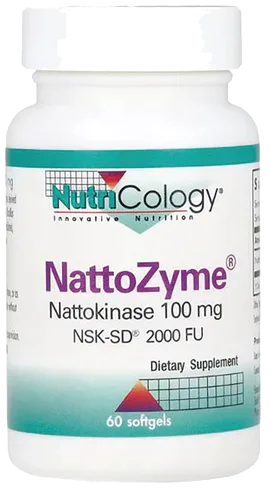
NutriCology NattoZyme Nattokinase 36 mg Review
NutriCology NattoZyme Nattokinase 36 mg is a dietary supplement from Nutricology (Allergy Research Group). Its active ingredient is nattokinase, a serine protease enzyme. The enzyme is extracted from natto, a traditional Japanese food made by fermenting soybeans with Bacillus subtilis var. natto. Nutricology has sold the product in softgel form, and the Amazon listing I found is a 300-count bottle. Nattokinase potency is usually expressed in fibrinolytic units (FU). NattoZyme's 100 mg softgel is labeled 2,000 FU. I could not confirm the FU rating for the 36 mg version, so check the label. The supplement is meant to be taken orally, often on an empty stomach so the enzyme survives digestion. Capsule contents are typically vitamin K2-free. That matters because natto naturally contains vitamin K2, which is a concern for people on a med. Nattokinase's proposed mechanisms are mainly cardiovascular and are based on in vitro, animal and small human studies: 1. Direct fibrinolysis. Nattokinase can break down fibrin, the protein mesh that holds blood clots together. It does this by cleaving cross-linked fibrin strands directly. 2. Plasmin support. Nattokinase may enhance the body's own clot-dissolving pathway. It is thought to raise plasmin activity by increasing the conversion of pro-urokinase to urokinase. It may also degrade plasminogen activator inhibitor-1 (PAI-1), which normally restrains fibrinolysis. 3. Fibrinogen and clotting factors. Some studies report modest reductions in fibrinogen and in factors VII and VIII. This suggests a mild effect on overall coagulability. 4. Blood pressure. Small trials suggest nattokinase may lower systolic and diastolic pressure. One proposed route is inhibition of angiotensin-converting enzyme activity. 5. Vascular health. Some studies suggest it may slow carotid intima-media thickening and atherosclerotic plaque progression, particularly alongside lipid management. The evidence is limited. Safety notes: because nattokinase has a med-like activity, people who take meds or antiplatelet drugs should consult a clinician. The same applies to people with bleeding disorders and people facing surgery. Soy or natto allergy is a contraindication. This product is not intended to diagnose, treat, cure or prevent any disease.
We don’t sell supplements. We help you make decisions and get the best price.
Lowest prices
We may earn a commission from some store links. How we choose.
Finding the lowest prices at the stores now. This takes a few seconds.
Study, Trial or Testing Result Summary
Members Only5 human studies · 3 improved
This product provides nattokinase at 216 milligrams a day. The label does not state its strength in fibrinolytic units, the measure the studies used, so it is unclear how it compares with the studied doses. The strongest study gave 265 older adults without heart disease nattokinase at 2,000 fibrinolytic units daily or placebo for about 3 years. It found no change in artery wall thickness, artery stiffness, blood pressure, or blood clotting and inflammation measures [1]. In 120 adults with symptom-free narrowing of brain or neck arteries, 6 months of a higher dose did not improve overall thinking scores, though an exploratory check found less decline in visuospatial skills [2]. Smaller, weaker studies were more positive. In 9 healthy men, a single dose helped hand temperature recover faster after cold water than placebo [3]. A related natto product reduced self-rated cold hands and feet and shoulder stiffness in women over 4 weeks [4]. It also raised clot-dissolving activity in an uncontrolled study of 28 volunteers [5]. Overall, the largest and longest trial found no benefit for blood flow. Animal and cell studies are never counted.
See all 5 studies →Hide the studies
- In 265 older adults without heart disease, taking nattokinase (2,000 fibrinolytic units) for about 3 years did not change artery wall thickness, artery stiffness, blood pressure or blood clotting and inflammation measures compared with placebo.Nattokinase atherothrombotic prevention study: A randomized controlled trial.
- In 120 adults with symptom-free narrowing of brain or neck arteries, 6 months of nattokinase (8,000 fibrinolytic units daily) did not improve overall thinking scores versus placebo, though an exploratory check found less decline in visuospatial skills.Nattokinase supplementation for cognitive enhancement in asymptomatic intracranial/carotid stenosis: A randomized contro…
- In a double-blind crossover study of 9 healthy men, a single 2,000 fibrinolytic unit dose of nattokinase helped skin temperature in the hand recover faster after cold water immersion than placebo, without changing heart rate or cardiac output.A single dose of oral nattokinase accelerates skin temperature recovery after cold water immersion: A double-blind, plac…
- In a crossover study of women with lifestyle diseases, 4 weeks of the natto-derived supplement NKCP reduced self-rated shoulder stiffness, low back pain and cold extremities more than an active placebo, but headache did not change.Effects of Bacillus subtilis var. natto products on symptoms caused by blood flow disturbance in female patients with li…
- In uncontrolled studies of 28 volunteers taking the natto-derived NKCP tablet for 2 weeks, and 23 volunteers for several months, clot-dissolving activity increased and shoulder stiffness improved.Fibrinolytic and anti-thrombotic effect of NKCP, the protein layer from Bacillus subtilis (natto).
Review Totals and Summary
Members Only1 reviews
Buyers are broadly positive about this nattokinase. They praise its quality and its Japanese-made ingredient, and several feel it works, though a few say it is pricey and hard to keep in stock. **What buyers say it did for them:** Most describe support for heart, circulation and cholesterol rather than dramatic results. One says it is "a subtle boost in energy and circulation," and another uses it "for vein and heart benifits." Others are more emphatic: "the effect is definitely there!" and one says it "has given me the results I needed." Some are still waiting to judge, with one noting its benefits are "soon to be determined." One reviewer also takes it for a parasite cleanse and says the dose should be raised gradually. **What they complain about:** Complaints are few. The main one is availability: "the down side is that its always sold out." Price is the other, covered below. One buyer says there were no side effects, and none report any problems, though the reviews do not describe any negatives about effectiveness. **Taste, smell, pill size and form:** The product is a small softgel in a compact jar. One buyer calls it a "small size gelatinous pill," another says "perfect size," and a third finds the softgels "easy to take." One reviewer likes that it avoids "the garlic breath you'd expect from other supplements." No one mentions an unpleasant taste or smell. One buyer suggests taking it on an empty stomach. Another notes it is a pure supplement without added vitamin K2, and a further reviewer mentions added soybean lecithin, which they think may help absorption. **Value for money:** Opinions are mixed but lean favorable. One buyer calls it a "great product at a great price," while others see it as costlier: "It's a bit pricey, but the quality" makes it worthwhile, and "Although expensive I think it's worth it." The sense is that people pay a premium and feel the quality justifies it. One reviewer also praises fast shipping and secure packaging, which matters to them because the ingredient is sensitive to heat and humidity. **Who it seems to suit and who it did not:** It seems to suit people who want a natural option for heart, cholesterol and circulation support and who want a supplement they can stay on long term. One says it feels "like a supplement I can stick with long-term." Another chose it as a natural blood-thinning option. Buyers who want a product without vitamin K2 may also like it, as one reviewer points out. Some reviewers describe a 100 mg (2,000 FU) softgel rather than the 36 mg product named here, so check the strength on the label before buying. No reviewer says it did not suit them, though shoppers on a tight budget may find the price a hurdle, and those who want it immediately may run into stock shortages.
Biohacker Summary
Members Only7 of 10 recommend it
Most of the panel recommends or uses nattokinase, the main ingredient here, though two are doubtful: one is neutral and one says it is not high on the list for heart protection and sees no convincing evidence. The most common reasons are to reduce artery plaque and blood clotting, with others using it to lower LDL cholesterol, thin the blood, break up bacterial biofilms, or support circulation. Several stress that dose matters: one says most products hold only 1,000 to 2,000 units while the data shows an effect at 8,000 units or more, another suggests 10,000 units a day, and one suggests starting at 12,000 and going up to 20,000. One suggests taking it at night on an empty stomach and another suggests taking it while fasted, while one former pill user found fermented soybeans (natto) worked better for shrinking plaque. Cautions include a warning against taking it with meds, a question over whether the enzyme survives stomach acid, and a note that more trials are needed to find the effective dose.
See all 9 biohackers →Hide the biohackers
Ben Greenfield · Nattokinase · neutral
- Questions the efficacy of nattokinase for plaque melting, asking how an enzyme can get through stomach acid and if the gut bacteria can utilize its chemical trash to make K.
- Notes there is good evidence that high-dose lumbrokinase and nattokinase from a specific source may help reduce or regress plaque, and he is looking into high-dose nattokinase as part of his damage control.
- Is glad that people are finally catching on to the idea of a high dose nattokinase protocol for heart health/plaque, emphasizing the importance of using adequate amounts, preferably more than 8000 units.
- Recommends nattokinase for plaque regression, stating that most supplements only have 1,000 to 2,000 units, but data shows an impact only at 8,000 units or more.
- Used to take nattokinase pills, but found the "earthy stuff" (fermented soybeans) to be more effective for shrinking plaque.
- Ben Greenfield recommends looking into nattokinase if concerned about plaque, noting its effect on coronary artery calcification.
- Ben Greenfield includes Nattokinase in his Vitaboom Heart Health Stack.
- Expresses skepticism about nattokinase for plaque melting, questioning how an enzyme can get through stomach acid and if it relies on specific gut bacteria to be effective, suggesting it's not a straightforward solution.
- Uses different types of enzymes like nattokinase to break open biofilms and hidden parasites so they can be killed off.
- Warns against combining nattokinase with pharmaceutical meds like a med, Pradaxa, a med, or a med, stating it could be potentially dangerous.
Andrew Huberman · Nattokinase · uses
- Started supplementing with nattokinase after a Function Health test revealed slightly out-of-range blood lipids, and a follow-up test confirmed it helped reduce his LDL cholesterol.
- Learned from a Function test that some of his blood lipids were slightly out of range, so he decided to start supplementing with nattokinase, which naturally helps reduce LDL cholesterol, and it worked.
- Started supplementing with nattokinase to naturally help reduce LDL cholesterol after a Function test showed his blood lipids were slightly out of range, and a follow-up test confirmed it worked.
- Started supplementing with nattokinase to naturally help reduce LDL cholesterol after a Function test showed his blood lipids were slightly out of range, and a follow-up test confirmed its effectiveness.
- Started supplementing with nattokinase after a Function Health test showed his blood lipids were slightly out of range, and a follow-up test confirmed this strategy worked to reduce LDL cholesterol.
- Started supplementing with nattokinase after a Function Health test showed some blood lipids were slightly out of range, and confirmed in a follow-up test that it helped reduce LDL cholesterol.
- Started supplementing with nattokinase to naturally help reduce LDL cholesterol after a Function test showed his blood lipids were slightly out of range, and a follow-up test confirmed it worked.
- States that he started supplementing with nattokinase to naturally help reduce LDL cholesterol after learning his blood lipids were slightly out of range, and confirmed its effectiveness with a follow-up test.
- Started supplementing with nattokinase to naturally help reduce LDL cholesterol after learning their blood lipids were out of range, and a follow-up test confirmed its effectiveness.
- Learned from a Function test that some of his blood lipids were slightly out of range, so he started supplementing with nattokinase, which naturally helped reduce his LDL cholesterol.
Dave Asprey · Nattokinase · recommends
- Recommends Nattokinase as one of the eight compounds in BioPurify for circulation and cellular health.
- Recommends Nattokinase, stating it supports healthy circulation and helps the body break down blood clots.
- Recommends taking nattokinase at night before bed on an empty stomach to help make a med, and notes it's also good for spike protein.
- Recommends taking high-dose nattokinase, starting at 12,000 units and potentially increasing to 20,000 units, to minimize the impact of the COVID vaccine, as it directly breaks up spike protein and reduces soft plaque.
- The episode discusses how nattokinase, a natural enzyme, has shown the ability to break down the spike protein.
- Nattokinase, an enzyme found in natto, breaks up protein clumps including blood clots, and studies show that at higher doses it can even reverse cardiovascular disease.
- For the last 25 years, Dave Asprey has been on a high dose of either serrapeptase or nattokinase to reduce stroke risk by breaking up thrombin and fibrinogen, also noting nattokinase breaks up soft plaque.
- Uses a lot of nattokinase and lumbrokinase to address histamine spike protein issues.
- Recommends nattokinase and other things to make blood flow well, especially for those with long COVID or who had COVID.
- Recommends nattokinase, stating that 4,000 units a day will likely break up clots from COVID and emerging research suggests it removes soft plaque, especially at higher doses on an empty stomach.
Dr. Eric Berg · Nattokinase · recommends
- Recommends Nattokinase as a top natural remedy for clots.
- Dr. Berg states that nattokinase, found in natto, is a very effective compound to reduce clotting.
- Recommends nattokinase as a supplement to prevent clotting.
- States that Nattokinase may help remove arterial plaque buildup naturally.
- Recommends Nattokinase, stating it can help decrease the thickness of the carotid wall.
- Has found Nattokinase really helpful, noting it may help break up clots.
- Recommends Nattokinase, an extract from soy, for dissolving fibrous tissue, breaking down clots, and addressing clogged arteries by breaking up blockages and protein formations in clots.
- Suggests that Nattokinase can potentially help lower cholesterol naturally.
- Recommends nattokinase as the best natural remedy to unclog arteries, noting it is an enzyme found in natto (fermented soybeans).
- Recommends Nattokinase as a potent remedy for unclogging arteries, noting its ability to break up clots, reduce oxidative LDL, provide anti-inflammatory properties, lower blood pressure, increase HDL, lower triglycerides, and decrease the risk of strokes, all with virtually no adverse effects.
Thomas DeLauer · Nattokinase · recommends
- Suggests increasing intake of nattokinase when in a fasted state to induce autophagy through a separate pathway from ghrelin, extending the autophagy period.
- Notes that nattokinase, a component of natto, may help clear out beta-amyloid plaque, which is a large contributor to Alzheimer's and dementia.
- Mentions that natto contains nattokinase, which helps clear out beta amyloid plaque, a primary contributor to Alzheimer's and dementia, noting the extremely low dementia count in Japan.
- Explains that nattokinase, a component of natto, may help clear out beta amyloid plaque, which is a large contributor to Alzheimer's and dementia.
Dr. Mark Hyman · Nattokinase · uses
- Uses nattokinase to break open bacterial biofilms, allowing antimicrobials to be more effective.
- Mentions using Nattokinase to lower lipoprotein little a, although it only lowers it by 20-30% and doesn't bring it back to normal.
- Recommends nattokinase for individuals with hypercoagulability to improve cognition.
- Mentions nattokinase as a natural supplement that can help thin blood and reduce inflammation and clotting.
- Mentions nattokinase as a natural supplement that can help thin blood and reduce inflammation and clotting.
- Uses nattokinase as a biofilm buster when a patient with candida is not getting better.
- Discusses Nattokinase as a great agent to help with clotting and microthrombosis, but notes it's in the experimental realm for the current virus.
Siim Land · Nattokinase · recommends
- Notes that some trials show nattokinase improving atherosclerotic plaque, with high doses showing an effect where low doses did not, and more studies are needed to find the threshold effect.
- Notes there are interesting studies suggesting Nattokinase might reduce atherosclerotic plaque and personally believes it does based on current evidence, but more clinical trials are needed to determine effective doses.
- Believes Nattokinase might reduce atherosclerotic plaque and blood viscosity, making it useful for people over 50, especially men, who have a higher risk of blood clotting.
- Discusses Nattokinase as a supplement.
- Recommends Nattokinase as a beneficial supplement for reducing atherosclerotic plaque and the risk of blood clots, suggesting a higher dose of 10,000 fibronotic units per day, but warns against taking it with meds.
- Cites a study where nattokinase at 6,000 fibrinolytic units per day for 26 weeks resulted in a 36.6% decrease in carotid plaque size and intima media thickness. He suggests that at least 6,000 fibrinolytic units per day might be needed for a significant decrease in plaque size, and also notes that nattokinase lowers blood pressure and clotting.
- Explains that Nattokinase, an enzyme from fermented soy, at a dose of 6,000 fibrinolytic units per day for 26 weeks, resulted in a 36.6% decrease in carotid plaque size.
- Plans to start taking Nattokinase after age 50, recommending a dose of at least 6,000 fibrinolytic units, and probably 10,000 units per day, for its benefits in heart health, cardiovascular disease risk reduction, and its antithrombotic, anti-blood coagulation, and anti-atherosclerotic effects.
- Uses Nattokinase as an ingredient in Novos Vital for organ health.
- Notes that there has been a lot of interest in nattokinase as an over-the-counter supplement that could potentially reverse plaque in the arteries.
Dr. Rhonda Patrick · Nattokinase · warns
- States that Nattokinase isn't high on their list for cardiovascular prevention and they don't see convincing evidence for it as a primary strategy for cardiovascular disease or stroke risk reduction.
- Dr. Rhonda Patrick reviews the evidence for nattokinase and its potential to protect the heart.
Peter Attia · Nattokinase · neutral
- Mentions Nattokinase as an over-the-counter supplement that showed more evidence for preventing DVT than a med, and it is plant-derived.
RAL Summary
Members OnlyTier 5 for Circulation
The review summary quotes written reviews even though none were counted or read for this product, and it describes a 100 mg (2,000 fibrinolytic unit) softgel rather than this 36 mg NattoZyme product, so it should be set aside. Its reviews are set aside, so it is graded on its studies alone. Good human studies show Nattokinase does not work for this goal.
- Not endorsed.
Where the evidence disagrees: 1 of the 5 human studies found no effect.
More Details
Members OnlyBody systems · Combine with · Possible side effects
Body systems: Cardiovascular system, Blood
Combine with: For circulation and cardiovascular support, nattokinase pairs well with omega-3 fish oil (EPA/DHA) for endothelial and triglyceride support, and with vitamin K2 (MK-7), which helps direct calcium to bone rather than arteries. Note that high-dose K2 is sometimes cautioned against with meds, so check with a clinician. Magnesium, CoQ10 or ubiquinol, and L-citrulline or L-arginine support vascular tone, nitric oxide production, and energy in heart tissue. Garlic extract and pycnogenol can add support for healthy blood pressure and microcirculation. If the user still wants true cellular and DNA repair support, they could add NAD+ precursors (NMN or NR), resveratrol or pterostilbene, and quercetin, but these are separate from nattokinase's function. Nattokinase has blood-thinning effects, so anyone on a med, antiplatelets, or other meds, or facing surgery, should consult a healthcare provider first, and it should not be combined casually with high-dose fish oil, ginkgo, or other meds without guidance.
Possible side effects: No major side effects reported.
Supplement Facts
Nattokinase NSK-SD 72 mg
| Nattokinase NSK-SD | 72 mg | † |
Other ingredients: Soybean Oil, Gelatin, Glycerin, Soybean Lecithin, Glycerin Fatty Acid Ester, Beeswax.
Directions: Suggested Use As a dietary supplement, 1 or 2 softgels three times daily, or as directed by a healthcare practitioner. May be taken with or without food. Take with 8 to 10 ounces of water.
Barcode (UPC) 713947547506 · Label source: NIH label database · Report a label change
Show entire label
More circulation products
Members OnlyThe highest ranked for the same goal
Read more
Our articles on this subject
- Supplements for Focus and Mental ClarityArticle · Jun 16, 2026
Graded November 7, 2026 by the Reverse Age Lab evidence engine, from human studies, real reviews and our biohacker panel. How we grade. Is this medical advice? No. Rala organizes the published evidence; go over any change with your doctor, especially if you take meds.
Privacy policyConsumer health dataAffiliate disclosureTermsDo Not Sell or Share My Personal InformationCookie settings