
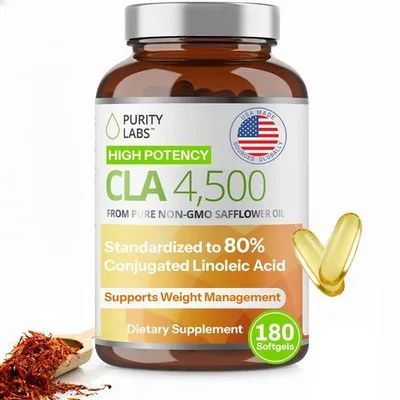
Purity Labs CLA 4,500 Review
The page sells Purity Labs CLA 4500MG, a non-GMO safflower oil softgel product marketed as supporting energy, heart health, and muscle health, supplied in a 180 soft gel count. The listing shows a regular price of US$74.99 and a special price of US$64.99, with availability shown as in stock. The supplier is listed as Purity Labs and the category path is Health and Household, Vitamins and Minerals and Supplements, then Essential Fatty Acids. The page offers Add to Cart and instant wallet checkout options including Apple Pay, Google Pay and Amazon Pay. Shipping is described as shipping from the United States to the United States in 5 to 10 days, with a US$19.99 shipping fee for any order. The store also states that it only sources from official suppliers, that it offers a broad selection of products, and that it aims for competitive prices. Delivery is described as a fixed rate of $19.99 regardless of order size, with delivery within 5 to 10 days. A WhatsApp contact number is provided for customer contact. The page includes multiple product images from different angles, with thumbnails of the bottle and packaging. The page shows no ingredients list, no barcode, no written customer reviews, and no star rating or rating histogram in the scraped text. A Verified Customers Reviews heading appears, but no review entries or counts follow it. The page therefore supplies pricing, availability, form, and product identity, but no ingredient, barcode, or review statistics. Cost per month cannot be calculated because the servings per container and servings per day are not stated in the scraped text.
We don’t sell supplements. We help you make decisions and get the best price.
Lowest prices
We may earn a commission from some store links. How we choose.
Finding the lowest prices at the stores now. This takes a few seconds.
Study, Trial or Testing Result Summary
Members OnlyHuman studies
No ingredient study findings were provided for this product, so this summary cannot point to any human research on conjugated linoleic acid for weight management in women. The label lists safflower oil at 1500 milligrams per serving. The store listing describes this as conjugated linoleic acid at 4,500 milligrams, which matches taking three softgels a day. Conjugated linoleic acid is commonly made from safflower oil, so the two descriptions appear to refer to the same product, with the dose stated in different ways. Because no studies were given, we cannot say whether the amount in this product matches any studied dose, or whether it helps with body fat, muscle or appetite. No written reviews could be counted for this record. The review overview available is mixed: some buyers report help with belly fat alongside diet and exercise, while others say it did not work, and some of the praise was flagged as possibly unnatural. Until human studies on this ingredient and this goal are added, treat any weight claims as unproven. Animal and cell studies are never counted.
Review Totals and Summary
Members Only8 reviews
Customer feedback on Purity Labs CLA 4,500 is mostly positive, and the praise centres on a few themes. Many buyers say it helps with stubborn midsection fat, especially belly fat after menopause. They describe it as an extra boost when combined with diet and exercise. They do not describe it as a stand-alone solution. Some users say they feel they keep muscle while losing weight. Others report steadier energy without the jitters of stimulant-based fat burners, and some mention better appetite or portion control. Long-term repeat buyers, including a reviewer who says they have taken it for years, praise its consistency. Several call it superior to other CLA brands they have tried. Others value the quality, the non-GMO and third-party-tested claims, the generous 180-count bottle and the reasonable price. A diabetic reviewer specifically appreciated the clean ingredients. Subscribe-and-Save customers like the convenient, quick shipping and the packaging. The complaints are fairly consistent. The most common is that the softgels are large and hard to swallow. One shopper called them "a little too big to swallow". Another frequent complaint is that the label is misleading. Users point out that you must take three capsules a day to reach the advertised 4,500 mg, and one described the name as slightly deceptive. That also means a bottle lasts a shorter time than people expect. Some buyers report that capsules arrived partly melted or clumped together in the bottle, which suggests heat damage in shipping or storage. Negative reviews also mention digestive side effects, and a number of people say it simply did not work for them. One independent analysis noted that the glowing weight-loss stories are less common than generic comments like "works great with healthy food choices". It also said that mixed feedback is typical of CLA products. A review-analysis service flagged a share of the Amazon reviews as likely unnatural, so some of the enthusiastic praise should be treated with caution. On eBay, the complaints are mostly about third-party sellers, and they involve slow shipping and cancellation problems. They do not concern the supplement itself. Overall, buyers like the potency, quality and value, but they dislike the size of the pills, the confusing dosing and the inconsistent results.
Biohacker Summary
Members Only3 of 10 recommend it
The main ingredient is conjugated linoleic acid, and the panel's view is mildly positive: of the ten, six spoke about it, and two recommend it outright while the others are neutral or simply mention it. They mostly take it or eat it for fat loss, better use of fat, appetite control and metabolic or heart health, with one panelist saying it blunts appetite and another saying it helps protect against cancer. Several say it comes from food such as grass-fed butter, grass-fed dairy and beef, and one says either food or supplements will do; nobody gave a dose or named anything to pair it with. Nobody said they stopped taking it or warned against it. Safflower oil is a smaller ingredient in this product, and six panelists warn against it, with two saying they have stopped eating it.
See all 8 biohackers →Hide the biohackers
Ben Greenfield · Conjugated Linoleic Acid · neutral
- Notes that keeping cattle on grass for around 200 days increases their levels of conjugated linoleic acid (CLA), which is described as beneficial for heart health.
- Advises avoiding safflower oil, especially when heated or fried, to play things safe regarding heart disease risk.
- Ben Greenfield warns against canola oil, safflower oil, sunflower oil, and rapeseed oil, stating that they are an issue due to rancidity, oxidation, processing, and pressurization, which can lead to chronic inflammation, mitochondrial dysfunction, and accelerated aging.
- Advises caution with canola oil, sunflower oil, and safflower oil due to their potential to cause inflammation when exposed to high heat, oxygen, and light.
- Identifies safflower oil as one of the "hateful eight" problematic vegetable oils that cause oxidative stress and are harmful due to their processing and fatty acid composition.
- Mentions conjugated linoleic acid as a supplement but less of a priority than creatine, protein, vitamin D, fish oil, and essential amino acids.
- Warns that safflower oil is incredibly fragile and creates free radicals when heated or put under pressure, which can rip apart cell membranes.
- Warns that safflower oil is incredibly fragile and when heated or put under pressure, it creates free radicals that can rip apart cell membranes, making it a problem for the body.
- Mentions that conjugated linoleic acid, a naturally occurring trans fat found in grass-fed beef, is studied as a potential cancer fighter.
- Warns against safflower oil due to its polyunsaturated fat content, which is prone to oxidation and promotes chronic inflammation.
- Warns against safflower oil due to its inflammatory properties.
- Recommends ensuring adequate amounts of conjugated linoleic acid for healthy nerve firing, suggesting supplementation if one doesn't consume enough from grass-fed beef, lamb, or raw dairy.
- Warns against canola oil, safflower oil, sunflower oil, and peanut oil, stating that these vegetable oils are often used to coat healthy foods, bastardizing them and damaging cell membranes, leading to inflammation.
- Notes that conjugated linoleic acid (CLA), found in grass-fed animal products, is a naturally occurring trans fat with health benefits, distinguishing it from industrial trans fats.
Thomas DeLauer · Conjugated Linoleic Acid · recommends
- States that conjugated linoleic acid (CLA) is good stuff, having been observed in fat loss and metabolic studies, and is found in significantly higher amounts in grass-fed butter.
- Notes that ground beef is high in conjugated linoleic acid (CLA), which is common in red meat fat and can help the body utilize fat in the mitochondria better.
- Warns against safflower oil, noting its history as a lamp oil and machine lubricant, and that it requires industrialization to remove cardiotoxic erucic acid, making it something no human or animal would naturally tolerate.
- Explains that CLA, or conjugated linoleic acid, is a naturally occurring trans fat found in beef that can influence gene expression, leading to a fat-burning and muscle-sparing effect.
- Notes that safflower oil is about 78% linoleic acid, which can be problematic when oxidized.
- Avoids safflower oil because when he eats it, he does not feel good, experiencing an inflammatory response, achiness, and brain fog.
- Warns against safflower oil, noting that Wild Protein Chips contain a significant amount of it, making the product more of an oil snack.
- Considers safflower oil, especially expeller pressed, acceptable a few times per week due to its high smoke point and less frequent use compared to canola or soybean oils. He notes observational research suggesting positive correlations with moderate amounts on blood glucose and inflammation.
- Highlights the benefits of conjugated linoleic acid (CLA) found in high-fat dairy like butter and cream, stating it has been demonstrated to be good for fat loss and weight loss by activating beneficial pathways in the body.
- Warns against fish oil soft gels that contain soybean oil, safflower oil, cottonseed oil, grapeseed oil, or sunflower oil, as these omega-6s compete with omega-3s for conversion enzymes and are unstable, increasing the risk of rancidity.
- Discusses a meta-analysis of 18 studies that found Conjugated Linoleic Acid (CLA) to be halfway decent for fat loss, with an average of 0.09 kg per week fat loss over 12 weeks.
- Includes safflower oil in a list of omega-6 rich oils that are often believed to cause inflammatory issues and notes that some studies on omega-6s were flawed because they included safflower oil margarine, which contains trans fats.
- Has been interested in the science surrounding conjugated linoleic acid (CLA) found in heavy cream and some milk fats, and has been experimenting with it.
- Is concerned by the 'safflower or sunflower oil' labeling, as it indicates a lack of transparency regarding ingredients based on manufacturing availability.
Peter Attia · Safflower Oil · warns
- Discusses a study where participants consumed safflower oil and safflower margarine, noting that it could suggest something wrong with safflower oil due to a higher mortality risk in the group that lowered saturated fat and raised polyunsaturated fat.
- Discusses safflower oil, noting that its original form was high in linoleic acid but has since been modified to be high in monounsaturated fats, which Peter Attia views as a problem.
Dr. Eric Berg · Safflower Oil · warns
- Lists safflower oil as one of the most harmful fats due to its instability and proneness to oxidation.
- Warns against refined safflower oil, stating that while it's positioned as heart-healthy, the refined version is not.
- Mentions that conjugated linoleic acid (CLA) found in grass-fed raw dairy products can aid in weight loss and have anti-inflammatory effects.
- Advises avoiding safflower oil, along with other seed oils, due to their instability and potential negative effects on health and appearance.
- Lists safflower oil as an example of a synthetic seed oil found in ultra-processed foods.
- Mentions that butter contains CLA (conjugated linoleic acid), which is known to decrease cholesterol, decrease inflammation, and help with weight loss.
- Warns that products listing multiple oils, including safflower, will likely use the cheapest option, implying it should be avoided.
- Does not recommend safflower oil due to its high omega-6 content, suggesting it's only okay in small, cold-pressed, organic amounts for certain people.
- Advises avoiding safflower oil as it is one of the omega-6 seed oils that are damaging to the immune system.
- Advises being careful about consuming too much safflower oil because it is highly inflammatory.
- Warns that safflower oil, like most vegetable fats, is high in omega-6 and will create more inflammation.
- Dr. Berg talks about Conjugated Linoleic Acid (CLA), a type of fat that will help burn fat that comes from dairy, animal fats, egg yolks and it must be 100% grass-fed.
- Warns against safflower oil, listing it among the vegetable oils that should be removed from the diet.
- Explains that Conjugated Linoleic Acid (CLA) is a type of fat found in dairy, animal fat, and egg yolks that can help burn fat, increase muscle strength and exercise endurance, boost metabolic rate, support the immune system, offer anti-cancer properties, decrease body fat, and stabilize blood sugars.
Dave Asprey · Safflower Oil · warns
- Dave Asprey warns that safflower oil, used as a petrol replacement and in paints, can increase blood sugar and make you crave sugary foods.
- Has stopped consuming safflower oil as part of his avoidance of omega-6 fats.
- States he does not consume safflower oil as part of his avoidance of omega-6 fats, which he believes helps with sun protection.
- Has not eaten safflower oil for the past 12 years, believing it helps prevent sunburn.
- The Bulletproof diet advises against safflower oil due to the negative effects of chronic consumption of partially oxidized omega-6s.
- Calls safflower oil one of the "hateful eight" oils that increase the risk of inflammatory conditions from COVID, explaining that its fats are unstable and deteriorate even in the bottle, forming toxic compounds.
- Lists safflower oil as one of the "hateful eight oils" that people should avoid.
- Humans rely on animals for conjugated linoleic acid (CLA), which is entirely unique to animal foods.
Dr. Mark Hyman · Safflower Oil · warns
- Dr Hyman advises getting rid of safflower oil, along with other unhealthy fats, from the diet.
- Mentions that conjugated linoleic acid (CLA) is very protective against cancer and improves metabolic health.
- Advises getting rid of safflower oil.
- Advises getting rid of safflower oil, along with other vegetable oils, due to their potential negative effects on metabolic health and their highly processed nature.
- Includes safflower oil in a list of highly refined and processed oils that are highly unstable and inflammatory.
- Advises to definitely stay away from safflower oil, calling it terrible.
- States that a vegan diet does not provide conjugated linoleic acid, which is important for health.
Siim Land · Conjugated Linoleic Acid · neutral
- Mentions Conjugated Linoleic Acid as a supplement to improve heart health.
Andrew Huberman · Conjugated Linoleic Acid · recommends
- Recommends consuming Conjugated linoleic acid (CLA), either from food or supplements, as it stimulates the release of CCK, which blunts appetite and helps regulate it to healthy levels.
- States that conjugated linoleic acid (CLA), from food or supplements, stimulates the release of CCK, which reduces or blunts appetite.
RAL Summary
Members OnlyTier 4 for Weight and Metabolism for Women
Rated emerging because no human studies on this goal were provided for its ingredients and no reviews were counted, so the evidence is too thin to rank it higher.
- Emerging: not enough evidence to rank higher yet.
- No human studies on this goal for its ingredients.
More Details
Members OnlyBody systems · Combine with · Possible side effects
Body systems: Metabolic system, Digestive system
Combine with: For its actual weight management purpose, CLA is commonly paired with green tea extract (EGCG) and caffeine for thermogenic support, L-carnitine to help transport fatty acids into mitochondria, and chromium or berberine for glucose handling. Fiber such as glucomannan or psyllium can support satiety, and omega-3 fish oil may help offset the possible inflammatory effects of some CLA isomers. Taking it with meals that contain fat can improve absorption. If the real goal is cellular and DNA repair, look instead at products with NMN or NR, resveratrol or pterostilbene, quercetin and fisetin, CoQ10 or PQQ, and alpha-lipoic acid, and talk to a healthcare provider before combining supplements, especially with diabetes, liver conditions, or meds.
Possible side effects: Reviews mention digestive upset and large softgels that are hard to swallow; no study side effects were provided.
Supplement Facts
Safflower Oil 1500 mg
| Safflower Oil | 1,500 mg | † |
Other ingredients: Gelatin, Glycerin, Water, Purified.
Directions: Standard serving: As a dietary supplement, adults take one (1) softgel daily with a meal, or as directed by a healthcare professional. Maximum serving: As a dietary supplement, adults take three (3) softgel daily with a meal, or as directed by a healthcare professional. Purity Labs CLA 4,500 should always be taken in conjunction with a healthy diet and regular exercise program.
Label source: NIH label database · Report a label change
Show entire label
More weight and metabolism for women products
Members OnlyThe highest ranked for the same goal
Graded November 7, 2026 by the Reverse Age Lab evidence engine, from human studies, real reviews and our biohacker panel. How we grade. Is this medical advice? No. Rala organizes the published evidence; go over any change with your doctor, especially if you take meds.
Privacy policyConsumer health dataAffiliate disclosureTermsDo Not Sell or Share My Personal InformationCookie settings