
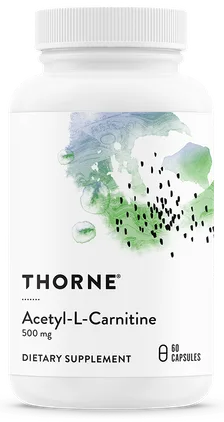
Thorne Acetyl-L-Carnitine Review
Thorne's Acetyl-L-Carnitine is presented as a supplement that supports the health of nerves in the brain and throughout the body. The page states that studies have demonstrated its effectiveness in supporting cognitive health and maintaining a positive mood, particularly in the elderly and during times of stress. The product description explains that Acetyl-L-Carnitine enhances the production of the neurotransmitter acetylcholine, which supports brain function. The headline on the page says the product supports cognitive performance, mood, and healthy nerve sensations in the hands and feet, and the introduction describes Acetyl-L-Carnitine as a well-absorbed amino acid derivative that supports brain and nerve function throughout the body and helps maintain healthy cortisol levels to support emotional well-being. The listed benefits include supporting nerve health in both the upper and lower limbs, supporting cognitive function, benefiting nerve function and comfort, helping maintain a positive mood, supporting healthy cortisol levels, and promoting healthy sperm count and motility. The page highlights that the acetylated form of carnitine is better absorbed and crosses the blood-brain barrier more rapidly than ordinary L-carnitine. Each capsule provides 500 mg of acetyl-L-carnitine, which the page describes as an optimal amount. The serving size is one capsule, with 60 servings per container. The product is offered as a one-time purchase or through a subscription that saves 10 percent on each delivery, with an additional 20 percent saving when subscribing to three or more different products. The page notes that the product has been third-party tested and certified to verify that what is in the package matches the label and to confirm that it contains no unsafe levels of contaminants such as heavy metals, pesticides, and microorganisms. The warnings section states that the product is contraindicated in an individual with a history of hypersensitivity to any of its ingredients, that anyone who is pregnant should consult a health-care practitioner before using it, and that there are no known adverse interactions or contraindications at publication date. The page also indicates that the product is HSA and FSA eligible and offers related payment information through Truemed, although the widget displayed an error when the page was captured.
We don’t sell supplements. We help you make decisions and get the best price.
Lowest prices
We may earn a commission from some store links. How we choose.
Finding the lowest prices at the stores now. This takes a few seconds.
Study, Trial or Testing Result Summary
Members Only44 human studies · 28 improved
Acetyl-L-carnitine is taken here at a full studied dose of 1500 mg a day. A 2003 pooled analysis of placebo-controlled trials in people with mild memory problems or mild Alzheimer's disease, using 1.5 to 3 grams daily, found a clear benefit on memory and thinking tests starting at 3 months [1]. A 1994 study of 481 older people with mild mental decline taking 1.5 grams daily for 90 days found better overall thinking scores, memory and mood [2]. In 2022, a 3-month placebo-controlled trial in 92 frail older adults taking 3 grams daily improved memory and thinking scores and lowered a marker of inflammation [3]. Results are weaker in established Alzheimer's disease. Two one-year trials at 3 grams daily did not slow decline overall, with only hints of benefit in younger people or those who finished the study [4][5]. A review of 11 trials in Alzheimer's disease found better clinician-rated overall impression but no benefit on thinking tests [6]. Overall, the support is strongest for older adults with mild decline, not for advanced disease. Animal and cell studies are never counted.
See all 44 studies →Hide the studies
- Across 48 studies of 3,650 children with attention problems testing 12 antioxidants including acetyl-L-carnitine, other antioxidants ranked best for attention, and the abstract reports no specific result for acetyl-L-carnitine.Safety and efficacy of antioxidant therapy in children and adolescents with attention deficit hyperactivity disorder: A …
- Two small trials in healthy young adults found no effect of L-carnitine on reaction time, vigilance or memory after three days, and the evidence was very low quality.L-carnitine for cognitive enhancement in people without cognitive impairment.
- In two small trials of 83 boys with fragile X syndrome given L-acetylcarnitine or placebo for one year, intellectual functioning and hyperactivity did not clearly improve, with low-quality evidence.L-acetylcarnitine for treating fragile X syndrome.
- Pooled placebo-controlled trials of 3 to 12 months in people with mild cognitive impairment or mild Alzheimer's disease using 1.5 to 3 grams daily showed a significant advantage over placebo on clinical and memory-thinking tests, beginning at 3 months.Meta-analysis of double blind randomized controlled clinical trials of acetyl-L-carnitine versus placebo in the treatmen…
- One study of 40 adults with Down syndrome tested acetyl-L-carnitine, but data were too limited to draw conclusions about its effect on cognitive decline.Pharmacological interventions for cognitive decline in people with Down syndrome.
- Across 11 placebo-controlled trials in people with Alzheimer's disease, acetyl-L-carnitine improved overall clinician-rated impression at 12 and 24 weeks but showed no benefit on cognition tests, and the reviewers said this may be due to chance.Acetyl-L-carnitine for dementia.
- Two studies of L-acetylcarnitine in people with fragile X syndrome and attention-deficit hyperactivity disorder reported positive effects with no side effects, but the review found no robust evidence overall.Systematic review of pharmacological treatments in fragile X syndrome.
- A review of 122 studies of mitochondria-targeting supplements in psychiatric disorders, including acetyl-L-carnitine, found heterogeneous results and high risk of bias, with no specific acetyl-L-carnitine result given.Clinical outcomes of mitochondrial-enhancing nutraceutical supplementation in psychiatric disorders: A systematic review…
- In 431 people with mild to moderate Alzheimer's disease, 3 g a day of acetyl-L-carnitine for one year did not slow decline overall compared with placebo, though a later subgroup look hinted at slower decline in those aged 65 or younger.A 1-year multicenter placebo-controlled study of acetyl-L-carnitine in patients with Alzheimer's disease.
- In a reanalysis of 334 people with Alzheimer's disease, acetyl-L-carnitine for one year gave the same average decline as placebo, but younger patients (about 61 or under) declined more slowly on the drug.Acetyl L-carnitine slows decline in younger patients with Alzheimer's disease: a reanalysis of a double-blind, placebo-c…
- In 229 people aged 45 to 65 with early-onset Alzheimer's disease, 3 g a day of acetyl-L-carnitine for one year did not slow decline on the main measures versus placebo, with less decline on a memory test only among those who completed the study.A 1-year controlled trial of acetyl-l-carnitine in early-onset AD.
- In 130 people with Alzheimer's disease, one year of oral acetyl-L-carnitine slowed decline compared with placebo on 13 of 14 measures, with significant benefits for attention, memory and logical thinking.Long-term acetyl-L-carnitine treatment in Alzheimer's disease.
- In 125 cirrhotic people with minimal hepatic encephalopathy, acetyl-L-carnitine over 90 days lowered blood ammonia and improved memory, attention and thinking test scores more than placebo did.Acetyl-L-carnitine treatment in minimal hepatic encephalopathy.
- In 119 people with cognitive decline taking donepezil, adding acetyl-L-carnitine together with ginkgo biloba extract was followed by a drop in mini-mental state scores at 12 and 24 weeks, while adding choline alfoscerate instead gave better results, so the acetyl-L-carnitine effect cannot be separated from ginkgo.Comparative study of choline alfoscerate as a combination therapy with donepezil: A mixed double-blind randomized contro…
- In 112 children aged 5 to 12 with ADHD taking 500 to 1500 mg twice daily for 16 weeks, the main test showed no benefit over placebo, though a subgroup with inattentive symptoms showed a possible improvement.Acetyl-L-carnitine (ALC) in attention-deficit/hyperactivity disorder: a multi-site, placebo-controlled pilot trial.
- In a double-blind placebo-controlled trial of 106 people with Alzheimer's disease, a multi-ingredient supplement containing acetyl-L-carnitine improved cognitive test scores within 3 months compared with placebo.A Phase II Randomized Clinical Trial of a Nutritional Formulation for Cognition and Mood in Alzheimer's Disease.
- In 96 elderly people with fatigue taking acetyl-L-carnitine, physical and mental fatigue decreased, and memory and thinking scores improved more than in the comparison group.Acetyl L-carnitine (ALC) treatment in elderly patients with fatigue.
- In 92 prefrail older adults, taking 1.5 g of acetyl-L-carnitine twice daily for 3 months improved memory and thinking scores and lowered C-reactive protein compared with placebo.Acetyl-L-carnitine Slows the Progression from Prefrailty to Frailty in Older Subjects: A Randomized Interventional Clini…
- In an 80-person double-blind trial of older adults with dysthymic disorder, L-acetylcarnitine improved depression and anxiety scores over 7 weeks and worked about as well as a med.Read the study on PubMed (23428336) →
- In 67 people with minimal hepatic encephalopathy, taking 2 grams of acetyl-L-carnitine twice daily for 90 days improved energy, daily functioning, well-being, depression scores and trail-making test times compared with placebo.Acetyl-L-carnitine reduces depression and improves quality of life in patients with minimal hepatic encephalopathy.
- In a placebo-controlled trial of 61 people with severe hepatic encephalopathy, 2 g twice daily of acetyl-L-carnitine for 90 days improved memory, attention and thinking test scores compared with placebo and lowered blood ammonia.Acetyl-L-carnitine improves cognitive functions in severe hepatic encephalopathy: a randomized and controlled clinical t…
- In a 3-month double-blind placebo-controlled trial of 60 elderly people with mild mental impairment, 2 g per day of acetyl-L-carnitine produced significant improvements in behavior scales, memory tests, attention and verbal fluency compared with placebo.Acetyl-L-carnitine in the treatment of mildly demented elderly patients.
- In 55 alcoholics with mild thinking deficits taking 2 g per day for 90 days, memory and drawing test scores improved more than with placebo.Role of acetyl-L-carnitine in the treatment of cognitive deficit in chronic alcoholism.
- In 51 boys with fragile X syndrome and ADHD analysed, acetyl-L-carnitine at 20-50 mg per kg a day for one year reduced hyperactivity and improved social behaviour more than placebo.A double-blind, parallel, multicenter comparison of L-acetylcarnitine with placebo on the attention deficit hyperactivit…
- In 40 adults with Down syndrome taking acetyl-L-carnitine for six months, brain function and thinking tests did not improve compared with controls.The effect of acetyl-L-carnitine administration on persons with Down syndrome.
- In a 6-week placebo-controlled trial of 40 children and adolescents with ADHD, adding acetyl-L-carnitine to methylphenidate produced no difference in parent or teacher ratings compared with placebo added to methylphenidate.Acetyl-L-carnitine as an adjunctive therapy in the treatment of attention-deficit/hyperactivity disorder in children and…
- In 36 people with Alzheimer's dementia taking 2 g per day for 24 weeks, short-term memory tests showed a trend toward benefit, but differences from placebo were not statistically significant.Double-blind, placebo controlled study of acetyl-l-carnitine in patients with Alzheimer's dementia.
- In a 6-month placebo-controlled trial of 34 people with mild cognitive impairment, a multi-ingredient nutrient formula that includes acetyl-L-carnitine improved dementia rating scores compared with placebo, and the placebo group improved after switching to the formula.A Nutritional Formulation for Cognitive Performance in Mild Cognitive Impairment: A Placebo-Controlled Trial with an Ope…
- In 30 adults over 65 with mild mental impairment, 2 grams a day of acetyl-L-carnitine for three months did not differ significantly from placebo overall, though treated patients improved on some memory, attention and behaviour tests.Mental impairment in aging: selection of patients, methods of evaluation and therapeutic possibilities of acetyl-L-carni…
- In a placebo-controlled pilot of 12 institutionalized people with moderate to late-stage Alzheimer's disease, a multi-ingredient nutrient formula that includes acetyl-L-carnitine delayed decline in dementia rating and clock-drawing scores compared with placebo.Efficacy of a vitamin/nutriceutical formulation for moderate-stage to later-stage Alzheimer's disease: a placebo-control…
- A multi-ingredient supplement containing acetyl-L-carnitine improved memory and attention test scores in community-dwelling adults without dementia compared with placebo, though adults 74 and older often did not improve.A vitamin/nutriceutical formulation improves memory and cognitive performance in community-dwelling adults without demen…
- In two placebo-controlled trials of elderly outpatients with mild to moderate cognitive decline, acetyl-L-carnitine produced significant EEG changes after 8 weeks and better clinical global impression and daily activity ratings after 12 weeks, with generally minor side effects.Pharmaco-electroencephalographic and clinical effects of the cholinergic substance--acetyl-L-carnitine--in patients with…
- In a single-blind study of 481 elderly people with mild mental decline, 1.5 g per day of L-acetylcarnitine for 90 days significantly improved overall cognitive scores, memory, and mood, with memory benefits persisting after stopping.L-acetylcarnitine treatment of mental decline in the elderly.
- In 236 mildly impaired elderly people taking 1500 mg per day in alternating 45-day phases with placebo, cognitive and mood scores improved more than with placebo.[Effects of L-acetylcarnitine on mental deterioration in the aged: initial results].
- In 17 healthy young adults, 1.5 grams a day of acetyl-L-carnitine for one month sped reflexes and reduced errors and time on a maze test compared with an untreated control group.[Psycho-functional changes in attention and learning under the action of L-acetylcarnitine in 17 young subjects. A pilot…
- In a double-blind crossover trial of 12 elderly people recovering from acute cerebral circulatory insufficiency, acetyl-L-carnitine outperformed placebo on memory, word and number tests, and simple reaction tasks, with no side effects reported.Effects of acetyl-L-carnitine on reaction times in patients with cerebrovascular insufficiency.
- In a 12-week double-blind placebo-controlled trial of people with early Alzheimer's disease or vascular dementia taking 2250 to 3000 mg of acetyl-L-carnitine per day, the drug's treatment effect was 2.8 times higher than placebo, and it was well tolerated.[Acetyl-L-carnitine (carnicetine) in the treatment of early stages of Alzheimer's disease and vascular dementia].
- In people with Down syndrome, 90 days of acetyl-L-carnitine improved visual memory and attention compared with untreated groups, while people with other intellectual disabilities did not improve.[Effect of the chronic treatment with L-acetylcarnitine in Down's syndrome].
- In an open-label randomized study of 90 people with chronic fatigue syndrome, 2 g per day of acetyl-L-carnitine for 24 weeks led to considerable improvement in 59% of patients, mainly in mental fatigue, and attention improved, though no placebo group was included.Exploratory open label, randomized study of acetyl- and propionylcarnitine in chronic fatigue syndrome.
- In an open-label one-year study of 24 people with Alzheimer's disease, a multi-ingredient supplement containing acetyl-L-carnitine kept cognitive performance and behavior at baseline levels, unlike the decline usually seen with placebo.Maintenance of Cognitive Performance and Mood for Individuals with Alzheimer's Disease Following Consumption of a Nutrac…
- In 23 people with mild Alzheimer's disease already on cholinesterase inhibitors, adding 2 g per day of acetyl-L-carnitine for 3 months raised the response rate from 38% to 50% in an open study without a control group.Effects of acetyl-L-carnitine in Alzheimer's disease patients unresponsive to acetylcholinesterase inhibitors.
- In 9 schizophrenia patients who completed 12 weeks of 1 g daily acetyl-L-carnitine added to clozapine, cognitive test scores did not significantly change and symptom improvement was limited to one symptom domain.Acetyl-L-Carnitine Augmentation of Clozapine in Partial-Responder Schizophrenia: A 12-Week, Open-Label Uncontrolled Prel…
- In a pilot study of 17 boys with fragile X syndrome, L-acetylcarnitine taken for one year significantly reduced hyperactivity as rated on a parent-teacher questionnaire.[L-acetylcarnitine treatment on fragile X patients hyperactive behaviour].
- A review of four published trials with over 100 patients each found that acetyl-L-carnitine over 3 months improved dementia-related rating scales beyond baseline variability, and placebo changes depended on how severe the disease was at the start.Efficacy and clinical relevance of cognition enhancers.
Review Totals and Summary
Members Only2,771 reviews · 94% positive
Thorne Acetyl-L-Carnitine has about 1,386 ratings across the stores that sell it, and most buyers are happy with it, mainly for energy and mental sharpness. A few found little change, and the complaints are mostly small. **What buyers say it did for them:** Energy and alertness come up most. One buyer says it "Makes a lot of difference in daily energy," and another reports "more mental acuity and alertness." Others mention focus during fasting, fewer exercise-related coughing episodes, and help with nerve issues. One says "Seems to be helping with nerve issues I have." A few report mood effects. One says they came off a med after 25 years, and another notes "Less depression" after a week. One buyer mentions losing fat. These are individual experiences, and one reviewer saw no weight loss yet. **What they complain about:** Complaints are few. One buyer was sent the wrong item, and another had not received a new shipment, which is a delivery problem and not a product one. One 2-star reviewer simply said they "Prefer others I've tried," without saying why. One reviewer said they had read online that it can cause anxiety and keep people hyper, and was scared off for a while. That is a worry they had before trying it, not something they reported experiencing. Another buyer, a week in, said they had no side effects like diarrhea or nausea. **Taste, smell, pill size or form:** Size is the one point raised. A buyer who has trouble swallowing large capsules found this one "very large for me." Another says it is "Easy to incorporate into the daily routine." Taste and smell are not discussed. These notes are about the capsules only. Reviews of other forms of the product were left out. **Value for money:** Price is not discussed by reviewers on either store summary, so there is nothing to report on value. Buyers do speak well of quality, with one praising "no fillers, no artificial ingredients, and very consistent dosing," and others calling Thorne a premium brand. **Who it seems to suit and who it did not:** It seems to suit people who already trust Thorne and want support for daily energy, focus, or exercise. One reviewer who does not eat red meat takes it every other day. People with nerve concerns or low mood also report benefits, though these are personal accounts. It suited some less well. That same non-meat eater doesn't notice a "huge difference" in energy or workout recovery, but hopes the effects are subtle. Another reviewer who rated it highly for quality said that unless someone has low natural carnitine production, a neurological need, or a clinical deficiency, it "may offer little practical advantage." Those who struggle with large capsules may find it hard to swallow. A few reviewers had only used it for a week to a month, so their impressions are early.
Biohacker Summary
Members Only6 of 10 recommend it
Most of the panel recommends or uses L-carnitine, with six of ten leaning positive in their latest word, three staying neutral, and one warning. The main reasons are that it moves fatty acids into the mitochondria for energy, and that it may help fat loss, exercise, heart health, and fertility, especially sperm quality. Several panelists name acetyl-L-carnitine specifically, and doses range from 500 to 2000 milligrams a day (often 500 once or twice daily), with one going up to 1 to 3 grams a day before conception; one takes it in the morning alongside a ketogenic diet, another before a workout in a fasted state, and one suggests pairing it with alpha-lipoic acid. On the cautionary side, one panelist stopped taking it because it converts to TMAO, a cardiovascular risk factor, and saw no clear benefit, another switched to a much lower injectable dose over the same concern, and one warns strongly against injecting it because of contamination risks. A couple also note that people who eat a lot of red meat already get plenty of carnitine, so not everyone needs it.
See all 9 biohackers →Hide the biohackers
Ben Greenfield · L-Carnitine · recommends
- Recommends L-carnitine for male fertility, explaining that it helps shuttle fatty acids into mitochondria, assisting with beta-oxidation, and its concentration in sperm correlates with sperm motility.
- He mentions L-carnitine as a supplement with real human data behind it for male fertility.
- Recommends L-carnitine at 1-3 grams per day for at least 30 days pre-conception to improve mitochondrial function tied to sperm quality.
- Recommends MitoQ +Heart, a Mitoquinol-enhanced blend with L-Carnitine, Magnesium, and Vitamin D3 for cardiovascular and energy support.
- States that acetyl L-carnitine is very important as a transport molecule that facilitates the entry of fatty acids into the mitochondrial chain, which can produce 100 ATP per molecule.
- Mentions L-carnitine as a supplement that is "not bad" but less of a priority than creatine, protein, vitamin D, fish oil, and essential amino acids.
- Recommends L-carnitine at 500 to 1,000 milligrams for male fertility, noting it can be found in capsules or as an intramuscular injection.
- Ben mentions that L-carnitine ranks pretty high in a database ranking of anti-aging drugs and compounds by effectiveness.
- States that he does not use L-carnitine, but many people in the exercise industry are reporting using it efficaciously for muscle gain as an injectable compound.
- Mentions L-Carnitine as an ingredient that helps existing functioning mitochondria make more energy.
Dr. Rhonda Patrick · L-Carnitine · neutral
- Discusses L-carnitine's role as a transporter for fatty acids into mitochondria for energy, its role in detoxifying metabolites, and its involvement in stabilizing cell membranes and ketone production. They mention studies showing it helps increase muscle mass and improve cognitive function in women, and meta-analyses showing reductions in body weight, waist size, and body fat in overweight and obese individuals.
- Takes acetyl-L-carnitine in the morning, believing it is beneficial with the ketogenic diet and can help boost ketosis, as people on a ketogenic diet can be deficient in carnitine.
- L-carnitine is important for transporting fatty acids into the mitochondria for energy and plays a role in detoxifying potentially toxic metabolites. Supplementation in the range of 1 to 4 g a day along with carbohydrates has shown benefits in muscle mass, cognitive function, and reductions in body weight and waist size in overweight and/or obese individuals.
- She thinks it would be useful to add acetyl-L-carnitine to her alpha-lipoic acid for mitochondrial benefits, but it's not high on her list because she eats a lot of meat, which is high in carnitine.
- Dr. Rhonda Patrick reviews how L-carnitine affects mitochondrial energy metabolism.
Andrew Huberman · L-Carnitine · recommends
- Andrew Huberman, based on discussions with fertility doctors, recommends L-carnitine for patients trying to increase fertility, egg quality, or sperm quality, noting it can be taken orally in higher dosages like 500 or 750 milligrams a day, or via injectable form.
- He shares science-based tools for modulating aggression, including supplementation with acetyl-L-carnitine.
- Discusses a study showing that acetyl-L-carnitine supplementation significantly improved symptoms of ADHD, including reductions in aggressive behavior, attentional problems, and delinquency.
- Recommends L-carnitine for sperm health.
- Has started experimenting with L-carnitine in an injectable form, taking a much lower milligram count than oral doses, to avoid absorption issues and concerns about increased TMAO from oral intake. They acknowledge its benefits for mitochondrial health.
- Mentions Acetyl-L-carnitine in the context of whole body pain.
- Recommends 1 gram of L-carnitine with 1 gram of vitamin C for male patients with any abnormal sperm parameter as part of a sperm enhancement protocol.
- Discusses L-Carnitine as a fertility supplement.
- Recommends L-carnitine in capsule form, 1 to 3 grams per day for 30 to 60 days, to significantly improve egg quality by supporting mitochondrial function, which is vital for chromosomal organization and egg fusion.
- Recommends L-Carnitine for hormone health.
Dave Asprey · L-Carnitine · recommends
- States that L-Carnitine shows changes happening in fertility.
- Mentions that Acetyl-L-Carnitine is usually a good mitochondrial enhancer, but not everyone needs it.
- Uses Acetyl-L-Carnitine on a regular basis as a well-known enhancer of mitochondrial fatty acid oxidation.
- Has included L-carnitine or acetyl-L-carnitine in his cognitive enhancement and longevity stack since his mid-20s, and finds its use for joints to be innovative.
- Dave Asprey mentions acetyl-L-carnitine as a mitochondrial stimulator that is widely available and can be felt right away.
- Notes that people in longevity have been taking acetyl-L-carnitine for 30 years for cognitive function and fat burning, and combining it with fatty 15 might produce PDC.
- Includes Acetyl-L-Carnitine as a helpful addition to a med protocol.
- Has been on acetyl-L-carnitine most of the time since [18:46] but found that taking too much caused jaw tension, so he had to dial back on it. He notes it is a mitochondrial enhancer.
- Used to take acetyl L-carnitine at a dose of about 500 milligrams, but stopped because it raised his acetylcholine levels too much, causing jaw tension.
- Dave found that if he takes too much acetyl-L-carnitine, he gets a headache and jaw tension, indicating he has enough in his system and it raises his acetylcholine levels more than he needs.
Dr. Mark Hyman · L-Carnitine · neutral
- Mentions that supplementing with L-carnitine can make mitochondria more efficient.
- Recommends Acetyl L-Carnitine as it is critical in fat metabolism and supports the transport of fatty acids into the mitochondria for energy.
- Recommends L-carnitine as critical for producing sperm and increasing antioxidant status in men.
- States that making energy in mitochondria requires carnitine and recommends acetylol carnitine or L-Carnitine at 500 to 2000 milligrams a day, usually 500 once or twice a day, as it is important in metabolizing fats.
- Mentions that L-carnitine was part of the mitochondrial therapy that helped a child with autism improve.
- Used L-carnitine as one of the first things with a 55-year-old woman with Graves' disease, as it can act as a thyroid peroxidase inhibitor, and she began to have relief from her symptoms.
- Used L-carnitine as one of the first interventions for a woman with Graves' disease, noting its ability to act as a thyroid peroxidase inhibitor, which provided symptom relief.
- Dr. Hyman discusses L-carnitine as an important nutrient for metabolic flexibility, helping the body use fat and carbohydrates for energy. He notes that people with diabetes, insulin resistance, pre-diabetes, and gestational diabetes are often low in this nutrient and that good prenatal vitamins often include it.
- Lists Acetyl-L-Carnitine 500mg as a product available, noting its regular price and capsule count.
- Acetyl-L-Carnitine 500mg is listed for sale on Dr. Mark Hyman's website.
Thomas DeLauer · L-Carnitine · recommends
- Recommends L-carnitine, especially if working out, to help shuttle fat into the cell better and improve fat oxidation, particularly in a fasted state before a workout.
- Takes L-carnitine.
- Takes supplements like Acetyl-L-Carnitine to enhance mitochondrial function.
- Discusses the mixed opinions on L-Carnitine for fat loss but concludes that it is beneficial, citing a meta-analysis showing an average of 1.33 kg of fat lost. He suggests that many people may be more deficient than they think, especially those who exercise intensely, and that it is an inexpensive supplement worth trying.
- Discusses the benefits of L-Carnitine for fat loss, citing a meta-analysis showing an average of 1.33 kg of fat lost, and suggests it's worth exploring as it's inexpensive and critical for fat oxidation.
- Recommends Acetyl L-Carnitine during a fast, especially for active individuals who deplete carnitine, as it's critical for fat burning, can cross the blood-brain barrier, and may have antioxidant effects and improve brain fat utilization.
- Discusses Acetyl L-Carnitine, noting its potential for cognitive improvement in dementia patients by stimulating mitochondrial function, acting as an antioxidant, and promoting neuronal growth and membrane stabilization.
- Recommends 1500 milligrams (1.5 grams) of L-Carnitine to help mobilize fat, suggesting it be taken earlier in the day, possibly during a fast.
- Recommends acetyl-L-carnitine, especially for active individuals or those fasting/low-carb, as it crosses the blood-brain barrier to provide fat-based fuel to the brain, promoting sharpness and alertness.
- Takes 2-4 grams of Acetyl-L-Carnitine, noting its importance for fat transport into mitochondria, especially for those on a ketogenic diet and athletes, and its mood-boosting effects for depression.
Dr. Eric Berg · L-Carnitine · neutral
- Mentions L-carnitine as another nutrient that can be depleted, similar to co-enzyme Q10.
- Explains that L-Carnitine helps burn fat during exercise, preserves muscle protein, and aids in recovery from exercise, noting it is very high in red meat.
- States that the best way to use L-Carnitine is for cardiovascular health, as the heart needs it to transport fatty acids for energy.
- Recommends L-carnitine for people with congestive heart failure, arrhythmia, or any type of heart damage, stating it is dynamite for the heart.
Peter Attia · L-Carnitine · warns
- Discusses L-carnitine, noting that people inject it for fat loss and to get more out of testosterone input, but warns against injecting it due to potential contamination from homebrewing or even compounding pharmacies, which have had issues leading to deaths.
- Warns that injecting L-carnitine, especially if home-brewed, is a bad idea due to sterilization concerns and potential for contamination, which can lead to serious health issues.
- Derek explores L-carnitine as a fat loss supplement.
Siim Land · L-Carnitine · stopped
- Stopped taking L-Carnitine because it converts to TMAO, a cardiovascular disease risk factor, and he hasn't noticed significant benefits for muscle growth or fat oxidation, preferring not to gamble with the risk given his family history of cardiovascular disease.
- States that L-Carnitine is great and can help with androgen receptor density for muscle growth, and he takes it before resistance training for this purpose, but not daily.
- Experimented with acetyl-L-carnitine to improve his performance on the soccer field, specifically his ability to read the play.
- Mentions L-carnitine as an ingredient in Kapex that helps transport fatty acids into the mitochondria and liver.
RAL Summary
Members OnlyTier 4 for Focus and Memory
The T5 grade rests on a misread verdict: most of the 44 human studies (28) found improvement, with benefit shown in mild memory decline and the negative results limited mainly to established Alzheimer's disease. So it is graded Tier 4, as the studies disagree.
- Emerging: not enough evidence to rank higher yet.
Where the evidence disagrees: 9 of the 44 human studies found no effect.
More Details
Members OnlyBody systems · Combine with · Possible side effects
Body systems: Nervous system
Combine with: For cognitive support, ALCAR pairs well with Alpha-Lipoic Acid (antioxidant and mitochondrial support, often used together in cellular energy research), Omega-3 fish oil (DHA/EPA for neuronal membranes), Bacopa monnieri or Lion's Mane for memory and neurotrophic support, and B vitamins (B12, folate, B6) for methylation and nerve health. Phosphatidylserine or citicoline may add to focus and memory benefits. If the user still wants weight management support, consider combining with green tea extract (EGCG), protein and fiber supplements such as glucomannan, and chromium or berberine for blood sugar balance, alongside diet and exercise.
Possible side effects: No major side effects reported. One buyer found the capsule very large and hard to swallow.
Supplement Facts
Acetyl-L-Carnitine 500 mg
| Acetyl-L-Carnitine | 500 mg | † |
Other ingredients: Hypromellose (derived from cellulose) capsule, Microcrystalline Cellulose, Leucine, Silicon Dioxide.
Directions: Take 1 capsule two to three times daily or as recommended by your health-care practitioner.
Label source: Reverseagelab · Report a label change
Show entire label
More focus and memory products
Members OnlyThe highest ranked for the same goal
Read more
Our articles on this subject
- Supplements for Focus and Mental ClarityArticle · Jun 16, 2026
- How to Build a Longevity Supplement Stack: An Evidence-First ReviewArticle · Sep 7, 2026
Graded November 6, 2026 by the Reverse Age Lab evidence engine, from human studies, real reviews and our biohacker panel. How we grade. Is this medical advice? No. Rala organizes the published evidence; go over any change with your doctor, especially if you take meds.
Privacy policyConsumer health dataAffiliate disclosureTermsDo Not Sell or Share My Personal InformationCookie settings