
Thorne L-Tyrosine Review
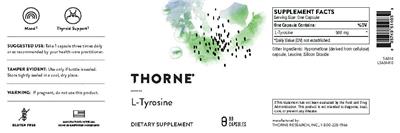
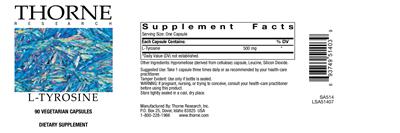
Thorne L-Tyrosine is a single-ingredient amino acid supplement from Thorne Research. Each vegetable (hypromellose) capsule contains 500 mg of free-form L-tyrosine. Leucine and silicon dioxide are used as flow agents. Retail listings give a typical adult serving of one capsule three times daily, or as directed by a health-care practitioner. The 90-count bottle has been listed on iHerb as a discontinued item, and Thorne's related Thyrocsin formula is also reported as being phased out. Availability varies by retailer. L-tyrosine is a "conditionally essential" amino acid. The body makes it from phenylalanine, and it is also found in dietary protein. It matters mainly because it is a biochemical precursor to several important compounds. 1. Catecholamine neurotransmitters. In neurons and in the adrenal medulla, the enzyme tyrosine hydroxylase converts tyrosine to L-DOPA. This is the rate-limiting step. L-DOPA is then converted to dopamine, which is converted to norepinephrine and then epinephrine. These messengers govern motivation, alertness, working memory and the stress response. During acute stress, sleep loss or heavy cognitive demand, catecholamine turnover rises and the brain's supply of them can fall. Supplemental tyrosine raises the amount of substrate available. Research suggests this helps maintain cognitive performance under stress. It is less likely to boost performance in people who are already rested and not stressed. One review describes tyrosine as supporting catecholamine synthesis to help maintain cognitive performance during stress, fatigue or sleep deprivation. 2. Thyroid hormones. In the thyroid gland, tyrosine residues on the protein thyroglobulin are iodinated. They are then coupled to form thyroxine (T4) and triiodothyronine (T3). Tyrosine therefore provides part of the molecular backbone of these hormones. Iodine and other cofactors are still required. Supplementing tyrosine alone does not by itself correct a thyroid disorder. 3. Melanin. Tyrosinase converts tyrosine to the pigments that colour skin and hair. Absorption happens through amino acid transporters in the gut. Tyrosine competes with other large neutral amino acids, such as the branched-chain amino acids and tryptophan, for transport across the blood-brain barrier. For this reason it is often taken on an empty stomach, away from high-protein meals. Some users report heartburn or nausea if they take it without food. Precautions: Retail labeling states that tyrosine is contraindicated with MAO-inhibitor meds, because of the risk of excessive catecholamine buildup and a hypertensive reaction. People with thyroid conditions, including hyperthyroidism or Graves' disease, and those on meds or levodopa should consult a clinician before use. Pregnant or nursing women should do the same. Taking it late in the day may interfere with sleep because of its stimulating, dopamine-supporting effect. This product is a dietary supplement. It is not intended to diagnose, treat, cure or prevent any disease.
We don’t sell supplements. We help you make decisions and get the best price.
Lowest prices
Finding the lowest prices at the stores now. This takes a few seconds.
Study, Trial or Testing Result Summary
Members Only30 human studies · 17 improved
This product gives 1500 mg of L-tyrosine a day at the directed use. Studies that found benefits mostly used 2000 mg, often as a single dose taken before a demanding task. A review of 15 mostly single-dose studies in healthy adults found tyrosine helped protect working memory and information processing under demanding conditions such as extreme weather or heavy mental load [1]. In 80 young adults, a single 2000 mg dose led to fewer missed responses on an attention task than placebo, though it did not change stress markers [2]. In 28 healthy men, a single 2 gram dose sped up decisions without hurting accuracy [3]. Military cadets taking 2 grams daily during a week-long combat course had better memory and tracking than a control group [4]. Results are not uniform. In 70 healthy volunteers, a single 2 gram dose worsened mental flexibility under high mental load [5]. In 17 adults aged 60 to 75, higher single doses were linked to poorer working memory [6]. Overall, the benefit shows up mainly under stress or heavy mental demand, not as an everyday boost, and it may not help older adults. Animal and cell studies are never counted.
See all 30 studies →Hide the studies
- A review of 15 mostly single-dose studies in healthy adults found tyrosine helped protect working memory and information processing under demanding conditions such as extreme weather or heavy mental load, but did little for exercise performance.Behavioral and cognitive effects of tyrosine intake in healthy human adults.
- A review of nine supplement ingredients including tyrosine for healthy adults found the evidence inconsistent, imprecise and often flawed, so no firm recommendations could be made.Dietary Supplement Ingredients for Optimizing Cognitive Performance Among Healthy Adults: A Systematic Review.
- In 80 young adults, a single 2000 mg dose of L-tyrosine did not change stress markers during a virtual reality shooter drill, but led to fewer missed responses on a Stroop task than placebo.Impact of L-theanine and L-tyrosine on markers of stress and cognitive performance in response to a virtual reality base…
- In 70 healthy volunteers, a single 2 g dose of tyrosine worsened cognitive flexibility under high mental load compared with placebo.Tyrosine negatively affects flexible-like behaviour under cognitively demanding conditions.
- In 24 young adults with phenylketonuria (compared with 24 healthy controls), 4 weeks of high-dose tyrosine at 100 mg per kg body weight daily raised blood tyrosine about 200% but gave no benefit to brain function compared with placebo.Effect of high-dose tyrosine supplementation on brain function in adults with phenylketonuria.
- In 45 healthy young adults, a single 2 g dose of L-tyrosine did not change average working memory performance, but helped low performers and impaired high performers.Baseline-dependent effect of dopamine's precursor L-tyrosine on working memory gating but not updating.
- In 42 tired office workers, four weeks of a five amino acid blend including tyrosine did not reduce fatigue but improved motivation and cognitive function after mental work compared with placebo.Effects of Five Amino Acids (Serine, Alanine, Glutamate, Aspartate, and Tyrosine) on Mental Health in Healthy Office Wor…
- In 38 healthy non-smokers, a single 2 g dose of L-tyrosine showed a trend toward stronger nicotine effects on cognitive control, improving flexibility at the cost of stability.Increased dopamine availability magnifies nicotine effects on cognitive control: A pilot study.
- In 28 healthy men, a single 2 g dose of tyrosine shortened decision response times without hurting accuracy, increased model-based learning and lowered physiological arousal compared with placebo.The catecholamine precursor Tyrosine reduces autonomic arousal and decreases decision thresholds in reinforcement learni…
- In 26 young healthy adults, a single tyrosine dose compared with placebo reduced the size of consciously perceived conflicts in one attention task but not another, and increased subliminally triggered conflicts in some situations.On the effects of tyrosine supplementation on interference control in a randomized, double-blind placebo-control trial.
- In 24 healthy older adults aged 61-72, a single tyrosine dose did not change stopping or anticipatory slowing overall, but older participants showed a greater harmful effect on anticipatory slowing than with placebo.Neuro-Cognitive Effects of Acute Tyrosine Administration on Reactive and Proactive Response Inhibition in Healthy Older …
- In 22 healthy adults, tyrosine compared with placebo improved mental flexibility by reducing the time cost of switching between tasks.Tyrosine promotes cognitive flexibility: evidence from proactive vs. reactive control during task switching performance.
- In 21 military cadets during a week-long combat course, 2 g of tyrosine daily improved memory and tracking performance compared with a carbohydrate drink control.Tyrosine improves cognitive performance and reduces blood pressure in cadets after one week of a combat training course.
- In 20 male college athletes, a single dose of a combined caffeine, theanine and tyrosine supplement improved movement accuracy during a performance test compared with placebo, without changing subjective ratings.Effects of acute caffeine, theanine and tyrosine supplementation on mental and physical performance in athletes.
- In 20 healthy participants exposed to lower body suction stress, tyrosine at 100 mg per kg of body weight raised pulse pressure and increased an attention-related brain response compared with placebo.L-tyrosine ameliorates some effects of lower body negative pressure stress.
- In 17 adults aged 60 to 75, single higher doses of tyrosine were linked to poorer working memory performance, with the largest declines in those whose blood tyrosine rose most.Dose-Dependent Effects of Oral Tyrosine Administration on Plasma Tyrosine Levels and Cognition in Aging.
- In 16 healthy young adults under noise stress, a single dose of tyrosine (100 mg per kg of body weight) improved performance on two stress-sensitive thinking tasks compared with placebo, with no effect on mood or heart rate.Effect of tyrosine on cognitive function and blood pressure under stress.
- In 10 people with narcolepsy, 9 g of tyrosine daily for 4 weeks produced only a mild stimulant effect on some mood ratings and no clinically meaningful change in sleepiness or symptoms compared with placebo.Treatment of narcolepsy with L-tyrosine: double-blind placebo-controlled trial.
- In eight children with phenylketonuria on low-protein diets, three months of tyrosine in a double-blind crossover study was followed by better psychological test results, though practice effects from repeated testing may account for part of the gain.[Case studies of the effect of tyrosine administration in children with phenylketonuria on cognitive processes].
- In 8 participants doing a military-style load carry in heat, tyrosine at 150 mg per kg body weight did not change cognitive function, physical performance, or time-trial results compared with placebo.Tyrosine Ingestion and Its Effects on Cognitive and Physical Performance in the Heat.
- In 8 male volunteers exposed to cold, a single dose of L-tyrosine (150 mg per kg of body weight) improved accuracy on the hardest memory task compared with placebo.Tyrosine reverses a cold-induced working memory deficit in humans.
- Tyrosine supplementation improved convergent thinking, the focused problem-solving type of creativity, compared with placebo, but did not affect divergent brainstorming.Food for creativity: tyrosine promotes deep thinking.
- Tyrosine improved performance on a reversal learning task compared with placebo in a crossover trial, though it did not affect task switching and combining it with brain stimulation cancelled its benefit.Catecholaminergic modulation of indices of cognitive flexibility: A pharmaco-tDCS study.
- In healthy adults aged 60 to 75, tyrosine did not raise the overall value they placed on a demanding memory task compared with placebo, but it raised it in less impulsive people and lowered it in more impulsive people.Catecholaminergic modulation of the cost of cognitive control in healthy older adults.
- In healthy men given alcohol, tyrosine either left unchanged or reduced the low mood alcohol caused in a crossover placebo-controlled study, but did not change alcohol-related memory impairment.Ethanol, monoamines, and affect.
- During about 13 hours of continuous night work with one night of lost sleep, a tyrosine dose of 150 mg per kg body weight reduced the usual decline in a psychomotor task and lowered lapses on a vigilance task compared with placebo, with benefits lasting about 3 hours.The effects of tyrosine on cognitive performance during extended wakefulness.
- In 20 adults, a single dose of tyrosine taken one hour before testing improved working memory accuracy during a multitasking battery compared with placebo, though it did not change other tasks.Tyrosine improves working memory in a multitasking environment.
- In 15 subjects after cold water immersion, tyrosine given at 300 mg per kg body weight prevented the drop in match-to-sample performance seen with placebo, though step test performance declined on both cold trials.Dietary tyrosine benefits cognitive and psychomotor performance during body cooling.
- In 10 healthy young men given 6.5 grams of tyrosine 90 minutes before a hot-environment test, brain response timing and reaction time held closer to normal than with placebo, suggesting less heat-related slowing of thinking.Tyrosine ameliorates heat induced delay in event related potential P300 and contingent negative variation.
- In seven children with attention deficit disorder with hyperactivity, oral tyrosine produced no significant improvement in symptoms in a single-blind study.Effect of tyrosine on attention deficit disorder with hyperactivity.
Review Totals and Summary
Members Only1,204 reviews · 90% positive
Customer feedback on Thorne L-Tyrosine comes mostly from iHerb, which has thousands of reviews from many countries. I also read general L-tyrosine user reviews on Drugs.com for context on how people experience the ingredient. These Drugs.com reviews are not specific to Thorne's brand. Most reviewers trust the brand. Several describe Thorne as one of the best-quality supplement makers, and some cite its purity and peer-reviewed reputation as the reason they chose it. The capsule gets repeated praise because it is easy to swallow. Others like the clean single-ingredient formula, the 500 mg dose and the packaging, and they call it good value. The most common benefit people report is mental. They describe better focus, mood, motivation and mental clarity, plus a lift in energy. Some use it as a pre-workout stimulant. Several people with hypothyroidism or thyroid concerns say it gives them a burst of energy. One reviewer reported that their TSH fell after they started taking it. Others take it to support recovery after a brain injury. In the Drugs.com tyrosine reviews, people with ADHD-type symptoms say they feel more focused and need less caffeine. Others describe fewer racing thoughts and say it eased anxiety. A few say their sleep improved. The feedback is not all positive. A reviewer on iHerb said they noticed no immediate or meaningful change in focus or well-being and concluded that results vary between people. Several warn about timing. Taking it too late in the day can disrupt sleep, particularly when it is combined with other dopamine-affecting supplements. Elsewhere, individual users report heartburn if they don't eat soon after a dose, jaw tightness and facial pressure, and in one case worse anxiety. Another reviewer could not tolerate Thorne's Thyrocsin on an empty stomach because of nausea. They attributed this to its other ingredients and not to the plain L-Tyrosine product. The remaining complaints are about availability and price. The 90-capsule bottle is marked discontinued on iHerb, and one third-party retailer shows it out of stock. Some buyers find it pricier than budget brands such as NOW. Overall, customers like its quality, ease of swallowing and mood and focus support. The main drawbacks are individual variability, sleep disruption and stomach upset, and the product being harder to find.
Biohacker Summary
Members Only6 of 10 recommend it
The panel leans toward recommending tyrosine, the main ingredient here, though opinion is mixed. Of the eight who spoke, four recommend or use it and four are neutral or cautious: one is neutral about it, one warns about it, and one has stopped. Those in favor take it for focus, dopamine, mood, and thyroid support, usually in the morning or early in the day, often on an empty stomach, with doses of 500 mg to 1,000 mg and one mention of 2 grams. Capsules are the form named, and it is paired with alpha GPC and coffee, or used to balance caffeine. Cautions include overstimulation from its adrenaline boosting effect, feeling too high on dopamine, and a worry that high levels may shorten lives, and two panelists stopped supplementing, one preferring protein rich foods such as meat, fish, eggs, and cheese.
See all 9 biohackers →Hide the biohackers
Andrew Huberman · Tyrosine · neutral
- Mentions Tyrosine as a precursor to dopamine.
- Discusses L-Tyrosine as a neuromodulator for cognitive enhancement and focus.
- He recommends 500 mg to 1,000 mg of L-tyrosine, an amino acid precursor to dopamine, taken alone or in conjunction with alpha GPC, to increase focus without stimulant-based alertness.
- Uses 500 milligrams of L-Tyrosine in capsule form, often combined with Alpha-GPC and coffee, early in the day before workouts or concentrated mental work to increase dopamine transmission for concentration and focus.
- Discusses L-Tyrosine and its relation to dopamine, also mentioning combining tools.
- Discusses L-Tyrosine as a supplement that can increase dopamine.
- Takes 500 mg of L-Tyrosine in the morning for focus.
- He mentions that some people leverage the reciprocal relationship between the visual system and dopamine by taking things like L-tyrosine to increase dopamine, but he prefers behavioral tools first.
- Lists L-Tyrosine as a compound to increase dopamine.
- Discusses L-Tyrosine and dopamine, cautioning about preexisting conditions.
Dave Asprey · Tyrosine · recommends
- Dave explains how L-tyrosine gives your brain the raw materials to make focus chemicals, and mentions the dose and timing that work.
- Uses L-Tyrosine, an amino acid, to provide the brain with raw ingredients to make dopamine and norepinephrine, which activate the focus switch. He takes 500 mg every morning and advises starting with that dose and working up if needed, ideally on an empty stomach.
- Mentions that some drivers might use tyrosine to balance some of the caffeine.
- Dave examines what this means for every guy stacking L-tyrosine nootropics or eating high-protein keto, as high tyrosine levels may be cutting years off men's lives.
- Dave Asprey mentions tyrosine as a supplement and cofactor that supports thyroid activation.
- Includes tyrosine in his Motivation 101 formula because it is a precursor for thyroid, dopamine, and stress hormones, and taking it in the morning usually boosts energy and motivation.
- Notes a Mendelian randomization analysis found that genetically higher tyrosine levels were associated with nearly one year shorter lifespan in men, reflecting lifelong endogenous levels, and advises understanding this signal if using tyrosine strategically.
- Recommends Tyrosine the day after doing ketamine to restore norepinephrine reserves.
- Takes tyrosine before bed, noting it is stimulating and helps make dopamine and norepinephrine.
- Warns that taking 5 grams of tyrosine can lead to overdoing it, causing high norepinephrine levels, nausea, shaking, and headaches.
Ben Greenfield · Tyrosine · uses
- Started using the Balance Protocol supplement protocol to replete his tyrosine levels, which were inadequate for turning tyrosine into thyroid hormone, dopamine, norepinephrine, and epinephrine.
- Says tyrosine helps her the next day if she is sleep deprived.
- Mentions tyrosine as a supplement that supports neurotransmitters and enhances focus, as suggested by a guest.
- Mentions L-tyrosine as a precursor to dopamine, which can help enhance dopamine production from the inside.
- Recommends L-Tyrosine as a great nootropic during the day, explaining it's a precursor that can make one feel happy, good, and focused, especially for those not eating red meat or following a carnivore diet.
- Ben asks about N-acetyl L-tyrosine, and Shawn explains it works synergistically as a dopamine precursor with paraxanthine to enhance dopamine neurotransmission.
- Mentions that many people are low in tyrosine, which is made from the essential amino acid phenylalanine, and this is a common issue related to thyroid function.
- States that they give tyrosine intravenously.
- Notes that N-acetyl L-tyrosine is included in Ignite for its effect on neurotransmitters, contributing to the overall nootropic effect and brain function benefits.
- Ben mentions that Reacher Nutrition's brain blend contains tyrosine.
Thomas DeLauer · Tyrosine · recommends
- Recommends taking 500 to 1,000 milligrams of tyrosine, calling it a really simple and highly effective amino acid for thyroid function.
- Recommends tyrosine, stating that it is highly effective for repleting neurotransmitters like dopamine when levels are depleted, which helps with hunger drive and 'food noise'.
- Recommends 2 grams of tyrosine to replete neurotransmitters like dopamine when they are depleted, which can occur in a low-calorie state.
- Recommends taking tyrosine in the morning to support dopamine function, as it is a precursor to dopamine and helps compensate for the dopamine hits usually received from the sun.
- Recommends consuming more tyrosine because it converts into dopamine, and the enzyme that converts it is not fully saturated, meaning there is room for more dopamine conversion and a potential boost in mood.
- Suggests that tyrosine, an amino acid building block for dopamine, can be very helpful for individuals with sleepy frontal lobes, such as the spontaneous brain type.
- Notes a study that found a correlation between higher protein consumption, specifically tyrosine, and improved working memory, episodic memory, and fluid intelligence.
- Suggests tyrosine might help with fatty acid metabolism and the switching of fuels.
- Suggests experimenting with taking tyrosine in supplemental form, as it is a precursor to dopamine and can presumably improve the ability to produce more dopamine.
- Expresses skepticism about Focus Factor, stating it's mostly a mineral blend with some ingredients like DMAE and phosphatidylserine, but highlights that N-acetyl tyrosine is worthless and suggests a bigger mental benefit would come from straight DHA from fish oil.
Dr. Eric Berg · Tyrosine · recommends
- Recommends foods high in L-tyrosine, such as meat, fish, eggs, and cheese, as it is a precursor to dopamine.
- Used to give L-tyrosine to people with ADHD to help with focus and calmness, but now recommends consuming foods high in L-tyrosine instead.
- Recommends getting plenty of tyrosine by consuming high-quality animal protein to help balance dopamine and other neurotransmitters naturally.
- Recommends tyrosine, an amino acid, as a cofactor that helps the production of dopamine, which can be obtained by consuming adequate good protein sources.
- Recommends L-tyrosine as one of his two favorite amino acids to help balance the fight or flight mechanism and calm the nervous system.
- Recommends L-Tyrosine as an amino acid that helps regulate noradrenaline and makes one feel calmer, thereby reducing stress.
- Recommends taking L-tyrosine as an amino acid precursor to stimulate dopamine production, especially if more raw material is needed.
- Mentions tyrosine as an amino acid in 5-hour energy drink that stimulates the nervous system and wakes you up.
- Recommends taking tyrosine, a natural amino acid that is a precursor to dopamine, to help build it up.
- Recommends taking tyrosine to help build up neurotransmitter reserves, aiding the transition off cigarette smoking without creating serious adrenal issues and weight gain.
Siim Land · Tyrosine · warns
- Warns that L-tyrosine is an 'adrenaline booster' found in pre-workouts that gives the body more ingredients to make adrenaline, which can lead to overstimulation.
- Recommends supplementing with L-tyrosine as a dopamine agent that can suppress prolactin and increase testosterone.
- Noticed that his tyrosine levels go up if he generally eats more protein, as it is not heavily utilized by exercise.
- Has taken tyrosine in the past to help with dopamine levels and as a nootropic, but is not currently taking it because his baseline dopamine levels are already high.
- Tried supplementing tyrosine but it made him 'too high dopamine' and didn't work for him, questioning why Bryan Johnson takes it in the evening.
- Discusses Tyrosine in comparison to L-Theanine.
- Lists tyrosine as one of the supplements Bryan Johnson takes with dinner.
Dr. Mark Hyman · Tyrosine · neutral
- Mentions looking at tyrosine, which is connected with dopamine, norepinephrine, and epinephrine pathways.
- Recommends tyrosine for dopamine production, which can be obtained from grass-fed and regeneratively raised beef, lamb, fish, chicken, nuts, seeds, eggs, and beans.
- Put a patient on L-Tyrosine, a precursor to dopamine, because he thought the patient had a dopamine deficiency.
- Gave a patient tyrosine to help the body with the production of neurotransmitters.
- Added tyrosine to Joey's regimen because a COMT gene variation left him unable to have enough dopamine in his brain, which made a significant difference in his brain function.
- Dr. Hyman mentions tyrosine as an amino acid that helps the body produce neurotransmitters.
- Put a patient with suspected dopamine deficiency on L-tyrosine, a precursor to dopamine, which helped him feel emotions he hadn't felt before and concentrate better.
- Explains that the body makes dopamine from tyrosine, a non-essential amino acid derived from dietary protein.
- Lists l-Tyrosine as a product available, noting its regular price and capsule count.
Peter Attia · Tyrosine · neutral
- Considers tyrosine an interesting supplement that may be beneficial for improving reaction time, noting they tinkered with it a little bit.
Dr. Rhonda Patrick · Tyrosine · neutral
- Dr. Rhonda Patrick explores supplemental tyrosine.
RAL Summary
Members OnlyTier 2 for Focus and Memory
Most controlled human trials, including a review of 15 studies, found tyrosine protects working memory and attention under stress [1][2], and 90% of 1204 reviews are positive, which meets the rules for tier 2.
Take 2 servings a day (2 capsules) to match the dose that worked in the studies.
Where the evidence disagrees: 6 of the 30 human studies found no effect.
More Details
Members OnlyBody systems · Combine with · Possible side effects
Body systems: Nervous system, Endocrine system, Digestive system
Combine with: For cognitive and stress-resilience support, L-Tyrosine pairs well with Vitamin B6 (as P5P) and folate, which are cofactors in neurotransmitter synthesis, plus L-Theanine for calm focus, Rhodiola rosea or Ashwagandha for stress adaptation, and Alpha-GPC or Citicoline for cholinergic support. If the real goal is cellular aging and DNA repair, consider adding separate evidence-based compounds such as NMN or NR with TMG, Resveratrol or Pterostilbene, CoQ10 or Ubiquinol, Alpha-Lipoic Acid, Vitamin D3 with K2, and Omega-3 fatty acids. Take tyrosine on an empty stomach, preferably earlier in the day, and avoid it if you take MAO inhibitors or meds, or have hyperthyroidism, unless a clinician approves.
Possible side effects: Studies found that higher doses may worsen working memory in older adults and mental flexibility under heavy load. Reviewers mention sleep disruption when taken late in the day, heartburn when not taken with food soon after, jaw tightness and, in one case, worse anxiety.
Supplement Facts
L-Tyrosine 500 mg
| L-Tyrosine | 500 mg | † |
Other ingredients: Hypromellose, Leucine, Silicon Dioxide.
Directions: Suggested use: Take 1 capsule three times daily or as recommended by your health-care practitioner.
Barcode (UPC) 693749514039 · Label source: NIH label database · Report a label change
Show entire label
More focus and memory products
Members OnlyThe highest ranked for the same goal
Read more
Our articles on this subject
- Supplements for Focus and Mental ClarityArticle · Jun 16, 2026
- How to Build a Longevity Supplement Stack: An Evidence-First ReviewArticle · Sep 7, 2026
Graded November 5, 2026 by the Reverse Age Lab evidence engine, from human studies, real reviews and our biohacker panel. How we grade. Is this medical advice? No. Rala organizes the published evidence; go over any change with your doctor, especially if you take meds.
Privacy policyConsumer health dataTermsDo Not Sell or Share My Personal InformationCookie settings