
Thorne Phosphatidylserine Review
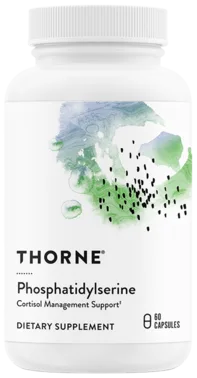
Thorne's Phosphatidylserine contains phosphatidylserine (PS), the primary phospholipid in brain cell membranes. The page states that PS improves cell communication to support memory and focus and helps regulate cortisol during stress. Phosphatidylserine is described as essential for healthy brain cell membranes and as a way to maintain an environment required for optimal brain function. The page says phosphatidylserine improves cell-to-cell communication in the brain, and thus cognitive function, at least in part by increasing cell membrane fluidity. Other mechanisms listed include enhancing cell metabolism, such as glucose utilization, and neurotransmitter formation. The page also says phosphatidylserine appears to have antioxidant activity, which would protect brain cells from free radicals. It states that abundant clinical research has shown this nutrient is important in promoting optimal cognitive function, particularly in the aging brain. On cortisol, the page says studies show supplementing with phosphatidylserine can lower cortisol spikes in response to stress. It explains that PS modulates cortisol by blunting the release of the hormone in the brain (ACTH) that normally signals the adrenal glands to secrete cortisol. The product is listed with one capsule per serving and 60 servings per container, with 100mg of Phosphatidylserine Isolate per capsule. The page states that the product has been third-party tested and certified to verify that what is in the package matches the label and to confirm it contains no unsafe levels of contaminants, such as heavy metals, pesticides, and microorganisms. The allergy warning says the product is contraindicated in an individual with a history of hypersensitivity to any of its ingredients and that it contains an ingredient derived from soy. The pregnancy note advises consulting a health-care practitioner before using the product if pregnant. The page lists no known adverse interactions or contraindications at publication date. The purchase options show a one-time price of $68 for 60 capsules, or $61.20 with a subscription at 10% off, with subscription delivery intervals from every 2 weeks up to every 4 months and a note that the subscription discount grows when a customer subscribes to three or more different products.
We don’t sell supplements. We help you make decisions and get the best price.
Lowest prices
Finding the lowest prices at the stores now. This takes a few seconds.
Study, Trial or Testing Result Summary
Members Only12 human studies · 8 improved
Phosphatidylserine is the only active ingredient, at 100 mg per capsule, which is within the studied range when taken at 100 to 300 mg a day. In 51 people with probable Alzheimer's disease, 300 mg a day for 12 weeks improved several thinking measures compared with placebo, most clearly in milder cases [1]. In 36 children with attention problems, 200 mg a day for 2 months improved attention and short-term memory compared with placebo [2]. A pooled analysis of three trials in 216 children found less inattention but no clear change in overall symptoms, and the evidence was low quality [3]. A larger pooled analysis in children and teens ranked phosphatidylserine well for attention, but those studies were also low quality [4]. Two trials that found memory gains tested combination formulas rather than phosphatidylserine alone: one with ginkgo and alpha-linolenic acid in older adults with mild memory decline [5], and one with magnesium in healthy adults [6]. Smaller studies without a comparison group in older adults with memory complaints also reported gains. Animal and cell studies are never counted.
See all 12 studies →Hide the studies
- In a pooled analysis of 48 studies with 3,650 children and teens with attention problems, phosphatidylserine ranked best for parent-rated attention and total score on one scale, but the studies were low quality, so the rankings should be read with caution.Safety and efficacy of antioxidant therapy in children and adolescents with attention deficit hyperactivity disorder: A …
- In a pooled analysis of three placebo-controlled trials with 216 children with attention-deficit disorder, 200-300 mg a day of phosphatidylserine reduced inattention more than placebo, but overall symptoms and hyperactivity did not improve significantly, and the evidence was low quality.Phosphatidylserine for the Treatment of Pediatric Attention-Deficit/Hyperactivity Disorder: A Systematic Review and Meta…
- In 190 older adults with mild cognitive impairment, a combination supplement giving about 63 mg a day of phosphatidylserine plus alpha-linolenic acid and ginkgo flavonoids for 12 months improved arithmetic, similarity and short-term memory scores compared with placebo.Effects of a food supplement containing phosphatidylserine on cognitive function in Chinese older adults with mild cogni…
- In 109 healthy Chinese adults, 2 grams a day of a magnesium L-threonate and phosphatidylserine formula for 30 days improved all memory test categories and overall memory score compared with placebo, with larger gains in older participants.A Magtein®, Magnesium L-Threonate, -Based Formula Improves Brain Cognitive Functions in Healthy Chinese Adults.
- In 51 patients with probable Alzheimer's disease, 300 mg a day of bovine cortex phosphatidylserine for 12 weeks improved several thinking measures compared with placebo, most clearly in those with milder impairment.Effects of phosphatidylserine in Alzheimer's disease.
- In 40 adults with mild to moderate Alzheimer-type dementia, 200 mg a day of phosphatidylserine for three months gave smaller cognitive gains than selegiline, a drug it was compared against, with no placebo group.Selegiline in the treatment of mild to moderate Alzheimer-type dementia.
- In 36 children with attention-deficit hyperactivity disorder, 200 mg a day of soy phosphatidylserine for 2 months improved symptoms, short-term auditory memory and attention compared with placebo.The effect of phosphatidylserine administration on memory and symptoms of attention-deficit hyperactivity disorder: a ra…
- In 28 healthy young adults, a single 120 mg dose of ginkgo extract bound to phosphatidylserine improved memory and memory speed over six hours compared with placebo, while plain ginkgo extract did not improve the main measures.Acute cognitive effects of standardised Ginkgo biloba extract complexed with phosphatidylserine.
- In 122 older adults with memory complaints, 100 mg a day of phosphatidylserine with omega-3 for 15 weeks improved attention and memory recognition in new users and kept thinking skills steady in those who continued.Phosphatidylserine containing omega-3 Fatty acids may improve memory abilities in nondemented elderly individuals with m…
- In 30 older adults with memory complaints, 300 mg a day of soybean phosphatidylserine for 12 weeks improved memory, executive function and mental flexibility, with no control group.The effect of soybean-derived phosphatidylserine on cognitive performance in elderly with subjective memory complaints: …
- In 18 healthy older adults with age-related memory problems (15 finished), 300 mg a day of plant-derived phosphatidylserine for 12 weeks improved most thinking measures by week 6, and the gains held at week 12, with no control group.An open trial of plant-source derived phosphatydilserine for treatment of age-related cognitive decline.
- This summary describes the methods of an Italian trial of bovine phosphatidylserine in Alzheimer's disease and reports no results for people.Phosphatidylserine in the treatment of clinically diagnosed Alzheimer's disease. The SMID Group.
Review Totals and Summary
Members Only704 reviews · 87% positive
Across the stores, Thorne Phosphatidylserine capsules carry about 435 ratings, and most are positive. Buyers mostly describe calmer evenings, better sleep and a modest mental lift, but a vocal minority felt nothing, and price comes up repeatedly. Gummy or powder reviews, if any appeared, were left out. **What buyers say it did for them:** Sleep and calm are the most common benefits. One buyer wrote that it "helps my mind to settle down so I can sleep." A combat veteran takes it for a racing mind at night and says, "I still wake up during the night but I am seeing results." Another pairs it with melatonin and is "sleeping more deeply than I have in years." Others mention focus and thinking: "it helps with my cognition and ability to think and focus," and "it keeps me calm and focused." One long-term user notices more energy and overall well-being. One reviewer reported clearer skin and sharper memory, and a Vitacost reviewer linked it to relief from morning cortisol spikes and anxiety. Those who respond well tend to describe gradual, subtle changes rather than anything immediate. The product is not a stimulant. **What buyers complain about:** The main complaint is that it did nothing. One one-star reviewer said it "helped not even a bit, no matter what dose," and that another company's phosphatidylserine also failed. A four-star reviewer "didn't notice any real changes." Vitacost reviewers said it had zero effect, or only a barely detectable calm. One said it made their stress worse, though they wondered whether a hormone imbalance was the cause. Another new user said they hadn't taken it long enough to feel a difference. **Taste, smell, pill size and form:** Only the Vitacost summary covers this. One reviewer found the capsules small and easy to take, with no taste or smell. They said a 60-capsule bottle lasts about a month. There is no quote for this theme. **Value for money:** Price is the most frequent concern. One reviewer called it "very expensive compared to alternatives that are also 3rd party tested." Another said it "felt pretty expensive for what I got out of it." A Vitacost reviewer did not think the slight calm was worth the money. On the positive side, buyers praise Thorne's quality and third-party testing, and the Vitacost summary mentions a clean formula without unnecessary fillers. **Who it seems to suit and who it did not:** It seems to suit people looking for help winding down at night, calming a busy mind, or getting some mild mental support, especially those happy to wait and see gradual effects. Some already trust the brand: "Always great products as usual!" One bought it for a parent who likes it. It did not suit people who wanted a clear, noticeable effect, especially for sleep or anxiety. Several of them tried different doses without success. Buyers who are price-sensitive and have cheaper tested options in mind may also hesitate. Several reviews are short, so details on dosing, timing and how long results take are thin.
Biohacker Summary
Members Only6 of 10 recommend it
Most of the panel recommends or uses phosphatidylserine, and the main reason is to bring down cortisol, the stress hormone, which several of them tie to better sleep, jet lag and travel. Others take it for memory, learning, attention and brain fog, and one panelist says krill oil is a good natural source. Doses vary: many give 300 to 400 milligrams, some use 100 to 300 milligrams, and a few go up to 600 or 800 milligrams, with one saying 400 was more effective than 800 in trials. Timing depends on the goal, with most taking it at night or before bed for cortisol and sleep, one suggesting morning if cortisol peaks then, one at lunch, and one right after learning. One panelist says the lower dose should be an occasional tool for very stressful days and not used consistently, and a few stay neutral and only describe the evidence, while one pairs it with ashwagandha and magnolia in a blend.
See all 9 biohackers →Hide the biohackers
Dr. Eric Berg · Phosphatidylserine · recommends
- Recommends phosphatidylserine, stating that 400 to 800 milligrams over several months can greatly help upgrade cortisol receptor sensitivity and support the nervous system.
Thomas DeLauer · Phosphatidylserine · recommends
- Recommends phosphatidylserine as a runner-up for stress and cortisol reduction, explaining it directly blunts the cortisol response, especially post-exercise, and helps regulate the hypothalamic-pituitary-adrenal axis.
- Recommends 400 mg of phosphatidylserine daily, noting that studies show it normalizes the HPA axis and cortisol response in chronically stressed individuals, addressing cortisol resistance.
- Recommends 100 to 300 mg of phosphatidylserine as an 'emergency switch' to blunt cortisol on highly stressful days, noting that it normalizes the cortisol response to stress but should not be used consistently.
- Recommends 100 to 300 milligrams of Phosphatidylserine as a temporary break on cortisol, helping to calm the body and blunt cortisol rhythms during stressful days.
- Recommends taking 3 to 800 milligrams of phosphatidylserine in supplemental form at lunch to calm the brain and have a statistically significant effect on cortisol levels.
- Expresses skepticism about Focus Factor, stating it's mostly a mineral blend with some ingredients like DMAE and phosphatidylserine, but highlights that N-acetyl tyrosine is worthless and suggests a bigger mental benefit would come from straight DHA from fish oil.
Peter Attia · Phosphatidylserine · neutral
- Peter reviews the evidence for select off-label medications and supplements commonly used for sleep, including glycine, magnesium, ashwagandha, and phosphatidylserine.
- Mentions phosphatidylserine as something that can help with sleep in the setting of chronic stress and hypercortisolemia.
- Occasionally takes 400 mg of Jarrow's phosphatidylserine gel caps for travel, particularly on long flights to overcome significant time zone changes.
- Occasionally takes Jarrow's phosphatidylserine gel caps, typically 400 mg, for travel to help overcome significant time zone changes.
- Uses 400 to 600 milligrams of phosphatidylserine in the evening to suppress cortisol production and facilitate sleep, especially when dealing with jet lag or time zone changes.
- Says that slamming yourself with 600 mg of phosphatidylserine really seems to move the needle in terms of both glucose and cortisol response.
- Takes 300 mg of Thorne Phosphatidylserine before bed for sleep.
Dr. Rhonda Patrick · Phosphatidylserine · uses
- Rhonda takes 300 mg of Phosphatidylserine before bed for sleep.
- Uses phosphatidylserine only when jet lagging or time zone hopping.
- Dr. Patrick notes that krill oil is a great source of phosphatidylserine, which accumulates in mitochondrial and cell membranes and has been shown to decrease in concentration with age, playing a role in neurodegenerative diseases like Parkinson's and Alzheimer's.
- He reserves melatonin and phosphatidylserine for jet lag.
- She mentions that Peter Attia takes 400 milligrams of phosphatidylserine from Jarrow when he travels.
Andrew Huberman · Phosphatidylserine · neutral
- Mentions that Phosphatidylserine can enhance learning and memory, and advises taking it late in or immediately after a learning episode for optimal results.
- He highlights specific nutrients, including phosphatidylserine, and discusses their recommended doses and dietary sources for brain structure, function and long-term cognitive health.
- Mentions Phosphatidylserine in the context of attention effects.
- Recommends Phosphatidylserine, stating it has been reliably demonstrated to tamp down the cortisol response, which can be helpful for insomnia patients whose cortisol spikes as they try to fall asleep.
- States that Phosphatidylserine (PS) is super effective at reducing cortisol, with 400 mg being more effective than 800 mg in trials, and recommends taking it in the morning if cortisol peaks high then, or at night if cortisol is high at night.
- Huberman suggests that acetylcholine precursors like phosphatidylserine are better ways to optimize nicotinic receptor activity.
- Mentions that Thesis uses high-quality ingredients like phosphatidylserine, which he has discussed before and uses himself.
- Mentions Phosphatidylserine as an example of a compound that can be researched on examine.com to find information about its effects.
- Used to take phosphatidylserine before sitting down to learn information or a physical skill, but now realizes this is not optimal for enhancing learning and memory.
- Mentions that Thesis uses high-quality ingredients like phosphatidylserine, which he has discussed on the podcast before.
Dave Asprey · Phosphatidylserine · recommends
- Identifies phosphatidylserine as one of the four best ingredients to reverse brain fog, noting that most people don't get enough of it.
- Says that phosphatidylserine or phosphatidylcholine would be life-changing for his mitochondrial lipids.
Dr. Mark Hyman · Phosphatidylserine · recommends
- Mentions that phosphatidylserine has good data, though not specifically for sleep, and suggests a dose of 300 to 400 milligrams.
- Mentions that phosphatidylserine also helps the brain.
- Took phosphatidylserine, which has been shown to reduce cortisol.
- Highlights Phosphatidylserine, a phospholipid integral to brain cell membranes, as being shown to improve memory, learning, and cognitive function.
- Uses Cortisol Manager, which contains ashwagandha, magnolia, and phosphatidylserine, to help lower cortisol levels for sleep.
- Mentions phosphatidylserine as a component for mitochondrial support.
- Recommends phosphatidylserine for mitochondrial support in patients with post-COVID syndrome.
Ben Greenfield · Phosphatidylserine · recommends
- Recommends phosphatidylserine at 100 to 300 milligrams per day for improved memory, attention, and cognitive performance, especially in older people, and also for controlling cortisol when taken at night if stressed.
- Recommends phosphatidylserine to be taken at night, in doses of 100 to 300 milligrams, to make the pituitary more sensitive to cortisol and lower nighttime cortisol over time.
- Recommends phosphatidylserine as a supplement to use whilst traveling.
- Recommends phosphatidylserine for modulating cortisol.
- Recommends phosphatidylserine for lowering plasma cortisol, noting good research on it and liking Thorne's ISO Phos supplement for this purpose.
- Uses phosphatidylserine in the evening, finding it excellent for lowering cortisol, especially on days with workouts or heavy stress.
- Warns against relying on phosphatidylserine as an exogenous way to control stress and cortisol.
- Implies that relying on phosphatidylserine to lower cortisol is less effective than deep breathing before bed.
- Suggests that 500 to 600 milligrams of phosphatidylserine may help lower elevated cortisol levels that can occur during fasting.
- Warns that if heavy metals are already present in the endothelial vasculature, using phosphatidylserine as an IV could push the heavy metals deeper into the vasculature. He recommends removing heavy metals first before using it.
Siim Land · Phosphatidylserine · recommends
- Mentions that Phosphatidylserine comes up as a recommendation because of its effect on cortisol.
RAL Summary
Members OnlyTier 2 for Focus and Memory
Placebo-controlled trials of phosphatidylserine alone showed improved thinking in Alzheimer's disease and better attention and memory in children, backed by 713 reviews that are 87% positive. Some of the supporting trials used combination formulas, so the strongest single-ingredient evidence comes from smaller trials.
Where the evidence disagrees: 1 of the 12 human studies found no effect.
More Details
Members OnlyBody systems · Combine with · Possible side effects
Body systems: Nervous system
Combine with: For cognitive support, phosphatidylserine pairs well with omega-3 fatty acids (DHA/EPA), which support neuronal membrane fluidity, and with citicoline or alpha-GPC for cholinergic support. Bacopa monnieri and ginkgo biloba may add memory and circulation benefits, while B vitamins (B6, B12, methylfolate) support methylation and homocysteine balance. If the user still wants cellular and DNA repair support, they should add separate agents such as NMN or NR with quercetin, resveratrol, or pterostilbene, plus CoQ10 or PQQ for mitochondrial health, and vitamin D3/K2, magnesium, and zinc as cofactors for DNA repair enzymes.
Possible side effects: No major side effects reported in the studies. One buyer felt their stress got worse, though they suspected another cause.
Supplement Facts
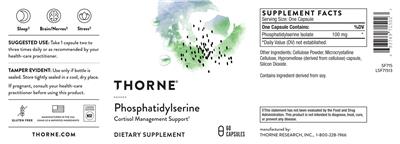
Phosphatidylserine Isolate 100 mg
| Phosphatidylserine Isolate | 100 mg | † |
Other ingredients: Cellulose, Powder, Microcrystalline Cellulose, Hypromellose, Silicon Dioxide.
Directions: Suggested use: Take 1 capsule two to three times daily or as recommended by your health-care practitioner.
Barcode (UPC) 693749715023 · Label source: NIH label database · Report a label change
Show entire label

More focus and memory products
Members OnlyThe highest ranked for the same goal
Read more
Our articles on this subject
- Supplements for Focus and Mental ClarityArticle · Jun 16, 2026
- How to Build a Longevity Supplement Stack: An Evidence-First ReviewArticle · Sep 7, 2026
Graded November 5, 2026 by the Reverse Age Lab evidence engine, from human studies, real reviews and our biohacker panel. How we grade. Is this medical advice? No. Rala organizes the published evidence; go over any change with your doctor, especially if you take meds.
Privacy policyConsumer health dataTermsDo Not Sell or Share My Personal InformationCookie settings