
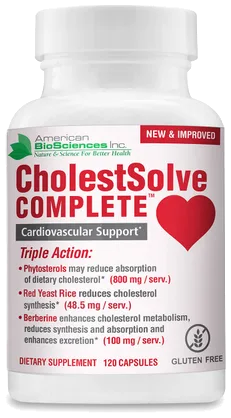
American BioSciences Cholest Solve 24/7 Review
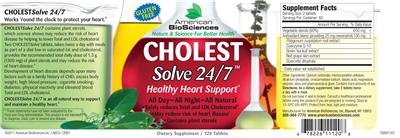
A revolutionary heart-health formula, containing super nutrients called plant sterols. The page states that plant sterols have been shown in scientific studies to lower Total and LDL cholesterol, and that the FDA now allows a health claim that taking 800 mg or more of plant sterols daily may reduce the risk of heart disease. Cholest Solve 24/7 is described as formulated with 1300 mg, which the page says is 62% more than most other cholesterol-lowering products on the market. In addition to plant sterols, the formula contains five other super nutrients: CoQ10, Resveratrol, Quercetin, Red Grape Skin Extract and Green Tea Extract, which the page says support vascular and heart health while providing antioxidant protection. The page says the product works round the clock to protect the heart. Suggested use: as a dietary supplement, take 2 tablets twice a day with meal, or as directed by a healthcare professional. Supplement facts per 2-tablet serving (60 servings per container): Calcium 200 mg (15% DV), plant sterol esters (95%) 650 mg, Antioxidant Blend 100 mg providing 25 mg resveratrol, Polygonum cuspidatum root extract 10 mg, plus Coenzyme Q10, Green Tea Leaf Extract, Red Grape Skin Extract and Quercetin dihydrate with no amount listed. Daily Value is not established for the other items. Other ingredients include calcium carbonate, microcrystalline cellulose, dicalcium phosphate, a film coat of hypromellose, glycerine and hydroxypropyl cellulose, croscarmellose sodium, stearic acid, magnesium stearate, and bamboo stem and leaf extract. Warnings: consult a healthcare practitioner if pregnant, nursing, taking any medication, or having a medical condition before taking any dietary supplement. Keep out of reach of children. Store in a cool, dry place. Do not use if the outer bottle seal is missing, torn, or damaged. Disclaimer: HiLife Vitamins notes that product images and information may be pending updates, that alternate packaging may ship, and that customers should read labels and directions rather than rely solely on the information provided by the site. The product is listed by HiLife Vitamins with UPC 678226111208, priced at $34.97 against a list price of $49.95, and is currently sold out. An AutoShip subscription option is offered with a 5% discount and delivery frequencies from every 30 days to every 180 days.
We don’t sell supplements. We help you make decisions and get the best price.
Lowest prices
We may earn a commission from some store links. How we choose.
Finding the lowest prices at the stores now. This takes a few seconds.
Study, Trial or Testing Result Summary
Members Only59 human studies · 45 improved
The main ingredient is plant sterols, taken at 1,300 milligrams a day, which matches or exceeds doses that worked in studies. Plant sterols reliably lower cholesterol. A pooled analysis of 125 studies found that foods with added plant sterols or stanols lowered bad cholesterol, with bigger drops at higher daily doses [1]. A pooled analysis of 28 trials with 1,777 adults found lower total cholesterol, bad cholesterol and apolipoprotein B, with larger doses working better [2]. An analysis of 14 trials in adults with high cholesterol found similar results [3]. A large analysis of 131 trials also found plant sterols lowered bad cholesterol more than placebo [4]. An older analysis found about 3.4 grams a day lowered bad cholesterol by 11 percent, compared with 2.3 percent on placebo [5]. Plant sterols did not clearly change the inflammation marker CRP [6]. The antioxidant blend has no clear amount of each part. The studies cited for it tested different antioxidant products, such as taurine with vitamin C, in small trials that were not clearly blinded, so they say little about this blend [7][8]. Animal and cell studies are never counted.
See all 59 studies →Hide the studies
- In a pooled analysis of 131 trials with 13,062 adults, plant sterols and stanols (among several supplements) lowered LDL and total cholesterol more than placebo, though bergamot and red yeast rice worked best.A network meta-analysis on the comparative effect of nutraceuticals on lipid profile in adults.
- This genetic and cohort study with a meta-analysis of 6 studies (4,362 people) found that high cholesterol absorption, not plant sterol intake, was linked to heart disease; it did not test sterol supplements for cholesterol lowering.High intestinal cholesterol absorption is associated with cardiovascular disease and risk alleles in ABCG8 and ABO: evid…
- In 28 randomized trials with 1,777 adults, plant sterol supplements lowered total cholesterol, LDL cholesterol and apolipoprotein B and raised HDL cholesterol, with larger doses working better.Effects of phytosterol supplementation on lipid profiles and apolipoproteins: A meta-analysis of randomized controlled t…
- In 23 trials (893 people on sterols/stanols, 769 on placebo), about 3.4 g a day lowered LDL cholesterol by 11% versus 2.3% with placebo, a smaller drop than policosanol.Meta-analysis of natural therapies for hyperlipidemia: plant sterols and stanols versus policosanol.
- In 20 randomized trials with 1,308 people, plant sterol foods lowered LDL cholesterol by about 14 mg/dL but did not significantly change the inflammation marker CRP.Effects of phytosterols on markers of inflammation: A systematic review and meta-analysis.
- In 14 randomized trials with 1,088 adults with high cholesterol, phytosterols lowered total and LDL cholesterol and slightly raised HDL cholesterol, with no change in CRP.Effects of phytosterol-rich foods on lipid profile and inflammatory markers in patients with hyperlipidemia: a systemati…
- In 7 trial comparisons with 439 people with high cholesterol, a plant-based diet including plant sterols lowered LDL cholesterol by about 17% compared with a standard cholesterol-lowering diet, but sterols were not tested alone.Portfolio Dietary Pattern and Cardiovascular Disease: A Systematic Review and Meta-analysis of Controlled Trials.
- In trials of 376 people with inherited high cholesterol, adding plant sterols to a cholesterol-lowering diet lowered LDL cholesterol by about 0.45 mmol/L, and stanols by about 0.58 mmol/L.Diet and Cardiovascular Disease Risk Among Individuals with Familial Hypercholesterolemia: Systematic Review and Meta-An…
- Across 32 trials of at least 1.5 grams a day of plant sterols, all carrier fats significantly lowered total and LDL cholesterol, and rapeseed/canola oil spreads lowered LDL cholesterol more than soybean/sunflower spreads.Fat type in phytosterol products influence their cholesterol-lowering potential: A systematic review and meta-analysis o…
- Pooling 125 studies, foods fortified with plant sterols or stanols lowered LDL cholesterol by an average of 0.55 mmol/L, with bigger drops at higher daily doses and smaller drops when given in bread, biscuits or cereals.Use of phytosterol-fortified foods to improve LDL cholesterol levels: A systematic review and meta-analysis.
- A review of many meta-analyses and trials found with high-quality evidence that foods with added plant sterols or stanols lowered LDL cholesterol by at least a moderate amount (0.20 to 0.40 mmol/L).The effects of foods on LDL cholesterol levels: A systematic review of the accumulated evidence from systematic reviews …
- A review of 141 meta-analyses of herbal medicines found that phytosterols, across 12 meta-analyses, lowered total cholesterol by 16.4 mg/dl and LDL cholesterol by 23.7 mg/dl, and raised HDL cholesterol by 10.6 mg/dl.Targeting dyslipidemia by herbal medicines: A systematic review of meta-analyses.
- In children and adolescents with familial hypercholesterolemia, 8 studies of plant sterols at 1.21 to 2.76 g per day lowered LDL cholesterol by 10 to 18 percent compared with control groups.Nutrition and dietary interventions for treatment and management of familial hypercholesterolaemia in children and adole…
- In 260 adults with modestly high triglycerides and LDL cholesterol, a spread with 2 g per day of plant sterols and 1 g of fish oil omega-3s for 4 weeks lowered triglycerides by about 11 percent and LDL cholesterol by about 5 percent compared with placebo.A low-fat spread with added plant sterols and fish omega-3 fatty acids lowers serum triglyceride and LDL-cholesterol con…
- In 202 adults with metabolic syndrome, 2 g per day of free phytosterol nanoparticles for 6 months led to fewer people with high triglycerides and reduced waist size compared with placebo, with no adverse effects reported.Effects of Daily Consumption of an Aqueous Dispersion of Free-Phytosterols Nanoparticles on Individuals with Metabolic S…
- In 200 adults with impaired blood sugar control, plant sterols taken alone for 12 weeks did not change total or low-density cholesterol compared with placebo, though they lowered triglycerides and a blood inflammation marker.A combination of omega-3 and plant sterols regulate glucose and lipid metabolism in individuals with impaired glucose re…
- In a randomized trial of 190 adults over 28 days, plant sterols did not lower LDL cholesterol more than placebo, while a med 5 mg daily lowered it by 35.2 percent more than placebo.Read the study on PubMed (36351465) →
- In 164 adults with moderately high cholesterol, 2 g per day of plant sterols added to yoghurt and cheese for 6 weeks lowered LDL cholesterol by about 10 percent compared with a control group, with no adverse effects noted.Safety aspects and cholesterol-lowering efficacy of low fat dairy products containing plant sterols.
- In 153 adults with mild high cholesterol, 1.8 to 2.6 g per day of sitostanol from margarine over one year lowered LDL cholesterol by 14.1 percent, compared with 1.1 percent in the control group.Reduction of serum cholesterol with sitostanol-ester margarine in a mildly hypercholesterolemic population.
- In 118 adults with high cholesterol, a supplement combining phytosterols with bergamot, olive fruit and vitamin K2 for 12 weeks did not significantly change LDL cholesterol compared with placebo.Randomized, Double-Blind, Placebo-Controlled Trial to Test the Effects of a Nutraceutical Combination Monacolin K-Free o…
- In 100 adults with high cholesterol in Indonesia, using plant sterol-enriched palm oil for cooking instead of regular palm oil lowered total and low-density lipoprotein cholesterol compared with placebo, with no change in inflammation markers.Plant Sterol-Enriched Palm Oil Intervention to Improve Lipid Profile and Inflammation Status in Hyperlipidemic Individua…
- In 84 previously sedentary adults with high cholesterol, plant sterol supplementation for 8 weeks lowered total cholesterol by about 8 percent and absolute LDL cholesterol compared with control, and the benefit was greatest when combined with endurance training.Plant sterols and endurance training combine to favorably alter plasma lipid profiles in previously sedentary hyperchole…
- In modestly high-cholesterol adults, about 2 grams a day of plant sterol esters in low-fat milk or yoghurt for 3 weeks lowered low-density cholesterol by about 5 to 8 percent compared with placebo.Plant sterol ester-enriched milk and yoghurt effectively reduce serum cholesterol in modestly hypercholesterolemic subje…
- In 72 adults with high cholesterol, 2 grams a day of plant sterols in biscuits for 6 weeks lowered total cholesterol by about 5% and bad cholesterol by about 8% compared with placebo biscuits, and adding oat fiber gave a larger drop.High molecular weight oat β-glucan enhances lipid-lowering effects of phytosterols. A randomised controlled trial.
- In 70 adults with high cholesterol, 2 grams a day of phytosterols for four weeks lowered total and low-density lipoprotein cholesterol compared with placebo, and adding curcumin produced a larger reduction.Curcumin potentiates cholesterol-lowering effects of phytosterols in hypercholesterolaemic individuals. A randomised con…
- In two feeding trials of 59 adults with high cholesterol, a portfolio diet containing plant sterols over 4 weeks changed many blood metabolites compared with a control vegetarian diet, including lower cholesterol esters and certain fats, though the abstract does not report the cholesterol result itself.Metabolomic profiling of a cholesterol lowering plant-based diet from two randomized controlled feeding trials.
- In 58 Brazilian adults with familial hypercholesterolemia, 2 g per day of phytosterol added to a cardioprotective diet over 120 days did not significantly change LDL cholesterol compared with placebo.An Adapted Cardioprotective Diet with or Without Phytosterol and/or Krill Oil Supplementation in Familial Hypercholester…
- In 57 adults with normal cholesterol, eating bakery products with 3.2 grams a day of plant sterol esters for 8 weeks lowered total and bad cholesterol compared with placebo bakery products.Bakery products enriched with phytosterol esters, alpha-tocopherol and beta-carotene decrease plasma LDL-cholesterol and…
- In 53 people with type 2 diabetes on meds, a combined supplement with 2.2 grams a day of plant sterols in chocolate, fish oil and green tea for 6 weeks lowered low-density cholesterol by about 14 percent and C-reactive protein by about 36 percent, but a later a med dose cut showed no added change.Read the study on PubMed (29503145) →
- In 50 Italian adults with high cholesterol in a placebo-controlled crossover trial, a daily 2.5 gram phytosterol drink for three weeks lowered total and low-density lipoprotein cholesterol more than placebo, with a bigger effect in people who followed a Mediterranean diet more closely.The Effect of Dietary Supplementation with Plant Sterols on Total and LDL-Cholesterol in Plasma Is Affected by Adherence…
- In 50 overweight people with fatty liver, a Mediterranean diet with or without an antioxidant supplement for 6 months improved blood fat levels, and the supplement added better insulin sensitivity and weight measures than diet alone.Effect of Mediterranean Diet and Antioxidant Formulation in Non-Alcoholic Fatty Liver Disease: A Randomized Study.
- In 46 hyperlipidemic adults, a diet high in plant sterols, soy, viscous fiber and almonds for 1 month lowered LDL cholesterol by 28.6 percent, a larger drop than a very low saturated fat diet alone (8.0 percent) and similar to a med.Effects of a dietary portfolio of cholesterol-lowering foods vs lovastatin on serum lipids and C-reactive protein.
- In 42 adults with mild high cholesterol, a capsule combining 1.8 grams of plant sterols with bergamot, artichoke leaf and hydroxytyrosol for 4 months did not lower low-density cholesterol more than placebo.The effects of a novel nutraceutical combination on low-density lipoprotein cholesterol and other markers of cardiometab…
- In 41 children aged 5 to 12 with familial high cholesterol, 2.3 grams of plant sterols a day for 4 weeks lowered total cholesterol by about 11 percent and LDL cholesterol by about 14 percent compared with placebo, but did not improve blood vessel function.Plant sterols lower LDL cholesterol without improving endothelial function in prepubertal children with familial hyperch…
- In two small trials of 15 and 26 people with moderately high cholesterol, yoghurt with 1 to 2 grams of plant sterols a day for 4 to 8 weeks lowered total and LDL cholesterol by about 2 to 6 percent compared with placebo, but the differences were not statistically significant.Effects of yoghurt enriched with free plant sterols on the levels of serum lipids and plant sterols in moderately hyperc…
- In 40 overweight adults, a daily probiotic capsule combining a probiotic strain, plant sterols and folate for 12 weeks lowered total and bad cholesterol more than placebo, though the amounts of plant sterols alone were not reported.Effects of a Probiotic Formulation Based on SF68, Phytosterols, and 6S-5-Methyltetrahydrofolic Acid on Body Composition,…
- In 34 adults with and without type II diabetes, 1.8 grams a day of plant sterols combined with glucomannan for 3 weeks lowered total and low-density lipoprotein cholesterol compared with placebo, while glucomannan alone lowered low-density lipoprotein cholesterol.Effect of plant sterols and glucomannan on lipids in individuals with and without type II diabetes.
- In 32 overweight adults, 4 weeks of plant-sterol-enriched milk did not change the lipid-carrying proteins in blood, but it reduced some inflammatory markers.Phytosterols and Omega 3 Supplementation Exert Novel Regulatory Effects on Metabolic and Inflammatory Pathways: A Proteo…
- In 32 healthy adults in a placebo-controlled crossover trial, 1.5 grams a day of a phytosterol supplement for one month lowered low-density lipoprotein cholesterol by about 10 percent compared with placebo.A Randomized, Placebo-Controlled, Double-Blind Crossover Study to Assess a Unique Phytosterol Ester Formulation in Lower…
- In 28 Brazilian children aged 6 to 9 with dyslipidemia, 1.2 g per day of plant sterols in milk for 8 weeks lowered LDL cholesterol by 10.2 percent compared with skim milk.Phytosterol-enriched milk lowers LDL-cholesterol levels in Brazilian children and adolescents: Double-blind, cross-over …
- In adults with metabolic syndrome and high LDL cholesterol, a soy and plant sterol medical food with hops and acacia extracts added to a low-glycemic diet for 12 weeks improved total cholesterol, LDL cholesterol and other lipids more than the diet alone.Subjects with elevated LDL cholesterol and metabolic syndrome benefit from supplementation with soy protein, phytosterol…
- In 23 children with high cholesterol, 5 weeks of a spread containing plant sterol esters lowered total cholesterol by about 6% and bad cholesterol by about 9%, with no change in good cholesterol or triglycerides.Red cell and plasma plant sterols are related during consumption of plant stanol and sterol ester spreads in children wi…
- In 23 overweight men with high cholesterol, 6 weeks of an oil enriched with plant sterols lowered total and bad cholesterol more than olive oil, with no change in good cholesterol.Phytosterols mixed with medium-chain triglycerides and high-oleic canola oil decrease plasma lipids in overweight men.
- In 23 men with high cholesterol, 2.6 grams a day of plant sterols taken with meals for 12 weeks lowered total cholesterol and raised HDL cholesterol compared with diet alone, with only a small effect on HDL subfractions and no effect on LDL particle quality.Effects of phytosterol supplementation on lipoprotein subfractions and LDL particle quality.
- In 23 children with high cholesterol who took at least 70 percent of doses, eight weeks of a phytosterol-enriched olive oil cream lowered total and LDL cholesterol compared with the control period.Chemometrics-guided plasma lipidomics insights underlying the decrease of plasma total cholesterol and LDLc in children …
- In Japanese men and women with normal or high cholesterol, 1.8 grams a day of plant sterols from a spread for about 3 weeks per period lowered total and bad cholesterol compared with a control spread, with similar results in both groups.A spread enriched with plant sterol-esters lowers blood cholesterol and lipoproteins without affecting vitamins A and E …
- In a crossover trial, 2 g per day of plant sterols for 4 weeks lowered triglycerides only in people carrying two copies of the G variant of the cholesteryl ester transfer protein gene rs5882 (10 people), with no effect in carriers of the A allele.Cholesterol ester transfer protein polymorphism rs5882 is associated with triglyceride-lowering in response to plant ste…
- In 102 men aged 45 and older with poor sperm quality and metabolic syndrome, taking an antioxidant supplement for 3 months alongside standard care was reported to normalize blood fat levels and lower oxidative stress, blood sugar markers and body weight compared with standard care alone.[Antioxidants as part of preconception preparation in men over 45 years of age].
- In 68 people with type 2 diabetes and early eye disease, taurine plus vitamin C for 42 days was reported to have a positive effect on blood sugar, blood fat and liver measures compared with a control group.[The influence of C-taurine antioxidant complex on biochemical blood parameters in the process of treatment of patients …
- In 64 men with metabolic syndrome, adding an antioxidant blend for 3 months to standard care was reported to normalize blood fat levels, cut oxidative stress about in half and lower HbA1c by 16% compared with standard care alone.[The role of antioxidants in the therapy of metabolic syndrome in men].
- In a multicenter open study in adults with high cholesterol and metabolic syndrome, 1600 mg per day of phytosterols for 8 weeks lowered total cholesterol, LDL cholesterol and non-HDL cholesterol compared with baseline, though the effect was smaller than a red yeast rice and omega-3 combination.Testing the Short-Term Efficacy of a Lipid-Lowering Nutraceutical in the Setting of Clinical Practice: A Multicenter Stu…
- In 109 healthy men, swapping saturated fats for unsaturated fats in the diet for 4 weeks, after a 4-week higher-saturated-fat diet, lowered bad cholesterol by about 0.5 mmol/L on average, though individual responses varied widely. No vegetable sterol supplement was tested.Variation of LDL cholesterol in response to the replacement of saturated with unsaturated fatty acids: a nonrandomized, …
- In 86 adults on meds, adding 2 grams a day of plant sterol capsules for four weeks further lowered total and low-density lipoprotein cholesterol by about 4 to 8 percent, without changing cholesterol absorption or production markers.Additive effects of plant sterols supplementation in addition to different lipid-lowering regimens.
- In 58 children with inherited or undefined high cholesterol, 12 weeks of plant sterol-enriched yoghurt lowered LDL cholesterol by about 11 to 16 percent, with high tolerability, in an open-label study without a control group.Primary hyperlipidemias in children: effect of plant sterol supplementation on plasma lipids and markers of cholesterol …
- In 44 adults with borderline high cholesterol taking one tablet daily of a supplement containing sunflower plant sterols plus other plant extracts, LDL cholesterol fell by about 7 to 10 mg/dL over 6 months in an uncontrolled study.Effects of Novel Nutraceutical Combination on Lipid Pattern of Subjects with Sub-Optimal Blood Cholesterol Levels.
- In 26 adults with fatty liver taking 2 grams of phytosterols daily for one year in an uncontrolled pilot, liver fat fell by about 19 percent, triglycerides and HDL cholesterol improved, and C-reactive protein dropped, with no adverse effects.Efficacy of Submicron Dispersible Free Phytosterols on Non-Alcoholic Fatty Liver Disease: A Pilot Study.
- A one-month diet high in plant sterols, soy protein, viscous fiber and almonds raised blood sterol levels only slightly, not significantly after correction, and did not change red blood cell fragility despite a 29 percent LDL cholesterol drop.Effects of a diet high in plant sterols, vegetable proteins, and viscous fibers (dietary portfolio) on circulating stero…
- In three large US cohorts of about 214,000 health professionals followed for years, higher phytosterol intake was linked to a modest, not clearly significant, lower risk of heart disease; campesterol intake showed a significant link, and higher intake was tied to lower blood cholesterol and lower IL-6.Phytosterol intake and risk of coronary artery disease: Results from 3 prospective cohort studies.
- In a case series of seven overweight adults with fatty liver disease, six weeks of two Bilirel antioxidant pills daily with a Mediterranean diet and more exercise improved liver fat, blood sugar and lipid metabolism, and weight.Lifestyle changes associated with a new antioxidant formulation in non-alcoholic fatty liver disease: a case series.
Review Totals and Summary
Members Only1 reviews
The feedback I could find is limited in volume. Most of it comes from iHerb, where about 17 international buyers (from Portugal, Latvia, Estonia, Canada, Cyprus, Bulgaria and the US) are overwhelmingly positive. Walmart and Vita Living show only a handful of reviews, and the Amazon pages I saw had none. The most common theme is that people believe it helps their cholesterol numbers. One US customer said their cholesterol dropped a few points and planned to keep going to see more progress. A Bulgarian reviewer with high total and "bad" cholesterol said improvement began after about two months and that their doctors were surprised. A Portuguese reviewer called it the most beneficial product they had used for lowering cholesterol and praised the ingredients and quality. A second theme is patience and a "wait and see" attitude. Several reviewers said they had just started, had not yet retested their lipids, or were hopeful but unsure how much it would help. Their satisfaction is therefore partly about expectations, not confirmed results. A few reviewers noticed no difference at all. One said plainly that they had not felt any different, which is a reminder that cholesterol changes cannot be felt and need a blood test. Some anecdotal comments describe general wellbeing. One buyer said they breathed better at night and slept better after a week, a benefit the product does not claim, so it may be a placebo effect or coincidence. Practical features also get positive mentions. Customers liked the quick delivery and secure packaging, found the tablets easy to swallow, and thought the bottle size suited regular use and travel. I found no complaints about side effects, taste, stomach upset or pill size. The negatives are mostly the absence of noticeable effects and the small number of reviews. Because most reviewers were not tracking lab results, and some reviews were incentivized ("rewarded review" on iHerb), the praise is encouraging but not strong evidence. Overall, buyers describe a well-made, easy-to-take heart-health supplement. They credit it with gradual cholesterol improvement over weeks to months and show little dissatisfaction.
Biohacker Summary
Members Only10 of 10 recommend it
The panel is split on plant sterols, the main ingredient here. Two of the eight who spoke on it recommend it, saying it competes with cholesterol for absorption in the gut and can lower LDL cholesterol, and one of them cited 2 grams a day as lowering LDL by 10% and said it can come from a supplement or from foods like beans, nuts and seeds. Three more were neutral but mentioned sterols and stanols as a way to manage cholesterol or noted good evidence for natural food sources, while one of them dislikes sterols added to processed foods. Two panelists warn against them, saying they can be harmful to the body, especially for people who absorb a lot of them, and one of these had earlier taken 2 grams twice a day for cholesterol and advises monitoring blood levels of sterols. Nobody spoke about any other ingredient in this product.
See all 8 biohackers →Hide the biohackers
Dr. Eric Berg · Plant Sterols · neutral
- Notes that plant sterols can bring down LDL.
- Notes that avocado oil contains phytosterols.
- Mentions that palm oil contains phytosterols, which are precursors to a med hormones like cortisol, helping to fight stress.
- Mentions that avocado contains phytosterols.
Andrew Huberman · Plant Sterols · neutral
- Mentions that plant sterols were a big focus of her lab at McGill for cholesterol reduction and reducing the risk of cardiovascular disease.
Dr. Mark Hyman · Plant Sterols · recommends
- Recommends plant sterols and stanols, as these compounds can help block cholesterol absorption in the intestine.
- Mentions that plant sterols, which come from food like soy, can be very helpful in lowering LDL cholesterol and balancing lipids.
- States that they sometimes use plant sterols as part of their overall care.
- Notes that plants have phytosterols and other antioxidants not found in beef.
- Recommends plant sterols, stating that 2 grams a day can lower LDL cholesterol by 10%, and they can be taken as a supplement or obtained from foods like beans, legumes, nuts, and seeds.
- Is trying plant sterols to see if they can replace meds for managing his cholesterol.
- Notes that plants contain phytosterols, which are helpful, antioxidant, anti-inflammatory, and may protect against cancer.
- Is trying plant sterols to see if he can use them to replace meds for high cholesterol.
Dr. Rhonda Patrick · Plant Sterols · warns
- Warns against using phytosterols to lower cholesterol, as they can be more atherogenic than cholesterol, especially if a patient has a defective ATP binding cassette and absorbs a lot of them.
- Discusses the risks of using phytosterols to lower cholesterol.
Siim Land · Plant Sterols · neutral
- Mentions plant sterols and stanols as a recommendation for cholesterol management.
Thomas DeLauer · Plant Sterols · recommends
- Recommends phytosterols, found in sacha inchi, because they compete with cholesterol for absorption in the gut, thereby limiting how much cholesterol enters the bloodstream.
Ben Greenfield · Plant Sterols · neutral
- Lists Phytosterols as bioactive compounds.
- Natural plant sterol sources have good evidence for helping lower small oxidized cholesterol particles, though Ben Greenfield is not a fan of them being added to processed foods.
- Recommends phytosterols, found in seeds, nuts, fruits, and vegetables, and often in high-dose antioxidant supplements, for controlling stress, especially for those engaged in intense physical activities that may require more than dietary intake.
- Recommends stepping up plant intake, specifically raw nuts and raw seeds, as they are high in plant sterols which can be effective at alleviating allergic symptoms.
Peter Attia · Plant Sterols · warns
- Warns that putting phytosterols into red blood cell membranes can lead to hemolytic anemias and abnormal red blood cell structures, as red blood cells need cholesterol, not phytosterols, to stay healthy.
- Warns against supplementing phytosterols, especially for hyper-absorbers, as evolution did not want them in the body and they can lead to phytosterol toxicity in humans. He advises monitoring phytosterols in the bloodstream.
- Takes 2 grams of plant sterols twice a day for cholesterol.
RAL Summary
Members OnlyTier 4 for Cholesterol
Plant sterols at a full dose have strong human evidence for lowering bad cholesterol [2], but no reviews were counted, so the product stays emerging.
- Emerging: not enough evidence to rank higher yet.
Where the evidence disagrees: 8 of the 59 human studies found no effect.
More Details
Members OnlyBody systems · Combine with · Possible side effects
Body systems: Cardiovascular system
Combine with: For its cholesterol-support purpose, it may pair well with omega-3 fish oil (EPA/DHA) for triglycerides and inflammation, soluble fiber such as psyllium or beta-glucan to reduce cholesterol absorption, and CoQ10 (ubiquinol), especially for anyone on meds. Plant sterols, bergamot extract, and berberine may add lipid and glucose support, and magnesium and vitamin K2 can support broader cardiovascular health. If the user's real aim is cellular and DNA repair, they should add separate targeted compounds such as NMN or NR with resveratrol or pterostilbene, quercetin and fisetin, PQQ, and alpha-lipoic acid, ideally after consulting a clinician, particularly if taking cholesterol or other medications.
Possible side effects: No major side effects reported.
Supplement Facts
Vegetable Sterols 650 mg · Antioxidant Blend 100 mg
| Vegetable Sterols | 650 mg | † |
| Antioxidant Blend | 100 mg | † |
Other ingredients: Calcium Carbonate, Microcrystalline Cellulose, Dicalcium Phosphate, Croscarmellose Sodium, Stearic Acid, Magnesium Stearate, Silica, Pharmaceutical Glaze.
Directions: Directions: As a dietary supplement, take 2 tablets twice a day with a meal.
Barcode (UPC) 678226111208 · Label source: NIH label database · Report a label change
Show entire label
More cholesterol products
Members OnlyThe highest ranked for the same goal
Read more
Our articles on this subject
- Best Diet for High Cholesterol: What to Eat, What to Cut, and What the Trials ShowArticle · Sep 13, 2026
- How to Lower LDL Cholesterol: A Practical Plan Based on Your Blood WorkArticle · Oct 27, 2026
Graded November 5, 2026 by the Reverse Age Lab evidence engine, from human studies, real reviews and our biohacker panel. How we grade. Is this medical advice? No. Rala organizes the published evidence; go over any change with your doctor, especially if you take meds.
Privacy policyConsumer health dataAffiliate disclosureTermsDo Not Sell or Share My Personal InformationCookie settings