
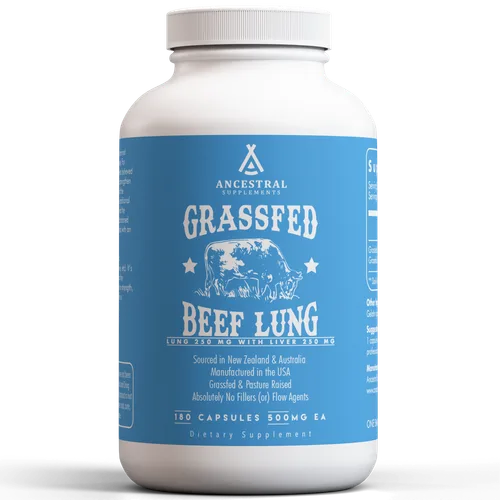
Ancestral Supplements Grassfed Beef Lung Review
We don’t sell supplements. We help you make decisions and get the best price.
Lowest prices
We hold no current store prices for it yet: check the store.
- AmazonPrice at AmazonCheck price at Amazon (opens in a new tab)
Also at: Ancestral Supplements
Some store links earn us a commission.
Study, Trial or Testing Result Summary
Members OnlyHuman studies
This product contains 250 milligrams of dried grassfed beef lung and 250 milligrams of dried beef liver in each serving. We found no human studies testing either beef lung or beef liver for slowing or reversing aging, for repairing cells, or for protecting DNA. Because neither ingredient has been studied for this goal, there is no studied dose to compare these amounts against. Neither ingredient is hidden in a blend, since both amounts are listed openly on the label. Organ meats contain a range of nutrients, but no studies here show that taking them as a dried capsule changes markers of aging or cell repair in people. Customer ratings are very positive overall, with most buyers rating it well, but we could not read the written reviews, so we do not know what results buyers describe or whether any relate to aging. Until human studies on this goal exist, any benefit for aging or cell repair is unproven. People interested in this product for aging should treat it as a general food supplement rather than a proven anti-aging treatment. Animal and cell studies are never counted.
Review Totals and Summary
Members Only1,443 reviews · 92% positive
Extensive customer reviews and qualitative feedback are currently being aggregated for this product. Check back soon for a detailed sentiment analysis.
Biohacker Summary
Members Only5 of 10 recommend it
Seven of the ten panelists spoke about liver, and most of them recommend it or use it, mainly as a dense source of nutrients such as choline, vitamin A, copper and iron. Choline came up most often, with three people pointing to liver for it, including during pregnancy, while others cited eye health, low iron and general nutrition. Forms vary: several eat fresh grass-fed or pasture-raised liver, one puts 2 to 3 ounces of raw liver in a morning smoothie and cooks it about once a week, and one takes it as capsules because the taste is unpleasant. Doses were given as about 1 to 2 ounces once every couple of weeks by one person, who also warned that eating liver daily could harm bone density, and another cautioned against overdoing copper from liver. One panelist avoids liver because of the taste, though he says those who like it could eat a little now and then.
See all 8 biohackers →Hide the biohackers
Dr. Eric Berg · Liver · neutral
- Mentions that liver contains active vitamin A, which helps support normal eye function.
- States that grass-fed liver is the number one most anti-aging food, loaded with B vitamins, zinc, copper, coenzyme Q10, retinol, heme iron, collagen, amino acids, vitamin K2, vitamin E, and vitamin D.
- Recommends getting copper from foods like liver.
- Recommends liver as a source of choline.
- Recommends liver as an organ meat for more nutrients.
- Recommends liver as one of the best sources of vitamin B1 and to increase vitamin B2 intake.
- Dr. Berg recommends consuming liver for zinc.
- Notes that liver is one of the best sources of vitamin A and is also loaded with zinc, both beneficial for acne.
- Mentions liver as one of the best foods for choline but states he does not like or eat it.
- Recommends liver as one of the best meals to support hair from a nutrient standpoint, highlighting its bioavailable heme iron, zinc, copper, and selenium.
Dr. Mark Hyman · Liver · recommends
- Recommends having liver as a source of choline for membrane health.
- Highly recommends consuming liver, such as beef or chicken liver, during pregnancy as it is a very good and nutritionally dense source of choline.
- States that liver is the best source of Vitamin A and mentions buying pasture-raised chicken livers for dinner.
- Adds liver to her diet to address postnatal depletion.
- Loves liver, including chopped liver and pâté, and recently bought grass-fed chicken livers at the farmer's market.
- Recommends liver, specifically pasture-raised chicken livers, as the best source of Vitamin A and the most nutrient-dense source of B vitamins, despite some finding it unappealing.
- Clarifies that the liver processes toxins but does not store them, addressing a common misconception about its role in detoxification.
- States that liver is one of the most nutritionally dense foods on the planet and the best source of B vitamins.
- States that liver has CoQ10 and B vitamins, making it a mitochondrial food.
- Mentions that a Chinese doctor prescribed him liver to build up his blood.
Thomas DeLauer · Liver · warns
- Warns that eating liver every day can be problematic, potentially messing up bone density by outcompeting vitamin D for shared receptors and reducing calcium absorption.
- Recommends adding 1 oz of liver every two weeks to get a balanced intake of nutrients, noting it is a highly nucleotide-dense food.
- Recommends liver as a source of vitamin A, which provides raw materials for goblet cells to produce mucus.
- Notes that liver could replace sardines but would not provide the same vitamin D and omega 3.
- Recommends adding liver periodically, about 1 to 2 ounces once every couple of weeks, to provide vitamin A, folate, and copper not found in sardines.
- Acknowledges that liver is amazing for health, despite finding it disgusting to eat personally.
- Recommends eating liver as "nature's multivitamin" because it contains a whole bunch of nutrients in proportions that are probably good for you, aligning with how humans evolved to eat.
- Recommends eating liver, even just an ounce once or twice a week, or taking a liver supplement, as it is arguably the most nutrient-dense food on the planet and can help with various health issues.
- Recommends liver as a source of B vitamins to reduce homocysteine.
- Recommends beef or liver as a food that can replace a multivitamin.
Ben Greenfield · Liver · uses
- Sometimes adds liver or other organ meats to their US Wellness Meats order.
- Decided to whip up some liver for dinner, sourcing it from US Wellness Meats.
- Uses raw liver in his smoothie every morning for the iron ratio, describing it as amazing once the right stuff is in it.
- Throws about 2 or 3 ounces of liver in his morning smoothie and makes himself liver about once a week, but his family is not as keen on it.
- Ben includes raw liver in his morning smoothie.
- Includes raw liver in his smoothie.
- Puts raw liver in his smoothie every morning, suggesting it's related to addressing anemia or MTHFR issues.
- Ben travels with liver capsules and his sons take beef brain capsules almost every morning, finding them convenient and nutritious.
- Ben Greenfield's house manager keeps track of his supply of frozen raw liver bites from U.S. Wellness Meats, which he uses in his morning smoothie.
- Recommends liver as one of the best bioavailable sources of sulfur.
Siim Land · Liver · recommends
- Recommends liver for eye health.
- Lists liver as a food source for copper.
- Mentions liver as one of the most nutrient-dense animal source proteins, calling it "nature's multivitamin."
- Warns against the 'Liver King approach' of overdosing on copper with liver, stating it's not necessary.
- Recommends eating liver if possible for low iron levels, as it contains iron and copper which are important for combating anemia and improving hemoglobin status.
- Will have some liver maybe once every two, three, or four weeks because it is replete with nutrients.
- Eats liver quite regularly as a source of methyl donors.
- Recommends liver as nature's multivitamin, rich in vital vitamins and minerals.
- Recommends incorporating liver as a vitamin A-rich food to combat wrinkles and promote skin vitality.
- The study protocol included three three-ounce servings of liver or liver supplement per week, which is nutrient-dense and high in methyl donors, as part of a methylation supportive diet.
Dave Asprey · Liver · uses
- Is a fan of liver but takes it encapsulated because it is 'pretty gross'.
- States that when recovering from surgery, he has liver because the body sucks it up.
- Recommends eating grass-fed liver as raw materials for targeted liver regeneration, or taking a supplement if the taste is disliked.
- Suggests eating liver because it provides choline, which is needed to insulate nerves and improve brain function.
- Recommends desiccated liver and other organs for next-level cellular support.
- Encourages trying liver supplements for a couple of months if one is young, struggling to lose weight, has poor skin, or experiences brain fog, to see if it brings about changes.
- Recommends grass-fed liver, noting it has tons of B vitamins and real vitamin A, and advises consuming it once a week without overdoing it.
- States he eats liver at least every two weeks, acknowledging its importance for minerals.
- Dave Asprey agrees with Andrea Bemis that liver is one of the best and most gentle first foods for babies' digestive systems.
- Dave Asprey has been recommending raw liver since his first book on fertility.
Dr. Rhonda Patrick · Liver · recommends
- Recommends that expecting mothers boost choline intake by eating choline-rich foods like liver.
Andrew Huberman · Liver · neutral
- Huberman mentions that liver is rich in beneficial things for health and that those who like it could eat a little bit every once in a while, though he personally avoids it due to taste.
RAL Summary
Members OnlyTier 4 for Healthy Aging
No human studies have tested beef lung or beef liver for reversing aging or for cell and DNA repair, so strong customer ratings alone leave the evidence thin. So it is graded Tier 4, lower than the rules alone gave.
- Emerging: not enough evidence to rank higher yet.
- No human studies on this goal for its ingredients.
More Details
Members OnlyBody systems · Combine with · Possible side effects
Body systems: Respiratory system, Digestive system
Combine with: Combine with a healthy diet and lifestyle.
Possible side effects: No major side effects reported.
Supplement Facts
Lung 250 mg · Liver 250 mg
| Lung | 250 mg | † |
| Liver | 250 mg | † |
Other ingredients: Gelatin.
Directions: Suggested use: 1 capsule with each meal or as directed by a healthcare professional
Label source: NIH label database · Report a label change
Show entire label
More healthy aging products
Members OnlyThe highest ranked for the same goal
Read more
Our articles on this subject
- Healthy Aging Tips: A Science-Backed Guide to Living Better for LongerArticle · Mar 17, 2026
- NAD Anti-Aging Supplements: Benefits, Evidence, and How to ChooseArticle · Jun 15, 2026
Graded November 27, 2026 by the Reverse Age Lab evidence engine, from human studies, real reviews and our biohacker panel. How we grade. Is this medical advice? No. Rala organizes the published evidence; go over any change with your doctor, especially if you take meds.
Privacy policyConsumer health dataAffiliate disclosureTermsBrand and legal noticesDo Not Sell or Share My Personal InformationCookie settings