
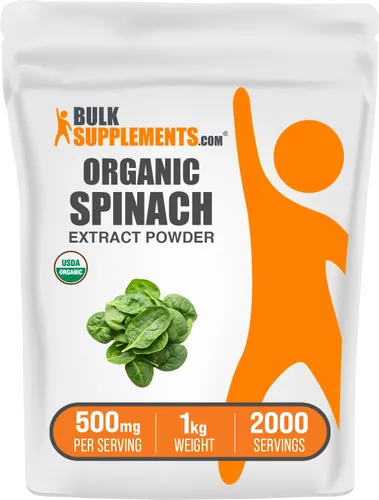
BulkSupplements.com Spinach Extract Powder 1000 mg Review
We don’t sell supplements. We help you make decisions and get the best price.
Lowest prices
We hold no current store prices for it yet: check the store.
Sold at: Bulksupplements · Walmart · Target
Study, Trial or Testing Result Summary
Members Only11 human studies · 7 improved
No human study has measured biological age with spinach, but several trials found improvements in markers linked to aging. One serving of this product gives 1000 milligrams of spinach extract, so two servings a day match the 2 grams that worked in a trial. In that trial of 45 adults over 50 doing strength training, 2 grams a day for 12 weeks improved muscle strength and muscle quality more than placebo [1]. In 68 obese men, 5 grams a day of a spinach thylakoid extract with exercise for 12 weeks improved antioxidant enzymes and lowered oxidative and muscle damage markers [2]. In 20 trained young men, 14 days of spinach raised antioxidant capacity after a half-marathon [3]. A study of 84 adults without a placebo group reported lower inflammation and oxidative stress markers and better skin scores [4]. Not every study agreed. A trial in 48 women found no change in oxidative stress markers [5], and a trial in 24 people with metabolic syndrome found no change in most inflammation and oxidative stress markers [6]. Several positive trials used a spinach thylakoid extract at higher doses, which may differ from this whole herb extract. Animal and cell studies are never counted.
See all 11 studies →Hide the studies
- In 68 obese men, 5 g a day of spinach thylakoid extract with CrossFit training for 12 weeks improved antioxidant enzyme levels and lowered markers of oxidative and muscle damage compared with the control groups.Antioxidant supplementation boosts the advantages of CrossFit workouts on oxidative and muscle damage markers in obese m…
- In 48 obese women with polycystic ovary syndrome on a low-calorie diet, 5 g a day of spinach thylakoid extract for 12 weeks lowered a gut toxin marker and raised a brain growth factor, but did not change oxidative stress markers versus placebo.The effect of calorie-restriction along with thylakoid membranes of spinach on the gut-brain Axis Pathway and oxidative …
- In 45 adults over 50 doing moderate strength training, 2 g a day of spinach extract for 12 weeks improved muscle strength and muscle quality more than placebo.A 12-Week Randomized Double-Blind Placebo-Controlled Clinical Trial, Evaluating the Effect of Supplementation with a Spi…
- In 24 people with metabolic syndrome, 70 g of spinach a day with eggs or egg substitute for 4 weeks did not change most inflammation and oxidative stress markers; only malondialdehyde was lower in the egg period, and spinach itself was not tested separately.The Effects of Eggs in a Plant-Based Diet on Oxidative Stress and Inflammation in Metabolic Syndrome.
- In 20 well-trained young men, spinach at 1 g per kg body weight daily for 14 days raised antioxidant capacity and kept oxidative stress and muscle damage markers lower after a half-marathon than placebo.The effect of spinach supplementation on exercise-induced oxidative stress.
- In 12 healthy volunteers, a spinach preparation providing 5 mg lutein daily for 10 days raised blood lutein and lipid peroxidation markers tended to fall, but antioxidant capacity of plasma did not change.Effect of Spinacia oleraceae L. and Perilla frutescens L. on antioxidants and lipid peroxidation in an intervention stud…
- In Japanese women, four weeks of a sulfated algae supplement reduced skin water loss, and it outperformed a control product of 70% corn starch and 30% spinach powder, though the abstract does not report that control improving skin.Sujiaonori-Derived Algal Biomaterials Inhibit Allergic Reaction in Allergen-Sensitized RBL-2H3 Cell Line and Improve Ski…
- In 12 peri- and post-menopausal women, 4 weeks of carotenoid-rich foods including boiled spinach lowered LDL cholesterol and inflammation and oxidative stress markers, and raised HDL cholesterol, with no control group.[Influence of dietary carotenoids on biomarkers of cardiometabolic risk in peri- and post-menopausal women].
- In 9 healthy women, eating 150 g of spinach daily for 3 weeks made their lymphocyte DNA more resistant to hydrogen peroxide damage, with no control group.Spinach and tomato consumption increases lymphocyte DNA resistance to oxidative stress but this is not related to cell c…
- In 84 adults, some of whom smoked daily, 45 days of an enzymatically treated spinach supplement was safe and reduced some inflammation and oxidative stress markers, improved mental quality-of-life scores, and improved some skin scores.Solarplast® Demonstrates Anti-Inflammatory and Anti-Oxidant Activity In Vivo and Positively Modulates Perceived Anti-Age…
- In laboratory tests on human cells and engineered skin, spinach thylakoid extract at 0.1% protected against ultraviolet damage and reactive oxygen species, and repaired ultraviolet damage when mixed into a cream.Study of antioxidant properties of thylakoids and application in UV protection and repair of UV-induced damage.
Review Totals and Summary
Members Only232 reviews · 85% positive
Extensive customer reviews and qualitative feedback are currently being aggregated for this product. Check back soon for a detailed sentiment analysis.
Biohacker Summary
Members Only5 of 10 recommend it
The panel is split on spinach, with a handful recommending or using it and about half raising cautions. Those in favor eat it for potassium, magnesium, fiber and general nutrients, often raw or cooked in smoothies and egg scrambles, and some pair it with lemon or oranges. One panelist suggests about 100 grams (3.5 ounces) a day, preferably raw, and another puts two cups of raw spinach in a smoothie. The most common caution, from about five of the ten, is its high oxalate content, which they link to kidney stones, poor iron and calcium absorption, and inflammation, and one told people to stop eating it. Two others flagged histamine problems, one called leafy greens too risky, and a few said to avoid eating too much or to choose low oxalate alternatives.
See all 10 biohackers →Hide the biohackers
Dr. Eric Berg · Spinach · recommends
- Dr. Eric Berg recommends pairing spinach with lemon for better iron absorption.
- Recommends spinach as a low-carb, potassium-rich food.
- States that spinach has 840 mg of potassium.
- Warns that veggie straws are primarily potato starch and corn flour, dyed with a dusting of spinach powder.
- Recommends leafy greens like Swiss chard and spinach for potassium, stating that one cup provides between 500 and 800 mg of potassium, and consuming five to ten cups of vegetables daily would provide plenty of potassium.
- Recommends spinach as a great vegetable option.
- Notes that leafy greens such as Swiss chard and spinach are high in potassium but also high in oxalates, and consuming them with calcium can help reduce the effects of oxalates.
- Recommends spinach for potassium, noting that cooked spinach provides 840 mg, which is higher than raw spinach, and advises sautéing it.
- Suggests spinach as a second meal in the rotating diet for cancer.
- Dr. Berg used to recommend spinach shakes as superfoods for the heart, but now he advises against them because they don't provide essential nutrients like protein and can lead to bloating and low energy.
Dr. Mark Hyman · Spinach · uses
- Includes spinach in their breakfast egg scramble.
- Warns that spinach, often considered healthy, can quietly make symptoms worse for individuals with mast cell activation syndrome (MCAS) by triggering histamine release.
- Explains why many 'healthy' foods like spinach can temporarily worsen symptoms when the histamine bucket is already full.
- Includes spinach in their smoothie for fiber and nutrients.
- Recommends spinach as a food-first approach.
- Included spinach in their breakfast scramble, noting they usually want a high-protein, high-fat breakfast with veggies.
- Mentions restricting spinach in phase three of a low histamine diet as it can trigger histamine reactions in some people.
- Recommends spinach as a high-fiber option for breakfast, suggesting it can be included in an omelette or breakfast scramble.
- Recommends leafy greens like spinach and kale for their folate and Vitamin K content.
- Mentions spinach as a source of magnesium.
Dave Asprey · Spinach · warns
- Warns that spinach is a 'healthy' food packed with anti-nutrients that cause inflammation and block nutrient absorption.
- Eats spinach and doesn't have a problem with it personally, but acknowledges that consuming excessive amounts could increase the risk of kidney stones for those at high risk.
- Advises to stop eating spinach, as it is the highest-oxalate food most people eat on purpose and can cause inflammation.
- Warns that one cup of raw spinach has 656 mg of oxalate, and half a cup cooked has 755 mg, which far exceeds the recommended daily limit.
- Warns against spinach, stating it contains plant defense chemicals that challenge the gut, stress the thyroid, and bind minerals.
- Gets rid of higher anti-nutrient plant toxic foods like spinach when transitioning people to burning fat.
- Warns that spinach is loaded with oxalates, which can cause kidney stones, gout, interstitial cystitis, joint pain, bad skin, and vulvodynia.
- Warns that spinach probably pulls minerals, including zinc and calcium, out of tissues rather than putting them in, despite the popular belief that it is good for muscles.
- Warns that spinach is designed by nature to limit how much you consume and may be stealing minerals from your body.
- Warns that spinach, a vegan superfood, contains oxalate crystals that can disrupt thyroid function and reproductive systems.
Thomas DeLauer · Spinach · neutral
- States that spinach's nitrate becomes nitric oxide and recommends trying it with oranges.
- Warns that spinach is not a good source of iron due to its low absorption rate of 2-8% as non-heme iron.
- Warns that spinach's oxalates lock up iron and calcium, reducing their bioavailability.
- Lists spinach as a high histamine food.
- Warns that spinach is abnormally high in oxalates, which can accumulate in joints and be hard on the kidneys if consumed daily, suggesting better alternatives like arugula.
- Cautions against adding a lot of spinach to the diet due to its high oxalate content, suggesting leaning more towards arugula instead.
- Loves spinach and includes it in her scrambled eggs for breakfast.
- Lists spinach as a histamine liberator, meaning it triggers the release of histamine in the body.
- Would eat less spinach due to its high oxalate content, which he believes contributed to his joint pain.
- Recommends spinach, suggesting to cook it if concerned about oxalates, and highlights its high levels of lutein and other antioxidants, noting lutein's benefits for eye health and its correlation with less cognitive decline.
Dr. Rhonda Patrick · Spinach · uses
- Lists spinach as a favorite source of potassium.
- Recommends focusing on magnesium-rich foods like cooked spinach to boost magnesium intake for cancer prevention.
- Recommends cooked spinach as an excellent dietary source of magnesium, providing a substantial amount in each serving.
- Dr. Patrick includes two cups of raw spinach in her smoothie, stating it's very high in magnesium and calcium, which helps reduce oxalate absorption.
- She drinks a vegetable smoothie almost every day which has kale and spinach and chard and more vegetables.
- Rhonda Patrick includes spinach in her daily morning micronutrient smoothie as a source of magnesium, vitamin K, calcium, and vitamin C.
- Dr. Patrick adds 3 cups of chopped spinach to her smoothie, highlighting its high folate content, which is essential for DNA integrity and regulating epigenetics.
- Dr. Patrick advises that if one is going to binge drink, they should replenish their magnesium levels the next day by eating a big plate of spinach or drinking a spinach smoothie.
- Dr. Rhonda Patrick recommends increasing consumption of dark green leafy vegetables such as spinach, which is high in magnesium, to maximize mitochondria.
- Dr. Patrick recommends eating spinach on a daily basis to ensure proper levels of magnesium in cells.
Ben Greenfield · Spinach · neutral
- Notes that some herbal books misinterpret biblical verses to suggest consuming spinach for healing.
- Lists raw spinach as part of Doug's diet.
- Considers most leafy greens, such as brassicas, spinach, and chard, to be pretty toxic for humans, stating that the risks far outweigh any potential benefits and he doesn't see much redeeming value in them.
- Uses Dr. Thomas Cowan's low oxalate vegetable powders in his morning smoothie, stating one teaspoon is like eating a salad and it avoids the high oxalate content of spinach and almonds.
- Includes spinach in his Rewind Bars, calling them "sneaky greens."
- Mentions a baby food flavor consisting of squash and spinach with avocado oil, which does not contain meat.
- Explains that spinach contains oxalic acid, and if one's microbiome cannot detoxify it, spinach can be unhealthy for them.
- Used to eat spinach, believing it was healthy, but stopped after a gut microbiome test indicated he needed to cut it down.
- Mentions a berry spinach apple fruit skin as great for kids' lunchboxes.
- Uses spinach in his morning smoothie.
Bryan Johnson · Spinach · warns
- States that spinach is great but one should be mindful not to have too much.
Andrew Huberman · Spinach · recommends
- Recommends eating 100 grams (3.5 ounces) of spinach daily, preferably raw, to get undenatured thylakoids that stimulate GLP-1 secretion and inhibit lipase, promoting satiety.
- He mentions spinach as a vegetable source of glutamine.
Siim Land · Spinach · warns
- States that eating spinach will likely not provide enough ecdysterone to have an effect on muscle growth, as one would need to consume several kilograms to get a meaningful amount.
- Lists spinach as one of the best whole food vegetables to eat.
- Consumes spinach for its magnesium and potassium content, but notes that it is not a good source of bioavailable calcium or iron due to oxalates and non-heme iron.
- Lists spinach as a food that is high in oxalates.
- Suggests spinach as an example of a first meal.
Peter Attia · Spinach · warns
- Cites spinach as an example of a plant food that can be harmful, noting that eating a lot of it can lead to kidney stones due to oxalate content.
RAL Summary
Members OnlyTier 3 for Healthy Aging
Several controlled human trials show improvements in aging-related markers such as antioxidant capacity and muscle strength, and 83% of 242 reviews are positive, which would support tier 2. It drops to tier 3 because 3 of the biohacker panel warn against spinach extract.
Where the evidence disagrees: 2 of the 11 human studies found no effect.
More Details
Members OnlyBody systems · Combine with · Possible side effects
Body systems: Muscular system, Immune system, Skin
Combine with: Combine with a healthy diet and lifestyle.
Possible side effects: No major side effects reported; one 45-day study found an enzymatically treated spinach supplement was safe.
Supplement Facts
Spinach Whole Herb Extract 1000 mg
| Spinach Whole Herb Extract | 1,000 mg | † |
Directions: Suggested use: As a dietary supplement, take 1000 mg (about 1/3 tsp) once or twice daily, or as directed by a physician.
Label source: NIH label database · Report a label change
Show entire label
More healthy aging products
Members OnlyThe highest ranked for the same goal
Read more
Our articles on this subject
- Healthy Aging Tips: A Science-Backed Guide to Living Better for LongerArticle · Mar 17, 2026
- NAD Anti-Aging Supplements: Benefits, Evidence, and How to ChooseArticle · Jun 15, 2026
Graded November 25, 2026 by the Reverse Age Lab evidence engine, from human studies, real reviews and our biohacker panel. How we grade. Is this medical advice? No. Rala organizes the published evidence; go over any change with your doctor, especially if you take meds.
Privacy policyConsumer health dataAffiliate disclosureTermsBrand and legal noticesDo Not Sell or Share My Personal InformationCookie settings