
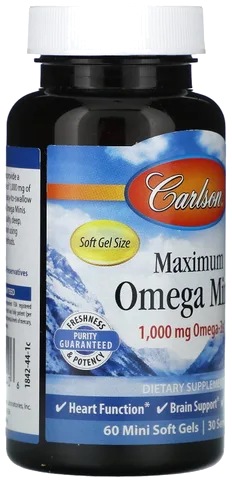
Carlson Maximum Omega Minis 1,000 mg Natural Lemon Flavor Review
We don’t sell supplements. We help you make decisions and get the best price.
Lowest prices
We may earn a commission from some store links. How we choose.
We hold no current store prices for it yet: check the store.
Sold at: iHerb · Walmart · PureFormulas
Study, Trial or Testing Result Summary
Members Only19 human studies · 8 improved
This product's omega-3 amount per serving is not shown on the label, so it cannot be compared with the doses used in studies. For reversing aging, the strongest evidence is not encouraging. A four-year trial in 1031 older adults found that 1 gram a day of marine omega-3 did not slow the shortening of telomeres, the protective caps on chromosomes, compared with placebo [1]. A four-month trial in 106 overweight adults lowered oxidative stress by about 15 percent, but telomere length did not change [2]. Some trials found less inflammation. In 112 healthy older adults, twelve weeks of omega-3 lowered a combined inflammation score, but it was given together with vitamins [3]. In 103 children with attention problems, eight weeks lowered inflammation markers and raised antioxidant enzyme activity [4]. Results for memory are mixed. A small trial in 44 adults aged 50 to 75 improved recall of object locations, though word-list memory did not change [5]. A two-year trial in 365 older adults at risk for dementia found no change in thinking or brain volume [6]. Overall, omega-3 may improve some markers linked to aging, but trials do not show that it reverses biological age. Animal and cell studies are never counted.
See all 19 studies →Hide the studies
- A review found that eating omega-3 fats (EPA and DHA) was linked to better metabolic health and to changes in how genes are switched on and off.Fatty acids, epigenetic mechanisms and chronic diseases: a systematic review.
- A review of 14 diet trials in people with lupus reported that omega-3 supplements reduced inflammation markers, disease activity and oxidative stress, and improved blood fats and blood vessel function.Diet and Systemic Lupus Erythematosus (SLE): From Supplementation to Intervention.
- A review of 13 controlled trials in healthy adults found omega-3 lowered some markers of muscle damage, inflammation and oxidative stress after exercise, though doses varied and results were mixed for muscle soreness.Omega-3 Fatty Acid Supplementation on Post-Exercise Inflammation, Muscle Damage, Oxidative Response, and Sports Performa…
- In 1031 older adults given 1 g a day of marine omega-3 for 4 years, there was no significant effect on telomere length compared with placebo, while vitamin D3 did slow telomere shortening.Vitamin D3 and marine ω-3 fatty acids supplementation and leukocyte telomere length: 4-year findings from the VITamin D …
- In 365 older adults at risk for dementia, 2 g a day of DHA for 24 months raised brain fluid DHA levels but did not change brain volume or thinking performance compared with placebo.CNS target engagement of high-dose DHA supplementation in older adults at risk for dementia: a randomised, double-blind,…
- In 112 healthy older adults, 12 weeks of omega-3 (1000 mg EPA plus DHA) combined with vitamins lowered a combined low-grade inflammation score compared with placebo.Multimicronutrient and omega-3 fatty acid supplementation reduces low-grade inflammation in older participants: An explo…
- In 106 overweight middle-aged and older adults, 4 months of omega-3 lowered oxidative stress by about 15% versus placebo, but telomere length did not differ between groups, though it rose as the omega-6 to omega-3 ratio fell.Omega-3 fatty acids, oxidative stress, and leukocyte telomere length: A randomized controlled trial.
- In 103 children with attention problems, 8 weeks of omega-3 lowered inflammation markers (CRP and IL-6), raised antioxidant enzyme activity and improved symptom scores compared with placebo.Effect of n-3 supplementation on hyperactivity, oxidative stress and inflammatory mediators in children with attention-d…
- In 63 people with Alzheimer disease, 1.7 g DHA and 0.6 g EPA daily for 6 months raised blood omega-3 levels and lowered DNA methylation at 2 of 4 tested sites compared with placebo, but the abstract does not show this to be a sign of younger biological age.DHA-rich n-3 fatty acid supplementation decreases DNA methylation in blood leukocytes: the OmegAD study.
- In 55 older women doing 4 months of exercise training, adding omega-3 from Calanus oil gave no additional benefit for fat tissue inflammation beyond exercise alone.Exercise Training Reduces Inflammation of Adipose Tissue in the Elderly: Cross-Sectional and Randomized Interventional T…
- In 44 healthy adults aged 50-75, 2,200 mg of omega-3 daily for 26 weeks improved recall of object locations compared with placebo, though a word-list memory test did not change.Impact of Omega-3 Fatty Acid Supplementation on Memory Functions in Healthy Older Adults.
- In 37 adults aged 40-70 with HIV, 1.6 g of fish oil daily for 12 weeks did not change inflammation or immune aging markers versus placebo, and more stomach side effects occurred with fish oil.Effects of Fish Oil on HIV-Related Inflammation and Markers of Immunosenescence: A Randomized Clinical Trial.
- In 27 older women aged 60 to 84, a multinutrient supplement with 1 g of omega-3 DHA per day for 6 months improved word recall and some cognitive tests compared with placebo.A High Omega-3 Fatty Acid Multinutrient Supplement Benefits Cognition and Mobility in Older Women: A Randomized, Double-…
- In 21 marathon athletes, 3 g per day of DHA-rich fish oil for 60 days increased lymphocyte proliferation and prevented a pre-race drop in cytokine production, but did not prevent marathon-induced immune cell death.Effects of DHA-rich fish oil supplementation on lymphocyte function before and after a marathon race.
- In 21 insulin-resistant adults over 6 months, 3.9 g per day of EPA and DHA raised omega-3 levels in blood and fat tissue but did not change fat tissue inflammation or insulin response compared with placebo.Very-long-chain ω-3 fatty acid supplements and adipose tissue functions: a randomized controlled trial.
- In 30 adults with diabetes, EPA plus DHA alone increased telomerase activity, but adding a med was followed by a decrease that showed only a non-significant trend.Read the study on PubMed (32723580) →
- In 27 young women, 1 month of 4 grams daily omega-3 fats lowered follicle-stimulating hormone in normal-weight women but not in obese women, and lowered inflammatory signals in obese women only.Omega-3 Fatty Acid Supplementation Lowers Serum FSH in Normal Weight But Not Obese Women.
- In 12 young and older adults, 16 weeks of 3.9 g per day of omega-3 fats in older adults lowered mitochondrial oxidant emissions and increased muscle protein synthesis, though mitochondrial respiration did not change.Influence of omega-3 fatty acids on skeletal muscle protein metabolism and mitochondrial bioenergetics in older adults.
- In Sardinian octogenarians and sexagenarians, plasma fatty acid and endocannabinoid profiles differed by age and longevity zone, but this observational study did not test any supplement.Circulating fatty acids and endocannabinoidome-related mediator profiles associated to human longevity.
Review Totals and Summary
Members Only1,567 reviews · 95% positive
Extensive customer reviews and qualitative feedback are currently being aggregated for this product. Check back soon for a detailed sentiment analysis.
Biohacker Summary
Members Only9 of 10 recommend it
Seven of the ten panelists recommend omega-3 fatty acids, one uses them, and two are neutral, with one of those neutral voices saying the research on heart disease outcomes is not very strong. The panel takes them for brain and mood support, lower inflammation, heart health, lower triglycerides, healthy aging, and fertility. Many prefer getting them from fatty fish such as salmon and sardines, while others choose fish oil or cod liver oil, and one warns that standard capsules are often too low in EPA and DHA, so people underdose. Doses given range from 1 gram a day up to 2 to 4 grams of combined EPA and DHA, and one panelist advises taking them with a meal that contains fat to improve absorption. Others suggest pairing them with real food sources and aiming for a better balance against omega-6 fats, and no one on the panel said they stopped taking them.
See all 10 biohackers →Hide the biohackers
Dr. Eric Berg · Omega-3 Fatty Acids · recommends
- Recommends fatty fish as one of the best foods for liver health.
- Lists omega-3 fatty acids as a natural cancer remedy.
- Notes that one can of sardines contains 900 mg of omega-3s (EPA and DHA).
- Recommends Omega-3s from fish oil or cod liver oil to improve the omega-6 to omega-3 ratio, which should be around 2:1 or 1:1 but is often 10:1 or 20:1 for most people.
- Notes that the meal is loaded with omega-3 fatty acids, which are super anti-inflammatory.
- Suggests that taking cod liver oil can help with flaky skin around the nose or forehead, which usually means too much omega-6 fat relative to omega-3 fat.
- Recommends fatty fish like salmon, sardines, and mackerel, which are high in omega-3 fatty acids (EPA and DHA) that reduce liver inflammation and prevent scarring.
- Recommends wild-caught salmon as a healthy food to eat every day, noting it contains about 2000 mg of omega-3s in just 3 ounces.
- Recommends wild salmon as it is rich in omega-3 fatty acids, which help reduce inflammation and support brain health and cognitive function, especially important as one ages.
- Recommends DHA, an omega-3 fatty acid, as a natural remedy that, along with sweet wormwood, can trigger iron into an explosion to hit cancer.
Dr. Mark Hyman · Omega-3 Fatty Acids · recommends
- Recommends eating fatty fish like salmon or sardines twice a week for brain-building omega-3s.
- Suggests that if kids' brains are malnourished and they don't have omega-3s, B vitamins, magnesium, or zinc, they won't be able to engage or function properly.
- States that 95% of Americans don't have an omega-3 index over 8%, and lower omega-3 index is a very high risk for cardiovascular disease and other issues like dementia, depression, ADHD, and bipolar disease.
- Explains why omega-3s are important for brain, mood, and healthy aging.
- Eats Zetopia's Atlantic salmon for Omega-3s and Vitamin D, especially in winter, noting that one serving provides as much EPA and DHA as two standard fish oil capsules.
- Mentions omega-3 fats as existing biomarkers that play a role in mental health, which Function Health includes in their measurements.
- Mentions that omega-3s are anti-inflammatory and helpful.
- Tries to supplement with omega-3s for psoriasis and considers them the one clearly clinically effective skin nutrient for skin, hair, and nails.
- Emphasizes the importance of focusing on omega-3s, noting that a national crisis of omega-3 deficiency exists and that low omega-3 levels are a significant problem, more so than omega-6s.
- Consumes omega-3 fats through salmon at dinner.
Dr. Rhonda Patrick · Omega-3 Fatty Acids · recommends
- States that omega-3 polyunsaturated fats, especially longer chain ones from seafood, have the strongest evidence for health benefits, including for heart attacks, and are overwhelmingly beneficial.
- Notes that Omega-3 fatty acids are an important part of cell membranes, neurons, and supporting cells around the brain, and also help regulate and resolve inflammation, which can contribute to memory problems.
- Mentions that if people eat a lot of sugar and saturated fat and then take in omega-3 fatty acids, it blunts the lipopolysaccharide response.
- Notes that Omega-3s (EPA and DHA) are important for neuronal membranes, brain function, and resolving inflammation, and higher levels are associated with lower dementia risk.
- Values salmon for its high content of omega-3 fatty acids.
- Highlights omega-3 fatty acids as important for cell membranes, neurons, supporting brain cells, the blood-brain barrier, and regulating inflammation, which can contribute to memory problems.
- Mentions that EPA is an omega-3 examined in mortality analysis and found primarily in seafood.
- States that Omega-3 fatty acids are very important for sperm health.
- Omega-3s may help slow biological aging, with added benefits when combined with vitamin D and strength training. In a 3-year randomized trial of healthy, mostly active older adults, omega-3 alone slowed several DNA-based aging clocks.
- Recommends regular intake of omega-3 rich seafood and supplementation with omega-3 fatty acids if it's appropriate for one's lifestyle, as they are beneficial for the heart by resolving inflammation and preserving membrane fluidity.
Andrew Huberman · Omega-3 Fatty Acids · recommends
- Mentions that AG1 is offering a free bottle of omega-3 co-enzyme Q10 with the first subscription to AG1 Pro.
- Mentions that AG1 is giving away a free bottle of omega-3 co-enzyme Q10 with the first subscription to AG1 Pro.
- AG1 is giving away a free bottle of omega-3 coenzyme Q10 with your first subscription.
- Mentions that AG1 is giving away a free bottle of Omega-3 co-enzyme Q10 with the first subscription to AG1 Pro.
- Discusses Omega-3 Fatty Acids and EPA.
- Mentions that AG1 is offering a free bottle of Omega-3 co-enzyme Q10 with a first subscription to AG1 Pro.
- Recommends a free bottle of Omega-3 co-enzyme Q10 with the first AG1 Pro subscription.
- Mentions Omega-3s in the context of the microbiome and processed foods.
- Recommends Omega-3 co-enzyme Q10, which is offered as a free bottle with the first AG1 Pro subscription.
- States that getting 1 to 3 grams of EPA essential fatty acid per day can improve mood and cognitive function, supporting focus and concentration.
Thomas DeLauer · Omega-3 Fatty Acids · recommends
- Recommends eating more omega-3s to turn over cell membranes more quickly.
- Recommends fish oil supplements as an omega-3 source for gut health, as they help reduce inflammatory signaling while tissue repairs.
- Recommends high-dose omega-3s, specifically 2 to four grams of combined EPA and DHA daily, to lower hepatic fat output and improve chylomicron clearance, which helps with non-fasting triglycerides.
- Recommends omega-3s, specifically 4 grams a day, to boost the muscle building response by making muscle cell membranes work better for the mTor switch to fire, and specifically mentions Pury for their clean, third-party tested omega-3s.
- Recommends consuming more omega-3s to help balance the mitochondrial membrane, as it will absorb more omega-3s instead of omega-6s.
- Recommends consuming more omega-3s to drive down inflammation.
- Recommends omega-3s, stating that a meta-analysis found 1,000 mg significantly reduced liver fat by shutting down inflammatory signals that promote fat storage, and advises looking for a triglycerol form for better absorption and to avoid oxidation.
- Recommends fatty fish like salmon and sardines, aiming for two to three servings per week, especially around a workout, because their omega-3s, particularly DHA, increase BDNF expression.
- Considers omega-3s a fundamental for brain protection, recommending both dietary sources and supplementation for EPA and DHA, as they produce pro-resolving mediators to limit inflammation.
- Recommends timing omega-3 intake around workouts because they directly help build and keep muscle by making muscle more responsive to growth signals and fighting anabolic resistance as one ages.
Siim Land · Omega-3 Fatty Acids · recommends
- Recommends taking omega-3s, including EPA and DHA, with a fat-containing meal to increase absorption.
- Increased his omega-3 intake to achieve a higher omega-3 index, which is associated with greater insulin sensitivity and better metabolic health markers.
- Increased his omega-3 index to 9.5% and notes that omega-3s have strong evidence for reducing elevated triglycerides.
- Mentions that EPA and DHA Omega-3s support heart and brain function and can lower triglycerides, with a higher omega-3 index associated with lower heart disease, Alzheimer's and mortality risk.
- Recommends Omega-3s for triglycerides and cardiovascular health, based primarily on human research, especially randomized controlled trials showing measurable benefits.
- Recommends choosing an omega-3 supplement from a brand that uses independent third-party testing and publishes a recent certificate of analysis, verifying EPA and DHA amounts, and testing for heavy metals, contaminants, and oxidation markers.
- Lists Omega-3s as one of 15 supplements backed by human studies.
- Explains that omega-3s can alter mitochondrial membranes and have broader cardiometabolic effects, making mitochondria more responsive to cellular signaling and oxidative stress from exercise, but they don't increase maximal mitochondrial respiration.
- Notes that 75% of people aren't meeting the daily recommendation for omega-3s and that Japanese people eat 2-3x more omega-3s per day than Americans or Europeans, which reflects in their higher omega-3 index.
- Thinks omega-3s have some of the strongest evidence and are worth considering.
Dave Asprey · Omega-3 Fatty Acids · recommends
- Suggests that omega-3s may help slow aging and support cellular repair.
- Recommends omega-3s, noting that 1 gram a day slowed epigenetic aging by up to 4 months in a randomized trial of people over 70.
- Dave Asprey recommends Omega-3, citing a randomized trial showing 1g a day slowed epigenetic aging in older adults, but warns that most people underdose due to low EPA and DHA content in standard capsules.
- A review of 41 human studies testing interventions against newer-generation epigenetic clocks found favorable changes for exercise, caloric restriction, omega-3s, plant-rich diets, multivitamins, a med, pitavastatin, and ketamine.
- Recommends getting nutrients like omega-3s from real food or Vision 101 for eyesight.
- Recommends adding omega-3 fats to improve how neurons absorb and use nutrients like vitamin C.
- States that Fatty15 supports cells better than omega-3s or fish oil, but he uses both.
- Notes that Inuit people consumed very high levels of omega-3s, specifically EPA and DHA, which contributed to their health on a whale blubber diet.
- Lists Omega-3s as a nutrient that forms the structure and different parts of the brain.
- Uses both C15 and omega-3s, noting that C15 supports cells better than omega-3s or fish oil with three times more benefits.
Ben Greenfield · Omega-3 Fatty Acids · neutral
- Notes that omega-3s have solid research behind them for fertility.
- Recommends omega-3 fatty acids, specifically EPA and DHA, at 1 to 3 grams per day for better sperm morphology and motility, noting that sperm membranes are rich in polyunsaturated fatty acids.
- Recommends getting Omega-3 from oily fish such as sardines, anchovies, mackerel, herring, and salmon with skin.
- Discusses why fatty fish or fish oil may matter more than plant-based omega-3s if seed oils are in one's diet.
- Says that omega-3 fatty acids are a great way to feed the system and help with stress.
- Recommends testing for and replenishing omega-3 fatty acids if levels are low, as they can affect the ability to maintain or preserve muscle, especially for those on GLP-1s.
- Recommends including EPA from fatty fish or fish oil in one's diet, especially if seed oils are present in the diet.
- Notes that B vitamins and Omega-3s work as a pair to support the brain, but not independently.
- Notes that the DO-Health study showed omega-3 had good effects, and it's a supplement people commonly take.
- Mentions that omega-3, vitamin D, and exercise all had good effects in the DO-Health study.
Peter Attia · Omega-3 Fatty Acids · neutral
- Peter and Michael explore the benefits of omega-3 fatty acids for cardiovascular trials and the challenge of delivering DHA to the brain.
- Mentions that some trials showing a benefit to PUFA were confounded by the inclusion of omega-3s, and argues that the literature on omega-3s is not super strong for decreasing hard cardiovascular disease endpoints.
- Took big doses of omega-3 postpartum to help maintain when she wasn't sitting down to eat full meals.
- Mentions consuming fatty fish, specifically sardines, as part of their diet, noting their high fat and protein content.
- Peter discusses how omega-3s from fish oil impact inflammation, heart health, and brain function, as well as the strengths and limitations of current research.
- Mentions the importance of DHA omega-3 fatty acids for neuronal membranes, which are concentrated in synapses and crucial for communication between neurons.
- Highlights the importance of DHA omega-3 fatty acids for neuronal membranes and communication between neurons, as they are concentrated in synapses.
- Discusses the mfsd2a transporter, which is specific to DHA in phospholipid form, and its role in blood-brain barrier integrity, noting that animal studies show disruption of this transporter causes significant breakdown of the blood-brain barrier and loss of omega-3 in the brain.
- States that there is a very strong clinical impression that high doses of omega-3s help with dry eye, primarily from an anti-inflammatory standpoint.
- Recommends omega-3 fatty acids, specifically DHA and EPA, for brain protection, especially for individuals with the APOE4 gene, stating that they require higher doses.
Bryan Johnson · Omega-3 Fatty Acids · uses
- Lists Omega-3 as a customer favorite.
- Recommends Omega 3 fatty acids as a supplement for skin health, noting they are in the Blueprint stack.
- During menopause, Bryan Johnson recommends ensuring adequate omega-3s for brain health.
RAL Summary
Members OnlyTier 3 for Healthy Aging
Tier 3 rests on 1567 reviews that are 95 percent positive, with only some study support: omega-3 lowered oxidative stress and inflammation in some trials [2][3], but the largest trial found no effect on telomere shortening [1].
- Omega-3 Fatty Acids: amount hidden in a blend
Where the evidence disagrees: 5 of the 19 human studies found no effect.
More Details
Members OnlyBody systems · Combine with · Possible side effects
Body systems: Cardiovascular system, Immune system, Nervous system
Combine with: Combine with a healthy diet and lifestyle.
Possible side effects: No major side effects reported.
Supplement Facts
Marine Oil Concentrate 1250 mg
| Calories | 15 | |
| Total Fat | 1.5 g | |
| Marine Oil Concentrate | 1,250 mg | † |
Other ingredients: Beef Gelatin, Glycerin, Water, Lemon Flavor, Natural, Mixed Tocopherols, Natural.
Directions: Directions: Adults: Take two soft gels daily at mealtime.
Barcode (UPC) 088395184406 · Label source: NIH label database · Report a label change
Other sizes and barcodes: 120 Mini Softgel(s), UPC 0 88395 18460 4 (found for sale); 120 Mini Softgel(s), UPC 0 88395 18460 4 (found for sale); 60 Mini Softgel(s), UPC 0 88395 18420 8 (not checked yet); 60 Mini Softgel(s), UPC 0 88395 18420 8 (not found for sale)
Show entire label
More healthy aging products
Members OnlyThe highest ranked for the same goal
Read more
Our articles on this subject
- Healthy Aging Tips: A Science-Backed Guide to Living Better for LongerArticle · Mar 17, 2026
- NAD Anti-Aging Supplements: Benefits, Evidence, and How to ChooseArticle · Jun 15, 2026
Graded November 19, 2026 by the Reverse Age Lab evidence engine, from human studies, real reviews and our biohacker panel. How we grade. Is this medical advice? No. Rala organizes the published evidence; go over any change with your doctor, especially if you take meds.
Privacy policyConsumer health dataAffiliate disclosureTermsBrand and legal noticesDo Not Sell or Share My Personal InformationCookie settings