DBI Distribution Mini Thin 25-50 Review
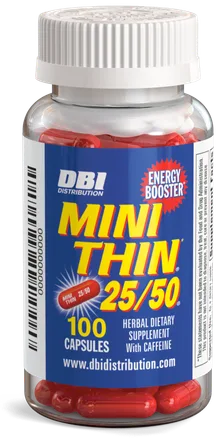
The DBI Distribution Mini Thin 25/50 listing is a 6 count packet of Mini Thin energy capsules sold on Amazon by DBI Distribution and shipped by Amazon. The product is listed under the Mini Thin brand, with green tea as the flavor, choline as the primary supplement type, and capsule as the item form. Each packet contains 6 capsules, and the item details list 6 servings per container, 6 items, and a container type of packet. The page describes the product as an energy supplement and lists an item size of 3.9 x 2.7 x 1.5 inches. The first bullet point describes a caffeine powered energy boost, stating that each tablet includes 200mg of caffeine for a powerful boost of energy throughout the day. The second bullet describes an exclusive proprietary blend featuring 25mg of Ephedrizine blend with Coryanthe Extract, Yerba Mate, Cayenne Pepper, White Willow Bark and more. The third bullet presents the product as a cost-effective energy solution, saying it offers more energy per serving than energy drinks or shots with 6 capsules per packet. The fourth bullet says the product provides sustained energy for more hours compared to other energy products on the market. The fifth bullet states that natural ingredients including Green Tea, Choline Bitartrate, D-Aspartic Acid and DMAE are included for a balanced energy boost. The page notes that the item is non-returnable due to potential safety risk as an ingestible product, though an item that arrives damaged or defective may be refunded or replaced through Your Orders by providing an image of the item and its defects. The brand applies a Transparency code to each item, which Amazon verifies before shipping. The listing is marked as from a small business brand. The page also carries a legal disclaimer stating that statements regarding dietary supplements have not been evaluated by the FDA and are not intended to diagnose, treat, cure, or prevent any disease or health condition. It further notes that manufacturers may alter ingredient lists and that buyers should read labels, warnings, and directions before use. The listing shows a one-time purchase price of $14.98, or $2.50 per count, and a Subscribe and Save price of $14.23 with a 5 percent saving, or $13.48 with a 10 percent saving on repeat deliveries. The product is rated 4.1 out of 5 stars from 69 ratings. The page shows an Amazon's Choice badge and a Competitively priced item label. The manufacturer part number is CBD-10-123P-17082023-6P-010 and the ASIN is B0CJT3MZHP. The best sellers rank is 115,329 in Health and Household, 859 in Sports Nutrition Endurance and Energy Products, and 4,372 in Blended Vitamin and Mineral Supplements.
We don’t sell supplements. We help you make decisions and get the best price.
Lowest prices
We may earn a commission from some store links. How we choose.
Finding the lowest prices at the stores now. This takes a few seconds.
Study, Trial or Testing Result Summary
Members Only39 human studies · 19 improved
The main ingredient with support is caffeine, taken here at 400 milligrams a day, a full dose. A pooled review of 13 randomized trials with 606 people found that more caffeine was linked to greater drops in weight, body mass and body fat [1]. In 52 adults, a coffee blend with about 121 milligrams of caffeine a day lowered body fat over 8 weeks [2]. In 27 overweight women exercising for 10 weeks, a caffeine and green tea drink improved muscle mass, fitness and strength [3]. In 24 women with obesity, caffeine before interval training reduced body fat about as much as training alone [4]. Not all studies agreed: green tea with caffeine did not change weight regain [5]. Bitter orange, at 166 milligrams a day, does not appear to help. A pooled review of 18 placebo-controlled trials found no meaningful weight loss and a rise in blood pressure with long-term use [6]. In 18 active women it did not change fat burning during exercise [7], and small pilot studies found no benefit [8]. The rest of the formula is a 30 milligram proprietary blend whose contents and doses are not shown, and no studies of it were given. Animal and cell studies are never counted.
See all 39 studies →Hide the studies
- Across 13 randomized trials with 606 people, more caffeine intake was linked to greater reductions in weight, body mass index and body fat, with each doubling of intake giving about 17 to 28 percent more reduction.The effects of caffeine intake on weight loss: a systematic review and dos-response meta-analysis of randomized controll…
- Pooling 18 placebo-controlled trials, bitter orange extract and synephrine did not produce significant weight loss or change body composition, and raised blood pressure after prolonged use.The Safety and Efficacy of Citrus aurantium (Bitter Orange) Extracts and p-Synephrine: A Systematic Review and Meta-Anal…
- A systematic review found only one eligible placebo-controlled trial, in 20 people over 6 weeks, which showed no significant weight loss benefit from citrus aurantium.Safety and efficacy of citrus aurantium for weight loss.
- A review of diet trials in adults with asthma noted caffeine raised lung function (FEV1) but did not report weight outcomes for caffeine, so it says little about weight management.Diet effects in the asthma treatment: A systematic review.
- In 167 overweight adults over 6 months, an herbal ephedra and caffeine supplement led to greater weight loss than placebo (5.3 kg vs 2.6 kg) and greater body fat loss, with more dry mouth, heartburn and insomnia.Herbal ephedra/caffeine for weight loss: a 6-month randomized safety and efficacy trial.
- In 142 people after weight-loss surgery, ephedrine plus caffeine for 27 weeks reduced the drop in resting energy burn and led to greater weight loss than placebo, with anxiety, dizziness, insomnia and tremors the most common side effects.Sympathomimetic increases resting energy expenditure following bariatric surgery: A randomized controlled clinical trial…
- In 140 obese adults over 24 weeks, a Chinese herbal formula containing citrus aurantium led to 3.58 kg weight loss versus 1.91 kg with a low-dose control, a significant difference, but it is a multi-herb mix.Chinese herbal medicine for obesity: a randomized, double-blinded, multicenter, prospective trial.
- In 104 overweight adults who had lost weight, 13 weeks of green tea with 104 mg caffeine daily did not change weight regain compared with placebo.Effects of green tea on weight maintenance after body-weight loss.
- In 68 overweight adults over 12 weeks, a thermogenic supplement with caffeine caused no meaningful change in body weight or composition, though it may have raised energy burn and reduced hunger.An Examination of a Novel Weight Loss Supplement on Anthropometry and Indices of Cardiovascular Disease Risk.
- In 67 overweight men and women over 8 weeks, a herbal supplement with 240 mg caffeine daily led to more weight loss than placebo (4.0 kg vs 0.8 kg), with 23% of the treated group withdrawing because of possible side effects.An herbal supplement containing Ma Huang-Guarana for weight loss: a randomized, double-blind trial.
- In 58 men and women over 12 weeks, green tea capsules with caffeine did not change body composition or gut bacteria compared with placebo.Long-Term Green Tea Supplementation Does Not Change the Human Gut Microbiota.
- In 52 men and women aged 18-45, drinking three servings a day of a green and roasted coffee blend (121 mg caffeine) for 8 weeks lowered body fat percentage, blood pressure, blood sugar, triglycerides and leptin compared with a control drink.Regularly consuming a green/roasted coffee blend reduces the risk of metabolic syndrome.
- In 52 healthy exercise-trained adults (half women), four weeks of protein plus a thermogenic supplement kept resting energy burn higher than no supplement, but body composition, body measurements and mood did not differ.Chronic Thermogenic Dietary Supplement Consumption: Effects on Body Composition, Anthropometrics, and Metabolism.
- In 50 adults (58% women), a single 1 mg/kg caffeine dose lowered breakfast calorie intake by about 10%, but 3 mg/kg did not, and appetite and food intake later in the day were unchanged.Caffeine Transiently Affects Food Intake at Breakfast.
- In 48 adolescents with obesity receiving nutrition counseling, drinking 2 cups of coffee a day (160 mg caffeine) for 6 months lowered BMI by 9.2%, versus 2.3% with green tea and a 0.76% rise with herbal tea.Effect of Coffee and Tea Consumption on Adolescent Weight Control: An Interventional Pilot Study.
- In 36 overweight adults on diet and exercise for 8 weeks, both supplement and placebo groups lost weight and fat similarly, while the supplement group had larger hip reductions in women and better leptin and adiponectin levels.The Combined Effects of Exercise, Diet, and a Multi-Ingredient Dietary Supplement on Body Composition and Adipokine Chan…
- In 30 obese men, 8 weeks of sprint interval training with caffeine taken before sessions produced greater reductions in body fat and better strength, fitness, blood sugar and cholesterol than training with placebo. The study enrolled men only.Eight Weeks of Sprint Interval Training With Adding Caffeine Ingestion Leads to Greater Improvements in Health-Related P…
- In two small pilot studies of 28 people over 8 weeks, citrus aurantium users gained about 1.1 kg versus 0.1 kg on placebo, and body composition, waist and hunger did not differ, so it did not help weight loss.Dietary herbal supplements with phenylephrine for weight loss.
- In 27 overweight and obese women, a caffeine and green tea extract drink taken daily for 10 weeks with exercise improved muscle mass, peak oxygen use and strength compared with placebo, and total cholesterol fell in the supplement groups.Physiological effects of caffeine, epigallocatechin-3-gallate, and exercise in overweight and obese women.
- In 24 women with obesity doing 8 weeks of high-intensity interval training, caffeine at 3 mg per kg before each session reduced body fat along with training alone, but only the caffeine group avoided the rise in blood sugar and insulin seen with training alone.Caffeine Optimizes HIIT Benefits on Obesity-associated Metabolic Adversity in Women.
- In 24 obese adults over 8 weeks, a combination of ephedrine, caffeine (150 mg) and a med produced more weight loss than placebo (2.2 kg vs 0.7 kg) without restricting food intake.Read the study on PubMed (8384187) →
- In 20 women walking on a treadmill, a 6 mg per kg caffeine dose slightly raised energy use compared with placebo, but the authors judged the increase too small to affect weight loss.The physiological effects of caffeine in women during treadmill walking.
- In 20 women of average fitness, a single caffeine dose of 3 or 6 mg per kg did not change energy cost, heart rate, or perceived effort during aerobic-dance bench stepping compared with placebo.The effects of caffeine in women during aerobic-dance bench stepping.
- In two groups of 10 overweight men given a single dose of a blend with 6 mg synephrine, total energy use at rest and during walking did not change, though fuel use shifted toward carbohydrate.Metabolic and physiological effects of ingesting extracts of bitter orange, green tea and guarana at rest and during tre…
- In 18 healthy active women, a single dose of 3 mg per kg p-synephrine did not change fat burning or energy use during exercise compared with placebo, though resting body temperature rose slightly.Effect of p-Synephrine on Fat Oxidation Rate during Exercise of Increasing Intensity in Healthy Active Women.
- In 17 healthy people, single doses of p-synephrine of 1 to 3 mg per kg raised the maximal rate of fat burning during exercise versus placebo, with the largest effects at 2 and 3 mg per kg.Dose-Response Effects of p-Synephrine on Fat Oxidation Rate During Exercise of Increasing Intensity.
- In 15 elite cyclists, a single dose of p-synephrine (3 mg per kg body weight) raised fat burning during an exercise test compared with placebo, without changing energy expenditure or heart rate.p-Synephrine, the main protoalkaloid of Citrus aurantium, raises fat oxidation during exercise in elite cyclists.
- In 14 healthy people, a single dose of p-synephrine (3 mg per kg body weight) increased fat burned during an hour of cycling (37.3 vs 33.6 g) compared with placebo, though the shift was small and energy expenditure did not change.Acute p-synephrine ingestion increases whole-body fat oxidation during 1-h of cycling at Fatmax.
- In 13 healthy adults, a single dose of caffeine (3 mg per kg of body weight) taken before cycling raised the peak rate of fat burning during exercise compared with placebo, without changing total energy use.Effects of p-Synephrine and Caffeine Ingestion on Substrate Oxidation during Exercise.
- In 12 men over three days, drinking water with 270 mg caffeine raised 24-hour energy expenditure by about 3.4 percent compared with plain water, and full-strength oolong tea also raised fat burning by 12 percent.Oolong tea increases metabolic rate and fat oxidation in men.
- In 12 healthy adults cycling for 1 hour, a 3 mg per kg caffeine dose increased the amount of fat burned compared with placebo, though total energy use did not change.Caffeine increases whole-body fat oxidation during 1 h of cycling at Fatmax.
- In 10 overweight or obese men taking 200 mg caffeine for 3 days, fat burning rose by about 26 to 35 percent compared with placebo, matching the effect of a low green tea extract dose.Epigallocatechin-3-gallate and postprandial fat oxidation in overweight/obese male volunteers: a pilot study.
- In rats given caffeine with albuterol for 4 to 8 weeks, body fat gain was reduced and lean mass gain increased without changes in food intake; in humans, single doses raised resting metabolic rate, but this was not tested for weight loss in women.The effect of caffeine and albuterol on body composition and metabolic rate.
- In 16 healthy adults, 200 mg caffeine combined with ephedrine raised blood pressure, heart rate, fasting glucose, and insulin more than either drug alone or placebo.Enhanced stimulant and metabolic effects of combined ephedrine and caffeine.
- In 13 women, matcha green tea drinks raised fat burning during a 30-minute brisk walk compared with control.Matcha Green Tea Drinks Enhance Fat Oxidation During Brisk Walking in Females.
- Prenatal caffeine exposure, including at the recommended safe level, was linked to more externalizing behavior problems in children aged 9 to 11.Prenatal caffeine exposure: association with neurodevelopmental outcomes in 9- to 11-year-old children.
- Higher caffeine levels during pregnancy were linked to shorter height in children aged 4 to 8, even at low caffeine intake.Association of Maternal Caffeine Consumption During Pregnancy With Child Growth.
- In a study of 106 young children of obese mothers, days when children had caffeine were linked to 121 more calories and 3.8 grams less protein, so caffeine tracked with poorer diet quality rather than weight control.Calories, Caffeine and the Onset of Obesity in Young Children.
- In 24 adults with obesity, caffeine was used as a test drug to measure enzyme activity, and weight loss of 3 to 6 months changed some drug-metabolizing enzyme activity; caffeine itself was not tested for weight loss.Examining the Impact of Diet-and-Exercise-Induced Weight Loss on Drug Metabolism and Gastric Emptying in Patients with O…
Review Totals and Summary
Members Only162 reviews · 75% positive
The feedback I could reach comes mostly from eBay product and seller reviews, plus an energy-drink review video. I found no large body of reviews from other regions. Many buyers like the energy lift. They describe the product as effective and "not too strong." Several say it gives a clean, noticeable boost for the price, and they present it as a cheaper alternative to energy drinks and shots. Buyers also praise the sellers: fast shipping, secure packaging, fresh stock and products that match the listing. Some reviewers say they buy from one seller specifically because of freshness and quick delivery. Positive reviews outnumber negative ones heavily, and most ratings are four or five stars. A smaller group complains about side effects. One reviewer got about an hour of pleasant energy, then roughly two hours of dizziness, a racing heart and sweating, and said they would not buy it again. Another buyer found the reformulated "new and improved" version too strong. They asked for the old formula and said they open the capsules and empty out some of the contents. This points to a recurring theme of reformulation. Other buyers say it is "not quite the same as it used to be," and some ordered by mistake because they expected a different capsule colour or version. That suggests inconsistent versions are in circulation (blue-pack, white-capsule and "new" formulas). Overall, customers like the affordable, noticeable stimulation and reliable delivery. Their main complaints are overstimulation and jitters in sensitive users, a short or uneven duration of effect, and changing formulas. Few reviewers mention weight loss directly. They treat it mainly as an energy pill rather than a proven fat burner. Because the sample is small and comes mainly from marketplace sellers, it likely skews positive.
Biohacker Summary
Members Only8 of 10 recommend it
All ten panelists spoke about caffeine, the main ingredient, and they are split: four use it, one recommends it, one is neutral, two warn against it, and one stopped for a year. People who like it take it for focus, mood, alertness, and fat burning before fasted or low intensity exercise, mostly through coffee or green tea, with doses of 100 to 200 milligrams for focused work, a range up to 400 milligrams, and 300 milligrams of slow release caffeine for jet lag. Two of them pair it with L-theanine for calmer focus, and one also adds Alpha GPC and MCT to his coffee. The most common caution is timing, since several say to stop by noon or lunch because later caffeine cuts into sleep, and others warn that it can raise stress, anxiety, or restlessness, set up an afternoon crash, or make fatigue worse. One panelist advises cutting it out in the three months before conception, and another says people differ in how strongly they feel it.
See all 10 biohackers →Hide the biohackers
Dave Asprey · Caffeine · uses
- Loves coffee, has the caffeine molecule tattooed on his arm, drinks it every morning, and says it does amazing things for your brain and for how long you can live, but it can't clear most brain fog on its own.
- Created Danger Coffee, a mineral-enriched, lab-tested, mold-free coffee that delivers rich flavor and clean caffeine without all the junk, and recommends it to others.
- Dave Asprey's lab proved that caffeine is a flow hack and the only known substance to actually make you flow prone. Coffee will make you more flow prone.
- Dave explains why the 1:2 ratio of caffeine to L-theanine beats coffee alone for working memory, accuracy, and calm, sustained concentration.
- States that his entire career started on caffeine and he uses it every morning, but notes it's like a loan from your future self, leading to an afternoon crash.
- Dave Asprey's company used caffeine, which is a safe ingredient, but they stopped using it because it doesn't provide the type of results and change in the skin that newer ingredients do.
- States that caffeine is one of his superpowers and increases the rate of ketone formation, which fuels neurons.
- Once I’ve hydrated and taken my creatine, I reach for Danger Coffee for caffeine and essential minerals in one cup.
- Uses caffeine, noting it blocks adenosine to increase norepinephrine and dopamine signaling, fueling the prefrontal cortex for focus. He mentions it got him through business school and is part of his longevity journey.
- Does not believe caffeine is a nootropic, considering it just a stimulant.
Thomas DeLauer · Caffeine · neutral
- Explains that caffeine from green tea mobilizes fatty acids, which can be converted into ketones, providing a ketone boost, especially in a fasted or low-carb state.
- Warns that treating brain fog with caffeine without addressing underlying inflammation is ineffective and likely to make the situation worse.
- Notes that caffeine significantly increased fat metabolism and fat oxidation during exercise, especially at lower intensities, and that adding coffee around an exercise bout led to more calories and fat burned.
- Says that caffeine significantly increased fat metabolism and that at low intensity cardio or exercise caffeine works better at mobilizing and utilizing fat.
- Might have some caffeine before fasted training.
- Recommends caffeine as a must on the fasting day to create a low-grade energy demand that forces the body to favor lipolysis.
- Recommends drinking 150 to 200 mg of caffeine immediately before a 20-minute nap to enhance alertness and performance, as the caffeine peaks when the nap has cleared adenosine.
- States that caffeine is probably the most studied ergogenic aid with a profound effect on fat mobilization, suggesting that simple is better.
- Mentions that people try cutting out caffeine when dealing with sleep issues, but it's not always the root cause.
- Warns that consuming more than 50-60 mg of caffeine in the first hour after waking stacks a stimulant on top of the body's natural cortisol-driven alertness, leading to a sharp spike and mid-morning crash, and building tolerance faster.
Andrew Huberman · Caffeine · uses
- Used caffeine, taking 400 milligrams, to improve his mood and physical vigor during mundane tasks like swimming, noting that it made life not so bad and allowed him to rip through the water.
- Mentions caffeine in a discussion about supplement use.
- Discusses caffeine timing as a tool related to sleep.
- He recommends caffeine, in coffee or tea form, or in tablet or capsule form at lower dosages than found in coffee and tea, as a reasonable way to explore stimulant-based approaches for enhancing cognitive function and focus.
- Huberman states that caffeine can improve focus and concentration, with a general useful range of 100 to 400 milligrams, and most people do well with 100 to 200 milligrams prior to focused work.
- Discusses caffeine as a tool for improving attention, noting its impact on focus and sleep.
- Mentions that coffee and tea produce caffeine, which were likely defense chemicals, and that plants learned it was better to alter consciousness than kill predators outright.
- Discusses caffeine and its health benefits.
- Recommends caffeine as a tool to increase motivation and dopamine.
- Huberman explains that regular ingestion of caffeine at safe levels of about 100 to 250 mg increases the number of D2 and D3 dopamine receptors, making circulating dopamine more potent.
Dr. Rhonda Patrick · Caffeine · neutral
- Explains that caffeine can activate AMPK, a cellular energy sensor involved in fat burning and glucose regulation, which helps muscle cells take up glucose and promotes using fatty acids for energy.
- Recommends pairing caffeine with L-theanine to enhance alertness and focus while mitigating anxiety and jitteriness, suggesting a dose of 100 to 150 mg of caffeine.
- Recommends pairing coffee with L-theanine to enhance cognitive performance, noting that L-theanine can help balance caffeine’s stimulatory effects.
- Recommends cutting out caffeine in the three months before conception for both men and women, as it affects sperm.
- Recommends caffeine for alertness and focus, especially when combined with L-theanine to smooth out the response and maintain cognitive benefits, suggesting a practical dose of 100-150 mg.
- Recommends cutting down or eliminating caffeine when actively trying to conceive.
- Warns that a very high dose of caffeine, around 350 mg pre-workout, may blunt some of creatine's performance benefit due to opposite effects on muscle relaxation.
- Self-administers 350 mg of caffeine in a bolus right after returning from mass and his workout, and before eating, noting that he likes dark roast Starbucks.
- The newest literature on Caffeine dose and its link to multiple cardiometabolic disease risk reduction shows that even the ≥400 mg group was healthier than 0 mg.
- Explains that caffeine works by blocking adenosine, a molecule that builds up and makes one feel tired, and that timing coffee intake is about leveraging adenosine biology for peak cognitive alertness.
Siim Land · Caffeine · recommends
- Recommends stopping caffeine earlier to improve sleep.
- Notes that polyphenolic compounds in coffee, both decaf and regular caffeinated, can influence cellular stress pathways and have been seen to increase autophagy activity in mice, with regular coffee appearing more potent due to caffeine's additional energetic stress.
- Recommends moving caffeine intake earlier in the day because having it too late can disrupt sleep, especially for slow metabolizers.
- Recommends not having caffeine after lunch, noting that 400 mg 4 hours before bed reduced deep sleep by approximately 30 minutes in a trial, although he personally has a fast caffeine metabolism.
- Warns that combining a large dose of glycine with caffeine can amplify negative experiences, as caffeine independently increases arousal and can cause restlessness, anxiety, and increased heart rate.
- States that regular coffee promotes visceral fat loss, and going from low or zero intake to moderate intake increases fat loss due to caffeine and polyphenols.
- Suggests that higher caffeine intake might be useful for older people because caffeine raises cortisol, and consuming it in the morning contributes to circadian regulation.
- States that caffeine has proven benefits for increasing exercise performance when used correctly and at the right time.
- States that caffeine raises blood pressure, but mostly if one is not used to consuming it, and habitual caffeine consumers develop tolerance to these effects.
- Quotes a tweet suggesting that without caffeine, civilization would be 100 years behind.
Ben Greenfield · Caffeine · stopped
- Came off caffeine for a year after his separation.
- Quit caffeine in the same year he quit testosterone replacement therapy and alcohol.
- Uses caffeine, such as coffee or green tea, in his morning fasted fat-burning session to slightly increase the oxidation of fats.
- Advises against relying on caffeine for morning energy, suggesting that natural sugar-based stimulants combined with hydration and meditation can provide sufficient wakefulness.
- Recommends Caffeine, noting that it can improve focus, mood, and training, help control appetite, raise calories burned, and reduce fatigue.
- Notes that 3 mg/kg of caffeine increases fat oxidation by 31%, and 5 mg/kg increases it by 51% compared to a placebo.
- Caffeine on its own isn’t particularly impressive as an ergogenic aid, but when combined with taurine, there are significant increases in power production.
- Mentions that caffeine can help mitigate the negative effects of a caloric deficit on lean muscle mass and metabolism.
- Has talked before about caffeine as a supplement that seems to assist with sleep deprivation.
- Warns that energy drinks can deliver large doses of caffeine quickly, which may overstimulate the heart and cause abnormal heart rhythms and electrocardiogram changes, especially in children.
Dr. Mark Hyman · Caffeine · warns
- Discusses with patients their caffeine consumption, suggesting that too much caffeine can artificially increase their stress response.
- Recommends stopping caffeine by noon.
- States that caffeine's effect on ADHD depends on the person, as it can help focus but also activate irritation or stress, and its impact is related to individual caffeine metabolism.
- Warns that drinking coffee first thing in the morning before eating layers caffeine on top of already elevated stress hormones, providing unsustainable energy and setting up for an afternoon crash.
- Notes that caffeine is one of the things that drives the hormone imbalance causing PMS.
- States that drinking coffee on an empty stomach, which is how most people do it, is probably not the best thing as it gives a jolt of caffeine and adrenaline before eating.
- Warns that caffeine, alcohol, and spicy foods can be potent triggers for hot flashes, and excess caffeine should be avoided.
- Warns that adding fiber does not cancel out the negative effects of caffeine and other processed additives.
- Warns that high caffeine intake, especially coffee, can contribute to dehydration by increasing fluid loss and masking fatigue, leading to a deficit if not balanced with sufficient water intake.
- Warns that caffeine without adequate protein creates blood sugar chaos, sending a stress signal to the brain and hindering healing.
Dr. Eric Berg · Caffeine · warns
- Warns that caffeine can keep you awake and advises to watch out for hidden sources of caffeine.
- Stimulating the body with caffeine can actually make fatigue worse.
- Dr. Berg warns that stimulating the body with caffeine can actually make fatigue worse.
- Warns that too much caffeine is a common cause of worry, indecision, fear, and tension, and that it depletes vitamin B1, negatively affecting the nervous system.
- Warns that even a lot of caffeine in the morning can inhibit melatonin at night.
- Warns that coffee does not give you energy; instead, caffeine binds to adenosine receptors, inhibiting sleep signals and merely preventing sleepiness.
- States that caffeine can affect the ability to absorb magnesium and cause a deficiency.
- Warns that drinking caffeinated beverages later in the day can keep you awake because the liver needs to detoxify the caffeine.
- Warns that consuming caffeine can worsen tinnitus, citing a person who noticed this effect.
- Stimulating the body with caffeine can actually make fatigue worse.
Bryan Johnson · Caffeine · uses
- Drinks coffee when starting to fade, ensuring the last cup is between 10 and 12 hours before bed so caffeine doesn't affect sleep.
- Used 300 mg of caffeine in the morning as part of their jet lag recovery.
- Uses 300 mg of slow release caffeine in the morning as part of a jet lag recovery protocol.
- Notes that coffee affects the gut, which then affects the brain, and that it is the coffee bean, not the caffeine, doing most of the work.
- Notes that the culture in DC involves running on caffeine, along with alcohol and sleep deprivation, leading to poor nutrition and an unhealthy environment.
- Warns that caffeine has a 6-hour half-life, so consuming it later in the day will leave a significant amount in the body at bedtime, recommending consumption earlier in the day.
- Recommends consuming no caffeine past noon due to its 6-hour half-life, suggesting that if sleep is nailed, caffeine might not be needed.
- Warns against stimulants like caffeine for sleep, advising to have the last cup of coffee before noon if going to bed at 10:00 p.m.
- Advises that if one is going to drink caffeine, they should try to have it earlier in the day and experiment to find the right time that doesn't disrupt their sleep.
- Has stopped all caffeine, as it has helped him improve his sleep.
Peter Attia · Caffeine · uses
- States that he needs two to three times the normal dose of any medication or drug to feel an effect, including caffeine, and can drink four cups of coffee without feeling anything.
- Mentions data suggesting caffeine might be more helpful in the luteal phase to help with fatigue components.
- Uses caffeine in combination with Alpha GPC, MCT, and Theanine, often adding it to coffee for long periods of cognitive work.
- Finds Alpha GPC works well with caffeine, and he puts a product containing Alpha GPC, MCT, and caffeine into his coffee for long periods of cognitive work.
- Mentions that experimenting with the timing of caffeine is a great idea for sleep.
- Warns that decaffeinated coffee can contain significant amounts of caffeine and advises cutting off all coffee, including decaf, by 11 a.m. for better sleep quality.
- Explains that caffeine is problematic because it blocks adenosine receptors, leading to a 'caffeine crash' when it wears off and adenosine floods the receptors, causing sleepiness.
- States that caffeine does not wake him up, which contributed to his belief that he did not have an addiction gene.
- States that caffeine does not wake him up.
- Warns that constantly consuming caffeine and Red Bull to turn up the sympathetic dial is a sign that the sympathetic system isn't working as it should, possibly due to overstimulation from stress.
RAL Summary
Members OnlyTier 4 for Weight and Metabolism for Women
The 162 review count and the review summary come mostly from eBay seller feedback (shipping, packaging, freshness) and an energy-drink video, so they do not reliably describe this product's effect. Its reviews are set aside, so it is graded on its studies alone. Human studies support Caffeine (15 of 29 human studies showed an improvement), but there are not yet enough reviews to confirm it (0).
- Emerging: not enough evidence to rank higher yet.
Where the evidence disagrees: 16 of the 39 human studies found no effect.
More Details
Members OnlyBody systems · Combine with · Possible side effects
Body systems: Nervous system, Cardiovascular system, Metabolic system
Combine with: If weight management is the real goal, pair with supportive, non-stimulant basics such as a high-quality multivitamin, magnesium glycinate for muscle and blood sugar support, chromium picolinate for glucose handling, soluble fiber like glucomannan or psyllium for satiety, and omega-3 fish oil. For natural energy, consider B-complex vitamins, CoQ10, and rhodiola or ashwagandha as adaptogens instead of stacking multiple stimulants. Avoid combining with extra caffeine, synephrine, or pre-workout stimulants, and consult a healthcare provider first if you have heart conditions, hypertension, anxiety, thyroid issues, or take medications such as MAOIs or meds.
Possible side effects: Studies report insomnia, dry mouth and heartburn with stimulant combinations and higher blood pressure with long-term bitter orange use. Reviewers mention jitters, dizziness, racing heart and sweating.
Supplement Facts
Caffeine 200 mg · Bitter Orange Peel Extract 83 mg · Proprietary Blend 30 mg
| Caffeine | 200 mg | † |
| Bitter Orange Peel Extract | 83 mg | † |
| Proprietary Blend | 30 mg | † |
Other ingredients: Microcrystalline Cellulose, Gelatin, Magnesium Stearate, Silicon Dioxide, FD&C Red #3, Titanium Dioxide, FD&C Red #40, FD&C Blue #1, FD&C Yellow 5 Aluminum Lake.
Directions: Suggested Use: As a dietary supplement, adults take one (1) capsule two times daily, preferably with water at mealtimes.
Barcode (UPC) 010684242061 · Label source: NIH label database · Report a label change
Show entire label

More weight and metabolism for women products
Members OnlyThe highest ranked for the same goal
Read more
Our articles on this subject
Graded November 5, 2026 by the Reverse Age Lab evidence engine, from human studies, real reviews and our biohacker panel. How we grade. Is this medical advice? No. Rala organizes the published evidence; go over any change with your doctor, especially if you take meds.
Privacy policyConsumer health dataAffiliate disclosureTermsDo Not Sell or Share My Personal InformationCookie settings