
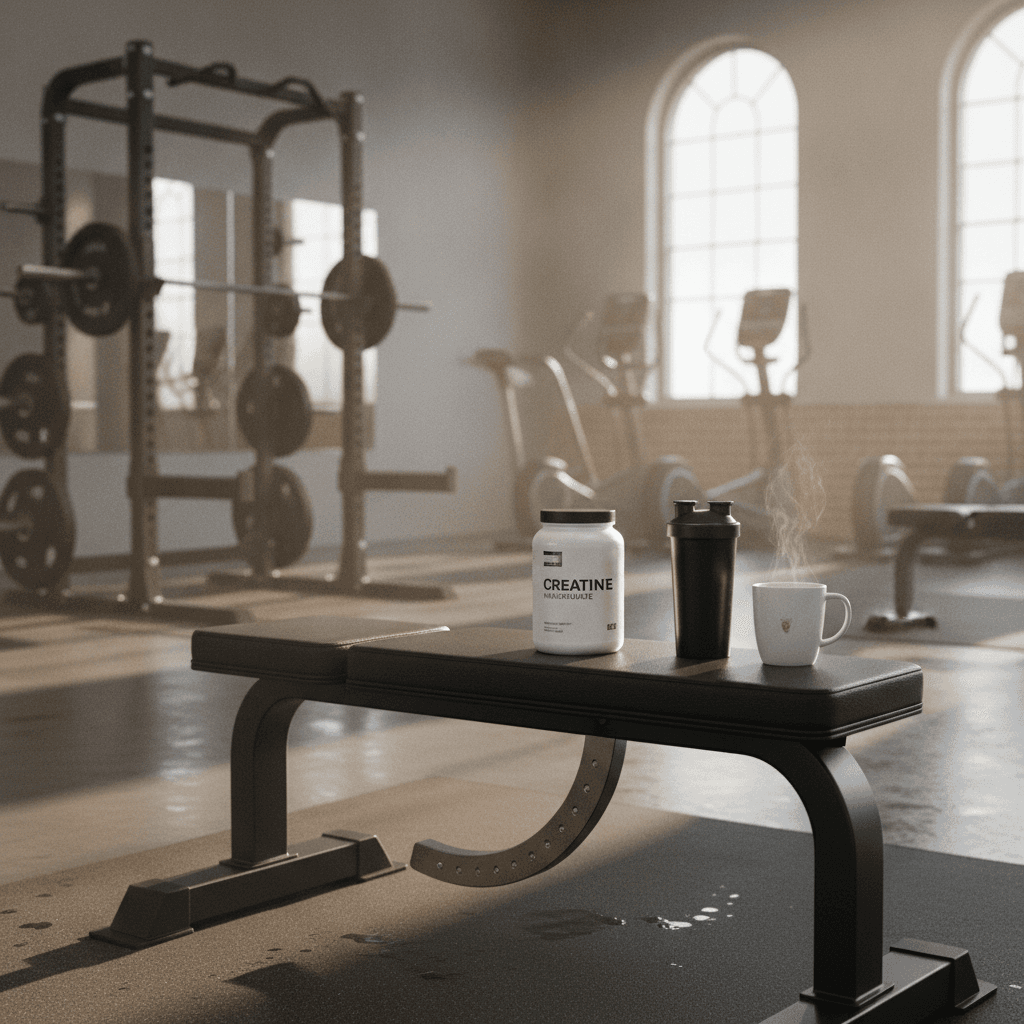
Layne Norton is the person to read after every other stack on this site. He holds a PhD in nutritional sciences, has competed as a natural bodybuilder and a world-record powerlifter, and has spent fifteen years on podcasts and social media saying the thing the supplement industry least wants said: that most products do nothing, and that the few that work do less than their labels claim. His own stack is the smallest we have reviewed and the best supported. It is also not free of the conflict that runs through every list here, because he sells supplements too, through Outwork Nutrition. This review goes through his core and his tier system, grades each item by the human evidence, lists what he refuses to take and why, and adds up the cost.
Norton's stack in 60 seconds. Tier one, in his own words: creatine monohydrate, whey protein and caffeine, the only three supplements he says are consistently justified by randomized trials for body composition and performance. Around them, by his public statements and the roundups under Sources: vitamin D3, omega-3 fish oil, magnesium glycinate and a multivitamin as insurance. Tier two, worth a try for specific goals: beta-alanine, citrulline, and possibly ashwagandha or rhodiola for stress. Tier three, which he calls junk: BCAAs, glutamine, fat burners, testosterone boosters, most pre-workouts and most greens powders. Our verdict: the tier-one three are the best-supported supplements in existence for their purposes, the insurance group is sensible after a blood test, and his refusal list is as useful as anything he takes. The whole core costs $40 to $80 a month.
The short answer: his stack is roughly what you get if you start from the trials instead of the marketing. The question with Norton is not what to remove; it is whether his performance-first core is also the right core for someone whose goal is a longer healthspan rather than a heavier squat. Mostly, it is.
Who Is Layne Norton, and Why Does His Stack Matter?
Norton earned his doctorate at the University of Illinois studying protein and muscle, then built a coaching practice, a nutrition app and a product line while continuing to compete. His public position on supplements has been consistent for a decade: about ninety-five percent are useless, most of the rest are oversold, and three of them clear the bar. He is also unusually willing to reverse himself when a trial goes against him, which is rare in this space and the main reason his list is worth more than most.
The conflict of interest is real and he says so: Outwork Nutrition sells the exact items in his tier one and two. The difference from Joe Rogan's Alpha Brain or Tim Ferriss's Momentous products is that Norton's products are commodity ingredients, creatine monohydrate and whey, with decades of independent trials behind them, so the evidence does not depend on the seller.
What Layne Norton Takes: The Stack, With the Human Evidence
The grades below are Reverse Age Lab's reading of the human research for the purpose Norton gives each item. Strong means repeated randomized trials in people show the effect. Moderate means the effect is real but conditional. Early means small or short human studies with mixed results. Weak means no convincing human trials for the claim.
Item | His tier | Why he takes it | Human evidence |
|---|---|---|---|
Creatine monohydrate, 5 g a day | Tier one | Strength, lean mass, repeated power; cognition under stress | Strong for strength and lean mass; early but promising for memory |
Whey protein | Tier one | Hitting the leucine threshold, protein target, recovery | Strong as part of adequate daily protein; a meta-analysis of 49 trials confirms the muscle gain |
Caffeine, before training | Tier one | Strength, power, endurance, lower perceived effort | Strong: an umbrella review of 21 meta-analyses confirms the performance effect |
Vitamin D3 | Insurance | Bone, immunity, a common deficiency | Moderate: corrects a low level; no extra benefit for the replete in the largest trial |
Omega-3 fish oil | Insurance | Heart, joints, inflammation | Moderate at 1 to 2 g a day; higher doses raise atrial fibrillation risk |
Magnesium glycinate | Insurance | Sleep, muscle, a common shortfall | Moderate for sleep and for people who are low |
Multivitamin | Insurance | Covering gaps in a dieting phase | Weak for healthy outcomes in large trials; reasonable insurance in a calorie deficit |
Beta-alanine | Tier two | Efforts of one to four minutes | Moderate: a meta-analysis shows small gains in that window; harmless tingling |
Citrulline malate | Tier two | Training volume, pump | Early to moderate: small effects on repetitions to failure |
Ashwagandha, rhodiola | Tier two, situational | Stress, cortisol | Early: small trials show lower stress scores; quality varies by extract |
What is not on the list matters as much. Norton has said in public that he does not take, and does not recommend, BCAAs, glutamine, fat burners, testosterone boosters, most pre-workout blends, and greens powders, and his reasons are in the trials, covered below.
What the Evidence Supports
Creatine. The International Society of Sports Nutrition's position stand reviews hundreds of trials: 3 to 5 g a day increases strength and lean mass in people who train and is safe in healthy adults. A 2023 meta-analysis found a small memory benefit, larger in older adults, which is where Norton's argument that everyone should take it starts to apply beyond the gym. Five grams of creatine monohydrate costs about a dollar a week.
Whey protein. The largest meta-analysis on the question, 49 trials and nearly 2,000 people, found that protein supplementation on top of resistance training adds lean mass and strength, with the benefit flattening around 1.6 g of protein per kilogram of body weight a day. Whey is the convenient way to reach that number, and for adults past fifty, who need more protein per meal to trigger muscle building, it is the most useful item on this list for healthspan.
Caffeine. An umbrella review of 21 meta-analyses found caffeine improves strength, power, endurance and perceived effort, at 3 to 6 mg per kilogram taken about an hour before training. Coffee does the job. The healthspan caveat is timing: caffeine after early afternoon costs sleep, and sleep beats any supplement.
The insurance group. Vitamin D corrects a low level and does nothing extra for the replete, per the 25,000-person VITAL trial; omega-3 at 1 to 2 g lowers triglycerides and sits below the dose linked to atrial fibrillation; magnesium helps sleep in people who are short. Norton's framing, insurance rather than enhancement, is the right one, and the blood test is the way to know whether you need the policy.
Tier two, for a specific job. Beta-alanine improves efforts lasting one to four minutes by a small margin in a meta-analysis of 40 trials; citrulline adds a few repetitions in some trials and nothing in others. Neither matters for longevity, and Norton does not claim they do.
What He Refuses to Take, and the Trials Behind the Refusal
BCAAs. The branched-chain amino acids were sold for years as a muscle builder. The mechanism argument fails because muscle building needs all the essential amino acids, and a 2017 review concluded that BCAAs alone do not stimulate muscle protein synthesis in people who already eat enough protein. Whey contains them. Buying them separately is paying twice.
Glutamine. The most abundant amino acid in muscle and one of the most sold supplements. A randomized trial of glutamine with resistance training found no effect on strength, muscle or protein breakdown, and later work agreed. Norton calls it junk; the trials call it inert.
Fat burners and testosterone boosters. The fat burner category's active ingredient, when it has one, is caffeine, which a cup of coffee provides for pennies; the rest is stimulants with no outcome data and occasional safety problems. Testosterone boosters sold over the counter (tribulus, fenugreek, D-aspartic acid and the like) have failed to raise testosterone in healthy men in controlled trials. If your testosterone is low, the fix is a blood test and a physician, not a bottle.
Greens powders. A multivitamin with a longer label and a much higher price, with no published trials of the products themselves. Norton's line is that if you eat vegetables you do not need one and if you do not, the money buys vegetables. Our reviews of Rogan and Ferriss reached the same conclusion about AG1.
What Layne Norton's Stack Costs
Retail prices in the United States as of September 2026, rounded, for a month at typical doses.
Item | Roughly per month | Evidence |
|---|---|---|
Creatine monohydrate, 5 g a day | $10 to $15 | Strong |
Whey protein, one to two scoops a day | $30 to $60 | Strong as food |
Caffeine (coffee or tablets) | $5 to $15 | Strong for performance |
Vitamin D3 | $5 to $10 | Moderate, when low |
Omega-3 at 1 to 2 g | $15 to $30 | Moderate |
Magnesium glycinate | $10 to $15 | Moderate for sleep |
Multivitamin | $10 to $20 | Insurance |
Beta-alanine, citrulline (optional) | $20 to $35 | Small effects for specific efforts |
The whole core, tier one plus insurance, runs $85 to $165 a month with the protein, or $40 to $80 without it, which is what it costs when the protein comes from food. That is the cheapest stack in this series and the one with the fewest items lacking evidence. The pattern from Bryan Johnson's Blueprint onward has been that the parts that work are cheap; Norton's list is what you get when you keep only those parts.
The Takeaway: The Right Core, With One Adjustment
Norton's stack is built for performance, and every item on it earns its place for that. For a healthspan goal the same core mostly holds, with one adjustment in emphasis: protein and creatine move to the front, because muscle is the organ of aging that people lose fastest and both are proven to protect it; caffeine moves to the side, because its performance value is real but its cost to sleep is the longevity price. The insurance group stays, on the condition Norton himself sets, that a blood test shows you need it. And his refusal list is the part to keep closest, because most of what people add to their stacks over the years comes from it.
Build Your Own Personalized Protocol
Norton's approach works because he starts from the trials and stops when the evidence runs out. Reverse Age Lab is built to do that for you, for your own body. Rala, our patented AI, reads the human studies and real reviews behind supplements, diet and exercise, then turns them into one personalized daily protocol built around your body, your goals and your blood work, organized so the pieces work together and nothing is doubled up. It checks what you already take for interactions, redundancies and safe upper limits, and it will tell you which items on your shelf belong in Norton's tier three. Build your protocol free at reverseagelab.net/protocol, or start by running what you take through the supplement stack checker.
Frequently Asked Questions
What supplements does Layne Norton take?
His tier one is creatine monohydrate, whey protein and caffeine, the three he says are consistently supported by randomized trials for body composition and performance. Around them he takes vitamin D3, omega-3 fish oil, magnesium glycinate and a multivitamin as insurance, and he considers beta-alanine and citrulline worth using for specific training goals.
What is Layne Norton's supplement tier system?
Tier one is supplements with consistent trial evidence for a meaningful effect: creatine, whey and caffeine. Tier two has evidence for a specific, smaller effect: beta-alanine, citrulline, some adaptogens. Tier three is everything without convincing human evidence, which he calls junk: BCAAs, glutamine, fat burners, testosterone boosters, most pre-workouts and greens powders.
Why does Layne Norton say BCAAs are useless?
Because building muscle needs all the essential amino acids, not just the three branched-chain ones, and a 2017 review found BCAAs alone do not stimulate muscle protein synthesis in people who already eat enough protein. Whey protein contains them, so a separate BCAA product is paying twice for something that does nothing on its own.
Is creatine good for people who do not lift weights?
The strength and muscle evidence is strongest in people who train, but creatine also helps preserve muscle with age and a 2023 meta-analysis found a small memory benefit, larger in older adults. At 3 to 5 g a day it is safe in healthy adults and costs about a dollar a week, which is why Norton says nearly everyone should take it.
How much does Layne Norton's stack cost?
About $85 to $165 a month with whey protein, or $40 to $80 if the protein comes from food. It is the cheapest stack in this series and the one with the fewest unproven items.
Which parts of Layne Norton's stack are worth copying for longevity?
Creatine at 3 to 5 g a day and enough protein, with whey as the convenient way to get there, because both protect the muscle that people lose fastest with age. Vitamin D, omega-3 and magnesium if a blood test shows you need them. Caffeine before training if it does not cost you sleep. And his refusal list, which is where most of the money in most stacks goes.
Sources
Norton's own statements: his tier-one post on X, Supplement Series: Tier 1 on his podcast, his FoundMyFitness episode on creatine and adaptogens, and the routine described to BarBend; his product line at Outwork Nutrition.
Kreider RB et al. International Society of Sports Nutrition position stand: safety and efficacy of creatine supplementation. Journal of the International Society of Sports Nutrition, 2017. PubMed.
Prokopidis K et al. Effects of creatine supplementation on memory in healthy individuals: a systematic review and meta-analysis. Nutrition Reviews, 2023. PubMed.
Morton RW et al. A systematic review, meta-analysis and meta-regression of the effect of protein supplementation on resistance training-induced gains in muscle mass and strength in healthy adults. British Journal of Sports Medicine, 2018. PubMed.
Grgic J et al. Wake up and smell the coffee: caffeine supplementation and exercise performance, an umbrella review of 21 published meta-analyses. British Journal of Sports Medicine, 2020. PubMed.
Manson JE et al. Vitamin D supplements and prevention of cancer and cardiovascular disease (VITAL). New England Journal of Medicine, 2019. PubMed.
Gencer B et al. Effect of long-term marine omega-3 fatty acids supplementation on the risk of atrial fibrillation: a systematic review and meta-analysis. Circulation, 2021. PubMed.
Mah J, Pitre T. Oral magnesium supplementation for insomnia in older adults: a systematic review and meta-analysis. BMC Complementary Medicine and Therapies, 2021. PubMed.
Saunders B et al. Beta-alanine supplementation to improve exercise capacity and performance: a systematic review and meta-analysis. British Journal of Sports Medicine, 2017. PubMed.
Trexler ET et al. Acute effects of citrulline supplementation on high-intensity strength and power performance: a systematic review and meta-analysis. Sports Medicine, 2019. PubMed.
Wolfe RR. Branched-chain amino acids and muscle protein synthesis in humans: myth or reality? Journal of the International Society of Sports Nutrition, 2017. PubMed.
Candow DG et al. Effect of glutamine supplementation combined with resistance training in young adults. European Journal of Applied Physiology, 2001. PubMed.
Chandrasekhar K et al. A prospective, randomized double-blind, placebo-controlled study of safety and efficacy of a high-concentration full-spectrum extract of ashwagandha root in reducing stress and anxiety in adults. Indian Journal of Psychological Medicine, 2012. PubMed.