If Rhonda Patrick is the careful end of biohacking, Ben Greenfield is the maximalist end. A former Ironman triathlete, coach and author with a long-running podcast, he has tried more things than anyone else in this series and written about most of them, from the ordinary to the frankly experimental. That range is why his content is worth reading carefully: there is real value in the fitness and recovery core, and a great deal around it that most people neither need nor should attempt. He also co-founded Kion, a supplement company whose products appear throughout his routine. This review goes through the routine as he has described it, grades the recurring items by the human evidence, adds up the cost, and separates the principles from the extremes.
Ben Greenfield's routine in 60 seconds. The constants, as he has described them in his books and on his podcast: hard training that mixes endurance, strength and mobility; sleep tracked and protected; whole food with a lot of organ meat, fish and vegetables; sauna, cold exposure and breathwork most days. The supplements change with the season and the sponsor, but the ones he returns to include creatine, essential amino acids (Kion Aminos), fish oil, vitamin D3 with K2, magnesium, colostrum, curcumin, a glutathione precursor, a probiotic and digestive enzymes, mushroom extracts, a greens or "superfood" powder, and, in cycles, ketone esters, NAD precursors and various nootropics. Beyond those sit the devices and services: red light, PEMF mats, hyperbaric oxygen, and peptide and stem cell therapies. What the evidence supports: the training, the sleep and a few cheap basics are among the best-supported choices anyone can make; the rotating stack is mostly early or unproven and expensive; the fringe therapies are experiments with a sample size of one.
The short answer: take the fitness core and the sleep discipline, keep creatine, an omega-3, magnesium and vitamin D if you test low, and treat everything else as optional experiments to approach with caution and ideally a professional.
Who Is Ben Greenfield, and Why Does His Routine Get Copied?
Greenfield competed in Ironman triathlons and obstacle racing, coached athletes, and built an audience by documenting what he tried on himself: diets, devices, supplements, injections and retreats. His podcast and books reach a large, motivated readership, and his willingness to try almost anything is both the appeal and the hazard. Through Kion he sells coffee, amino acids, creatine, a multivitamin and other products that feature in his routine, which is the same conflict that runs through most of this series.
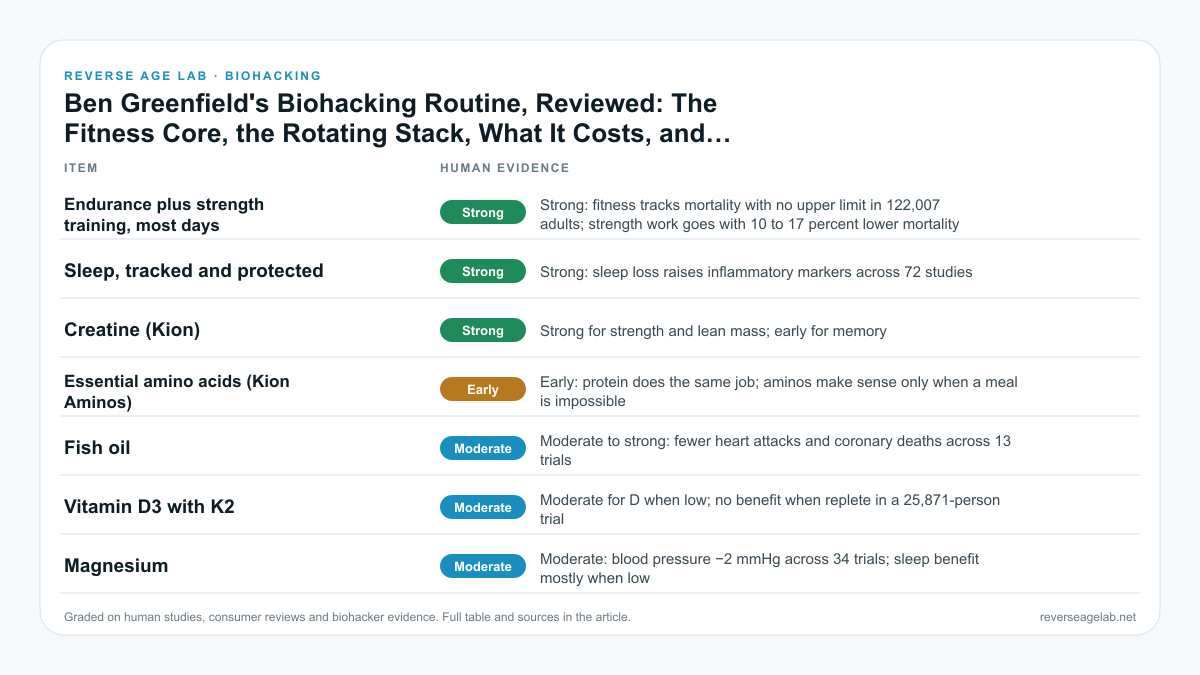
What Ben Greenfield Takes and Does: The Routine, With the Human Evidence
The grades below are Reverse Age Lab's reading of the human research for the purpose given for each item. Strong means repeated randomized trials in people show the effect. Moderate means the effect is real but conditional, for example only when a deficiency exists. Early means small or short human studies with mixed results. Weak means no convincing human trials for the claim.
Item | What it is | Why he says he does it | Human evidence |
|---|---|---|---|
Endurance plus strength training, most days | The fitness core | Performance, longevity | Strong: fitness tracks mortality with no upper limit in 122,007 adults; strength work goes with 10 to 17 percent lower mortality |
Sleep, tracked and protected | Dark room, early caffeine, trackers | Recovery, hormones | Strong: sleep loss raises inflammatory markers across 72 studies |
Creatine (Kion) | Creatine monohydrate | Strength, muscle, brain | Strong for strength and lean mass; early for memory |
Essential amino acids (Kion Aminos) | A free-form amino acid blend | Muscle in a fasted state | Early: protein does the same job; aminos make sense only when a meal is impossible |
Fish oil | Omega-3 EPA and DHA | Heart, brain, inflammation | Moderate to strong: fewer heart attacks and coronary deaths across 13 trials |
Vitamin D3 with K2 | The sunshine vitamin plus a cofactor | Immunity, bone | Moderate for D when low; no benefit when replete in a 25,871-person trial |
Magnesium | Usually glycinate at night | Sleep, recovery | Moderate: blood pressure −2 mmHg across 34 trials; sleep benefit mostly when low |
Colostrum | First milk from cows | Gut lining, immunity | Early: small trials in athletes with mixed results |
Curcumin | From turmeric | Inflammation, joints | Moderate for arthritis pain across eight trials; weak for general inflammation |
Glutathione precursors (NAC, glycine) | Amino acids the body makes glutathione from | Antioxidant defence, aging | Early: glycine plus NAC improved several aging markers in one 16-week trial |
Probiotic and digestive enzymes | Live bacteria and enzymes | Gut | Strain-specific: probiotics cut antibiotic-associated diarrhea 42 percent; enzymes have small trials for specific complaints |
Mushroom extracts, greens powders | Blends of fungi and dried plants | Immunity, "superfood" cover | Weak: no trials of the blends; a multivitamin does the vitamin part for less |
Ketone esters | A drink that raises blood ketones | Endurance, focus | Early: changed fuel use and endurance performance in a small study of elite cyclists; mixed since |
Sauna and cold plunges | Heat and cold exposure | Recovery, resilience | Sauna: 40 percent lower mortality in a cohort, observational. Cold: winter swimmers had more active brown fat in one small study; recovery trials are mixed |
Red light, PEMF, hyperbaric oxygen | Devices and chambers | Recovery, mitochondria | Early at best; no agreed protocols |
Peptides and stem cell therapies | Injected or infused treatments | Repair, anti-aging | Not supplements: unregulated or off-label, with real risks and no outcome trials for healthy adults |
What the Evidence Supports
The training. This is the strongest part of any routine in this series. In 122,007 adults followed for a median of eight years, all-cause mortality fell step by step with cardiorespiratory fitness and kept falling into the elite range (Mandsager K et al., 2018). Muscle-strengthening activity of 30 to 60 minutes a week goes with 10 to 17 percent lower all-cause mortality across cohorts (Momma H et al., 2022). Greenfield's mix of endurance, strength and mobility is exactly what those findings recommend, and it is free.
The sleep. Across 72 studies, sleep disturbance and short sleep went with higher inflammatory markers (Irwin MR et al., 2016), and six nights of four hours in bed worsened glucose tolerance in a controlled study (Spiegel K et al., 1999). His habit of measuring sleep and protecting it is one to copy.
The cheap basics. Creatine monohydrate is safe and effective for strength and lean mass (Kreider RB et al., 2017) with early evidence for memory (Avgerinos KI et al., 2018); omega-3 supplementation was associated with fewer heart attacks and coronary deaths across 13 trials (Hu Y et al., 2019); magnesium lowers blood pressure a little across 34 trials (Zhang X et al., 2016); and vitamin D helps when a test shows you are low, which about 42 percent of US adults are (Forrest KY et al., 2011), while VITAL found no benefit in people who were not (Manson JE et al., 2019).
Sauna. In 2,315 Finnish men followed for about 20 years, sauna four to seven times a week went with about 40 percent lower all-cause mortality than once a week (Laukkanen T et al., 2015). Observational, and consistent with the rest of his recovery emphasis.
Curcumin and GlyNAC, for a reason. About 1,000 mg of curcumin a day eased arthritis pain across eight randomized trials (Daily JW et al., 2016), and 16 weeks of glycine plus N-acetylcysteine improved oxidative stress, inflammation, gait speed and strength in older adults (Kumar P et al., 2023). Both are worth it for a person with the problem they treat, and neither is a reason for a healthy thirty-year-old to add a bottle.
What Is Not Worth Copying, or Needs a Professional
Ketone esters. The original study, in elite cyclists, found that a ketone drink changed fuel use and improved a time-trial result (Cox PJ et al., 2016). Later trials in less rarefied athletes have been mixed, the drink costs more per month than the whole evidence-backed core, and for a desk worker seeking focus there is nothing to lean on.
Cold plunges. Young men who swam in winter had more active brown fat and burned more energy in the cold in one small study (Søberg S et al., 2021). That is physiology, not a health outcome, and the recovery literature is mixed, with some evidence that cold after strength training blunts muscle gains. A cold shower is harmless; a $5,000 plunge tub is a hobby.
The rotating stack. Colostrum, mushroom blends, greens powders, the nootropic of the month: these have small or no trials and change too often to evaluate. Volume has a cost of its own. About 15 percent of older adults are at risk of a major drug interaction, often involving a supplement (Qato DM et al., 2016), and FDA testing found 776 products sold as supplements that contained hidden drugs over nine years (Tucker J et al., 2018). Thirty bottles are thirty chances for one of those.
Peptides, stem cells and the device shelf. Injected peptides and stem cell treatments are not supplements; they are unregulated or off-label medicine with real risks and no outcome trials in healthy adults. Red light, PEMF and hyperbaric oxygen have early studies with no agreed protocol. All of it belongs with a physician, if anywhere, and none of it belongs on a copy-this list.
What Ben Greenfield's Routine Costs, and What the Same Evidence Costs
Typical US retail prices, rounded, for a month at the doses he describes; branded items at list price as of October 2026.
Item | Roughly per month | Evidence |
|---|---|---|
Creatine (Kion or any monohydrate) | $10 to $35 | Strong |
Kion Aminos | $45 to $60 | Early |
$15 to $40 | Moderate to strong | |
Vitamin D3 with K2 | $8 to $15 | Moderate, when low |
Magnesium | $10 to $20 | Moderate |
Colostrum | $40 to $70 | Early |
Curcumin | $20 to $35 | Moderate for joints |
NAC or glycine | $10 to $25 | Early |
Probiotic and enzymes | $40 to $80 | Strain-specific |
Mushroom and greens powders | $50 to $100 | Weak |
Ketone esters | $100 to $200 | Early |
NAD precursors, nootropics (rotating) | $60 to $150 | Early to weak |
Devices (red light, PEMF, plunge tub) | $500 to $10,000 one-off | Early |
Peptide and stem cell therapies | Hundreds to thousands per course | Not supplements |
The supplements alone run roughly $400 to $800 a month before a device or a clinic. The evidence-backed core, creatine, a fish oil, magnesium and vitamin D dosed to a test, costs $30 to $55. The training and the sleep that carry the best evidence cost a gym membership and a dark room.
The Takeaway: Keep the Core, Skip the Extremes
Greenfield's real contribution is an example of taking training, recovery and sleep seriously, and on those the trials are on his side. Almost everything layered on top is either a narrow win for a specific problem, an early result in a small study, or an experiment on himself. Borrow the principles: train hard across endurance and strength, protect sleep, eat whole food, use heat if you enjoy it. Keep the four cheap basics. Treat the rest as optional and reversible, add one thing at a time, and verify with measurements rather than enthusiasm. The spectrum from sensible to fringe is mapped in what is biohacking, and the sleep options in best supplements for sleep.
Frequently Asked Questions
What supplements does Ben Greenfield take?
The recurring ones he has described are creatine, essential amino acids, fish oil, vitamin D3 with K2, magnesium, colostrum, curcumin, a glutathione precursor, a probiotic with enzymes, mushroom extracts and a greens powder, with ketone esters, NAD precursors and nootropics in cycles. The list changes often and much of it is sold through Kion.
Is Ben Greenfield's routine backed by science?
Its core is: training that mixes endurance and strength, protected sleep and whole food are among the best-supported choices in longevity. The rotating stack, the devices and the fringe therapies rest on small, short or no human trials.
Do ketone esters work?
In a study of elite cyclists a ketone drink changed fuel use and improved a time trial. Trials since have been mixed, and there is no evidence for focus in everyday use. They cost $100 to $200 a month.
Are cold plunges worth it?
Winter swimmers had more active brown fat in one small study; recovery trials are mixed and cold after strength training may blunt muscle gains. A cold shower costs nothing; a plunge tub is a hobby, not a treatment.
What is the most useful thing to take from Ben Greenfield?
His seriousness about fitness and sleep. Fitness tracks mortality with no upper limit, strength work goes with 10 to 17 percent lower mortality, and sleep loss raises inflammation. Pair that with creatine, an omega-3, magnesium and vitamin D if you test low.
How much does Ben Greenfield's routine cost?
The supplements as he describes them run roughly $400 to $800 a month before any device or clinic. The evidence-backed core costs $30 to $55.
Sources
Ben Greenfield's own descriptions of his routine: bengreenfieldlife.com, his books (Boundless, Beyond Training) and his podcast, compared for this review.
Mandsager K et al. Association of Cardiorespiratory Fitness With Long-term Mortality Among Adults Undergoing Exercise Treadmill Testing. JAMA network open, 2018. Cardiorespiratory fitness and mortality in 122,007 adults. PubMed
Momma H et al. Muscle-strengthening activities are associated with lower risk and mortality in major non-communicable diseases: a systematic review and meta-analysis of cohort studies. British journal of sports medicine, 2022. Muscle-strengthening activity and mortality across cohorts. PubMed
Irwin MR et al. Sleep Disturbance, Sleep Duration, and Inflammation: A Systematic Review and Meta-Analysis of Cohort Studies and Experimental Sleep Deprivation. Biological psychiatry, 2016. 72 studies on sleep and inflammation. PubMed
Spiegel K et al. Impact of sleep debt on metabolic and endocrine function. Lancet, 1999. Six nights of four hours of sleep and glucose tolerance. PubMed
Kreider RB et al. International Society of Sports Nutrition position stand: safety and efficacy of creatine supplementation in exercise, sport, and medicine. Journal of the International Society of Sports Nutrition, 2017. Creatine position stand. PubMed
Avgerinos KI et al. Effects of creatine supplementation on cognitive function of healthy individuals: A systematic review of randomized controlled trials. Experimental gerontology, 2018. Creatine and cognition in randomized trials. PubMed
Hu Y et al. Marine Omega-3 Supplementation and Cardiovascular Disease: An Updated Meta-Analysis of 13 Randomized Controlled Trials Involving 127 477 Participants. Journal of the American Heart Association, 2019. Omega-3 and cardiovascular outcomes across 13 trials. PubMed
Zhang X et al. Effects of Magnesium Supplementation on Blood Pressure: A Meta-Analysis of Randomized Double-Blind Placebo-Controlled Trials. Hypertension (Dallas, Tex., 2016. Magnesium and blood pressure across 34 trials. PubMed
Forrest KY et al. Prevalence and correlates of vitamin D deficiency in US adults. Nutrition research, 2011. Vitamin D deficiency in 41.6 percent of US adults. PubMed
Manson JE et al. Vitamin D Supplements and Prevention of Cancer and Cardiovascular Disease. The New England journal of medicine, 2019. VITAL: vitamin D in unselected adults. PubMed
Laukkanen T et al. Association between sauna bathing and fatal cardiovascular and all-cause mortality events. JAMA internal medicine, 2015. Sauna frequency and mortality in 2,315 Finnish men. PubMed
Daily JW et al. Efficacy of Turmeric Extracts and Curcumin for Alleviating the Symptoms of Joint Arthritis: A Systematic Review and Meta-Analysis of Randomized Clinical Trials. Journal of medicinal food, 2016. Curcumin for arthritis pain across eight trials. PubMed
Kumar P et al. Supplementing Glycine and N-Acetylcysteine (GlyNAC) in Older Adults Improves Glutathione Deficiency, Oxidative Stress, Mitochondrial Dysfunction, Inflammation, Physical Function, and Aging Hallmarks: A Randomized Clinical Trial. The journals of gerontology. Series A, Biological sciences and medical sciences, 2023. Glycine plus NAC in older adults. PubMed
Cox PJ et al. Nutritional Ketosis Alters Fuel Preference and Thereby Endurance Performance in Athletes. Cell metabolism, 2016. Ketone esters and endurance performance in elite cyclists. PubMed
Søberg S et al. Altered brown fat thermoregulation and enhanced cold-induced thermogenesis in young, healthy, winter-swimming men. Cell reports. Medicine, 2021. Brown fat in winter-swimming men. PubMed
Qato DM et al. Changes in Prescription and Over-the-Counter Medication and Dietary Supplement Use Among Older Adults in the United States, 2005 vs 2011. JAMA internal medicine, 2016. Interaction risk among older adults in the United States. PubMed
Tucker J et al. Unapproved Pharmaceutical Ingredients Included in Dietary Supplements Associated With US Food and Drug Administration Warnings. JAMA network open, 2018. FDA warnings on 776 tainted supplements. PubMed
Hempel S et al. Probiotics for the prevention and treatment of antibiotic-associated diarrhea: a systematic review and meta-analysis. JAMA, 2012. Probiotics and antibiotic-associated diarrhea across 63 trials. PubMed
Reverse Age Lab is not affiliated with, sponsored by, or endorsed by Ben Greenfield or Kion. This review is independent commentary on publicly described routines and products.