
Dave Asprey did more than almost anyone to bring the word biohacking into the mainstream, which is why his routine still gets copied two decades after he started selling it. He is an entrepreneur and author, founder of the Bulletproof brand and later of Danger Coffee, Upgrade Labs and a string of supplements, with a stated goal of living to 180. That ambition is the brand. It also means that almost everything on his list is something he sells or has sold, so his stack needs the same test as any other: which items have human trials behind them, which are expensive experiments, and which are a marketing story. This review goes through the routine as he has described it in his books, on his podcast and on his site, grades each item by the human evidence, adds up the cost, and ends with the short version worth borrowing.
Dave Asprey's stack in 60 seconds. The recurring items, as he has described them: Bulletproof Coffee (coffee blended with grass-fed butter or ghee and Brain Octane, a C8 medium-chain triglyceride oil) most mornings, a high-fat, lower-carb way of eating with intermittent fasting most days, vitamins A, D and K taken together, magnesium at night, krill oil for omega-3, vitamin C, methylated B vitamins, collagen protein, glutathione, a PQQ and CoQ10 blend sold as Unfair Advantage, activated charcoal after a questionable meal, and a rotating set of devices: red light, cryotherapy, neurofeedback and sleep trackers. What the evidence supports: vitamin D when a blood test shows it is low, magnesium, an omega-3 and the sleep-first habits are supported by human trials and cost very little; the coffee is a preference with a thin evidence base; the charcoal, the glutathione capsules, the PQQ and the devices are where the money goes and the evidence stops.
The short answer: borrow the habits, not the catalogue. Asprey's useful ideas are tracking how food affects your energy, protecting sleep and eating whole food. The products wrapped around those ideas are mostly unproven, and the coffee that made him famous has never been tested as a health intervention.
Who Is Dave Asprey, and Why Does His Stack Get Copied?
Asprey made his money in Silicon Valley, lost a hundred pounds on a regimen he designed himself, and turned the story into Bulletproof: a coffee, a diet, a book series and a podcast that ran for more than a thousand episodes. He coined "biohacking" as most people now use it, treating the body as a system to be measured and tuned, and he was early to the tools the field now takes for granted, from sleep trackers to continuous glucose monitors. He has since stepped back from running Bulletproof and now fronts Danger Coffee, Upgrade Labs and a supplement line, so the conflict of interest is permanent: the routine is the product range.
Two things follow. First, his list is long and changes with his businesses, so any review is a snapshot of what he describes most often. Second, his routine was built for a wealthy man with a lab, a sauna and a staff. Whether any single item belongs in your day depends on your blood work, your diet and your goals, which is the whole point of a personalized protocol.
What Dave Asprey Takes: The Stack, With the Human Evidence
The grades below are Reverse Age Lab's reading of the human research for the purpose given for each item. Strong means repeated randomized trials in people show the effect. Moderate means the effect is real but conditional, for example only when a deficiency exists. Early means small or short human studies with mixed results. Weak means no convincing human trials for the claim.
Item | What it is | Why he says he takes it | Human evidence |
|---|---|---|---|
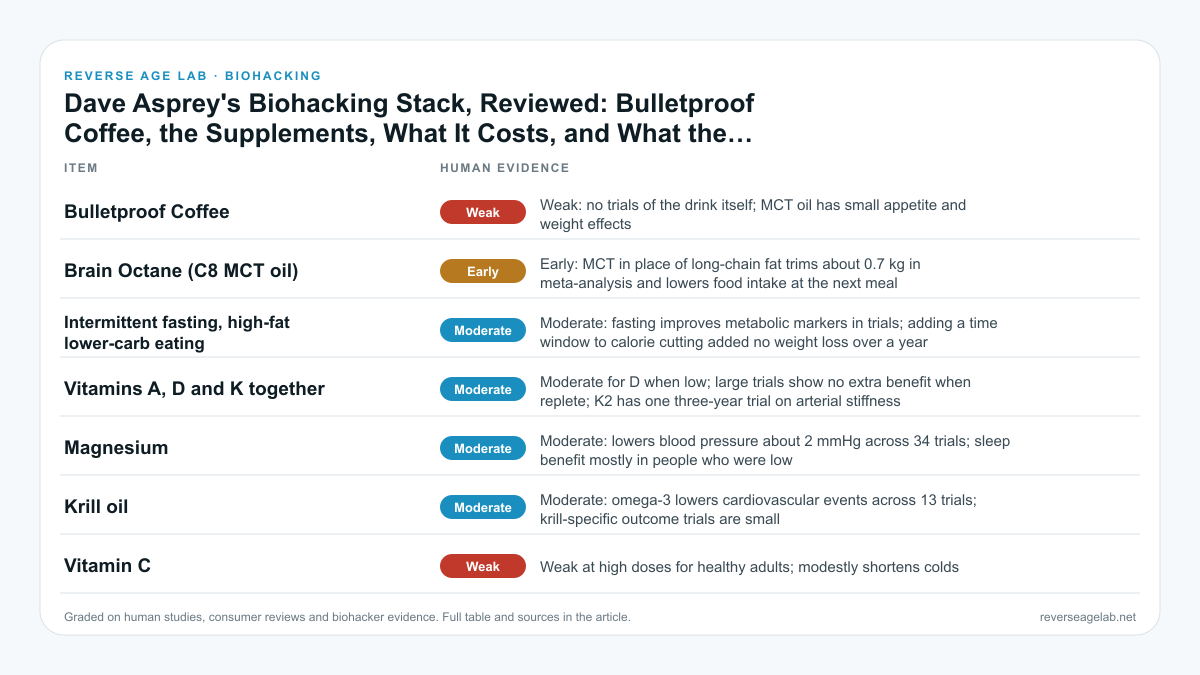
Bulletproof Coffee | Coffee blended with butter or ghee and C8 MCT oil | Energy, focus, appetite control through the morning | Weak: no trials of the drink itself; MCT oil has small appetite and weight effects |
Brain Octane (C8 MCT oil) | Caprylic acid, a medium-chain fat | Ketones for the brain, fat burning | Early: MCT in place of long-chain fat trims about 0.7 kg in meta-analysis and lowers food intake at the next meal |
Intermittent fasting, high-fat lower-carb eating | A daily eating window and a fat-heavy plate | Metabolic health, ketosis | Moderate: fasting improves metabolic markers in trials; adding a time window to calorie cutting added no weight loss over a year |
Vitamins A, D and K together | The fat-soluble trio | Bone, immunity, calcium routing | Moderate for D when low; large trials show no extra benefit when replete; K2 has one three-year trial on arterial stiffness |
Magnesium | Usually citrate or glycinate at night | Sleep, stress, muscle | Moderate: lowers blood pressure about 2 mmHg across 34 trials; sleep benefit mostly in people who were low |
Krill oil | Omega-3 EPA and DHA with phospholipids | Heart, brain, inflammation | Moderate: omega-3 lowers cardiovascular events across 13 trials; krill-specific outcome trials are small |
Vitamin C | Ascorbic acid at gram doses | Immunity, collagen | Weak at high doses for healthy adults; modestly shortens colds |
Methylated B vitamins | Folate and B12 in active forms | Methylation, energy | Moderate when B12 or folate is low; no trials of the "methylation support" claim in healthy adults |
Collagen protein | Hydrolyzed collagen peptides | Skin, joints, recovery | Early: strength and body composition gains with resistance training in older men in one trial |
Glutathione capsules | The body's main antioxidant, swallowed | Detox, immunity | Weak: oral glutathione is poorly absorbed; the trial that moved glutathione used glycine and NAC instead |
Unfair Advantage (PQQ and CoQ10) | Two mitochondrial cofactors | Energy, mitochondria | Weak to early: CoQ10 helps in heart failure; no trials for energy in healthy adults |
Activated charcoal | Adsorbent carbon | After a poor meal or alcohol | Weak: an emergency-room treatment for poisoning; no trials for everyday use, and it binds nutrients and medicines |
Red light, cryotherapy, neurofeedback, trackers | Devices and services | Recovery, mood, sleep | Early at best; the trackers are useful for measurement, not treatment |
A note on completeness: Asprey has also described iodine, L-tyrosine, glycine, creatine, polyphenol blends, oxaloacetate and a mineral-infused coffee over the years. None of them changes the picture, so they are left out of the grading.
What the Evidence Supports
Sleep, and keeping caffeine early. The part of Asprey's message that holds up best is the part that costs nothing. Sleep disturbance and short sleep raise inflammatory markers across 72 studies (Irwin MR et al., 2016). A coffee-centred routine runs into that evidence head on: 400 mg of caffeine taken six hours before bed cut measured sleep by about an hour in a controlled study (Drake C et al., 2013). Morning coffee is fine. The afternoon cup is the one that costs you.
Whole food, and less of the processed kind. In a cohort of nearly 20,000 adults, the heaviest consumers of ultra-processed food had 62 percent higher all-cause mortality than the lightest (Rico-Campà A et al., 2019). Asprey's insistence on real food, whatever he wraps around it, points the right way.
Vitamin D, when a test shows you are low. About 42 percent of US adults are deficient by the common cut-off (Forrest KY et al., 2011), and correcting a low level is sensible. The caution is VITAL: 2,000 IU a day for five years did not reduce cancer or cardiovascular disease in more than 25,000 adults who were mostly not deficient (Manson JE et al., 2019). Test, treat a low level, retest.
Magnesium. Across 34 randomized trials, about 370 mg a day for three months lowered blood pressure by 2.0 over 1.8 mmHg (Zhang X et al., 2016), and it improves glucose handling in people who are low or at risk of diabetes (Veronese N et al., 2016). Taken at night it is also the one item on his list most people can feel.
Omega-3. Marine omega-3 supplementation was associated with fewer heart attacks and coronary deaths across 13 trials and 127,477 people, with larger effects at higher doses (Hu Y et al., 2019). Krill oil carries the same fatty acids at a higher price; the outcome trials were run with fish oil.
Intermittent fasting, with a caveat. A review of the human evidence finds fasting patterns improve metabolic markers and weight (de Cabo R et al., 2019). But the trial that matters for most people's question, whether the eating window adds anything on top of eating less, found that a year of time-restricted eating plus calorie restriction produced no more weight loss than calorie restriction alone (Liu D et al., 2022). The window is a tool for eating less, not a separate effect.
What Is Not Worth Copying
Bulletproof Coffee as a health intervention. There is no trial of coffee blended with butter and MCT oil for any outcome. What exists is the MCT literature: replacing long-chain fat with MCT trimmed about 0.7 kg across 11 trials (Bueno NB et al., 2015), and MCT at breakfast reduced food intake at the next meal in a small crossover study (St-Onge MP et al., 2014). Those are modest effects from the oil, not from the ritual, and the drink replaces a breakfast with 400 or more calories of fat and no protein or fiber. If you enjoy it, it is a preference. It is not a metabolic tool.
Activated charcoal. Charcoal adsorbs whatever is in the gut, which is why emergency departments use it for some poisonings. Taken after dinner it binds the nutrients and medicines in that meal too, and there are no trials of it for hangovers, "toxins" or anything else in healthy adults. It is the clearest example on the list of a plausible story with nothing behind it.
Glutathione capsules. Oral glutathione is largely broken down before it reaches the blood. The trial that actually raised glutathione in older adults, with gains in oxidative stress, inflammation, gait speed and strength, used its precursors, glycine and N-acetylcysteine, for 16 weeks (Kumar P et al., 2023). If the goal is glutathione, that is the evidence-backed route, and it costs a fraction of the branded capsule.
PQQ and CoQ10 for energy. CoQ10 has a real trial in heart failure, where 100 mg three times a day for two years reduced major cardiovascular events (Mortensen SA et al., 2014). For blood pressure the Cochrane review found the trials too unreliable to show an effect (Ho MJ et al., 2016), and for energy in healthy adults there is nothing. PQQ has no outcome trials at all.
The devices. Red light, cryotherapy, neurofeedback and the rest sit on small, short studies with no agreed protocol. A sleep tracker is different: it measures rather than treats, and measurement is the one part of Asprey's method that always earns its place.
What Dave Asprey's Stack Costs, and What the Same Evidence Costs
Typical US retail prices, rounded, for a month at the doses he describes; branded items at list price as of October 2026.
Item | Roughly per month | Evidence |
|---|---|---|
Bulletproof or Danger Coffee beans | $30 to $45 | Weak for the drink; coffee itself is fine |
Brain Octane C8 oil | $30 to $45 | Early |
Grass-fed butter or ghee | $15 to $25 | None needed; it is breakfast fat |
Vitamins A, D and K blend | $20 to $35 | Moderate for D when low |
Magnesium | $10 to $20 | Moderate |
Krill oil | $30 to $50 | Moderate for omega-3; fish oil does the same for $15 to $25 |
Vitamin C | $8 to $15 | Weak at his dose |
Methylated B vitamins | $15 to $25 | Moderate when low |
Collagen protein | $35 to $50 | Early |
Glutathione capsules | $40 to $60 | Weak |
Unfair Advantage (PQQ and CoQ10) | $50 to $70 | Weak to early |
Activated charcoal | $10 to $20 | Weak |
Devices (red light panel, tracker, sessions) | $300 to $2,000 and up, one-off or recurring | Early |
The supplements and the coffee alone come to roughly $290 to $460 a month before a device. The evidence-backed core, vitamin D3 dosed to a blood test, magnesium, a plain fish oil and a methylated B vitamin if your B12 is low, costs $25 to $45. That is the same pattern as Joe Rogan's stack: the parts that work are cheap, and the price is in the parts that might.
The Takeaway: Borrow the Mindset, Skip the Catalogue
Asprey's lasting contribution is an attitude: your biology is something you can measure and improve, and you should pay attention to how food, sleep and habits change how you feel. That attitude is sound, and the cheapest items on his list, sleep, whole food, vitamin D when low, magnesium and an omega-3, are the ones the trials support. The coffee is a ritual, the charcoal and glutathione are stories, and the devices are experiments with a sample size of one. Take the mindset, verify with real measurements, and spend the difference on vegetables.
One more thing his routine gets right by accident: it is his. It reflects his tests, his money and his beliefs. Yours should reflect yours, which is why the next section exists. The spectrum from sensible to fringe is mapped in what is biohacking, and the lean version of a stack in how to build a supplement stack without wasting money.
Frequently Asked Questions
What supplements does Dave Asprey take?
As he has described them, the regulars are vitamins A, D and K together, magnesium, krill oil, vitamin C, methylated B vitamins, collagen protein, glutathione, a PQQ and CoQ10 blend, and activated charcoal after a poor meal, alongside Bulletproof Coffee with Brain Octane oil and intermittent fasting. The list changes with his product range.
Is Bulletproof Coffee good for you?
There are no trials of the drink. MCT oil, its active ingredient, trims about 0.7 kg in meta-analysis and lowers intake at the next meal a little. The drink swaps a breakfast for 400 or more calories of fat with no protein or fiber, so it is a preference, not a metabolic upgrade, and the afternoon version costs you sleep.
Does intermittent fasting work?
Fasting patterns improve metabolic markers in trials, but a one-year trial found that adding an eating window to calorie restriction produced no extra weight loss. The window helps some people eat less; it is not a separate effect.
Is activated charcoal worth taking after a big meal?
No. It is an emergency treatment for certain poisonings. Taken with food it binds nutrients and medicines, and there are no trials for everyday use.
Which parts of Dave Asprey's routine are worth copying?
Protecting sleep, keeping caffeine before noon, eating whole food, tracking how you respond, and the cheap basics: vitamin D if a test shows you are low, magnesium at night, and an omega-3.
How much does Dave Asprey's stack cost?
The coffee and supplements he describes come to roughly $290 to $460 a month at list prices, before any device. The evidence-backed core costs $25 to $45.
Sources
Dave Asprey's own descriptions of his routine, products and diet: daveasprey.com, his books (The Bulletproof Diet, Super Human, Smarter Not Harder) and The Human Upgrade podcast, compared for this review.
Drake C et al. Caffeine effects on sleep taken 0, 3, or 6 hours before going to bed. Journal of clinical sleep medicine, 2013. The sleep study behind "keep caffeine early". PubMed
Irwin MR et al. Sleep Disturbance, Sleep Duration, and Inflammation: A Systematic Review and Meta-Analysis of Cohort Studies and Experimental Sleep Deprivation. Biological psychiatry, 2016. 72 studies on sleep and inflammation. PubMed
Rico-Campà A et al. Association between consumption of ultra-processed foods and all cause mortality: SUN prospective cohort study. BMJ, 2019. Ultra-processed food and mortality in 19,899 adults. PubMed
Forrest KY et al. Prevalence and correlates of vitamin D deficiency in US adults. Nutrition research, 2011. Vitamin D deficiency in 41.6 percent of US adults. PubMed
Manson JE et al. Vitamin D Supplements and Prevention of Cancer and Cardiovascular Disease. The New England journal of medicine, 2019. VITAL: no fewer cancers or heart events from 2,000 IU of vitamin D a day in unselected adults. PubMed
Zhang X et al. Effects of Magnesium Supplementation on Blood Pressure: A Meta-Analysis of Randomized Double-Blind Placebo-Controlled Trials. Hypertension (Dallas, Tex., 2016. Magnesium and blood pressure across 34 trials. PubMed
Veronese N et al. Effect of magnesium supplementation on glucose metabolism in people with or at risk of diabetes: a systematic review and meta-analysis of double-blind randomized controlled trials. European journal of clinical nutrition, 2016. Magnesium and glucose handling. PubMed
Hu Y et al. Marine Omega-3 Supplementation and Cardiovascular Disease: An Updated Meta-Analysis of 13 Randomized Controlled Trials Involving 127 477 Participants. Journal of the American Heart Association, 2019. Omega-3 and cardiovascular outcomes across 13 trials. PubMed
de Cabo R et al. Effects of Intermittent Fasting on Health, Aging, and Disease. The New England journal of medicine, 2019. The review of intermittent fasting in people. PubMed
Liu D et al. Calorie Restriction with or without Time-Restricted Eating in Weight Loss. The New England journal of medicine, 2022. One year of time-restricted eating added nothing to calorie restriction. PubMed
Bueno NB et al. Dietary medium-chain triacylglycerols versus long-chain triacylglycerols for body composition in adults: systematic review and meta-analysis of randomized controlled trials. Journal of the American College of Nutrition, 2015. MCT versus long-chain fat and body weight across 11 trials. PubMed
St-Onge MP et al. Impact of medium and long chain triglycerides consumption on appetite and food intake in overweight men. European journal of clinical nutrition, 2014. MCT at breakfast and food intake at the next meal. PubMed
Kumar P et al. Supplementing Glycine and N-Acetylcysteine (GlyNAC) in Older Adults Improves Glutathione Deficiency, Oxidative Stress, Mitochondrial Dysfunction, Inflammation, Physical Function, and Aging Hallmarks: A Randomized Clinical Trial. The journals of gerontology. Series A, Biological sciences and medical sciences, 2023. GlyNAC, the precursor route to glutathione, in older adults. PubMed
Mortensen SA et al. The effect of coenzyme Q10 on morbidity and mortality in chronic heart failure: results from Q-SYMBIO: a randomized double-blind trial. JACC. Heart failure, 2014. CoQ10 in heart failure (Q-SYMBIO). PubMed
Ho MJ et al. Blood pressure lowering efficacy of coenzyme Q10 for primary hypertension. The Cochrane database of systematic reviews, 2016. Cochrane: CoQ10 for blood pressure. PubMed
Knapen MH et al. Menaquinone-7 supplementation improves arterial stiffness in healthy postmenopausal women. A double-blind randomised clinical trial. Thrombosis and haemostasis, 2015. Vitamin K2 and arterial stiffness over three years. PubMed
Zdzieblik D et al. Collagen peptide supplementation in combination with resistance training improves body composition and increases muscle strength in elderly sarcopenic men: a randomised controlled trial. The British journal of nutrition, 2015. Collagen peptides with resistance training in older men. PubMed
Reverse Age Lab is not affiliated with, sponsored by, or endorsed by Dave Asprey, Bulletproof, Danger Coffee or Upgrade Labs. This review is independent commentary on publicly described routines and products.