

This guide now also covers "Longevity Protocol: How to Build One That Works", "How to Build a Supplement Stack Without Wasting Money", "Personalized Supplement Plan: Do You Need One?" and "Unlock Your Health: A Personalized Vitamin Plan Guide", which used to be separate articles and now redirect here.
A supplement protocol is not a shopping list. A list is what you get from a podcast: eleven bottles, no order, no logic, no idea which ones matter for you. A protocol is a structured stack where every item earns its place, nothing fights anything else, and the whole thing is built around your goals instead of someone else's routine. Here is how to build one, in the order that actually works.
The short answer: start from two or three goals and a blood baseline, build a foundation of vitamin D if low, magnesium, omega-3 and creatine, add one evidence backed pick per goal, prune anything that duplicates a mechanism or interacts with a medication, group the rest into timing blocks, then retest in six to eight weeks and keep only what moved your numbers.
Key takeaways
A supplement protocol is not a shopping list, it is a sequence built on your own data.
Start with goals and a baseline blood panel, not with products.
Layer the foundation first, then a small number of goal specific picks.
Check for conflicts and overlapping ingredients before you add anything.
Timing matters: fat soluble with food, stimulating early, calming late.
Let the retest prune the stack.
Do you need a personalized protocol at all?
Why Personalization Beats a Generic Stack
Most people build their routine by collecting ideas from articles, ads, and influencers. The upgrade is simple: supplements reward you most when each one fills a real gap or serves a real goal. Vitamin D delivers the biggest lift when you are actually low. Omega-3s matter most if you rarely eat fish. Iron is valuable when you are deficient. Personalization points each supplement at the person who benefits from it, so every item in your stack is pulling its weight. That is what turns a routine into results. The evidence backs that up: in the 25,000 person VITAL trial, vitamin D and omega-3 did little for people who were already replete, while the omega-3 benefit concentrated in those who ate little fish (Manson et al., 2019; Manson et al., 2019), and iron cut fatigue only in women who were actually low in ferritin (Vaucher et al., 2012).
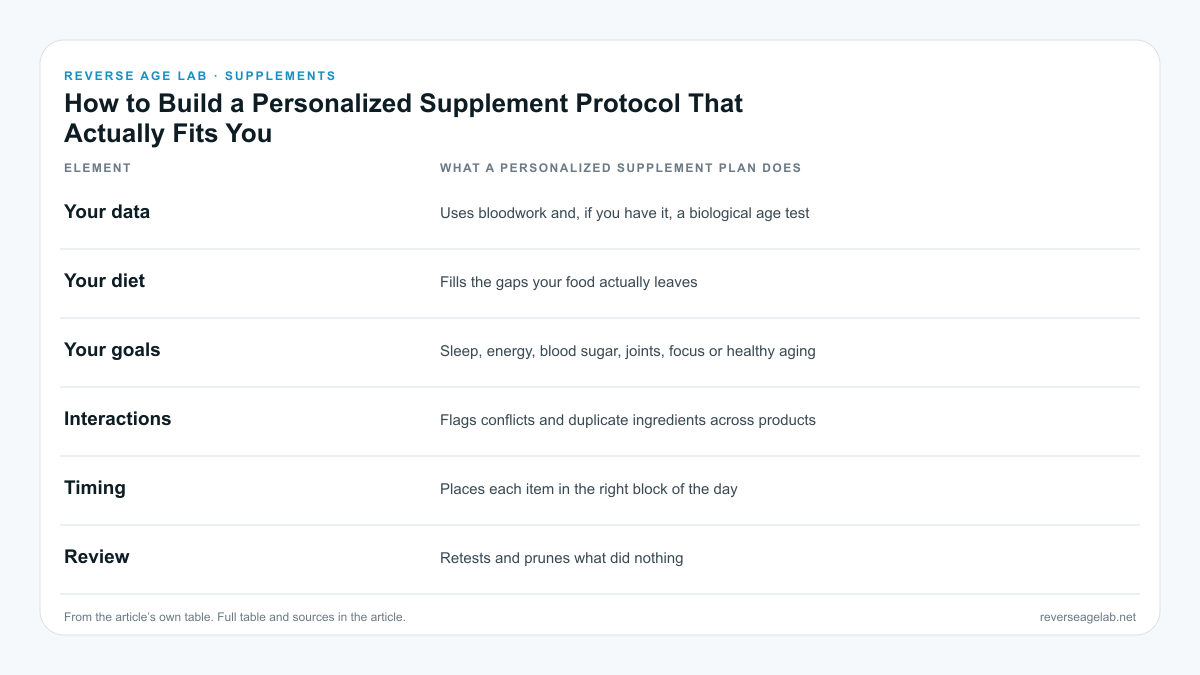
Element | What a personalized supplement plan does |
|---|---|
Your data | Uses bloodwork and, if you have it, a biological age test |
Your diet | Fills the gaps your food actually leaves |
Your goals | Sleep, energy, blood sugar, joints, focus or healthy aging |
Interactions | Flags conflicts and duplicate ingredients across products |
Timing | Places each item in the right block of the day |
Review | Retests and prunes what did nothing |
Who Actually Benefits From One
Personalization helps almost anyone who takes supplements, but it matters most for a few groups. People who already take several supplements and are not sure which are working benefit from trimming to what actually helps. People with specific goals, like improving energy or sleep, benefit from a targeted rather than scattershot approach. People with known deficiencies or dietary restrictions benefit from filling their particular gaps. And anyone tired of wasting money on products that do nothing benefits from a plan built on their own needs. If you take more than a couple of supplements without a clear reason for each, you are a strong candidate. Trimming matters for safety as well as money: about one in six older adults takes a combination of medications and supplements with a potentially serious interaction (Qato et al., 2016).
Start your supplement protocol with goals and a baseline, not products
The mistake almost everyone makes is starting at the supplement. You read about magnesium, you buy magnesium. Start instead with two things: what you are trying to change, and where your body currently stands.
Write down your top two or three goals in plain terms. Better sleep. Lower blood pressure. More energy in the afternoon. Slower biological aging. Then get a baseline: basic bloodwork covering vitamin D, HbA1c, a lipid panel, and inflammation, plus a biological age test if aging is one of your goals. The baseline does two jobs. It tells you which deficiencies to fix first, and it gives you the numbers you will retest against later to see if the protocol is working.
Layer | What it covers | How you decide |
|---|---|---|
Layer one, foundation | Vitamin D, omega-3, magnesium, creatine, protein and fiber | Bloodwork and diet gaps |
Layer two, goal specific | Sleep, stress, blood sugar, joints, focus | One or two at a time, human evidence only |
Layer three, conflicts | Interactions and duplicate ingredients | About 15 percent of older adults risk a major interaction |
Layer four, timing | Morning, with meals, evening, before sleep | Absorption and stimulation |
Then measure | Retest and prune | Keep only what moved |
Layer one: the foundation
Every protocol sits on a small foundation with unusually broad human evidence: vitamin D if your bloodwork shows you are low, magnesium, omega-3s, and creatine. These are not exciting. They are the base because they have deep human data across many outcomes and they correct the deficiencies most people actually have. If your labs show a specific shortfall, fixing that comes before anything you read about online. A deficiency is the one place where a supplement reliably produces a large effect. The foundation has the broadest human data: creatine (Kreider et al., 2017), marine omega-3 for cardiovascular outcomes (Hu et al., 2019) and magnesium (Zhang et al., 2016).
The foundation, graded by Rala. These are the best graded products in Reverse Age Lab's catalog for each foundation ingredient on 16 October 2026. The tier is the strength of the human evidence behind the ingredient (how the tiers work), the reviews are counted across the stores that sell the product, and the cost is per month at the label dose. Grades change as new studies and reviews come in; your own protocol shows the current ones.
| Ingredient | Best graded product | Evidence tier | What buyers report | Cost per month |
|---|---|---|---|---|
| Vitamin D3 | Kirkland Signature Vitamin D3 50 mcg | Tier 1 | 16,749 reviews, 100% positive | $0.75 |
| Magnesium | NOW Magnesium Citrate | Tier 2 | 101,961 reviews, 93% positive | $11.99 |
| Omega-3 | Kirkland Signature Fish Oil 1,000 mg | Tier 1 | 6,066 reviews, 96% positive | not priced yet |
| Creatine | Nutricost Creatine Monohydrate | Tier 2 | 64,464 reviews, 91% positive | $5.69 |
| Creatine | Thorne Creatine | Tier 2 | 20,997 reviews, 93% positive | $14.67 |
Layer two: your goal-specific picks
On top of the foundation go the compounds matched to your specific goals, and only your goals. This is where the by-goal evidence comes in. Trouble sleeping points to melatonin at a low physiological dose or glycine. Blood pressure points to beetroot and magnesium. Blood sugar points to berberine. Stress points to ashwagandha KSM-66. Joints point to UC-II collagen. Pick the strongest evidence-backed option for each of your two or three goals, not five options per goal. A protocol with four well-chosen items beats one with fourteen hopeful ones. The evidence behind those picks: melatonin (Ferracioli-Oda et al., 2013), beetroot nitrate (Siervo et al., 2013), berberine (Guo et al., 2021), ashwagandha (Akhgarjand et al., 2022) and UC-II collagen (Lugo et al., 2016). The full ranked list is in the supplements with real human evidence, by goal.
Layer three: check for conflicts before you add anything
This is the layer that separates a protocol from a pile, and it is the step almost everyone skips. Before an item goes in, check it against everything already in the stack. Are you stacking the same mechanism twice, three nitric-oxide boosters doing one job? Does anything interact with your medications, the way berberine does with some drugs or St John's Wort does with birth control? Does anything cancel or blunt something else? Redundancies waste money. Interactions are a safety issue. A real protocol is pruned, not just assembled. St John's Wort is the textbook case, with clinically relevant interactions across dozens of drugs including oral contraceptives (Nicolussi et al., 2020).
Check it against your medications before you buy anything
A personalized supplement plan is only personal if it knows what else you take. Three kinds of trouble are worth a minute each. Some supplements block a medicine's absorption (calcium, iron, magnesium and zinc near thyroid medicine or near some antibiotics); the fix is a gap of two to four hours. Some do the same job as a medicine (berberine with blood sugar medicines, fish oil or vitamin E with blood thinners, potassium with blood pressure medicines that already raise it); the fix is the prescriber adjusting a dose, not you guessing. And a few change how the liver clears a medicine, St John's wort above all; those are not to be combined without the prescriber's word.
The pairs, with the evidence behind each, are in Supplement and Medication Interactions You Should Know. A pharmacist will check your list for free. And Reverse Age Lab's supplement interaction checker does it automatically: every supplement against every medication you list and against every other supplement, with the schedule built so the right things stay apart. Medications are never changed; their lines always read "as directed by your health care provider".
Layer four: timing
When you take things changes whether they work. Fat-soluble vitamins and omega-3s absorb better with a meal that has fat. Magnesium and glycine belong at night if sleep is the goal. Stimulating compounds go in the morning. Some pairs should be spaced apart because they compete for absorption. Grouping your protocol into timing blocks, on waking, with meals, before bed, turns a bag of bottles into a routine you can actually follow, which is the only kind that produces results. A controlled trial found vitamin D3 absorption rose about a third when taken with a fat containing meal (Dawson-Hughes et al., 2015). Timing rules by supplement are in the best time to take your vitamins and supplements.
Then measure, and let the numbers prune the stack
A protocol is not finished when you build it. Run it for a defined window, six to eight weeks for bloodwork markers, three to six months for biological age, then retest against the baseline you took at the start. Keep what moved your numbers. Cut what did not. This is how a protocol gets better over time instead of just getting longer, which is the default failure mode of everyone who keeps adding and never subtracts.
The part that is genuinely hard to do alone
Every layer above is doable by hand. Doing all of them, correctly, for your specific profile, is where it breaks down. Matching compounds to your goals means reading the evidence. Checking interactions across a full stack plus your medications means holding a lot in your head at once. Getting timing right means knowing the absorption quirks of each item. Most people do one or two layers and skip the rest, which is why most stacks are half-right and overpriced.
That full build is what Rala, Reverse Age Lab's patented AI engine, does in one pass. You enter your profile, goals, current supplements, and lab results, and it reads the human studies and real user reviews behind each option, ranks them by evidence, and assembles a personalized daily protocol organized by timing, with interactions and redundancies flagged. We do not sell supplements, so it optimizes for the evidence and for you, not for a product to move. When you retest, you upload the new numbers and it adjusts the stack. How the tiers are assigned is on the methodology page.
Start with your goals and a baseline. Build the foundation, add your goal-specific picks, prune the conflicts, set the timing. Then measure and let your results decide what stays.
Find your gaps before you buy anything
The most reliable supplements are the ones that correct a real shortfall, so the next step is finding yours. Bloodwork is the best tool here, since it can reveal common gaps like low vitamin D or other markers worth addressing. Beyond labs, your diet tells a story too: if you rarely eat fish, omega-3s are a logical candidate, and if your intake of certain nutrients is consistently low, that points to a target. Filling genuine gaps gives you the clearest return on your money. The VITAL trial is the cautionary tale: vitamin D and omega-3 did nothing for cancer or heart disease in adults who were not selected for deficiency (Manson et al., 2019, omega-3 arm).
Layer | What goes in it | How to decide |
|---|---|---|
Foundation | Vitamin D if low, omega-3 if you skip fish, magnesium, creatine, protein and fiber | Bloodwork and diet gaps |
Goal specific | Sleep, stress, blood sugar, blood pressure, joints or focus picks | One or two at a time, each with human data |
Quality check | Single clearly dosed ingredients with third party testing | Published Certificate of Analysis |
Prune | Anything that did not move a marker or how you feel | Retest after a few months |
The protocol around the supplements: movement, food, sleep
The Movement Layer
If a protocol has one non-negotiable, it is regular physical activity, the closest thing we have to a longevity drug. A good movement layer pairs cardiovascular work, a mix of easy sessions most days plus the occasional hard effort, with resistance training two or three times a week to hold on to the muscle and bone that decline with age. You do not need to be an athlete. The best routine is the one you will actually keep, so start where you are and build the habit before you chase intensity. Sources: exercise training and blood pressure across 93 trials (Cornelissen and Smart, 2013) and 30 to 60 minutes a week of muscle strengthening activity with 10 to 17 percent lower mortality (Momma et al., 2022).
The Nutrition Layer
Nutrition in a longevity protocol is less about a trendy diet and more about a few durable principles. Build meals around whole foods and plenty of plants, get enough protein to protect your muscle as you age, and prioritize fiber for your gut and blood sugar. Keep ultra-processed foods and added sugar low, since the swings they drive in blood sugar and inflammation are among the biggest accelerators of aging. Aim for a consistently good diet rather than a perfect one, because the protocol works only because you can sustain it. In a 20,000 person cohort, more than four servings of ultra processed food a day was associated with 62 percent higher all cause mortality (Rico-Campà et al., 2019), and a 2022 meta-analysis supports protein above the standard allowance for muscle mass and function (Journal of Cachexia, Sarcopenia and Muscle, 2022).
Sleep and Stress
Sleep is where your body does most of its repair, so a protocol that ignores it is incomplete. Aim for seven to nine hours, keep a consistent sleep and wake time, and protect the wind-down hour before bed. Good sleep quietly makes every other layer easier, from appetite control to exercise recovery. Stress is the partner problem, because chronic, unmanaged stress works against your sleep, your metabolism, and your motivation. You do not need a perfect system, just a reliable way to decompress, whether that is a daily walk, breathing practice, time outdoors, or real connection with people you care about. A meta-analysis of 72 studies ties short and disturbed sleep to higher inflammatory markers (Irwin et al., 2016). The sleep stack is in sleep: how to do it right.
The part most protocols miss
Knowing the pillars is the easy part. Assembling them so they work together is where most protocols fall apart. The same supplement can help or do nothing depending on when you take it and what you take it with. Calcium competes with iron and zinc, food carries the fat-soluble compounds and blunts others, and two products can quietly do the same job while a third cancels part of it. Your fasting window matters too, since protein and some amino acids break a fast and switch off autophagy, the cellular cleanup that several reverse-aging strategies depend on. A protocol is a sequenced day built around timing blocks, on waking, with your first meal, with your last meal, and before sleep, not a list of bottles taken whenever you remember. Timing rules are in the best time to take your vitamins and supplements.
What the research says about testing before supplementing
The case for personalising rests on a few well established human findings.
In the largest trial of its kind, vitamin D and omega-3 did not prevent cancer or heart disease in adults who were not chosen for deficiency. The benefit appears when you are genuinely low, which is the whole argument for testing first (Manson et al., 2019, omega-3 arm).
Only about 12 percent of American adults meet the criteria for good metabolic health, so assuming you are average is a poor starting point (Araújo et al., 2019).
Low magnesium intake is widespread and is linked to inflammation and metabolic disease (Rosanoff et al., 2012).
Vitamin D absorbs about 32 percent better when taken with a meal containing fat, so timing changes the result even when the dose is right (Dawson-Hughes et al., 2015).
About 15 percent of older adults are at risk of a major drug interaction, often involving a supplement, which is why a plan should look at everything you take together (Qato et al., 2016).
Frequently Asked Questions
Where do I start when building a personalized supplement plan?
Start with your goals and a baseline, not with products. Write down your top two or three goals, then get bloodwork covering vitamin D, HbA1c, lipids, and inflammation, plus a biological age test if aging is a goal. Fix any deficiencies first, then build from there.
What should the foundation of a protocol be?
A small base with broad human evidence: vitamin D if you are low, magnesium, omega-3s, and creatine. These correct common deficiencies and have deep data across many outcomes, so they anchor the stack before you add goal-specific compounds.
How do I avoid dangerous supplement combinations?
Check every item against the rest of your stack and your medications before adding it. Watch for stacking the same mechanism, interactions like berberine with certain drugs or St John's Wort with birth control, and compounds that blunt each other. Prune redundancies rather than piling on.
How do I know if my protocol is working?
Retest against your starting baseline: six to eight weeks for bloodwork markers, three to six months for biological age. Keep what moved your numbers and cut what did not, so the protocol improves over time instead of just growing.
Ready to build yours? Rala runs all five layers in one pass from your profile, goals, current supplements and lab results, with interactions and redundancies flagged. Reverse Age Lab sells no supplements. Start your 7 day free trial, or grade what you already take with the free research tool.
Related reading: How to Tell if a Supplement Is Evidence-Based or Just Good Marketing
Related reading: The Evidence-Based Supplement Guide: What Human Studies and Real Reviews Actually Show · How to build a supplement stack without wasting money · A daily protocol that lowers your biological age