This guide now also covers "How to Find Longevity Supplements That Actually Work (and Skip the Hype)", "Evidence-Based Supplements: The Complete Guide" and "The Best Daily Supplements: A Professional Guide", which used to be separate articles and now redirect here.
I spent 13 years building supplement products, and I can tell you the label is designed to sell you, not to inform you. The good news is that the tricks are predictable. Once you know what to look for, you can pick up almost any bottle and tell within a minute whether it is backed by evidence or backed by a marketing budget. Here is the checklist I use. This is how to choose supplements that hold up.
The short answer: check the dose against the dose used in the studies, refuse proprietary blends, read the claim for hedging or overreach, look for an NSF, USP or Informed Sport seal, and read the whole review distribution, not the featured quotes. A product that fails any one of those is a marketing product, whatever the ingredient's evidence.
Key takeaways
Check the dose on the label against the dose used in the trial.
Refuse proprietary blends, because a hidden dose cannot be checked.
Read the claim for weasel words like supports and promotes.
Insist on third party testing and a published Certificate of Analysis.
FDA testing found 776 supplements tainted with hidden drugs over nine years.
How to choose supplements: check the dose against the studied dose
This is the single most common trick, and it catches most products. A supplement will cite a real study, then include a fraction of the dose that study used. The research shows an effect at 500 mg, the capsule contains 50 mg, and the label still quotes the study. You get the citation and none of the result.
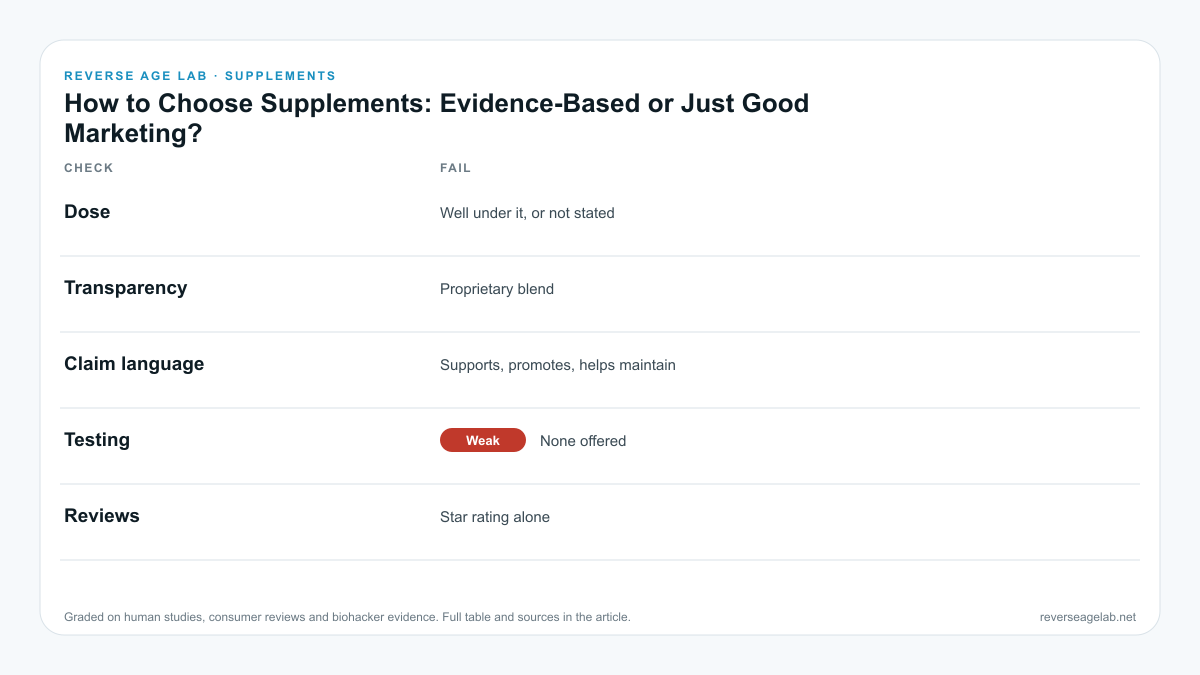
So the first move is always the same: find the dose that worked in the research, then check how much is actually in the product. Ashwagandha studies use around 600 mg of KSM-66. Curcumin needs a bioavailable form because raw curcumin barely absorbs. If a product is well under the studied dose, the evidence on the label does not apply to what is in the bottle. The stress trials behind ashwagandha used about 600 mg a day of a standardized root extract (Akhgarjand et al., 2022), and plain curcumin is so poorly absorbed that formulation decides whether it works at all (Anand et al., 2007).
Check | Pass | Fail |
|---|---|---|
Dose | Matches the studied dose | Well under it, or not stated |
Transparency | Every ingredient dosed on the label | Proprietary blend |
Claim language | Specific and measurable | Supports, promotes, helps maintain |
Testing | Third party, published Certificate of Analysis | None offered |
Reviews | Read for side effects and consistency | Star rating alone |
Refuse to accept proprietary blends
A "proprietary blend" means the label lists several ingredients under one total weight without telling you how much of each is in there. It sounds like a trade secret worth protecting. It is almost always a way to hide that the active, expensive ingredient is present in a tiny amount, with the blend padded out by cheap fillers.
If you cannot see the exact dose of each active ingredient, you cannot evaluate the product, and you should treat that as the answer. A company confident in its formula lists its doses. A proprietary blend is a reason to put the bottle down.
Read the claim for weasel words
Supplement claims are written in a careful legal language designed to imply a benefit the product cannot prove. Learn the tells. "Supports," "promotes," "helps maintain," and "may improve" are structure-function phrases that legally mean the company is not claiming the product does anything specific. That is not automatically bad, most legitimate supplements use this language, but stacked three deep, "supports healthy immune function to promote overall wellness," it is filler hiding the absence of a real, measured effect.
The bigger red flags are the claims that are too strong: "clinically proven," "cures," "reverses," or a specific number like "10 years younger." No supplement can promise those, and a company willing to make the claim is telling you how it operates.
Look for third-party testing
Supplements are loosely regulated, which means what is on the label is not guaranteed to be in the bottle. Independent testing closes that gap. Look for a seal from NSF, USP, or Informed Sport, which means an outside lab verified the contents and checked for contaminants. This does not tell you the supplement works. It tells you that you are actually getting what the label says, which is the floor, not the ceiling. Between 2007 and 2016 the FDA identified unapproved drug ingredients hidden in 776 supplement products, most sold for weight loss, sexual enhancement or muscle building (Tucker et al., 2018).
Weigh reviews, but read them correctly
User reviews are real evidence, if you read the whole distribution instead of the top three. A product with thousands of reviews and a consistent pattern, most people reporting the same specific effect, is a stronger signal than a handful of glowing five-star quotes the brand chose to feature. Look at the negative reviews too. They tell you the common failure modes and side effects the label will never mention. One candid three-star review often teaches you more than fifty curated five-star ones.
Put it together
Evaluating a supplement is really two questions layered on top of each other. Does the ingredient have human evidence for your goal, and does this specific product deliver that ingredient at the right dose, in the right form, verified, without hiding behind a blend? An ingredient can be well-studied and the product still be junk. A product can be clean and the ingredient still be hype. You have to clear both.
Doing that for every supplement you consider is a real amount of work: finding the studied dose, checking the form, decoding the blend, verifying testing, and reading through the review distribution. That is exactly the work Rala, Reverse Age Lab's patented AI engine, does for you. It reads the human studies behind each ingredient and the real user reviews behind each product, then ranks them by evidence, so you see both layers at once, the strength of the science and how the actual product measures up, with the studies attached. We do not sell supplements, so nothing on our side benefits from talking you into a bottle. We just show you where it lands. The five evidence tiers Rala assigns are explained on the methodology page.
Pick up the bottle. Check the dose, kill the proprietary blends, read the claim, confirm the testing, weigh the reviews. Or let the engine run the checklist for you and skip to the answer.
Three filters for the evidence itself
Filter one: human data, not mouse data
This is the filter that eliminates most of the market. A huge share of longevity claims trace back to studies in mice, worms, or cells in a dish. Those are worth funding and worth watching. They are not proof that anything happens in a person.
Resveratrol is the cautionary tale. It extended life in yeast and lit up every anti-aging headline for a decade. In humans, the dose that worked in the lab barely survives digestion, and the longevity benefit never showed up. The mouse result was real. The human product was hype. In a nine year study of older adults, measured resveratrol exposure had no association with lifespan, heart disease, cancer or inflammation (Semba et al., 2014).
So the first question for any supplement is blunt: has this been tested in people, not just animals? If the answer is no, it belongs on a watch list, not in your cabinet.
Filter two: a real outcome, not just a moved biomarker
A supplement can pass the human test and still be selling you very little. The next trick is the biomarker swap. A compound raises some marker in your blood, the marketing calls that "clinically proven," and you never find out whether the marker translates into anything you can feel or measure in your health.
NAD precursors like NMN and NR are the clean example. They reliably raise NAD+ levels in humans. That part is proven. But raising NAD+ is a biomarker, not an outcome. The functional benefits, more energy, better metabolism, a longer healthspan, have largely not held up in human trials. The marker moves. Whether your life gets better is a separate question the label skips. In the best known trial, NMN improved muscle insulin sensitivity in prediabetic women but changed no other measured outcome (Yoshino et al., 2021), and a 2023 trial in healthy adults found higher NAD with modest functional change (Yi et al., 2023). Our full breakdown is in NAD supplements: benefits, evidence and how to choose.
For any longevity compound, separate three things: a mechanism or biomarker, a functional human outcome, and actual lifespan or disease prevention. Most compounds have the first. Some have the second. Almost none have the third. Know which one you are actually buying.
Filter three: replicated, not a single splashy study
The last filter catches the compounds that pass the first two but rest on one small trial, often run by the company selling the product.
This is where you have to read carefully even on the good ones. Calcium alpha-ketoglutarate is a genuinely interesting longevity compound with a widely cited human result showing a meaningful drop in biological age. It is worth attention. It is also, so far, resting on a small early study, with a proper controlled trial still underway. That does not make it worthless. It makes it a promising bet you size accordingly, not a sure thing you build your whole protocol around. That widely cited result is a retrospective study of 42 people taking Rejuvant, not a randomized trial (Demidenko et al., 2021).
Contrast that with Urolithin A, which has produced real functional gains in muscle and endurance across multiple human trials. That is the profile you want: human, functional, and replicated. When a compound clears all three filters, it earns a permanent spot. When it clears one or two, it earns a small, watchful bet. Two separate randomized trials found gains in muscle endurance and strength (Liu et al., 2022; Singh et al., 2022).
Longevity supplement | Human data | Real outcome | Replicated |
|---|---|---|---|
Urolithin A | Yes | Yes, muscle endurance | Yes |
Calcium alpha-ketoglutarate | Yes | Biological age marker only | No |
NAD precursors | Yes | Marker only | Partly |
GlyNAC | Yes | Yes, strength and cognition | Small trials only |
NMN alone | Yes | Modest | No |
Resveratrol | Yes | No | Contradicted |
Spermidine | Observational | No | No |
The two questions that decide everything
Every supplement worth taking has to answer two questions, and both matter.
The first is the science. Does this ingredient have human trials behind it for the goal you care about, or does the evidence stop at a mouse study? A huge share of supplement claims trace back to research in animals or cells that never replicated in people. Resveratrol extended life in yeast and went nowhere in humans. NAD precursors reliably raise a biomarker but have not delivered the functional benefits people buy them for. Separating a real human outcome from a promising lab result is the first filter, and it eliminates most of the market. In older adults, measured resveratrol exposure showed no link to lifespan, inflammation or heart disease (Semba et al., 2014), and NMN trials show a raised biomarker with, so far, narrow functional gains (Yoshino et al., 2021; Yi et al., 2023).
The second is the lived experience. What do real users report over thousands of reviews, not the three the brand chose to feature? Reviews are genuine evidence when you read the whole distribution. A consistent pattern of people reporting the same specific effect is a signal. The negative reviews tell you the side effects and failure modes the label omits. Studies tell you what should happen in a population. Reviews tell you what actually happens to people.
A supplement that clears both, human trial evidence and a consistent positive review pattern, is in a completely different category from one that clears neither. Most of the aisle clears neither.
Test | What to look for | Red flag |
|---|---|---|
Was it tested in people | Randomised human trials | Mouse or petri dish only |
Did it change something real | A symptom, a function, an outcome | A moved blood marker alone |
Has it been repeated | More than one independent trial | One splashy study |
Is the product the studied one | Same form and dose as the trial | Proprietary blend hiding doses |
Is it independently tested | Published Certificate of Analysis | No third party testing |
Why the product matters as much as the ingredient
Clearing the evidence filter is only half the job. An ingredient can be well-studied and the specific product still be useless, because the dose is a fraction of what the studies used, the active is buried in a proprietary blend, or the form is one your body barely absorbs. Raw curcumin is a good example, nearly worthless without a bioavailable formulation. So the evaluation is really two layers: does the ingredient have evidence for your goal, and does this product actually deliver that ingredient at the studied dose, in the right form, verified by third-party testing. Both have to be true. Plain curcumin is poorly absorbed and rapidly cleared, which is why formulation decides whether it does anything (Anand et al., 2007).
Frequently Asked Questions
How do I know if a supplement has the right dose?
Find the dose used in the studies behind the ingredient, then check how much is actually in the product. A common trick is citing research done at a high dose while including a fraction of it. If the amount in the bottle is well under the studied dose, the evidence does not apply.
Why are proprietary blends a red flag?
A proprietary blend lists several ingredients under one total weight without disclosing the dose of each, which usually hides a tiny amount of the active ingredient padded with cheap fillers. If you cannot see the exact dose of each ingredient, you cannot evaluate the product.
What does third-party testing actually tell me?
A seal from NSF, USP, or Informed Sport means an independent lab verified the product contains what the label says and screened for contaminants. It confirms quality and accuracy, not effectiveness, so it is the floor for trusting a product, not proof that it works.
Are user reviews reliable evidence?
They are, if you read the whole distribution rather than the featured quotes. A large, consistent pattern across thousands of reviews is a real signal, and negative reviews reveal side effects and failure modes the label omits. Rala aggregates the full review picture alongside the human studies.
Want the checklist run for you? Rala grades every product on the human studies and the full review picture and builds one daily protocol around your goals. Reverse Age Lab sells no supplements. Start your 7 day free trial, or check any bottle you own with the free research tool.
Related reading: The Evidence-Based Supplement Guide: What Human Studies and Real Reviews Actually Show · How to build a supplement stack without wasting money · The supplements with real human evidence, by goal · How to build a personalized supplement protocol