


Magnesium is one of the most useful and most underrated supplements, in large part because so many people quietly run low on it. It is involved in hundreds of processes in the body, from sleep and stress to muscle function and blood sugar, which is why correcting a shortfall can have a noticeable, broad effect. The catch is that not all magnesium is the same, and the right form and dose matter. Here is an evidence-based guide to magnesium and how to use it well. The magnesium benefits below all come from human trials.
The short answer: about half of adults get less magnesium than they need, and topping up has trial support for sleep, stress and blood pressure, mostly in people who were low. Glycinate is the gentle default, citrate absorbs well and loosens the bowels, oxide is cheap and poorly absorbed. Take it in the evening if sleep is the goal, and check with a clinician if you have kidney disease or take medication.
Key takeaways
About half of adults get less magnesium than they need.
Trial support is strongest for sleep, stress and blood pressure, mostly in people who were low to begin with.
Glycinate is the gentle default, citrate absorbs well but loosens the bowels, oxide is cheap and poorly absorbed.
Take it in the evening if sleep is the goal.
Check with a clinician first if you have kidney disease or take prescription medication.
Why Magnesium Matters So Much
Magnesium is a mineral your body needs for hundreds of enzyme reactions, which is a fancy way of saying it is involved in an enormous range of everyday functions. It helps regulate muscle and nerve function, supports steady blood sugar and blood pressure, contributes to bone health, and plays a role in the systems that govern relaxation and sleep. Because it touches so many processes, a genuine deficiency can show up in vague but real ways, like poor sleep, muscle cramps, or low energy. That broad reach is exactly why it is one of the first supplements worth getting right.
The magnesium benefits that hold up
A few benefits stand out as the most relevant and best supported.
Sleep and relaxation is the most popular reason people take it. Magnesium supports the body's calming pathways, and many people find that adequate magnesium, especially in the evening, helps them wind down and sleep better, particularly if they were low to begin with. In a double blind trial in older adults with insomnia, 500 mg a day improved sleep time, sleep efficiency and time to fall asleep (Abbasi et al., 2012).
Stress and mood support is related. Magnesium is involved in the stress response, and correcting a deficiency may help some people feel calmer, though it is a support rather than a cure. A systematic review found most trials report lower subjective stress and anxiety with supplementation, with the strongest effects in people who were low or anxious to begin with (Boyle et al., 2017).
Muscle function is a classic use, since magnesium helps muscles contract and relax, and low levels are associated with cramps for some people.
Healthy aging ties it together. Adequate magnesium supports metabolic health, bone, and heart function, all of which matter for how you age, making it a sensible foundational supplement for many adults. Across randomized trials magnesium lowers blood pressure by about 2 mm Hg (Zhang et al., 2016), and higher intake tracks with a lower risk of type 2 diabetes in large cohort analyses (Dong et al., 2011). It is one of the few supplements in our blood pressure plan with real trial data.
The through-line across all of these is that magnesium helps most when you are actually low, which, given how common shortfalls are, applies to a lot of people.
Are You Likely Low on Magnesium?
Magnesium shortfalls are surprisingly common, partly because modern diets and food processing reduce intake. You may be more likely to fall short if your diet is low in leafy greens, nuts, seeds, legumes, and whole grains, if you drink a lot of alcohol, or if you have certain health conditions. Many people sit at a level that is not a severe clinical deficiency but is still below optimal, which is the group most likely to notice a benefit from topping up. Food first is ideal, but a supplement is a reasonable way to close the gap. About half of Americans consume less than the estimated average requirement, a gap researchers have argued is underestimated as a health risk (Rosanoff et al., 2012).
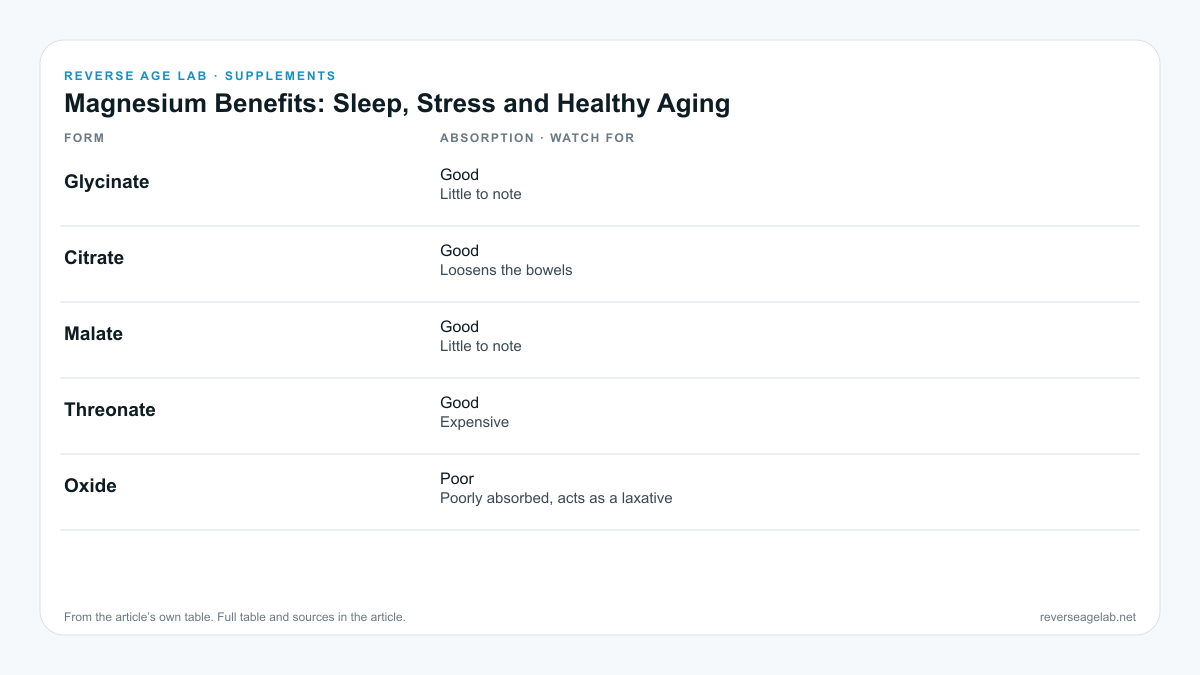
Form | Absorption | Best for | Watch for |
|---|---|---|---|
Glycinate | Good | Sleep and stress, the gentle default | Little to note |
Citrate | Good | Constipation and general topping up | Loosens the bowels |
Malate | Good | Daytime use | Little to note |
Threonate | Good | Studied for the brain | Expensive |
Oxide | Poor | Cheap bulk magnesium | Poorly absorbed, acts as a laxative |
Which Form of Magnesium Should You Take?
This is where many people go wrong, because the form changes both absorption and effect. Magnesium glycinate is gentle on the stomach and is commonly used for sleep, stress, and general support, which makes it a good default for most people. Magnesium citrate is well absorbed and also has a mild laxative effect, so it doubles for people who want digestive support. Magnesium oxide is cheap and common but poorly absorbed, so it is less ideal for raising your levels. Other forms like magnesium malate or threonate are marketed for energy or brain support, with lighter evidence. For most goals, glycinate is a sensible, well-tolerated choice. A randomized comparison found citrate more bioavailable than oxide and amino acid chelate over both a single dose and two months (Walker et al., 2003).
How to Take It Sensibly
A few practical notes make magnesium safer and more effective. Take it consistently, often in the evening if your goal is sleep and relaxation. Start at a modest dose and stay within sensible limits, since too much, especially of the laxative forms, can cause digestive upset. Favor well-absorbed forms like glycinate or citrate over cheap oxide. And as always, food sources like leafy greens, nuts, and seeds should be the foundation, with the supplement filling the gap. If you take medication or have kidney issues, check with a healthcare provider first.
Where Magnesium Fits in Your Routine
Magnesium is a strong example of a supplement that earns its place by filling a common, real gap rather than chasing a trend. But whether you specifically need it, in what form and dose, depends on your diet, your goals, and your body. Figuring that out, and building it into a coherent routine, is exactly what Reverse Age Lab is built to do. Rala, our patented AI, reviews the human studies and turns them into one personalized daily protocol of supplements, diet, and exercise built around your body, then helps you refine it as you retest. Build your protocol free at ReverseAgeLab.net. The evening timing question is answered in the best time to take your vitamins and supplements, and the rest of the sleep stack is in our sleep guide.
Frequently Asked Questions
What are the benefits of magnesium?
Magnesium is involved in hundreds of processes in the body and supports sleep and relaxation, the stress response, muscle and nerve function, steady blood sugar, and bone and heart health. The benefits are most noticeable in people who are low, which is common, making it one of the more genuinely useful supplements.
Which form of magnesium is best?
For most people, magnesium glycinate is a sensible default because it is well tolerated and commonly used for sleep, stress, and general support. Magnesium citrate is well absorbed and also helps with digestion, while magnesium oxide is cheap but poorly absorbed. The best form depends on your goal and how your stomach tolerates it.
Does magnesium help with sleep?
Magnesium supports the body's calming pathways, and many people find that adequate magnesium, especially taken in the evening, helps them relax and sleep better, particularly if they were low to begin with. It is a gentle support rather than a sedative, and it works best alongside good sleep habits.
Should I take a magnesium supplement?
If your diet is low in magnesium-rich foods like leafy greens, nuts, and seeds, or you have signs of a shortfall, a supplement can be a reasonable way to fill the gap, since deficiencies are common. Food sources are ideal first, and it is wise to choose a well-absorbed form and check with a provider if you take medication or have kidney issues.
Not sure whether magnesium belongs in your routine? Rala reads the studies and reviews behind every form and builds one daily protocol around your diet, goals and labs. Reverse Age Lab sells no supplements. Start your 7 day free trial, or check the product you already take with the free research tool.
Related reading: How to Tell if a Supplement Is Evidence-Based or Just Good Marketing
Related reading: The Evidence-Based Supplement Guide: What Human Studies and Real Reviews Actually Show · How to build a personalized supplement protocol
Related reading: How to Build a Personalized Supplement Protocol That Actually Fits You
Related reading: The Supplements With Real Human Evidence, Sorted by What You Want to Fix