


Nearly half of American adults have high blood pressure, and only about one in four of them has it under control. Those two numbers explain why hypertension is still a leading contributor to heart disease and stroke in the United States. The encouraging part is how much of it responds to things you control: what you eat, how you move, how you sleep, and a short list of supplements with real human data behind them.
This is a practical guide to how to lower blood pressure naturally, for the person who wants to move their numbers without guessing. Everything below is ranked by how much the evidence actually supports it, strongest levers first.
The short answer: the biggest, best proven drops come from the DASH eating pattern with less sodium and more potassium, 150 minutes a week of aerobic movement, seven hours of sleep and a daily stress practice. Supplements add a few points on top, with beetroot nitrate, magnesium and potassium carrying the strongest human evidence. Measure at home for a week first so you can see what each change does.
Key takeaways
Measure at home for a week before you change anything, because home readings predict risk better than office readings.
The DASH eating pattern with less sodium and more potassium is the single biggest lever.
150 minutes a week of aerobic movement lowers pressure even without weight loss.
Seven hours of sleep and a daily stress practice set the baseline everything else sits on.
Among supplements, beetroot nitrate, magnesium and potassium carry the strongest human evidence.
Retest after eight to twelve weeks so you can see what each change actually did.
Know your numbers before you change anything
Blood pressure is two readings. Systolic (the top number) is the force when your heart beats. Diastolic (the bottom) is the force between beats. Under 120/80 mm Hg is normal. 120 to 129 systolic is elevated. 130/80 to 139/89 is Stage 1 hypertension. 140/90 or higher is Stage 2. The cutoffs come from the American Heart Association guideline, and a 2024 meta-analysis found home readings predict heart attacks and strokes better than office readings (Journal of Hypertension, 2024).
Buy a validated home cuff and take readings at the same time each day for a week. One reading in a doctor's office tells you almost nothing. A week of morning and evening readings tells you where you actually stand and gives you a baseline to measure every change against.
How to lower blood pressure naturally with diet
The DASH eating pattern is the most tested diet for blood pressure, and the results are large. In controlled trials it dropped blood pressure by an average of 11.4/5.5 mm Hg in people with hypertension. That is bigger than most single medications. DASH is built on vegetables, fruit, whole grains, lean protein, and low-fat dairy, with saturated fat and sodium kept down. The original DASH trial in the New England Journal of Medicine reported an 11.4/5.5 mm Hg drop in participants with hypertension (Appel et al., 1997), and the follow up DASH Sodium trial showed the effect grows as sodium falls (Sacks et al., 2001).
The sodium piece does most of the work. Cutting sodium and raising potassium from food shifts the ratio your blood vessels respond to. Most of the sodium in a typical diet comes from packaged and restaurant food, not the salt shaker, so the fix is cooking more of your own meals rather than salting less at the table. A dose response meta-analysis of randomized trials found potassium lowers blood pressure most in people with hypertension and high sodium intake (Filippini et al., 2020).
Movement lowers pressure even without weight loss
Regular aerobic exercise lowers blood pressure by roughly 5/3 mm Hg, and that happens independent of whether you lose weight. Brisk walking, cycling, swimming, and jogging all qualify. The target that shows up in the research is 150 minutes of moderate activity a week, plus resistance training twice a week. The figure comes from a systematic review of 93 exercise trials (Cornelissen and Smart, 2013).
Even treatment-resistant hypertension responds. A 2021 trial put people whose blood pressure would not budge on medication through a structured exercise and lifestyle program and saw meaningful reductions. Movement is not optional support around the edges of a medication plan. It is one of the main levers. That was the TRIUMPH randomized trial, published in Circulation (Blumenthal et al., 2021).
Stress and sleep set the baseline everything else sits on
Chronic stress keeps blood vessels constricted and heart rate elevated, and over time that becomes a permanent higher reading. Short daily practices that lower the stress response, breathing work, meditation, time outdoors, measurably help. A meta-analysis of transcendental meditation trials found reductions of about 4/2 mm Hg (Bai et al., 2015).
Sleep is the piece people skip. Under seven hours a night is linked to higher blood pressure and more cardiovascular events. If your readings are high and you sleep five hours, fixing sleep may do more than any supplement on this page. In the national NHANES follow up, adults sleeping five hours or less had roughly double the risk of developing hypertension (Gangwisch et al., 2006). If sleep is the weak link, start with the supplements with real sleep evidence.
The supplements with real human evidence
Supplements are the smallest lever here, not the first one. They work best stacked on top of the diet and movement changes above, and the evidence behind them varies a lot by ingredient. These are the ones with human trial data, ranked by how strong that data is.
Beetroot and dietary nitrate have the strongest evidence in this group. Meta-analysis shows systolic reductions around 4.4 mm Hg, with larger effects in people who already have hypertension. Beets convert to nitric oxide in the body, which widens blood vessels. It also improves exercise endurance, which compounds with the movement work. (Siervo et al., 2013, a meta-analysis of 16 trials.)
Magnesium acts as a natural calcium channel blocker and relaxes vascular muscle. In people who are hypertensive or deficient, it lowers blood pressure by roughly 4.5/3.0 mm Hg. Glycinate and taurate are the better-absorbed forms. The pooled estimate across 34 randomized trials was about 2/1.8 mm Hg at 300 mg or more a day (Zhang et al., 2016). Magnesium also earns its place for sleep and stress, which feed back into pressure.
Potassium counters sodium directly and lowers pressure mainly in people who are hypertensive. Food sources and potassium-based salt substitutes are the better route than pills for most people, since dose matters and too much is a real risk for anyone with kidney issues. (Filippini et al., 2020.)
L-citrulline raises nitric oxide through better absorption than L-arginine and lowers systolic and aortic pressure. Aged garlic extract brings systolic down about 4 mm Hg across a nine-trial analysis. Taurine, in a 25-trial meta-analysis, produced significant reductions in blood pressure alongside glucose and triglycerides. CoQ10 delivers modest reductions and matters more for anyone on a statin, since statins deplete the body's own CoQ10. Sources: L-citrulline meta-analysis (Mahboobi et al., 2018), aged garlic extract in uncontrolled hypertension (Ried et al., 2016), taurine in prehypertension (Sun et al., 2016), and the Cochrane review of CoQ10 (Ho et al., 2016).
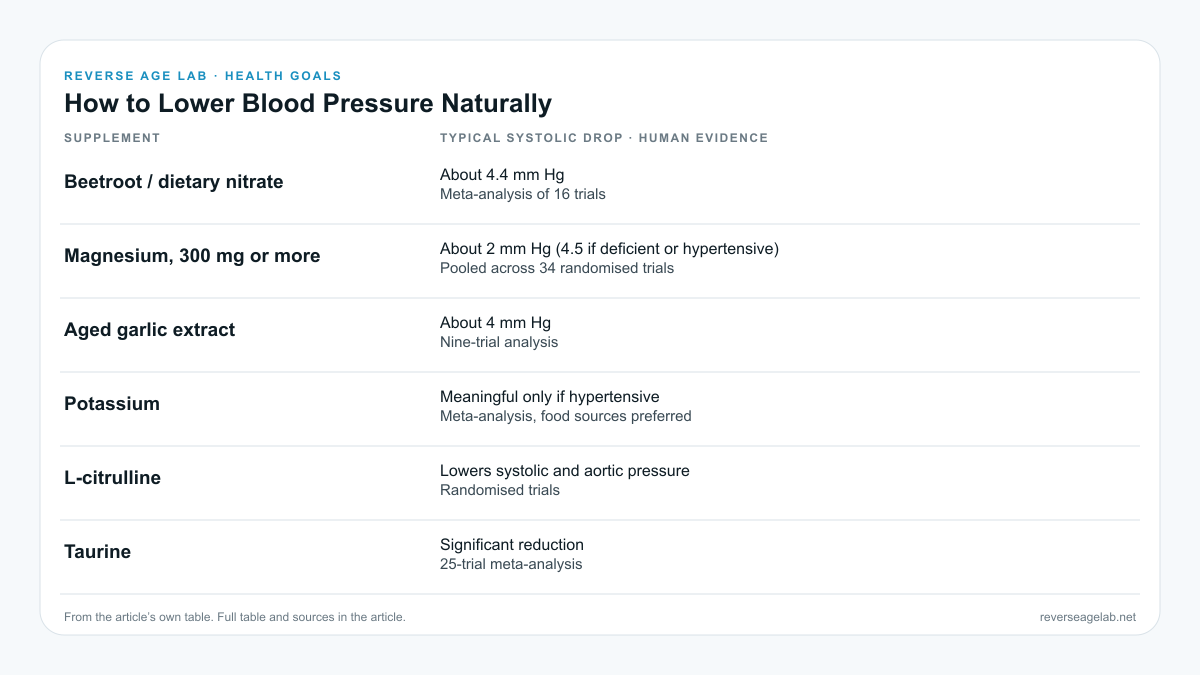
Supplement | Typical systolic drop | Human evidence |
|---|---|---|
Beetroot / dietary nitrate | About 4.4 mm Hg | Meta-analysis of 16 trials |
Magnesium, 300 mg or more | About 2 mm Hg (4.5 if deficient or hypertensive) | Pooled across 34 randomised trials |
Aged garlic extract | About 4 mm Hg | Nine-trial analysis |
Potassium | Meaningful only if hypertensive | Meta-analysis, food sources preferred |
L-citrulline | Lowers systolic and aortic pressure | Randomised trials |
Taurine | Significant reduction | 25-trial meta-analysis |
Notice the pattern: each of these buys you a few points. Stacked on a DASH pattern and 150 minutes of movement, a few points from two or three of them adds up. On their own, they are a rounding error. That order of operations is the whole game.
Turning this into a plan that fits you
The list above is generic on purpose, because an article cannot see your readings, your current stack, your kidney function, or which of these you already get from your diet. The version that works is the one built around your specific numbers and goals, so you are not doubling up on nitric oxide boosters or taking potassium you do not need. The longevity supplement guide explains how every product is graded, and this guide shows how a personal protocol is assembled.
That is what Rala, Reverse Age Lab's patented AI engine, is built to do. It reads the human studies and real user reviews behind every option, then builds one personalized daily protocol of supplements, diet, and exercise around your profile and your goal. We do not sell supplements. We show you the evidence, tier it by how strong it is, and you make the call. For blood pressure specifically, that means seeing exactly which of these levers fits your body instead of buying all eight and hoping.
Start with a week of home readings and a DASH grocery list. Add the movement. Layer in two or three of the evidence-backed supplements that match your profile. Then retest and let the numbers tell you what is working.
Related reading:Magnesium for sleep, stress and healthy aging · Best supplements for better sleep · The evidence based supplement guide · Diet, exercise, sleep and stress in one plan
Related reading: this guide ranks every natural lever. Two companion pieces go deeper: the DASH diet for high blood pressure, meal by meal, and how to lower diastolic blood pressure, the bottom number specifically.
Frequently Asked Questions
What is a healthy blood pressure reading?
Under 120/80 mm Hg is normal. Elevated is 120 to 129 systolic. Stage 1 hypertension is 130/80 to 139/89, and Stage 2 is 140/90 or higher.
Can diet alone lower blood pressure significantly?
Yes. The DASH pattern dropped blood pressure by an average of 11.4/5.5 mm Hg in hypertensive trial participants, which rivals a single medication. Cutting sodium and raising potassium from food does most of the work. (Appel et al., 1997.)
Which supplements have the best evidence for blood pressure?
Beetroot and dietary nitrate have the strongest human data, followed by magnesium, potassium, L-citrulline, aged garlic, taurine, and CoQ10. Each provides a modest reduction and works best on top of diet and exercise changes.
How fast can I expect results?
Diet and exercise changes show up in home readings within a few weeks. Supplements build over similar timeframes. This is why a home cuff and a weekly baseline matter: they show you what is actually moving your numbers.
Ready to move your numbers? Rala reads the human studies and real reviews behind every option above and builds one daily protocol around your readings, your medications and your goals. Reverse Age Lab sells no supplements. Start your 7 day free trial, or check any product you already take with the free research tool.
This is a practical guide to how to lower blood pressure naturally, for the person who wants to move their numbers without guessing. Everything below is ranked by how much the evidence actually supports it, strongest levers first.
The short answer: the biggest, best proven drops come from the DASH eating pattern with less sodium and more potassium, 150 minutes a week of aerobic movement, seven hours of sleep and a daily stress practice. Supplements add a few points on top, with beetroot nitrate, magnesium and potassium carrying the strongest human evidence. Measure at home for a week first so you can see what each change does.
Know your numbers before you change anything
Blood pressure is two readings. Systolic (the top number) is the force when your heart beats. Diastolic (the bottom) is the force between beats. Under 120/80 mm Hg is normal. 120 to 129 systolic is elevated. 130/80 to 139/89 is Stage 1 hypertension. 140/90 or higher is Stage 2. The cutoffs come from the American Heart Association guideline, and a 2024 meta-analysis found home readings predict heart attacks and strokes better than office readings (Journal of Hypertension, 2024).
Buy a validated home cuff and take readings at the same time each day for a week. One reading in a doctor's office tells you almost nothing. A week of morning and evening readings tells you where you actually stand and gives you a baseline to measure every change against.
How to lower blood pressure naturally with diet
The DASH eating pattern is the most tested diet for blood pressure, and the results are large. In controlled trials it dropped blood pressure by an average of 11.4/5.5 mm Hg in people with hypertension. That is bigger than most single medications. DASH is built on vegetables, fruit, whole grains, lean protein, and low-fat dairy, with saturated fat and sodium kept down. The original DASH trial in the New England Journal of Medicine reported an 11.4/5.5 mm Hg drop in participants with hypertension (Appel et al., 1997), and the follow up DASH Sodium trial showed the effect grows as sodium falls (Sacks et al., 2001).
The sodium piece does most of the work. Cutting sodium and raising potassium from food shifts the ratio your blood vessels respond to. Most of the sodium in a typical diet comes from packaged and restaurant food, not the salt shaker, so the fix is cooking more of your own meals rather than salting less at the table. A dose response meta-analysis of randomized trials found potassium lowers blood pressure most in people with hypertension and high sodium intake (Filippini et al., 2020).
Movement lowers pressure even without weight loss
Regular aerobic exercise lowers blood pressure by roughly 5/3 mm Hg, and that happens independent of whether you lose weight. Brisk walking, cycling, swimming, and jogging all qualify. The target that shows up in the research is 150 minutes of moderate activity a week, plus resistance training twice a week. The figure comes from a systematic review of 93 exercise trials (Cornelissen and Smart, 2013).
Even treatment-resistant hypertension responds. A 2021 trial put people whose blood pressure would not budge on medication through a structured exercise and lifestyle program and saw meaningful reductions. Movement is not optional support around the edges of a medication plan. It is one of the main levers. That was the TRIUMPH randomized trial, published in Circulation (Blumenthal et al., 2021).
Stress and sleep set the baseline everything else sits on
Chronic stress keeps blood vessels constricted and heart rate elevated, and over time that becomes a permanent higher reading. Short daily practices that lower the stress response, breathing work, meditation, time outdoors, measurably help. A meta-analysis of transcendental meditation trials found reductions of about 4/2 mm Hg (Bai et al., 2015).
Sleep is the piece people skip. Under seven hours a night is linked to higher blood pressure and more cardiovascular events. If your readings are high and you sleep five hours, fixing sleep may do more than any supplement on this page. In the national NHANES follow up, adults sleeping five hours or less had roughly double the risk of developing hypertension (Gangwisch et al., 2006). If sleep is the weak link, start with the supplements with real sleep evidence.
The supplements with real human evidence
Supplements are the smallest lever here, not the first one. They work best stacked on top of the diet and movement changes above, and the evidence behind them varies a lot by ingredient. These are the ones with human trial data, ranked by how strong that data is.
Beetroot and dietary nitrate have the strongest evidence in this group. Meta-analysis shows systolic reductions around 4.4 mm Hg, with larger effects in people who already have hypertension. Beets convert to nitric oxide in the body, which widens blood vessels. It also improves exercise endurance, which compounds with the movement work. (Siervo et al., 2013, a meta-analysis of 16 trials.)
Magnesium acts as a natural calcium channel blocker and relaxes vascular muscle. In people who are hypertensive or deficient, it lowers blood pressure by roughly 4.5/3.0 mm Hg. Glycinate and taurate are the better-absorbed forms. The pooled estimate across 34 randomized trials was about 2/1.8 mm Hg at 300 mg or more a day (Zhang et al., 2016). Magnesium also earns its place for sleep and stress, which feed back into pressure.
Potassium counters sodium directly and lowers pressure mainly in people who are hypertensive. Food sources and potassium-based salt substitutes are the better route than pills for most people, since dose matters and too much is a real risk for anyone with kidney issues. (Filippini et al., 2020.)
L-citrulline raises nitric oxide through better absorption than L-arginine and lowers systolic and aortic pressure. Aged garlic extract brings systolic down about 4 mm Hg across a nine-trial analysis. Taurine, in a 25-trial meta-analysis, produced significant reductions in blood pressure alongside glucose and triglycerides. CoQ10 delivers modest reductions and matters more for anyone on a statin, since statins deplete the body's own CoQ10. Sources: L-citrulline meta-analysis (Mahboobi et al., 2018), aged garlic extract in uncontrolled hypertension (Ried et al., 2016), taurine in prehypertension (Sun et al., 2016), and the Cochrane review of CoQ10 (Ho et al., 2016).
Notice the pattern: each of these buys you a few points. Stacked on a DASH pattern and 150 minutes of movement, a few points from two or three of them adds up. On their own, they are a rounding error. That order of operations is the whole game.
Turning this into a plan that fits you
The list above is generic on purpose, because an article cannot see your readings, your current stack, your kidney function, or which of these you already get from your diet. The version that works is the one built around your specific numbers and goals, so you are not doubling up on nitric oxide boosters or taking potassium you do not need. The longevity supplement guide explains how every product is graded, and this guide shows how a personal protocol is assembled.
That is what Rala, Reverse Age Lab's patented AI engine, is built to do. It reads the human studies and real user reviews behind every option, then builds one personalized daily protocol of supplements, diet, and exercise around your profile and your goal. We do not sell supplements. We show you the evidence, tier it by how strong it is, and you make the call. For blood pressure specifically, that means seeing exactly which of these levers fits your body instead of buying all eight and hoping.
Start with a week of home readings and a DASH grocery list. Add the movement. Layer in two or three of the evidence-backed supplements that match your profile. Then retest and let the numbers tell you what is working.
Related reading:Magnesium for sleep, stress and healthy aging · Best supplements for better sleep · The evidence based supplement guide · Diet, exercise, sleep and stress in one plan
Frequently Asked Questions
What is a healthy blood pressure reading?
Under 120/80 mm Hg is normal. Elevated is 120 to 129 systolic. Stage 1 hypertension is 130/80 to 139/89, and Stage 2 is 140/90 or higher.
Can diet alone lower blood pressure significantly?
Yes. The DASH pattern dropped blood pressure by an average of 11.4/5.5 mm Hg in hypertensive trial participants, which rivals a single medication. Cutting sodium and raising potassium from food does most of the work. (Appel et al., 1997.)
Which supplements have the best evidence for blood pressure?
Beetroot and dietary nitrate have the strongest human data, followed by magnesium, potassium, L-citrulline, aged garlic, taurine, and CoQ10. Each provides a modest reduction and works best on top of diet and exercise changes.
How fast can I expect results?
Diet and exercise changes show up in home readings within a few weeks. Supplements build over similar timeframes. This is why a home cuff and a weekly baseline matter: they show you what is actually moving your numbers.
Ready to move your numbers? Rala reads the human studies and real reviews behind every option above and builds one daily protocol around your readings, your medications and your goals. Reverse Age Lab sells no supplements. Start your 7 day free trial, or check any product you already take with the free research tool.
Related reading: Focus, Cognition & Mental Clarity Guide
Related reading: Weight Loss - a Science Backed Holistic Approach
Related reading: Energy - Get More Naturally