
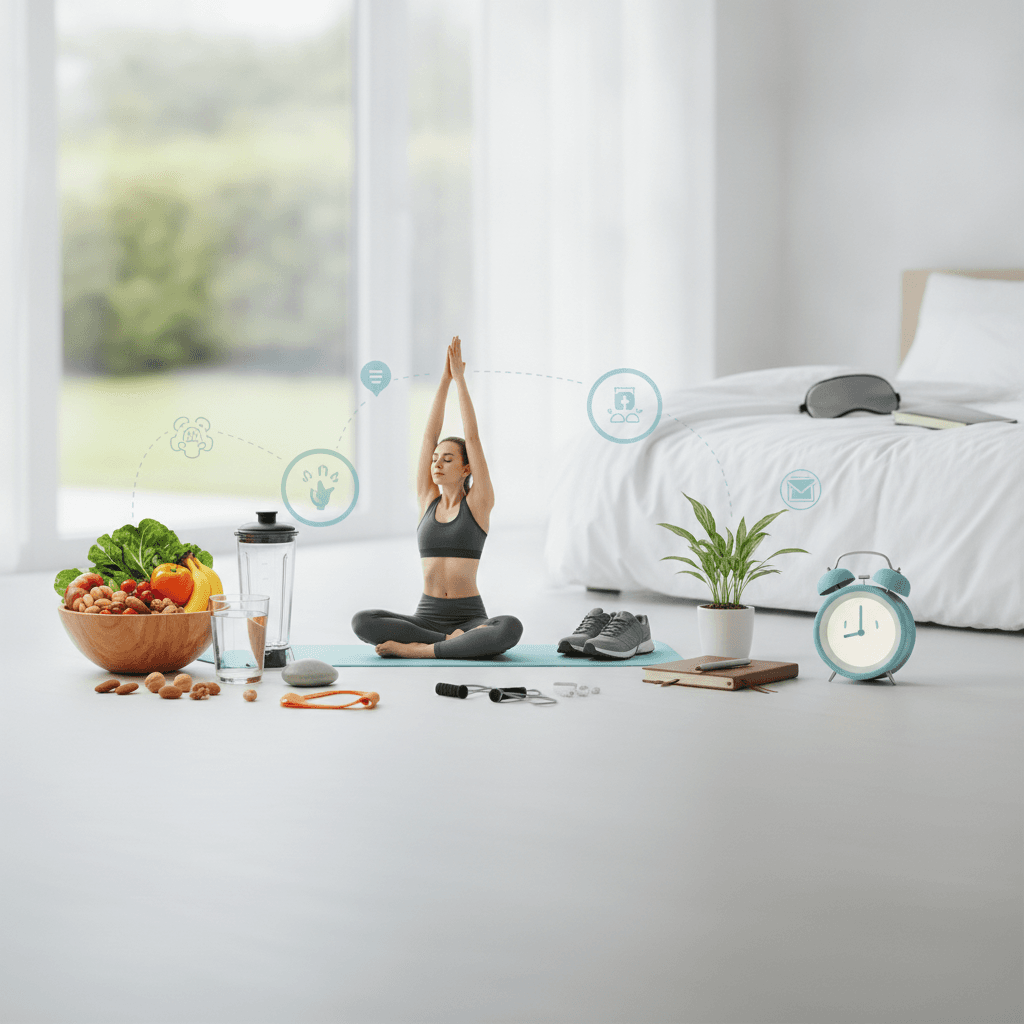
Ask ten people what it means to be healthy and you will get ten different answers. There is no single definition that fits everyone, but there are a few universal pillars that hold for nearly all of us. Balanced health is not about a perfect diet or an extreme routine. It is about getting the fundamentals right, consistently, in a way that fits your life.
The short answer: balanced health rests on four pillars: mostly whole food with enough protein and fiber, regular cardio plus strength training, seven to nine hours of sleep, and managed stress with real social connection. Supplements fill gaps on top of those, never in place of them. Measure a baseline, change a few things, and retest.
What follows is a practical guide to those fundamentals, and how to make them personal. These are the four pillars of good health, in order.
Key takeaways
Four pillars carry almost all of it: food, movement, sleep and stress.
They reinforce each other, so balance across all four beats perfecting one.
Sleep and movement have the broadest ripple effects.
Supplements sit on top and fill measured gaps only.
The best place to start is whichever pillar you are currently neglecting most.
What the pillars of good health really mean
Health is more than the absence of illness. A useful way to think about it is healthspan, the years you live feeling strong, clear, and capable, not just the total number on the calendar. Balanced health rests on four connected pillars, how you eat, how you move, how you sleep, and how you handle stress. Each one supports the others, and weakness in one tends to drag down the rest. You do not need to perfect all four at once. You need to keep all four in view.
Pillar | What good looks like | Evidence |
|---|---|---|
Eat | Mostly whole food, enough protein, plenty of fiber | Mediterranean diet cut major cardiovascular events by about 30 percent |
Move | Regular cardio plus strength training | Fitness tracks mortality with no upper limit |
Sleep | Seven to nine hours on a regular schedule | Short sleep raises inflammatory markers across 72 studies |
Stress and connection | Movement, daylight, real relationships, downtime | Strong social ties, 50 percent higher odds of survival |
Pillar 1: Eat Well Without the Dogma
There is no single perfect diet, and the endless debates often miss the point. The pattern that shows up again and again in research is simple, mostly whole foods, enough protein to maintain muscle, plenty of fiber and colorful plants, and far fewer ultra-processed foods and added sugars. You do not need to follow a strict label to eat well. Build most meals around real food, and the details matter far less than the consistency. The PREDIMED trial found about 30 percent fewer major cardiovascular events on a Mediterranean diet with olive oil or nuts (Estruch et al., 2018), heavy ultra processed food intake was linked to 62 percent higher mortality (Rico-Campà et al., 2019), and protein above the standard allowance supports muscle with age (Journal of Cachexia, Sarcopenia and Muscle, 2022).
Pillar 2: Move in a Way You Will Sustain
Physical activity is the closest thing we have to a longevity drug, and the best routine is the one you will actually keep. A balanced approach combines regular cardio for your heart and energy with strength training to protect the muscle and bone that decline with age. You do not need to train like an athlete. A few sessions a week, done consistently for years, beats an intense program you abandon in a month. Fitness tracks mortality in a stepwise way with no upper limit (Mandsager et al., 2018), and 30 to 60 minutes a week of strength work is associated with 10 to 17 percent lower all cause mortality (Momma et al., 2022).
Pillar 3: Sleep Like It Matters, Because It Does
Sleep is when your body and brain repair themselves, and it is the pillar people sacrifice first. Consistently short or poor sleep is linked to higher inflammation, worse metabolic health, and impaired focus and mood. Aim for seven to nine hours on a regular schedule. Improve this one thing and nearly everything else, from your appetite to your workouts, gets easier. Short and disturbed sleep both raise inflammatory markers across 72 studies (Irwin et al., 2016). See best supplements for better sleep.
Pillar 4: Manage Stress and Stay Connected
Your mind is part of your biology. Chronic, unmanaged stress keeps stress hormones elevated in ways that work against your long-term health, while strong social connection is consistently associated with longer, healthier lives. You do not need a perfect mindfulness practice. Regular movement, time outdoors, real relationships, and a few minutes of genuine downtime go a long way. Strong social relationships were associated with 50 percent higher odds of survival across 148 studies (Holt-Lunstad et al., 2010), and eight weeks of mindfulness practice produced small to moderate reductions in anxiety and stress in a review of 47 trials (Goyal et al., 2014). Calming supplements are covered in magnesium for sleep, stress and healthy aging.
Where Supplements Fit
Supplements can support balanced health, but they sit on top of the four pillars, not in place of them. The sensible role is filling genuine gaps, correcting a vitamin D deficiency, adding omega-3s if you rarely eat fish, ensuring enough protein and fiber. Be skeptical of products promising to replace good habits. Most of the value comes from food, movement, sleep, and stress management, and the right supplements simply round out a routine that is already solid. The VITAL trial found neither vitamin D nor omega-3 prevented cancer or heart disease in unselected adults (Manson et al., 2019, omega-3 arm), which is why we say test first. How to choose is in how to build a supplement stack without wasting money.
Make It Personal
The part most guides skip is that balanced health is personal. Two people with the same goals may need different things based on their bodies, their bloodwork, and their lives. The most reliable way to find what works for you is to measure rather than guess. Establish a baseline with standard bloodwork, make focused changes across the pillars, hold them for a few months, then retest to see what actually moved. What a biological age test can and cannot tell you is in biological age vs chronological age.
Fitting all of this together into one sustainable plan is the hard part, and it is exactly what Reverse Age Lab is built to do. Rala, our patented AI, reviews the human studies and real reviews behind supplements, diet, and exercise, then turns them into one personalized daily protocol built around your body and goals, organized so the pieces work together, and helps you refine it as you retest. Build your protocol free at ReverseAgeLab.net. Our grading rules are on the methodology page.
Ready to make it personal? Reverse Age Lab sells no supplements. Start your 7 day free trial and Rala builds one daily protocol around your goals and test results, or check any product with the free research tool.
Related reading:Daily habits for longevity · Healthy aging tips · Supplements and habits for more energy
Frequently Asked Questions
What does it mean to be healthy?
Being healthy is more than not being sick. A practical definition is having the energy, strength, and clarity to do what matters to you, supported by good habits across diet, movement, sleep, and stress. It looks a little different for everyone, but those fundamentals are nearly universal.
What are the pillars of good health?
The four core pillars are nutrition, physical activity, sleep, and stress management, with strong social connection woven through all of them. They work together, so balance across all four matters more than perfecting any single one.
How do I start being healthier?
Start small and pick one pillar. Improving your sleep schedule, adding a couple of walks, or building meals around whole foods are all high-impact first steps. Consistency beats intensity, and small changes that stick will do far more than a dramatic overhaul you cannot maintain.
Is one pillar more important than the others?
They reinforce each other, so the fair answer is that balance wins. That said, sleep and regular movement tend to have the broadest ripple effects, often making the other pillars easier to manage. The best choice is usually whichever pillar you are currently neglecting most.