

Wondering whether a general chatbot can do this job? We answered that separately: Can ChatGPT build my supplement protocol?
This guide now also covers "AI Longevity: The Future of Personalized Aging", which used to be a separate article and now redirects here.
Generic health advice fails for a simple reason: it is written for the average person, and nobody is the average person. The protocol that fixes one person's fatigue does nothing for another's, because the cause is different. Sorting out which version applies to you is the exact problem AI is now good at, and it is why a personalized plan built by software beats a one-size-fits-all article every time.
The short answer: the same symptom has different causes in different people, so a generic list makes you pay for fixes you do not need. A health AI worth using takes your goals, habits, supplements and lab results, matches them against the human research, narrows the field to the two or three interventions that fit you, and flags the interactions a person reading one article at a time misses. It supports decisions. It does not diagnose.
AI supplements guidance is only as good as the data behind it. Here is what that actually means when you have a real problem to solve, not a science-fiction promise about the future of medicine.
Key takeaways
The same symptom has different causes in different people, which is why generic lists fail.
AI supplements guidance is only as good as the human studies behind it.
It should read your goals, habits, current stack and lab results together.
It is not a doctor and it does not diagnose or treat disease.
Prefer tools that show their sources over ones that hand you a confident answer.
Why the same advice works for one person and not another
Take low energy, the most common complaint there is. The causes are wildly different: poor sleep, low iron, a thyroid issue, blood sugar swings, a magnesium or vitamin D shortfall, too little protein, or simple overtraining. Each one has a different fix. A generic "supplements for energy" list throws all of them at you at once, so even if one addresses your cause, you cannot tell which, and you are paying for five things you did not need. One example of how specific the fix is: in a randomized trial, iron supplements cut fatigue by about half in women with low ferritin who were not anemic, and would do nothing for the other causes on that list (Vaucher et al., 2012). The energy stack itself is covered in how to get more energy naturally.
Personalization is the act of narrowing that list to your version of the problem. Do it well and the plan gets shorter, cheaper, and more likely to work. Do it by hand, reading studies and cross-checking your own labs, and it takes weeks most people never spend.
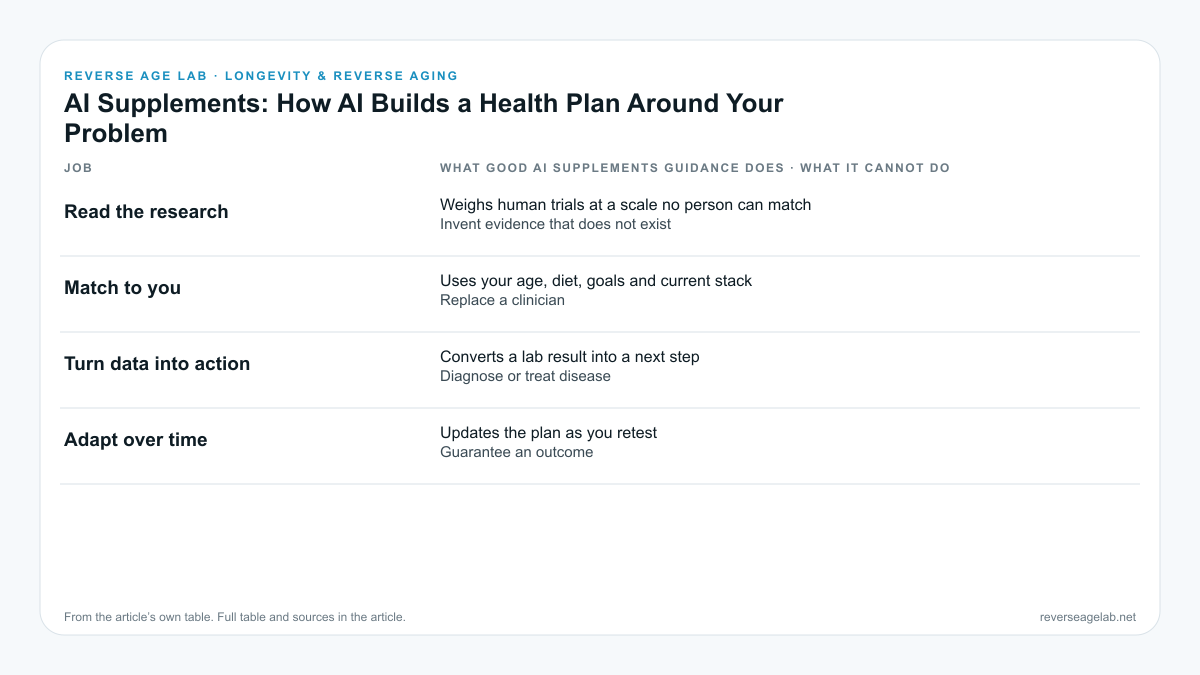
Job | What good AI supplements guidance does | What it cannot do |
|---|---|---|
Read the research | Weighs human trials at a scale no person can match | Invent evidence that does not exist |
Match to you | Uses your age, diet, goals and current stack | Replace a clinician |
Turn data into action | Converts a lab result into a next step | Diagnose or treat disease |
Adapt over time | Updates the plan as you retest | Guarantee an outcome |
What AI actually does with your information
The useful version of health AI is not a chatbot guessing. It is a system that takes your specific inputs, your age, your goals, your habits, your current supplements, and your lab results if you have them, and matches them against the human research on what works for your situation.
It reads more studies than any person has time for and holds them all at once. When you say the problem is sleep, it does not hand you the generic list. It weighs your caffeine timing, your magnesium status, your stress load, and the evidence behind each option, then produces the two or three interventions that fit your profile. That is the difference between information and a plan. Information is a pile of options. A plan is the short list that applies to you.
The other thing it does well is catch interactions and redundancies. Run eleven supplements and some cancel each other out, some double up, some should never be taken together. A system holding your whole profile flags that. A human reading one article at a time usually misses it. That risk is not theoretical: by 2011 about one in six older adults in the United States was taking a combination of medications and supplements with a potentially serious interaction (Qato et al., 2016), and supplement use has kept rising since (Zhao et al., 2025).
Where AI supplements guidance helps and where it does not
AI is strong at pattern matching against a huge body of evidence, personalizing to your inputs, and adjusting as your data changes. It is not a doctor, it does not diagnose disease, and it does not replace testing. The framing that fits is a decision-support engine. It turns the overwhelming amount of health research into a plan you can actually follow, tuned to you instead of to the average.
That is a real and valuable thing. It is also a narrower claim than most health AI marketing makes, which is exactly why it works. The tools that overpromise a cure disappoint. The one that says here is your evidence-based plan, built around your data, and here are the studies behind it, delivers something you can use tomorrow.
Putting it to work on your problem
This is what Rala, Reverse Age Lab's patented AI engine, is built to do. You fill out a short profile, name the problem you want to solve, and it reads the human studies and real user reviews behind every relevant option, then builds one personalized daily protocol of supplements, diet, and exercise for your specific goal. You can upload your lab results and the plan adjusts. We do not sell supplements, so the recommendations follow the evidence, not a product we need to move. Every recommendation shows its evidence tier and the studies behind it, so you see why it is on your list. The tiers and the verification step are described on the methodology page.
Name your one health challenge. Let the engine narrow the entire field of options down to the few that fit you, backed by the research, and start there.
What AI is not, and how to use it without the hype
What AI Is Not
It is worth being clear-eyed. AI is not a doctor, and it does not diagnose, treat, or cure disease. Its recommendations are only as good as the evidence and data behind them, so grounding in real human studies matters enormously. Because it runs on your personal health information, how that data is handled should never be an afterthought. Used carelessly, AI can scale bad advice as easily as good. Used well, it does the opposite. Grounding matters because the products themselves are unreliable: FDA testing found 776 supplements tainted with hidden drugs over nine years (Tucker et al., 2018). How we grade evidence is on the methodology page.
How to Use AI Without the Hype
Favor tools that show their reasoning and cite the evidence, not ones that simply hand you a confident answer. Keep a human in the loop for anything medical. And treat AI as a way to organize and personalize what is already supported, not as a shortcut around the fundamentals of sleep, movement, nutrition, and sensible supplementation. The goal is fewer, better decisions, not more noise. The same rules apply to any product: see how to evaluate evidence based supplements.
Frequently Asked Questions
How does AI personalize a health plan?
It takes your inputs, age, goals, habits, current supplements, and lab results, and matches them against the human research on what works for your specific situation, then produces a short list of interventions that fit your profile instead of a generic list.
Can AI replace my doctor?
No. AI is a decision-support engine, not a diagnostic tool. It does not diagnose or treat disease. It turns the overwhelming body of health research into an evidence-based plan tuned to your data, which is a different and narrower job than a physician's.
Why is a personalized plan better than a generic supplement list?
A generic list throws every possible option at you, so you cannot tell which one addresses your cause and you pay for things you do not need. Personalization narrows the list to your version of the problem, which is shorter, cheaper, and more likely to work.
How does Reverse Age Lab use AI?
Rala reads the human studies and user reviews behind each option and builds one personalized daily protocol of supplements, diet, and exercise around your profile and goal, with every recommendation showing its evidence and studies. It sells no supplements, so the plan follows the evidence.
Ready to name your problem? Rala builds one daily protocol of supplements, diet and exercise around your goal, your profile and your labs, with the studies attached. Reverse Age Lab sells no supplements. Start your 7 day free trial, or check any product with the free research tool.
Related reading: How to Build a Daily Protocol That Actually Lowers Your Biological Age · How to build a personalized supplement protocol · Personalized supplement plan: do you need one? · The future of AI in personalized longevity
Related reading: How to Find Longevity Supplements That Actually Work (and Skip the Hype)