
This guide now also covers "Age Reversal: What's Real and What's Hype" and "A Science-Backed Approach to Slowing Cellular Aging", which used to be separate articles and now redirect here.
It is one of the most searched questions in health, and the answer has two parts. You cannot stop the calendar or become literally younger, but you can lower your biological age, the measurable estimate of how your cells and systems are actually aging, and a growing body of human research shows that number moves. That distinction is where most of the confusion, and most of the hype, lives.
The short answer: chronological age cannot be reversed, biological age can be lowered. A controlled eight week lifestyle trial cut measured biological age by about three years, fitness tracks with lower mortality, and a short list of supplements has moved aging markers in people. Extreme protocols and unmeasured miracle claims are the hype.
What the science supports, separated from the marketing, comes down to a handful of things you can actually measure. So can aging be reversed? Here is what the human data shows.
Key takeaways
You cannot become younger, but you can lower measured biological age.
An eight week controlled trial lowered it by about three years.
Exercise, whole food, sleep and managed stress account for most of the measurable progress.
A short list of supplements has human data on aging markers.
Establish a baseline, hold changes for a few months, then retest.
Can aging be reversed? What that really means
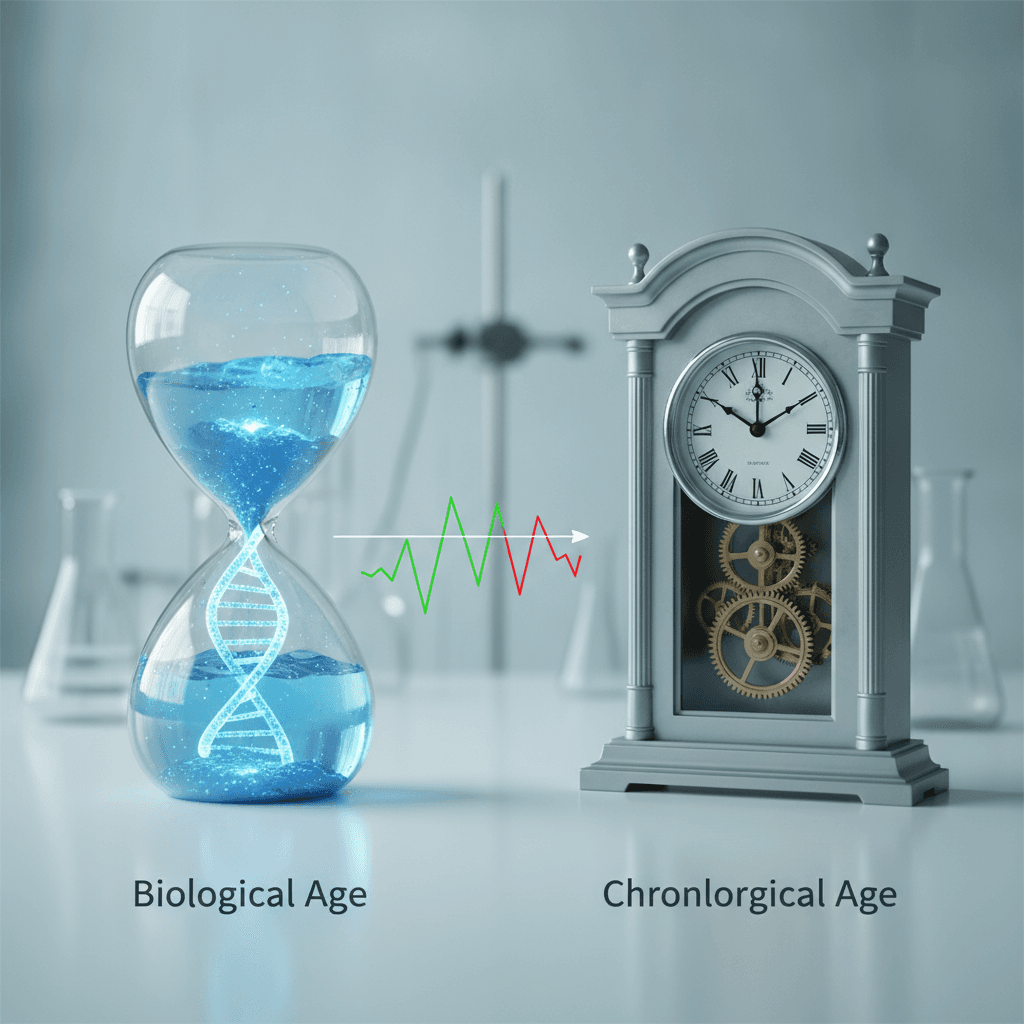
There are two different ages worth tracking. Your chronological age is the number of years since you were born, and nothing changes that. Your biological age is an estimate of how old your cells and systems behave, based on measurable markers in your blood and DNA, and it can run younger or older than your chronological age depending on how you live. When researchers talk about reversing aging, they almost never mean making you literally younger. They mean lowering that biological age and slowing the pace at which you accumulate age-related decline, which is a real, measurable goal rather than science fiction. Biological age is read from DNA methylation clocks, beginning with the multi tissue clock (Horvath, 2013). The difference is explained in biological age versus chronological age.
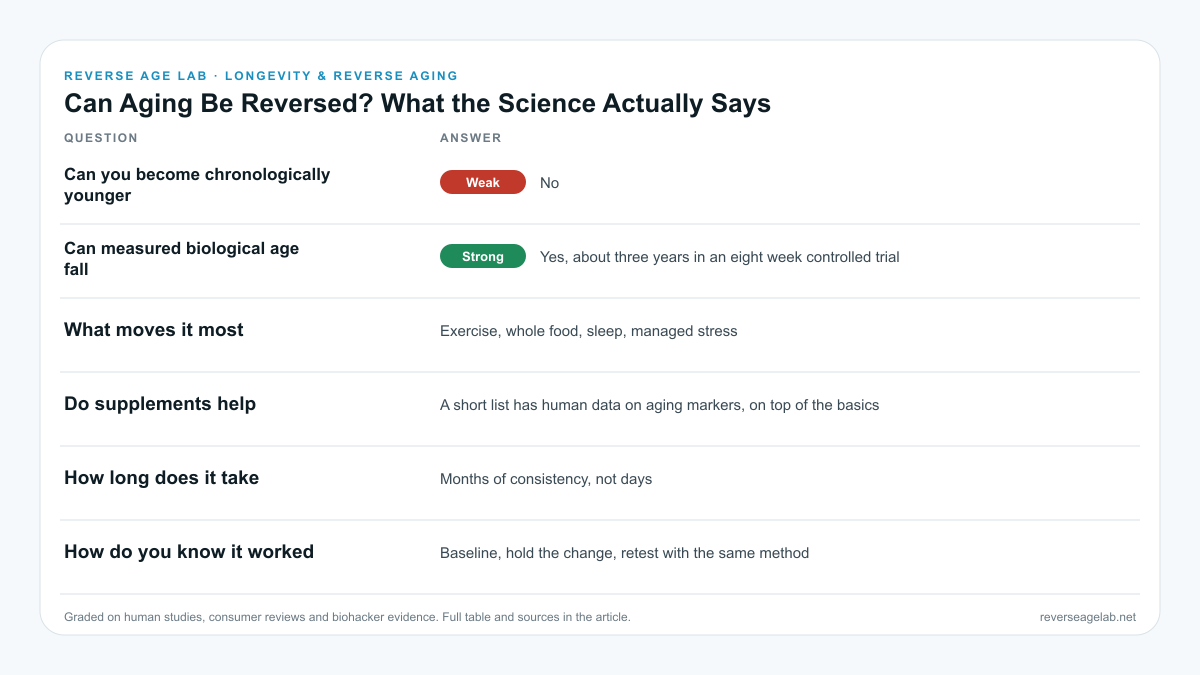
Question | Answer |
|---|---|
Can you become chronologically younger | No |
Can measured biological age fall | Yes, about three years in an eight week controlled trial |
What moves it most | Exercise, whole food, sleep, managed stress |
Do supplements help | A short list has human data on aging markers, on top of the basics |
How long does it take | Months of consistency, not days |
How do you know it worked | Baseline, hold the change, retest with the same method |
The Evidence That Biological Age Can Move
Biological age is not fixed. A small 2021 controlled study published in the journal Aging found that an eight-week diet and lifestyle program was associated with roughly a three-year reduction in participants' measured biological age compared with a control group. It was a small trial that needs replication, but it pointed to something powerful, that ordinary daily habits can shift the markers of aging. Other lines of research reinforce the same idea, from higher cardiorespiratory fitness linked to lower mortality risk to healthy-aging patterns that show up again and again in large population studies. The fair caveat is that much of this work is early and no single study should be oversold, but the direction is clear and consistent. Your choices move the needle. Sources: the eight week trial (Fitzgerald et al., 2021) and cardiorespiratory fitness and long term mortality (Mandsager et al., 2018).
What Actually Moves the Needle
The interventions with the strongest evidence are not exotic. Regular exercise that combines cardio and strength, a whole-food diet that keeps blood sugar and inflammation in check, consistent quality sleep, and managed stress account for most of the measurable progress people make. Supplements sit on top of that foundation, and the right ones are a real part of the picture, not a rounding error. A handful of compounds have moved aging markers in people, not just animals. Calcium alpha-ketoglutarate, sold as Rejuvant, was linked to an average reduction of roughly eight years in biological age in a retrospective human study using DNA-methylation clocks. GlyNAC, which is glycine plus NAC, restores age-related glutathione loss and improves strength, cognition, and metabolic markers in older adults. NAD precursors like those in Elysium Basis raised NAD+ in a human trial, and urolithin A, sold as Mitopure, improves muscle endurance through mitochondrial renewal. These earn a place because human evidence supports them, but they work best on top of the fundamentals, not instead of them. Sources: calcium alpha-ketoglutarate (Demidenko et al., 2021), GlyNAC (Kumar et al., 2023), nicotinamide riboside with pterostilbene (Dellinger et al., 2017) and urolithin A (Liu et al., 2022). Each is examined in reverse aging supplements: what the evidence supports.
The Hype to Ignore
The reversal conversation attracts more hype than almost any topic in health. Be skeptical of extreme, six-figure protocols presented as the only path, of any product that promises a dramatic transformation it never measures, and of before-and-after claims with nothing tracked behind them. Impressive is not the same as effective, and the most photogenic protocols are rarely the most practical. Real age reversal is unglamorous, evidence-based, and personalized, and it is judged by your numbers rather than someone else's marketing. Even the most exciting laboratory work, cellular reprogramming that restored vision in old mice (Lu et al., 2020), has no approved human treatment behind it.
How to Track Whether It Is Working
Because biological age is measurable, you do not have to guess. Establish a baseline with an epigenetic age test and a standard blood panel, make focused changes, hold them for a few months, then retest. This diagnose, act, and retest loop turns the question of whether aging can be reversed into a personal experiment with real feedback rather than a debate. The step by step plan is in how to lower your biological age.
A Realistic Path Forward
The realistic answer is that you can meaningfully slow aging and lower your biological age, but only with a plan that fits your body and that you actually follow. That is what Reverse Age Lab is built to deliver. Rala, our patented AI, reviews the human studies and real reviews behind supplements, diet, and exercise, then turns them into one personalized daily protocol built around your goals and organized so the pieces work together, and it helps you refine that protocol as you retest. Build your protocol free at ReverseAgeLab.net. Our grading rules are on the methodology page.
Two different things people call age reversal
The confusion starts with the word itself. Chronological age, the years since you were born, cannot be reversed, full stop. Biological age, an estimate of how old your cells and systems behave based on measurable markers, is different, and it can move in either direction depending on how you live. When responsible scientists talk about reversing aging, they almost always mean improving biological age and the markers behind it, not literally making you younger. When marketing talks about it, the meaning is often left deliberately vague. Keep that distinction front of mind and most claims become easier to judge. Biological age is measured with epigenetic clocks built on DNA methylation, from the original multi tissue clock (Horvath, 2013) to GrimAge, which predicts lifespan and healthspan (Lu et al., 2019). The difference is spelled out in biological age versus chronological age.
Age reversal claim | What was actually shown | Verdict |
|---|---|---|
Lowering biological age | About three years in an eight week controlled trial | Real but early |
Exercise and fitness | Stepwise lower mortality with no upper limit | Real |
Cell reprogramming | Vision restored in old mice, lifespan extended in a mouse model | Real science, not yet human |
Dramatic six figure protocols | One person, no control group | Not evidence |
Before and after marketing | Nothing measured | Hype |
How to tell real from hype
A few questions cut through most claims. Does it promise to reverse chronological age or restore youth effortlessly? That is a red flag. Is the evidence from human studies, or mainly from animals, cells, or testimonials? Human evidence matters far more. Does it ask you to skip the proven fundamentals in favor of a product or treatment? That inverts the real hierarchy. And is it selling a one-size-fits-all miracle, or acknowledging that results depend on your body and consistency? Real age reversal is measured, individualized, and modest in its promises.
What is actually aging: the cellular view
Researchers describe aging through what they call the hallmarks of aging, a set of interconnected processes that drive your body's decline over time. A few of the most important are worth understanding, because each one is something you can influence. The framework comes from López-Otín et al. (2013), expanded to twelve hallmarks in the 2023 update.
Your mitochondria, the tiny power plants inside your cells, become less efficient with age and produce less clean energy. Senescent cells, sometimes called zombie cells, stop dividing but refuse to die and leak inflammatory signals into surrounding tissue. Chemical tags on your DNA shift in ways that change how your genes are read, and low-grade chronic inflammation quietly accelerates damage across the whole system.
The encouraging part is that these are not fixed. The pace at which they progress responds to how you live.
Lever | What it does to cellular aging | Evidence |
|---|---|---|
Resistance training and protein | Protects muscle, the most protective tissue you have | 30 to 60 minutes a week means 10 to 17 percent lower mortality |
Cardiovascular fitness | Improves the mitochondria that decline with age | Stepwise lower mortality, no upper limit |
Whole food eating | Reduces blood sugar swings and inflammation | Heavy ultra processed intake linked to 62 percent higher mortality |
Sleep | Most cellular repair happens while you sleep | Short sleep raises inflammatory markers across 72 studies |
Selected supplements | A thin extra layer, not a foundation | Calcium alpha-ketoglutarate, GlyNAC, NAD precursors, urolithin A |
Frequently Asked Questions
Can you actually reverse aging?
Not in the sense of becoming younger or stopping aging entirely. But you can slow the rate at which you age and lower your biological age, the measurable estimate of how old your body behaves. Early research, including small controlled trials, supports this when people commit to consistent changes.
Can you lower your biological age?
Yes, this is the more accurate framing. Biological age responds to exercise, diet, sleep, stress management, and a few well-studied supplements. A 2021 study tied an eight-week lifestyle program to a roughly three-year reduction in measured biological age, though larger studies are still needed to confirm how durable those changes are.
How long does it take to see changes in biological age?
It varies, but meaningful shifts in biomarkers typically take months of consistent effort, not days. The practical approach is to establish a baseline, hold your changes for a few months, and then retest to see what actually moved.
Are there supplements that reverse aging?
A short list has real human evidence for lowering biological age. Calcium alpha-ketoglutarate, sold as Rejuvant, was linked to about eight years off measured biological age in a human study, and compounds like GlyNAC, NAD precursors, and urolithin A have human trials behind them. No supplement replaces exercise, diet, and sleep, but the right ones, chosen on human evidence rather than marketing, are a real part of the picture.
Ready to measure yours? Rala turns your test results, goals and habits into one daily protocol of supplements, diet and exercise and adjusts it when you retest. Reverse Age Lab sells no supplements. Start your 7 day free trial, or check any product with the free research tool.
Related reading:Age reversal: what is real and what is hype · A science backed approach to slowing cellular aging · A daily protocol that lowers your biological age