
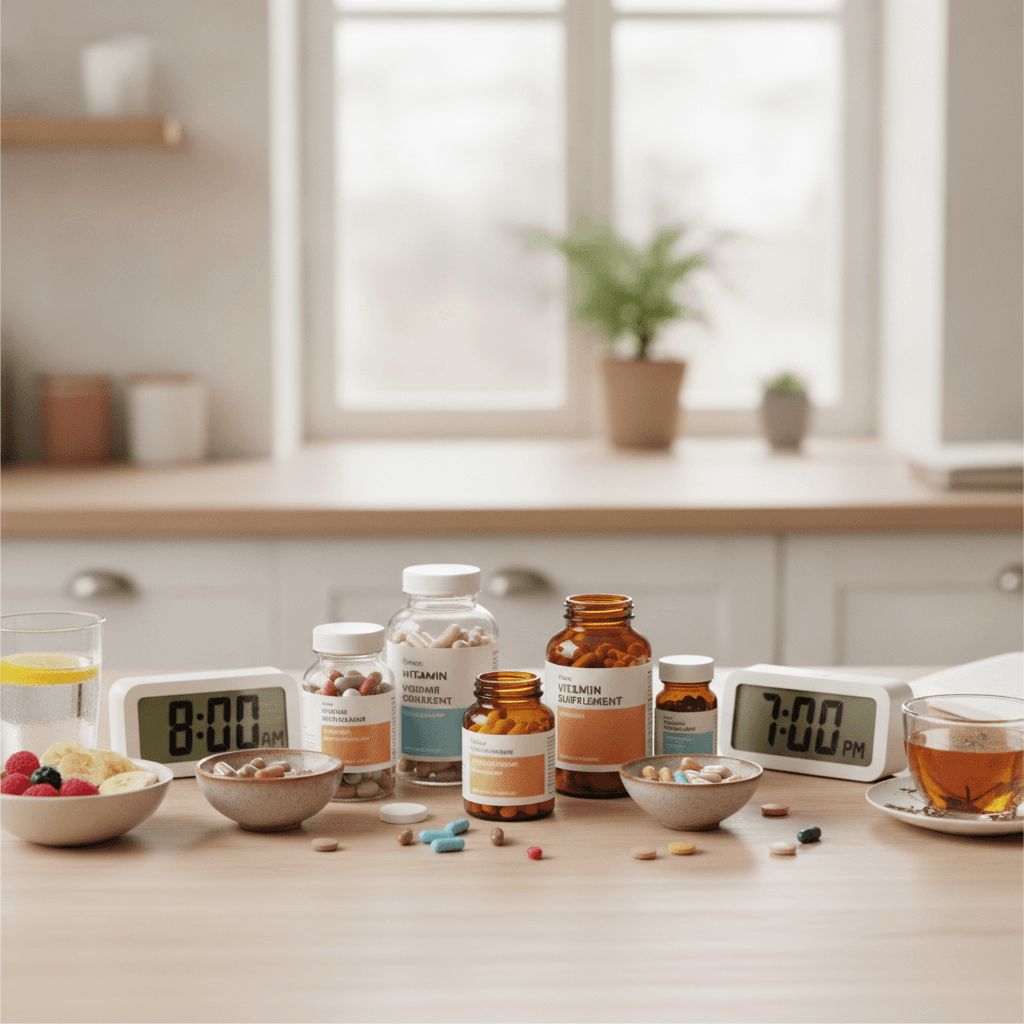
Timing changes how well some supplements work, and the rules are different for a basic vitamin than for a longevity compound. A handful are genuinely timing-sensitive, and the rest matter far less than the internet suggests. What follows is the quick version for vitamins, the non-vitamin supplements most people actually take, several reverse-aging picks with real human evidence, and the part almost everyone gets wrong. This is the best time to take supplements, category by category.
The short answer: take fat soluble vitamins, omega-3 and most longevity compounds with a meal that has fat; B vitamins, caffeine, creatine and NAD precursors in the morning; magnesium, glycine, ashwagandha and low dose melatonin in the evening; iron alone, away from calcium and coffee. Consistency beats the perfect hour, and the interactions between products matter more than any single clock.
Key takeaways
Fat soluble vitamins and omega-3 absorb better with a meal that contains fat.
B vitamins, caffeine, creatine and NAD precursors suit the morning.
Magnesium, glycine, ashwagandha and low dose melatonin suit the evening.
Iron works best alone, away from calcium and coffee.
Consistency beats the perfect hour, and interactions matter more than any single clock.
Vitamins, the Quick Version
Fat-soluble vitamins, A, D, E, and K, absorb best with a meal that contains some fat, so an empty-stomach multivitamin wastes part of the dose. B vitamins can be mildly stimulating, so morning suits them better than night. Vitamin C is flexible and fine any time. Iron absorbs best on an empty stomach and away from calcium and coffee, which blunt it. For most people the single biggest lever is not the perfect hour, it is taking them consistently, with a meal, so the habit sticks. Vitamin D taken with a fat containing meal raised blood levels about 32 percent more than fat free (Dawson-Hughes et al., 2015).
When | What to take | Why |
|---|---|---|
Morning, with food | Vitamin D, omega-3, B vitamins, NAD precursors | Fat aids absorption; B vitamins and NAD are mildly stimulating |
Morning, any time | Creatine, caffeine | Daily consistency matters more than timing; caffeine must stay early |
Away from meals | Iron | Calcium and coffee blunt absorption |
Evening | Magnesium, glycine, ashwagandha | Calming, and glycine is studied before bed |
30 to 60 minutes before bed | Low dose melatonin | It is a timing signal, not a sedative |
The best time to take supplements: the popular ones
Magnesium, especially the glycinate form, fits the evening, where it supports relaxation and sleep. Creatine can go any time of day, because daily consistency matters far more than timing. Omega-3 fish oil belongs with a meal that contains fat, which improves absorption and reduces the fishy aftertaste. Probiotics are strain-dependent, and many do best taken with or just before a meal, so follow the label. Protein and whey work around training or whenever you are short of your daily protein target, and they break a fast. Caffeine and pre-workout belong early, ideally not within eight hours of bed. Ashwagandha is flexible, and many people take it in the evening when they use it for stress or sleep. Melatonin works in a low dose thirty to sixty minutes before bed, not as a nightly sedative. Sources: magnesium for insomnia in older adults (Abbasi et al., 2012), creatine dosing (Kreider et al., 2017), ashwagandha for stress (Akhgarjand et al., 2022) and melatonin dose and timing (Ferracioli-Oda et al., 2013). The sleep options are compared in best supplements for better sleep.
Timing the Reverse-Aging Supplements
The compounds with real human evidence for lowering biological age follow the same logic, and Reverse Age Lab rates each one on human studies plus real review data. Rejuvant, which is calcium alpha-ketoglutarate, suits a morning meal, and a retrospective human study using DNA-methylation clocks found an average reduction of roughly eight years in biological age. Elysium Basis, nicotinamide riboside with pterostilbene, raised NAD+ significantly in a human trial and reads as energizing, so morning fits best. Mitopure, urolithin A, improves muscle endurance in older adults through mitochondrial renewal and goes with a meal. GlyNAC, glycine plus NAC, restores glutathione and improves multiple aging markers in human studies, and the glycine half nudges it toward evening for sleep. The pattern is simple once you see it, energizing compounds early, calming ones late, and the rest with food. Sources: calcium alpha-ketoglutarate (Demidenko et al., 2021), nicotinamide riboside with pterostilbene (Dellinger et al., 2017), urolithin A (Liu et al., 2022), GlyNAC (Kumar et al., 2023) and glycine before bed (Bannai et al., 2012). Each is graded in reverse aging supplements: what the evidence supports and NAD supplements: benefits, evidence and how to choose.
The Part Everyone Gets Wrong
Timing one supplement in isolation misses the bigger picture. What you eat changes how things absorb, since fat carries the fat-soluble vitamins, fiber slows some minerals, and calcium and coffee blunt iron. Supplements also interact with each other, so calcium competes with iron and zinc, magnesium can soften the kick of a stimulant, and two products can quietly do the same job while a third cancels part of it. Your fasting window matters too, because protein, whey, and some amino acids break a fast and switch off autophagy, the cellular cleanup that several reverse-aging strategies depend on. None of this shows up when you look at a single bottle and a single clock. It only resolves when you sequence the whole day. About 15 percent of older adults are at risk of a major drug interaction, often involving a supplement (Qato et al., 2016). Building the stack itself is covered in how to build a supplement stack without wasting money.
How Reverse Age Lab Does It
Reverse Age Lab starts with your full health profile, your diet, and every supplement you take, then lays them into a single daily protocol built around timing blocks, on waking, with your first meal, with your last meal, before sleep, and as needed. The engine accounts for synergies that make pairs work better, negative combinations that fight each other, redundancies where two products overlap, and the fasting and autophagy windows that decide what you can take and when. That is the difference between a cabinet full of bottles and a routine where every item earns its place, which is exactly what we do at Reverse Age Lab. Our grading rules are on the methodology page.
Want your whole day sequenced? Reverse Age Lab sells no supplements. Start your 7 day free trial and Rala lays every item into timing blocks around your meals and sleep, or check any product with the free research tool.
Related reading:A professional guide to daily health supplements · Magnesium for sleep, stress and healthy aging · Do you need a personalized supplement plan?