Most supplement roundups list the same four things and call it a day. The real picture is wider and more useful: for almost any common health goal, there is a specific compound with actual human trials behind it, and a pile of popular ones with nothing but marketing. The trick is matching the compound to the goal in front of you instead of defaulting to a generic multivitamin.
The short answer: match the compound to the goal. Melatonin, glycine and theanine for sleep; ashwagandha for stress; creatine and Bacopa for memory; berberine for blood sugar; psyllium for cholesterol; beetroot and magnesium for blood pressure; UC-II collagen for joints; urolithin A for longevity. Each has human trials. Taking all of them at once is the mistake, because several interact.
These are science backed supplements, chosen on human trials. Below is that match, organized by what you are actually trying to fix. Each pick has human evidence, not a mouse study. Match your goal, start with the strongest option, and skip the rest.
Key takeaways
Match the supplement to the problem you actually have, not to a trend.
Every pick below has human trial data, not a mouse study.
Start with one change at a time so you can tell what worked.
Correct a measured deficiency before adding anything optional.
Retest after a few months and drop whatever did nothing.
Science backed supplements for sleep
Melatonin is the most tested, and the surprise is the dose. The physiological dose of 0.3 to 0.5 mg shortens the time it takes to fall asleep and helps most with circadian or delayed-phase problems. The 5 to 10 mg most stores sell is far more than you need. Glycine at 3 grams before bed improves subjective sleep quality and next-day alertness in small controlled trials. L-theanine at 200 to 400 mg helps through relaxation rather than sedation, so it pairs well with a racing mind. Sources: melatonin (Ferracioli-Oda et al., 2013), glycine (Bannai et al., 2012) and L-theanine (Hidese et al., 2019). More on the sleep stack in our sleep guide.
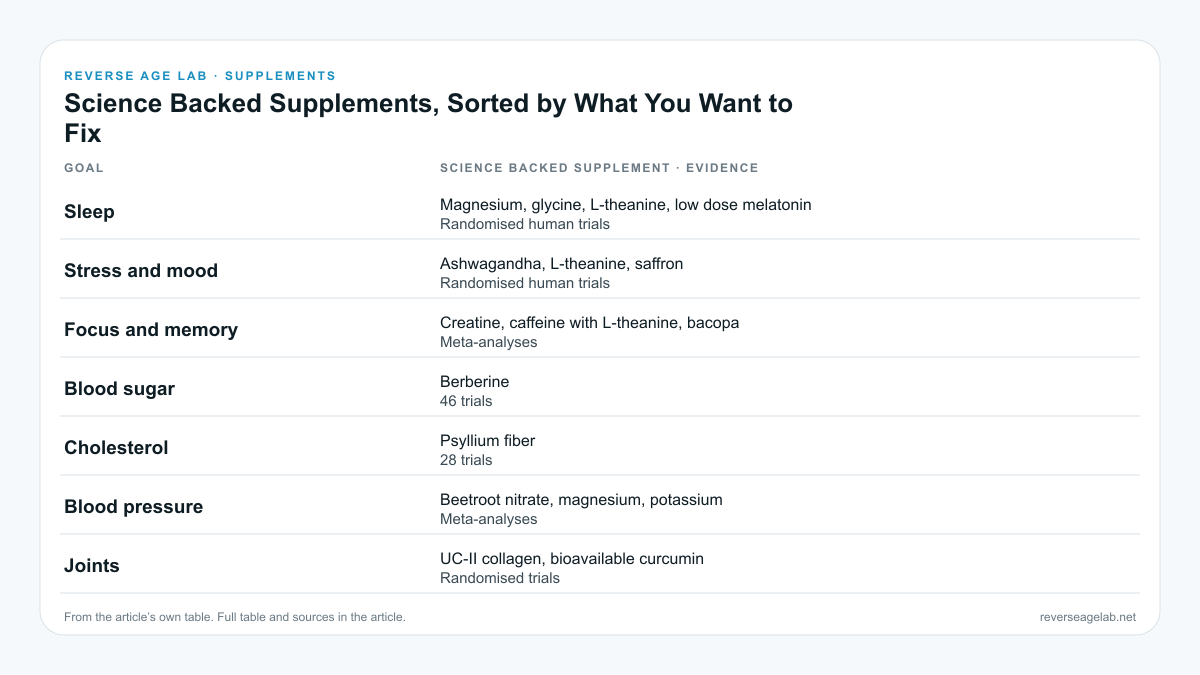
Goal | Science backed supplement | Evidence |
|---|---|---|
Sleep | Magnesium, glycine, L-theanine, low dose melatonin | Randomised human trials |
Stress and mood | Ashwagandha, L-theanine, saffron | Randomised human trials |
Focus and memory | Creatine, caffeine with L-theanine, bacopa | Meta-analyses |
Blood sugar | Berberine | 46 trials |
Cholesterol | Psyllium fiber | 28 trials |
Blood pressure | Beetroot nitrate, magnesium, potassium | Meta-analyses |
Joints | UC-II collagen, bioavailable curcumin | Randomised trials |
Stress and mood
Ashwagandha, specifically the KSM-66 extract, has a nine-trial meta-analysis showing a real drop in perceived stress and serum cortisol. It is the best-supported adaptogen, not a vague one. For low mood, saffron at 30 mg a day performed comparably to standard antidepressants in mild-to-moderate depression across several trials, and St John's Wort has Cochrane-level support across 29 trials, though it carries serious drug interactions with birth control, SSRIs, and blood thinners, so it is not a casual add. Sources: ashwagandha (Akhgarjand et al., 2022), saffron (Hausenblas et al., 2013), the Cochrane review of St John's Wort (Linde et al., 2008) and its interaction profile (Nicolussi et al., 2020).
Focus and memory
Creatine is not just for muscle. A 16-trial meta-analysis found it improves memory, with the strongest effect under sleep deprivation, stress, or aging. Bacopa monnieri improves memory recall with consistent use over 12 weeks or more. The classic caffeine plus L-theanine combination gives focus without the jitter. Most of the flashier nootropics, lion's mane included, have only small, short, narrow signals so far. Sources: creatine and cognition (Avgerinos et al., 2018) and Bacopa (Kongkeaw et al., 2014). The longer version is in the focus and mental clarity guide.
Blood sugar and metabolic health
Berberine is the standout, with more than 46 trials showing lower fasting glucose and HbA1c in type 2 diabetes, working as an adjunct. It is rough on the gut and interacts with medications, so it is not casual. Psyllium, a simple soluble fiber, improves both blood sugar and cholesterol at the same time. (Guo et al., 2021.)
Cholesterol
Psyllium again earns its place, lowering LDL cholesterol by roughly 6 to 12 percent in trial meta-analyses. It is one of the most evidence-backed and least glamorous things on this whole list. (Jovanovski et al., 2018.)
Blood pressure
Beetroot and dietary nitrate lead, dropping systolic pressure around 4 mm Hg with larger effects in people who already run high. Magnesium acts as a natural vessel relaxant and lowers pressure in people who are hypertensive or deficient. Sources: beetroot (Siervo et al., 2013) and magnesium (Zhang et al., 2016). The full plan is in how to lower your blood pressure naturally.
Joints
For knee osteoarthritis, UC-II undenatured collagen at 40 mg a day reduces pain and stiffness over three to six months. Bioavailable curcumin, in a phytosome form, matched anti-inflammatory drugs for pain in some trials. The form matters here more than almost anywhere else, since raw curcumin is barely absorbed. Sources: UC-II collagen (Lugo et al., 2016) and curcumin phytosome (Belcaro et al., 2010).
Longevity
Urolithin A has the strongest functional human data in the longevity category, with real gains in muscle and endurance. Calcium alpha-ketoglutarate is a promising bio-age bet with an early human signal. The unglamorous foundation, omega-3s, vitamin D if you are low, magnesium, and creatine, has deeper human evidence than most compounds marketed as exotic. Sources: urolithin A (Liu et al., 2022), calcium alpha-ketoglutarate (Demidenko et al., 2021) and the creatine position stand (Kreider et al., 2017).
The catch that makes a list like this dangerous
Handed a list like this, the natural move is to buy ten of these things. That is the mistake. Some of them interact. Berberine and certain medications do not mix. St John's Wort undermines birth control. Take three different nitric-oxide boosters and you are stacking the same mechanism three times. A list tells you what has evidence for a goal. It cannot tell you which ones are right for your body, your other supplements, and your medications, and which combinations to avoid.
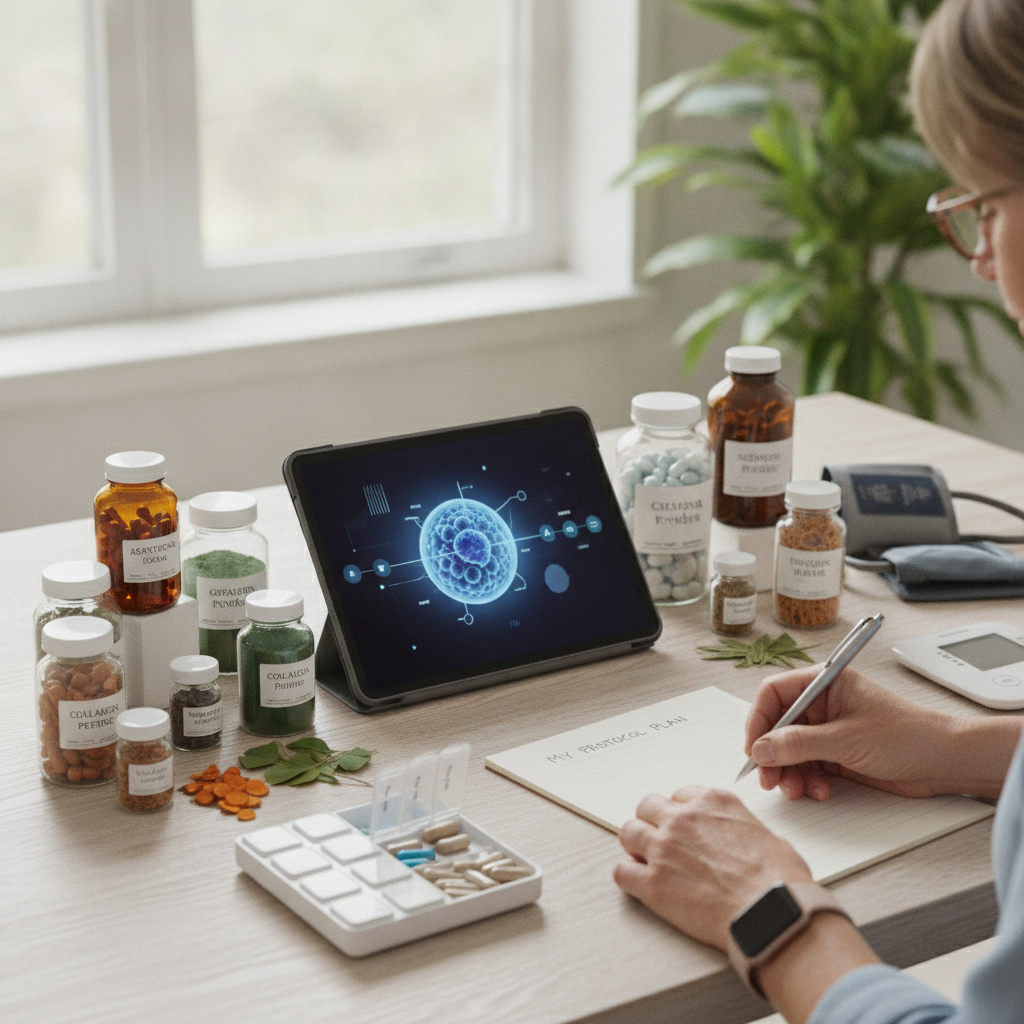
That last step is what turns a list into a protocol, and it is exactly what Rala, Reverse Age Lab's patented AI engine, is built for. You enter your profile and goals, and it reads the human studies and real user reviews behind each option, ranks them by evidence strength, and assembles them into one personalized daily protocol, flagging the interactions and redundancies a list like this cannot. We do not sell supplements. We show you the evidence and let you choose. Pick your goal, take the strongest evidence-backed option for it, and let the system handle the part where the pieces have to fit together. How each product earns its tier is on the methodology page.
Frequently Asked Questions
What is the single best-evidenced supplement for most people?
There is no single answer, because the best supplement depends on your goal. Creatine and omega-3s have unusually broad human evidence, and vitamin D matters if you are deficient. Beyond that foundation, match the compound to the specific issue you want to fix.
Which supplements have the strongest human trials?
By goal: melatonin for sleep, ashwagandha KSM-66 for stress, berberine for blood sugar, psyllium for cholesterol, beetroot for blood pressure, UC-II collagen for joints, and urolithin A in the longevity category. Each has human trial data, not just animal studies.
Is it safe to take several of these at once?
Not automatically. Some interact with medications or with each other. Berberine, St John's Wort, and stacking multiple nitric-oxide boosters are common problems. Check interactions and redundancies before combining, which is where a personalized protocol beats a raw list.
How do I turn this list into a plan for me?
Match your specific goals to the evidence-backed options, then account for your other supplements, medications, and which combinations to avoid. Rala does this automatically, ranking options by evidence and assembling a personalized protocol that flags conflicts.
Ready to turn the list into your protocol? Rala matches these options to your goals, medications and current stack, and flags the conflicts. Reverse Age Lab sells no supplements. Start your 7 day free trial, or grade a product you already take with the free research tool.
Related reading: How to Tell if a Supplement Is Evidence-Based or Just Good Marketing
Related reading: The Evidence-Based Supplement Guide: What Human Studies and Real Reviews Actually Show · How to build a personalized supplement protocol · Magnesium for sleep, stress and healthy aging
Related reading: How to Build a Personalized Supplement Protocol That Actually Fits You