


Mark Hyman is one of the most recognizable doctors in the wellness world, and his message is simple at its core: food is the most powerful lever you have over how you age. That idea is well supported. Around it sits a broader system, functional medicine, that is sometimes ahead of the strongest evidence, a growing longevity practice, and a supplement store that carries his name. This review does what the others in this series do: it lays out what he recommends and describes taking, grades each item by the human evidence for the reason he gives, adds up the cost, and says what is worth borrowing.
Mark Hyman's approach in 60 seconds. Eat whole food, mostly plants, with enough protein and healthy fat; keep blood sugar steady and inflammation low; fix the gut; test and personalize. The supplements he has described taking and recommends most often: a high-quality multivitamin, vitamin D3 with K2, omega-3 fish oil, magnesium, a probiotic, curcumin, urolithin A for mitochondria, creatine, and N-acetylcysteine or glutathione support, many of them sold through the Dr. Hyman store. What the evidence supports: the food principles are the best-supported part of any routine in this series; vitamin D when low, omega-3, magnesium and creatine are solid; urolithin A and curcumin have real but narrow trials; the detox framing, some functional medicine tests and the branded bundles need proof the name does not supply.
The short answer: take the plate, be selective about the pills. The parts of Hyman's approach that do the heavy lifting are largely free, and the supplement list is where the brand and the evidence part company.
Who Is Mark Hyman, and Why Does His Approach Get Copied?
Hyman is a physician, the author of more than a dozen best-selling books, the host of The Doctor's Farmacy podcast, and a founder of the functional medicine movement in the United States, including its program at the Cleveland Clinic. In recent years he has turned to longevity, with a book on it and a membership service built around blood testing. His reach is enormous and his central message, that what you eat is the foundation of how you feel and age, is the reason it deserves to be. He also sells supplements under his own name, which means product picks need their own evidence rather than his.
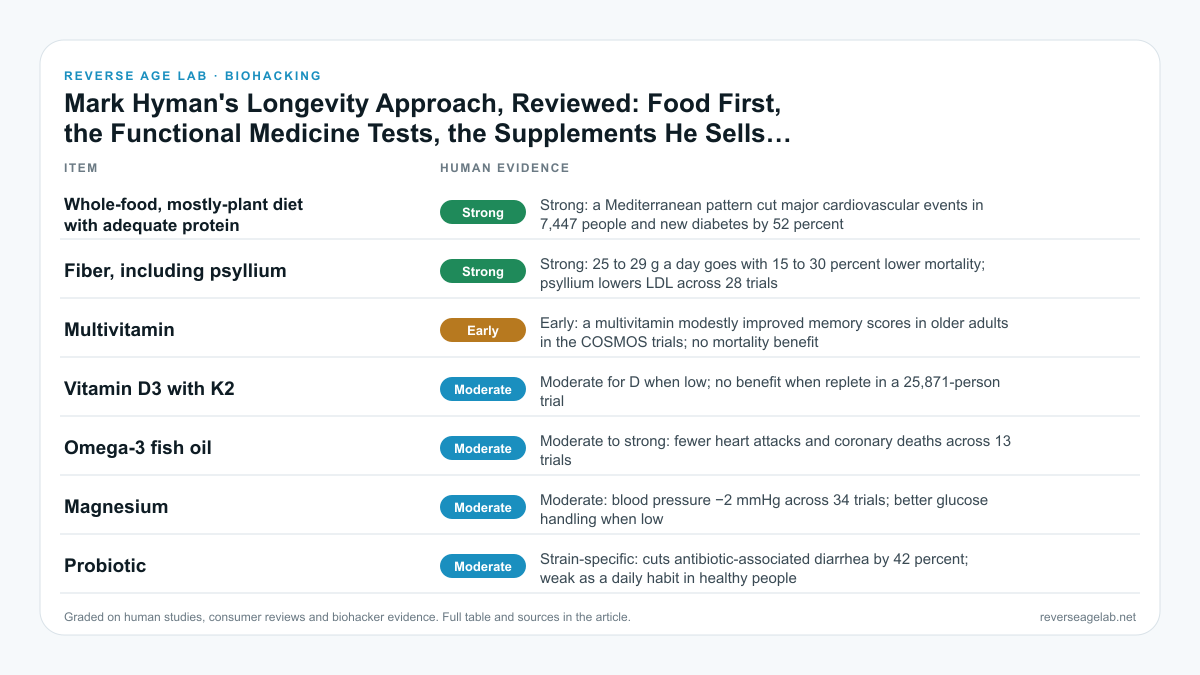
What Mark Hyman Recommends and Takes: The List, With the Human Evidence
The grades below are Reverse Age Lab's reading of the human research for the purpose given for each item. Strong means repeated randomized trials in people show the effect. Moderate means the effect is real but conditional, for example only when a deficiency exists. Early means small or short human studies with mixed results. Weak means no convincing human trials for the claim.
Item | What it is | Why he recommends it | Human evidence |
|---|---|---|---|
Whole-food, mostly-plant diet with adequate protein | A Mediterranean-style plate, low in sugar and refined starch | Blood sugar, inflammation, healthspan | Strong: a Mediterranean pattern cut major cardiovascular events in 7,447 people and new diabetes by 52 percent |
Fiber, including psyllium | Soluble and insoluble plant fiber | Gut, cholesterol, blood sugar | Strong: 25 to 29 g a day goes with 15 to 30 percent lower mortality; psyllium lowers LDL across 28 trials |
Multivitamin | A daily broad-spectrum formula | Insurance against gaps | Early: a multivitamin modestly improved memory scores in older adults in the COSMOS trials; no mortality benefit |
Vitamin D3 with K2 | The sunshine vitamin plus a cofactor | Bone, immunity, inflammation | Moderate for D when low; no benefit when replete in a 25,871-person trial |
Omega-3 fish oil | EPA and DHA | Heart, brain, inflammation | Moderate to strong: fewer heart attacks and coronary deaths across 13 trials |
Magnesium | Glycinate or citrate | Sleep, blood sugar, blood pressure | Moderate: blood pressure −2 mmHg across 34 trials; better glucose handling when low |
Probiotic | Live bacteria in a capsule | Gut health | Strain-specific: cuts antibiotic-associated diarrhea by 42 percent; weak as a daily habit in healthy people |
The active part of turmeric | Inflammation, joints | Moderate for joint pain in arthritis across eight trials; weak for general inflammation | |
Urolithin A (Mitopure) | A compound gut bacteria make from pomegranate | Mitochondria, muscle | Early to moderate: better muscle endurance in two randomized trials; no outcome beyond that |
Creatine | The most studied sports supplement | Muscle, brain | Strong for strength and lean mass; early for memory |
N-acetylcysteine or glutathione support | A glutathione precursor | Detox, antioxidant defence | Early: glycine plus NAC raised glutathione and improved several aging markers in one 16-week trial |
Functional medicine testing panels | Broad blood, stool and hormone panels | Finding root causes | Mixed: standard blood tests are useful; many specialty panels have no trial showing they change outcomes |
What the Evidence Supports
Food first. This is the strongest claim in the whole series. In PREDIMED, 7,447 adults at high cardiovascular risk ate a Mediterranean diet with extra-virgin olive oil or nuts and had fewer major cardiovascular events than a reduced-fat control (Estruch R et al., 2018); in its Reus centre, the same diet without calorie counting cut new cases of diabetes by 52 percent over four years (Salas-Salvadó J et al., 2011). The lifestyle arm of the Diabetes Prevention Program cut new diabetes by 58 percent (Knowler WC et al., 2002). At the other end, the heaviest consumers of ultra-processed food had 62 percent higher mortality in a cohort of 19,899 adults (Rico-Campà A et al., 2019). Hyman's plate is the one the trials would draw.
Blood sugar and fiber. Fiber intakes of 25 to 29 g a day go with 15 to 30 percent lower mortality and diabetes risk in the Lancet series, and higher fiber lowered weight, blood pressure and cholesterol in trials (Reynolds A et al., 2019). Psyllium, the fiber he recommends most, lowered LDL cholesterol across 28 trials (Jovanovski E et al., 2018).
The gut. Gut dysbiosis was added to the hallmarks of aging in 2023 (López-Otín C et al., 2023), and a 10-week randomized trial found that a diet high in fermented foods raised microbiome diversity and lowered inflammatory markers (Wastyk HC et al., 2021). The food version of gut health is well supported; probiotics help for named uses, above all cutting antibiotic-associated diarrhea by 42 percent across 63 trials (Hempel S et al., 2012).
The basics. Vitamin D when a test shows you are low, omega-3 (Hu Y et al., 2019), magnesium (Zhang X et al., 2016) and creatine (Kreider RB et al., 2017) carry the same evidence here as on every other list in this series, and the same caveat: VITAL found no benefit from vitamin D in adults who were not deficient (Manson JE et al., 2019).
Urolithin A. This is the most interesting newer item on his list. In 66 adults aged 65 to 90, four months of urolithin A improved muscle endurance and mitochondrial markers (Liu S et al., 2022), and in middle-aged adults it improved muscle strength by about 12 percent and exercise performance (Singh A et al., 2022). Both trials were funded by the maker. The effect is real on the measures taken; whether it changes anything that matters over years is unknown.
Curcumin. Across eight randomized trials, about 1,000 mg a day of curcumin reduced arthritis pain about as well as the comparators (Daily JW et al., 2016). For general "inflammation" in people without a condition, there is no comparable evidence.
Where the Evidence Gets Thin
Functional medicine testing. The instinct to look upstream and personalize is sound, and standard blood work, lipids, HbA1c, vitamin D, B12, ferritin and thyroid, is exactly what a personalized protocol should start from. The specialty panels are a different matter: stool "dysbiosis" scores, organic acids, hormone saliva tests and food sensitivity IgG panels have no trial showing that acting on them improves anything, and some lead to needless restriction. The philosophy is more reliable than every test within it.
Detox and glutathione. "Detox" is a framing, not a measurable outcome. The one solid trial in this area raised glutathione in older adults with glycine and N-acetylcysteine for 16 weeks and improved oxidative stress, inflammation, gait speed and strength (Kumar P et al., 2023); that is a result about aging markers, not toxins, and it used cheap precursors rather than a glutathione product.
The multivitamin. The COSMOS trials found a modest improvement in memory scores in older adults taking a daily multivitamin (Vyas CM et al., 2024), which is more than most multivitamin trials have found, and still a small effect on a test rather than on health. It is a reasonable low-cost hedge, not a treatment.
The store. Hyman's dietary advice stands on its own evidence. The products sold under his name do not inherit it. FDA testing found 776 supplement products tainted with hidden drugs over nine years (Tucker J et al., 2018), which is the reason to judge any product, his included, by its certificate of analysis rather than its label. Where a product on his shelf is the same ingredient sold elsewhere for less, buy the ingredient.
What Mark Hyman's List Costs, and What the Same Evidence Costs
Typical US retail prices, rounded, for a month at common doses; branded items at list price as of October 2026.
Item | Roughly per month | Evidence |
|---|---|---|
Multivitamin | $20 to $45 | Early |
Vitamin D3 with K2 | $8 to $15 | Moderate, when low |
Omega-3 fish oil | $15 to $40 | Moderate to strong |
Magnesium | $10 to $20 | Moderate |
Probiotic | $25 to $50 | Strain-specific |
Curcumin | $20 to $35 | Moderate for joints |
Urolithin A (Mitopure) | $100 to $125 | Early to moderate |
Creatine monohydrate | $10 to $15 | Strong |
N-acetylcysteine or glutathione support | $15 to $40 | Early |
Psyllium fiber | $8 to $15 | Strong for LDL |
Functional medicine panels | $300 to $1,500 and up, one-off | Mixed |
The supplement list as he sells it comes to roughly $200 to $350 a month before testing. The evidence-backed core, vitamin D3 dosed to a test, a fish oil, magnesium, creatine and psyllium, costs $30 to $55. The plate that carries the strongest evidence of all costs what groceries cost.
The Takeaway: Take the Plate, Be Selective About the Pills
Hyman is right about the thing that matters most, and he says it more clearly than almost anyone: whole food, steady blood sugar, low inflammation and a cared-for gut are how you age well, and the largest diet trials ever run back him up. The functional medicine system around that message is sound in philosophy and uneven in practice, and the store is a store. Keep the food principles whole, keep standard blood work, take the cheap basics the trials support, treat urolithin A and curcumin as reasonable experiments for a specific goal, and let every product earn its place on its own evidence.
Blood sugar tools are in natural ways to lose weight, what probiotics can and cannot do in probiotics for gut health, and how to judge any product in how to choose supplements.
Frequently Asked Questions
What supplements does Mark Hyman take?
He has described a multivitamin, vitamin D3 with K2, omega-3 fish oil, magnesium, a probiotic, curcumin, urolithin A, creatine and N-acetylcysteine or glutathione support, and he recommends psyllium fiber. Many are sold through his own store, so each needs its own evidence.
Is functional medicine backed by science?
The principles, looking at root causes, personalizing care and using tests to guide decisions, are reasonable and increasingly mainstream. Standard blood work is useful. Many specialty panels, such as stool dysbiosis scores and IgG food sensitivity tests, have no trial showing they improve outcomes.
Does urolithin A work?
Two randomized trials, both funded by the maker, found better muscle endurance in older adults and about 12 percent more strength in middle-aged adults after four months. Nothing longer or larger exists yet. It is a reasonable experiment for muscle, at about $100 a month.
Should I buy Mark Hyman's supplements?
His dietary advice is valuable on its own. Judge each product on its ingredient, dose and certificate of analysis, and buy the same ingredient elsewhere when it is cheaper. The food and lifestyle fundamentals he champions are free.
What is the best thing to take from Mark Hyman's approach?
The plate: whole food, mostly plants, enough protein, little sugar or refined starch, with fiber in the 25 to 29 g range. That pattern has the largest trials in longevity behind it.
How much does Mark Hyman's supplement list cost?
Roughly $200 to $350 a month as he sells it, before testing. The evidence-backed version costs $30 to $55.
Sources
Mark Hyman's own recommendations and descriptions of his routine: drhyman.com, his books (Young Forever, Food Fix, The Pegan Diet) and The Doctor's Farmacy podcast, compared for this review.
Estruch R et al. Primary Prevention of Cardiovascular Disease with a Mediterranean Diet Supplemented with Extra-Virgin Olive Oil or Nuts. The New England journal of medicine, 2018. PREDIMED: Mediterranean diet and cardiovascular events in 7,447 adults. PubMed
Salas-Salvadó J et al. Reduction in the incidence of type 2 diabetes with the Mediterranean diet: results of the PREDIMED-Reus nutrition intervention randomized trial. Diabetes care, 2011. PREDIMED-Reus: 52 percent fewer new cases of diabetes. PubMed
Knowler WC et al. Reduction in the incidence of type 2 diabetes with lifestyle intervention or metformin. The New England journal of medicine, 2002. Diabetes Prevention Program: lifestyle cut new diabetes 58 percent. PubMed
Rico-Campà A et al. Association between consumption of ultra-processed foods and all cause mortality: SUN prospective cohort study. BMJ, 2019. Ultra-processed food and mortality in 19,899 adults. PubMed
Reynolds A et al. Carbohydrate quality and human health: a series of systematic reviews and meta-analyses. Lancet, 2019. Fiber and health outcomes across 185 cohorts and 58 trials. PubMed
Jovanovski E et al. Effect of psyllium (Plantago ovata) fiber on LDL cholesterol and alternative lipid targets, non-HDL cholesterol and apolipoprotein B: a systematic review and meta-analysis of randomized controlled trials. The American journal of clinical nutrition, 2018. Psyllium and LDL cholesterol across 28 trials. PubMed
López-Otín C et al. Hallmarks of aging: An expanding universe. Cell, 2023. The 2023 hallmarks of aging, including gut dysbiosis. PubMed
Wastyk HC et al. Gut-microbiota-targeted diets modulate human immune status. Cell, 2021. Fermented foods, microbiome diversity and inflammation. PubMed
Hempel S et al. Probiotics for the prevention and treatment of antibiotic-associated diarrhea: a systematic review and meta-analysis. JAMA, 2012. Probiotics and antibiotic-associated diarrhea across 63 trials. PubMed
Hu Y et al. Marine Omega-3 Supplementation and Cardiovascular Disease: An Updated Meta-Analysis of 13 Randomized Controlled Trials Involving 127 477 Participants. Journal of the American Heart Association, 2019. Omega-3 and cardiovascular outcomes across 13 trials. PubMed
Zhang X et al. Effects of Magnesium Supplementation on Blood Pressure: A Meta-Analysis of Randomized Double-Blind Placebo-Controlled Trials. Hypertension (Dallas, Tex., 2016. Magnesium and blood pressure across 34 trials. PubMed
Kreider RB et al. International Society of Sports Nutrition position stand: safety and efficacy of creatine supplementation in exercise, sport, and medicine. Journal of the International Society of Sports Nutrition, 2017. Creatine position stand. PubMed
Manson JE et al. Vitamin D Supplements and Prevention of Cancer and Cardiovascular Disease. The New England journal of medicine, 2019. VITAL: vitamin D in unselected adults. PubMed
Liu S et al. Effect of Urolithin A Supplementation on Muscle Endurance and Mitochondrial Health in Older Adults: A Randomized Clinical Trial. JAMA network open, 2022. Urolithin A in adults aged 65 to 90. PubMed
Singh A et al. Urolithin A improves muscle strength, exercise performance, and biomarkers of mitochondrial health in a randomized trial in middle-aged adults. Cell reports. Medicine, 2022. Urolithin A in middle-aged adults. PubMed
Daily JW et al. Efficacy of Turmeric Extracts and Curcumin for Alleviating the Symptoms of Joint Arthritis: A Systematic Review and Meta-Analysis of Randomized Clinical Trials. Journal of medicinal food, 2016. Curcumin for arthritis pain across eight trials. PubMed
Kumar P et al. Supplementing Glycine and N-Acetylcysteine (GlyNAC) in Older Adults Improves Glutathione Deficiency, Oxidative Stress, Mitochondrial Dysfunction, Inflammation, Physical Function, and Aging Hallmarks: A Randomized Clinical Trial. The journals of gerontology. Series A, Biological sciences and medical sciences, 2023. Glycine plus NAC in older adults. PubMed
Vyas CM et al. Effect of multivitamin-mineral supplementation versus placebo on cognitive function: results from the clinic subcohort of the COcoa Supplement and Multivitamin Outcomes Study (COSMOS) randomized clinical trial and meta-analysis of 3 cognitive studies within COSMOS. The American journal of clinical nutrition, 2024. The COSMOS multivitamin and cognition result. PubMed
Tucker J et al. Unapproved Pharmaceutical Ingredients Included in Dietary Supplements Associated With US Food and Drug Administration Warnings. JAMA network open, 2018. FDA warnings on 776 tainted supplements. PubMed
Reverse Age Lab is not affiliated with, sponsored by, or endorsed by Mark Hyman or the Dr. Hyman store. This review is independent commentary on publicly described routines and products.