
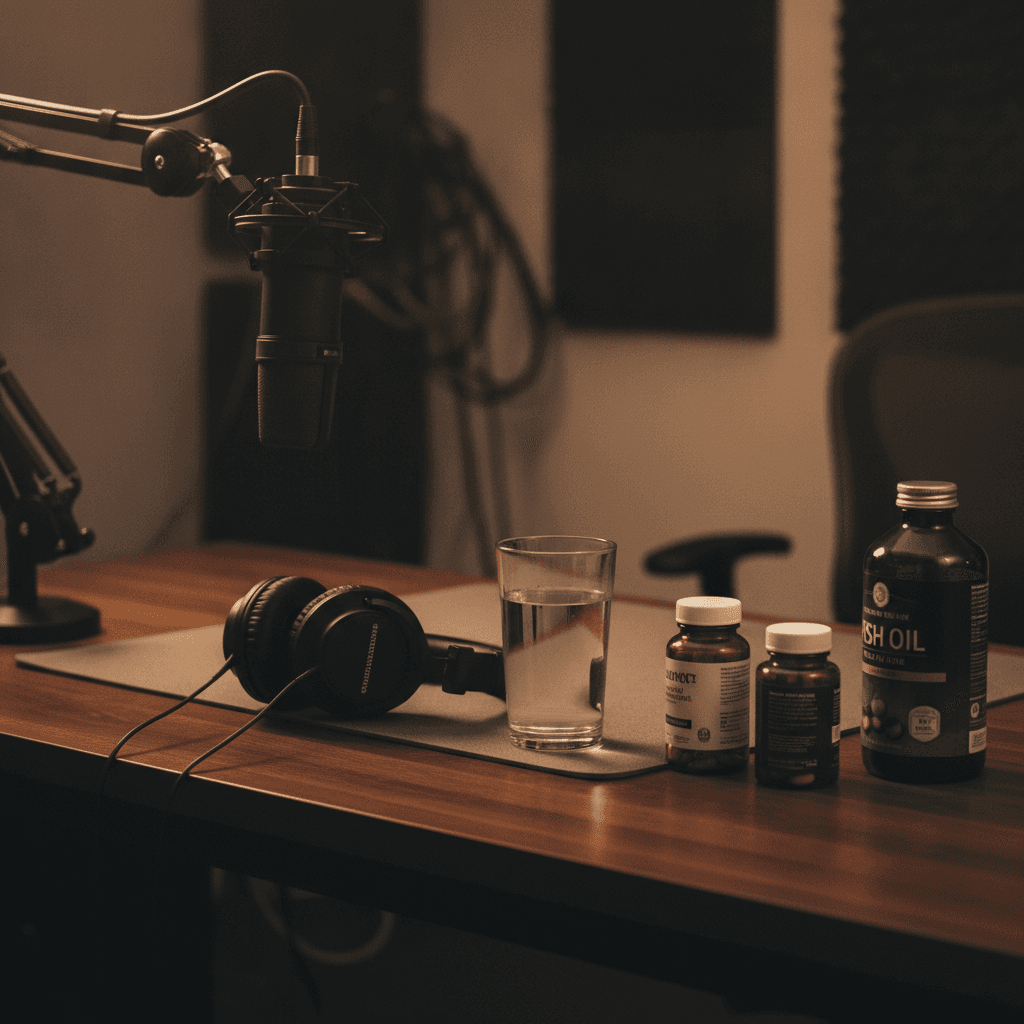
Joe Rogan talks about supplements more than almost anyone with an audience his size, and his stack gets copied for that reason alone. He is 59, a former martial artist and UFC commentator, and he co-founded Onnit, the company behind Alpha Brain, which means some of what he takes he also sells. That does not make the stack wrong. It does mean it deserves the same test as anything else: which of these products have human trials behind them, which are expensive experiments, and which need a doctor rather than a shopping cart. This review goes through the list as he has described it, grades each item by the evidence, adds up the cost, and ends with the short version most people should actually copy.
Joe Rogan's stack in 60 seconds. The recurring items, as he has described them on the podcast and in interviews collected by the roundups listed under Sources: vitamin D3 at about 5,000 IU with vitamin K2, large daily doses of Carlson's liquid fish oil, creatine, Onnit's Alpha Brain and New Mood, AG1 greens powder, NMN capsules and periodic NAD+ drips, resveratrol, ketone esters, a probiotic, and an immune group of vitamin C, zinc and quercetin, plus prescribed testosterone therapy and, at times, growth hormone under medical care. Our verdict: creatine, vitamin D when a blood test shows it is low, and a moderate dose of fish oil are backed by human evidence and cost about $40 a month together; the nootropic, the greens powder, the NAD+ drips and the resveratrol are where the money goes and where the evidence is thinnest; the hormones are medicine, not supplements.
The short answer: copy the boring parts. Three of his cheapest items are his best-supported ones. The expensive, exciting items are either unproven in people, proven only in the company's own small trial, or prescriptions that need blood work and a physician.
Who Is Joe Rogan, and Why Does His Stack Get Copied?
Rogan hosts the most-listened-to podcast in the world, has practiced martial arts for most of his life, and has spent years interviewing doctors, researchers and biohackers about what they take. He is unusually open about his own routine: the sauna, the cold plunge, the workouts, and the supplements, including the testosterone therapy he started in his forties. He is also a founder of Onnit, sold to Unilever in 2021, whose products appear throughout his stack. When a person with that reach says a product works for him, millions of people hear it, and a good share of them buy it.
Two things follow. First, his list is a moving target: products come and go as guests persuade him, and the roundups that track it disagree on details. Second, Rogan's stack is built for Rogan: a man in his late fifties who trains hard several times a week, fasts some of the time, has a medical team, and can afford $600 or more a month. Whether a given item is worth taking depends on your body, your goals and your blood work, which is the whole premise behind a personalized protocol.
What Joe Rogan Takes: The List, With the Human Evidence
The grades below are Reverse Age Lab's reading of the human research for the purpose Rogan gives each product. Strong means repeated randomized trials in people show the effect. Moderate means the effect is real but conditional, for example only when a deficiency exists. Early means small or short human studies with mixed results. Weak means no convincing human trials for the claim.
Product | What it is | Why he says he takes it | Human evidence |
|---|---|---|---|
Creatine monohydrate (about 5 g a day) | The most studied sports supplement | Strength, muscle, recovery; he has mentioned brain benefits too | Strong for strength and lean mass; early but promising for memory |
Vitamin D3, about 5,000 IU, with K2 | The sunshine vitamin plus a cofactor | Immunity, bone, general health | Moderate: corrects a low level; large trials show no extra benefit for people already replete |
Carlson's fish oil, several tablespoons a day | Omega-3 EPA and DHA, at a high dose | Joints, brain, heart, inflammation | Moderate at 1 to 2 g a day for triglycerides and heart risk; high doses raise atrial fibrillation and bleeding risk |
Alpha Brain (Onnit) | A nootropic blend: bacopa, huperzine A, alpha-GPC, L-theanine and others | Focus, verbal recall on air | Weak to early: one small company-funded trial found a verbal memory gain; nothing independent since |
New Mood (Onnit) | 5-HTP, L-tryptophan, vitamin B6, magnesium | Winding down, mood | Early: 5-HTP has small mood studies; the blend itself is untested |
AG1 greens powder | A multivitamin, probiotic and greens mix | Covering the bases, especially when traveling | Weak: no published trials of the product; the vitamins in it work like a multivitamin |
NMN capsules | A precursor the body turns into NAD | Energy and aging, after David Sinclair | Early: raises NAD in blood; small trials show modest, mixed functional gains |
NAD+ intravenous drips | NAD infused directly into a vein | Recovery, energy, aging | Weak: no controlled trials for any anti-aging outcome |
Resveratrol | A polyphenol from grape skins | Longevity, after Sinclair | Weak in humans: poorly absorbed; trials of health outcomes are mostly null |
Ketone esters | A drink that raises blood ketones without fasting | Focus and endurance | Early: performance effects are mixed and the cost is high |
Probiotic (Onnit Total Gut Health) | Live bacteria plus enzymes | Digestion | Strain-specific: some strains help specific conditions; a general daily probiotic has weak evidence in healthy people |
Vitamin C, zinc, quercetin | An immune group | Colds and travel | Moderate for zinc shortening colds when started early; weak for quercetin; vitamin C modestly shortens colds |
Testosterone therapy and, at times, growth hormone | Prescription hormones | Energy, muscle, recovery in his fifties | Not a supplement: real effects and real risks; needs blood work and a physician |
A note on completeness: Rogan has also mentioned CBD, cordyceps (Onnit's Shroom Tech), glutamine, a multivitamin and various protein and electrolyte products over the years. None of those changes the picture, so they are left out of the grading.
What the Evidence Supports
Creatine. This is the strongest item on the list by a distance. The International Society of Sports Nutrition's position stand reviews decades of trials: 3 to 5 g of creatine monohydrate a day increases strength and lean mass in people who train, and it is safe in healthy adults at that dose. A 2023 meta-analysis of randomized trials found a small improvement in memory, larger in older adults, which is the reason a longevity audience should care. It costs about a dollar a week. If you copy one thing from Joe Rogan, copy this.
Vitamin D3, when your level is low. Rogan's 5,000 IU is a sensible dose for someone who tests low, and pairing it with K2 is reasonable for people who take vitamin D long term. The catch is that the biggest trial ever run, VITAL, with more than 25,000 adults over five years, found no reduction in cancer or cardiovascular disease from 2,000 IU a day in people who mostly were not deficient. The rule that follows is simple: test first, treat a low level, retest. Taking 5,000 IU without a blood test is guessing.
Fish oil, at a moderate dose. Omega-3s lower triglycerides, and the REDUCE-IT trial showed a purified EPA prescription cut cardiovascular events in people with high triglycerides on statins. That is real, and 1 to 2 g of combined EPA and DHA a day is a defensible dose for most adults. Rogan's several tablespoons of liquid fish oil is a different thing: by the roundups' arithmetic it is well over 10 g of omega-3s a day. A 2021 meta-analysis in Circulation found that omega-3 supplementation raised the risk of atrial fibrillation, and the risk rose with the dose above about 1 g a day. High-dose fish oil also thins the blood. A moderate dose keeps the benefit and drops most of the risk.
Zinc for colds, started early. Zinc lozenges begun within a day of symptoms shorten a cold by about a day in several trials. That is a use case, not a daily habit; long-term high zinc depletes copper.
What Is Not Worth Copying, or Needs a Doctor
Alpha Brain. The evidence for Onnit's flagship is one 2016 randomized trial of 63 adults, funded by the company, which reported an improvement in verbal memory after six weeks and no change on most other measures. Nine years later there is still no independent replication. The ingredients are not dangerous, but at $70 to $125 a month you are paying for a trial the seller ran on itself, recommended by a man who owns part of the seller. That is a conflict of interest, not a data set.
NAD+ drips and NMN. NAD precursors reliably raise NAD levels in blood, and that is where the settled science ends. The best human trial of NMN, in prediabetic women, found improved muscle insulin sensitivity but no change in the other outcomes measured; other small trials report modest gains in walking distance or sleep quality, and some report nothing. Intravenous NAD+ has no controlled trials at all for aging, energy or recovery, and sessions run from $300 to more than $1,000. Our full reading is in NAD anti-aging supplements: benefits, evidence, and how to choose. If you want to try an NAD precursor, an oral one is the cheap, reversible way to do it.
Resveratrol. The molecule that made David Sinclair famous in mice has not delivered in people. It is poorly absorbed, and trials of blood pressure, insulin sensitivity and inflammation are mostly null or inconsistent. It is on Rogan's list because of a guest, which is the least reliable reason to take anything.
AG1. Greens powders are multivitamins with a longer ingredient list and a much higher price. AG1 has no published trials of the product itself. If you eat vegetables, you do not need it; if you do not, a $15 multivitamin covers the same vitamins and the extra money buys actual vegetables.
Ketone esters. They raise blood ketones within an hour, and elite endurance athletes have shown small performance changes in some trials and none in others. For a desk worker seeking focus, the evidence is thin and a month's supply costs more than everything in the evidence-backed core combined.
Testosterone and growth hormone. Rogan has been candid that he uses testosterone replacement and has used growth hormone. Both are prescriptions with monitored doses, and both change your body in ways that show up in blood work, fertility, red cell counts and, for growth hormone, blood sugar and joint tissue. They can be the right call for a specific man with a specific lab result. They are not supplements and they are not a recommendation for anyone else. If your energy or muscle is the problem, the first step is a blood panel, not a purchase.
What Joe Rogan's Stack Costs, and What the Same Evidence Costs
Retail prices in the United States as of September 2026, rounded, for a month at the doses the roundups describe.
Item | Roughly per month | Evidence |
|---|---|---|
Creatine monohydrate | $10 to $15 | Strong |
Vitamin D3 with K2 | $8 to $12 | Moderate, when low |
Carlson's liquid fish oil at his dose | $70 to $90 | Moderate at a lower dose; risky at his |
Alpha Brain Black Label | $70 to $125 | Weak to early |
New Mood | $30 to $50 | Early |
AG1 | $79 to $99 | Weak |
NMN | $50 to $90 | Early |
Resveratrol | $20 to $40 | Weak |
Ketone esters | $100 to $200 | Early |
Probiotic | $30 to $60 | Strain-specific |
Vitamin C, zinc, quercetin | $15 to $25 | Moderate for zinc, weak for the rest |
NAD+ drips (each) | $300 to $1,000 or more | Weak |
The bottles alone come to roughly $480 to $800 a month before a single NAD+ drip, and before the hormones, which are priced by a clinic. The evidence-backed core, creatine plus vitamin D3 with K2 plus fish oil at 1 to 2 g of EPA and DHA a day, costs $35 to $55 a month. That is the same pattern we found in Bryan Johnson's Blueprint: the parts that work are cheap, and the price is in the parts that might.
The Takeaway: Copy the Boring Parts
Joe Rogan's stack is a fair snapshot of what a curious, wealthy, hard-training man in his fifties ends up taking after a decade of expert guests: a few essentials with strong evidence, a few company products, and a rotating set of longevity bets. Take the essentials. Test your vitamin D before you dose it. Keep fish oil at a moderate dose. Treat the nootropic, the greens and the NAD+ drips as expensive experiments, which is what they are. And put the hormones in the doctor's column, where he keeps them himself.
One more thing his list gets right by accident: it is his. It reflects his training load, his fasting pattern and his blood work. Yours should reflect yours, which is why the next section exists.
Build Your Own Personalized Protocol
The problem with copying anyone's stack is that it was built for someone else's body. Reverse Age Lab is built to fix that. Rala, our patented AI, reads the human studies and real reviews behind supplements, diet and exercise, then turns them into one personalized daily protocol built around your body, your goals and your blood work, organized so the pieces work together and nothing is doubled up. It checks what you already take for interactions, redundancies and safe upper limits, and it tells you which of a celebrity stack's items actually belong in yours. Build your protocol free at reverseagelab.net/protocol, or start by running what you take through the supplement stack checker.
Frequently Asked Questions
What supplements does Joe Rogan take?
As he has described them on his podcast, the regulars are creatine, vitamin D3 with K2, a large dose of Carlson's fish oil, Onnit's Alpha Brain and New Mood, AG1, NMN capsules with occasional NAD+ drips, resveratrol, ketone esters, a probiotic, and an immune group of vitamin C, zinc and quercetin. He also uses prescribed testosterone therapy. The list changes over time, and the roundups that track it differ on details.
Is Alpha Brain backed by science?
Barely. One randomized trial of 63 adults in 2016, funded by Onnit, reported better verbal memory after six weeks and no change on most other measures. There has been no independent replication. The ingredients are generally safe, but the product costs $70 to $125 a month for evidence that amounts to one small company study.
Is Joe Rogan's fish oil dose safe?
Several tablespoons of liquid fish oil a day works out to well over 10 g of omega-3s, five to ten times the dose used in most trials. A 2021 meta-analysis found omega-3 supplements raised the risk of atrial fibrillation, more so at doses above 1 g a day, and high doses thin the blood. One to two grams of combined EPA and DHA a day keeps the triglyceride and cardiovascular benefit with far less of the risk.
Does NMN or an NAD+ drip slow aging?
Not by any human trial so far. Oral NMN and NR reliably raise NAD in blood, and small trials show modest, inconsistent gains in things like insulin sensitivity or walking distance. Intravenous NAD+ has no controlled trials for aging, energy or recovery. If you want to experiment, an oral precursor is cheap and reversible; a drip is neither.
Which parts of Joe Rogan's stack are worth copying?
Creatine at 3 to 5 g a day, vitamin D3 with K2 if a blood test shows you are low, and fish oil at 1 to 2 g of EPA and DHA a day. Together they cost $35 to $55 a month and carry the strongest evidence on his list. Everything else is either an experiment, a company product, or a prescription.
How much does Joe Rogan spend on supplements?
At retail, the products he describes add up to roughly $480 to $800 a month before NAD+ drips, which run $300 to more than $1,000 each, and before hormone therapy, which a clinic prices separately. The evidence-backed core of the same list costs about $40 a month.
Sources
Roundups of Rogan's public statements about his stack, compared for this review: Jinfiniti (2026), FastLifeHacks (2026), Omre (2026).
Kreider RB et al. International Society of Sports Nutrition position stand: safety and efficacy of creatine supplementation. Journal of the International Society of Sports Nutrition, 2017. PubMed.
Prokopidis K et al. Effects of creatine supplementation on memory in healthy individuals: a systematic review and meta-analysis of randomized controlled trials. Nutrition Reviews, 2023. PubMed.
Manson JE et al. Vitamin D supplements and prevention of cancer and cardiovascular disease (VITAL). New England Journal of Medicine, 2019. PubMed.
Bhatt DL et al. Cardiovascular risk reduction with icosapent ethyl for hypertriglyceridemia (REDUCE-IT). New England Journal of Medicine, 2019. PubMed.
Gencer B et al. Effect of long-term marine omega-3 fatty acids supplementation on the risk of atrial fibrillation in randomized controlled trials of cardiovascular outcomes: a systematic review and meta-analysis. Circulation, 2021. PubMed.
Solomon TM et al. A randomized, double-blind, placebo controlled, parallel group, efficacy study of alpha BRAIN administered orally. Human Psychopharmacology, 2016. PubMed.
Yoshino M et al. Nicotinamide mononucleotide increases muscle insulin sensitivity in prediabetic women. Science, 2021. PubMed.
Novelle MG et al. Resveratrol supplementation: where are we now and where should we go? Ageing Research Reviews, 2015. PubMed.
Cox PJ et al. Nutritional ketosis alters fuel preference and thereby endurance performance in athletes. Cell Metabolism, 2016. PubMed.
Hemilä H. Zinc lozenges and the common cold: a meta-analysis comparing zinc acetate and zinc gluconate. JRSM Open, 2017. PubMed.