
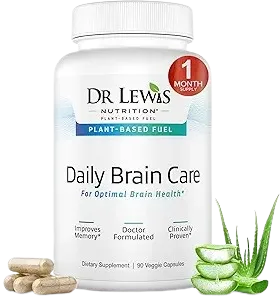
Dr Lewis Brain Health Supplement Brain Care Review
Stay sharp, focused, and balanced with daily brain health support.
We don’t sell supplements. We help you make decisions and get the best price.
Lowest prices
We may earn a commission from some store links. How we choose.
Lowest cost per month first, in stock, at 2 servings a day. Checked Nov 9.
- Dr LewisLowest$40.00 a bottle$40.00/moBuy at Dr Lewis (opens in a new tab)
Study, Trial or Testing Result Summary
Members Only31 human studies · 17 improved
1 of these 31 human studies gave ingredient list (multiple ingredients) by drip, not by mouth.
Every ingredient in this product sits inside a 2.5 gram blend with no amounts shown, so we cannot tell whether any of them reaches a dose that was studied. The strongest support is for N-acetyl cysteine. In 84 people with long-term schizophrenia, 1200 milligrams a day for 12 weeks improved attention, working memory and processing speed [1]. In 81 service members with mild blast brain injury, a week of N-acetyl cysteine made symptoms such as memory loss much more likely to clear than placebo [2]. A review of 25 trials found no overall thinking gain, but better working memory with N-acetyl cysteine [3]. A larger review of 70 trials found anti-inflammatory add-ons gave small working memory gains, though small trials may have inflated the effect [4]. Tart cherry ranked among the best foods for learning and memory in a review of 25 trials in healthy older adults [5]. A combined nutrient formula improved thinking scores in people with Alzheimer's disease, but that was a different formula [6]. Most of this research was in people with illness, not healthy adults, and the amounts in this blend are unknown. Animal and cell studies are never counted.
See all 31 studies →Hide the studies
- Across 70 placebo-controlled trials in people with psychotic disorders, anti-inflammatory add-ons gave small improvements in symptoms and working memory, but effects may be overestimated because many trials were small.Efficacy and safety of anti-inflammatory agents in treatment of psychotic disorders - A comprehensive systematic review …
- In 25 trials of 1951 people with schizophrenia, these agents did not significantly improve overall cognition, but N-acetyl cysteine did improve working memory.Effect of N-methyl-D-aspartate-receptor-enhancing agents on cognition in patients with schizophrenia: A systematic revie…
- In 25 trials of 1861 healthy older adults, raisins and tart cherry ranked best for learning and memory and bacopa for executive function, while effects on attention were limited.The effect of plant active substances on cognitive function in healthy older adults: a systematic review and network met…
- In 12 trials with 587 people, omega-3 supplements raised blood levels of a brain growth protein more than placebo, with similar results at 2000 mg a day in trials under 10 weeks.A systematic review and meta-analysis of the omega-3 fatty acids effects on brain-derived neurotrophic factor (BDNF).
- A review of 63 trials in people with schizophrenia found N-acetyl-cysteine only weakly improved cognition, while stronger evidence was for symptoms, and the authors urged caution because trials were small.Read the study on PubMed (37852631) →
- In 31 trials of 3582 people with Alzheimer's or mild cognitive impairment, many natural products showed possible cognitive benefits, but curcumin and lemon balm had limited effects and quality varied.Natural Products in Alzheimer's Disease: A Systematic Review of Clinical Trials and Underlying Molecular Mechanisms.
- In 11 studies of people with mild brain injury, nutrients such as omega-3, magnesium and N-acetyl cysteine given within days were linked to better recovery including cognition, but studies were too varied for firm advice.Nutritional interventions to support acute mTBI recovery.
- Eight studies in malnourished children found dried fish powder helped body weight recovery, with cognitive development only one of several outcomes and no clear cognitive result stated.Effect of Fish-Based Diet on Malnourished Children: A Systematic Review.
- In 106 people with Alzheimer's disease, a combined nutrient formula improved thinking test scores compared with placebo within 3 months, while daily living activities did not change.A Phase II Randomized Clinical Trial of a Nutritional Formulation for Cognition and Mood in Alzheimer's Disease.
- In 84 people with chronic schizophrenia, 1200 mg of N-acetyl cysteine added to usual medication for 12 weeks improved symptoms and some thinking skills such as attention, working memory and processing speed compared with placebo.Therapeutic effect of adjunctive N-acetyl cysteine (NAC) on symptoms of chronic schizophrenia: A double-blind, randomize…
- In 81 service members with blast-related mild brain injury, N-acetyl cysteine for 7 days made symptoms like memory loss and headache much more likely to resolve than placebo, with 86% resolving when given within 24 hours versus 42% on placebo.Amelioration of acute sequelae of blast induced mild traumatic brain injury by N-acetyl cysteine: a double-blind, placeb…
- In 60 people with early schizophrenia, 3600 mg a day of N-acetyl cysteine for 52 weeks improved overall and negative symptoms but did not improve thinking test scores or brain structure compared with placebo.Effects of 12-month, double-blind N-acetyl cysteine on symptoms, cognition and brain morphology in early phase schizophr…
- In 60 healthy adults over 56, 250 mg a day of arabinoxylan rice bran (Biobran) for 3 months improved physical and mental health-related quality of life scores compared with placebo.The enhancing effects of Biobran/MGN-3, an arabinoxylan rice bran, on healthy old adults' health-related quality of life…
- In 60 healthy older adults aged 65 to 80, 2.2 g per day of alpha-linolenic acid from flaxseed oil for 12 weeks improved verbal fluency compared with corn oil placebo, while other cognitive tests did not differ.Supplementation with Flaxseed Oil Rich in Alpha-Linolenic Acid Improves Verbal Fluency in Healthy Older Adults.
- In 58 people with psychosis, 2 g daily of N-acetyl cysteine for 24 weeks improved working memory compared with placebo, though the authors call these preliminary results.Cognitive effects of adjunctive N-acetyl cysteine in psychosis.
- In 50 Malian infants starting weaning at 6 months, rice bran given at 1 to 5 grams a day for 6 months led to favorable weight changes and altered blood metabolites linked to antioxidant defense and brain chemistry, but cognition was not directly measured.Non-Targeted Dried Blood Spot-Based Metabolomics Analysis Showed Rice Bran Supplementation Effects Multiple Metabolic Pa…
- In 50 people with chronic post-concussion syndrome, N-acetyl cysteine given as daily oral doses and weekly infusions improved symptoms, anxiety and mood compared with standard care alone, along with changes in brain network connectivity.Changes in Resting-State Functional Connectivity and Cognitive-Affective Symptoms in Patients With Post-Concussion Syndr…
- In 37 adults aged 65 to 80, drinking two cups of tart cherry juice daily for 12 weeks improved memory confidence and one learning test compared with the control group.Effect of Montmorency tart cherry juice on cognitive performance in older adults: a randomized controlled trial.
- In 34 people with mild memory impairment, a multi-nutrient formula taken for 6 months improved overall thinking scores compared with placebo, and the placebo group improved after switching to the formula.A Nutritional Formulation for Cognitive Performance in Mild Cognitive Impairment: A Placebo-Controlled Trial with an Ope…
- In 29 cancer patients receiving active treatment, 3 grams per day of rice bran arabinoxylan compound for 24 weeks improved quality of life, fatigue, pain and appetite compared with placebo, with no side effects reported, though cognitive functioning only trended higher.Effects of rice bran arabinoxylan compound on quality of life of cancer patients during active treatment: a randomised p…
- In 27 middle-aged adults, a single 60 ml dose of tart cherry concentrate changed some blood vessel measures and lowered blood pressure, but did not improve thinking performance or mood compared with placebo.Montmorency Tart cherries (Prunus cerasus L.) modulate vascular function acutely, in the absence of improvement in cogni…
- In 17 adults with alcohol use disorder over 12 weeks, adding N-acetyl cysteine 1200 mg daily to topiramate did not reduce topiramate's cognitive side effects or heavy drinking compared with placebo, and some craving scores were worse in the N-acetyl cysteine group.Safety and tolerability of topiramate and N-acetyl cysteine combination in individuals with alcohol use disorder: a 12 w…
- In a small placebo-controlled pilot of 12 institutionalized people with moderate to late-stage Alzheimer's disease, a multi-ingredient vitamin and nutrient formula slowed decline on a dementia rating scale and a clock-drawing test compared with placebo.Efficacy of a vitamin/nutriceutical formulation for moderate-stage to later-stage Alzheimer's disease: a placebo-control…
- In community-dwelling adults without dementia, a multi-ingredient nutrient formulation improved memory and thinking test scores compared with placebo, and scores fell back when the formulation was stopped and rose again when it was restarted.A vitamin/nutriceutical formulation improves memory and cognitive performance in community-dwelling adults without demen…
- In a small placebo-controlled trial in people with bipolar disorder, 2000 mg daily of N-acetyl cysteine for 6 months did not change cognitive function compared with placebo.Effects of N-acetyl cysteine on cognitive function in bipolar disorder.
- In a 6-month placebo-controlled trial in healthy adults aged 60 to 80, a daily flaxseed lignan supplement of 600 mg did not change cognition compared with placebo, though it lowered blood pressure in people with high readings.Influence of Flaxseed Lignan Supplementation to Older Adults on Biochemical and Functional Outcome Measures of Inflammat…
- In an open study of 42 cancer patients given N-acetyl cysteine 1800 mg daily with alpha-lipoic acid and other treatments for up to one year, patients reported better thinking abilities and blood markers of inflammation fell, with no placebo comparison.Subcutaneous interleukin-2 in combination with medroxyprogesterone acetate and antioxidants in advanced cancer responder…
- In 24 people with Alzheimer's disease taking a multi-ingredient nutrient formulation for one year in an open-label study, thinking ability and behavior symptoms stayed at their starting levels rather than declining.Maintenance of Cognitive Performance and Mood for Individuals with Alzheimer's Disease Following Consumption of a Nutrac…
- In an open study of 16 cancer patients who had responded to chemotherapy, maintenance treatment including N-acetyl cysteine 1800 mg daily was associated with better thinking abilities, though the study had no placebo group and most patients' disease progressed.Immunotherapy (recombinant interleukin 2), hormone therapy (medroxyprogesterone acetate) and antioxidant agents as combi…
- This review of plant omega-3 (alpha-linolenic acid) describes early but promising evidence that it may counteract cognitive decline, while noting that cognition research on it is still at an early stage.Impact of α-Linolenic Acid, the Vegetable ω-3 Fatty Acid, on Cardiovascular Disease and Cognition.
- In a study mainly in mice, flaxseed lignans eased depression-like behavior and reduced brain and gut inflammation, with limited detail on human participants.Lignans Alleviate Depression by Modulating the Gut-Brain Axis: Effect and Mechanism Based on Multi-Omics Analyses.
Review Totals and Summary
Members Only247 reviews · 76% positive
Real users of Brain Health Supplement Brain Care have shared a generally favorable impression, with the majority expressing satisfaction with the product and noting perceived benefits related to cognitive clarity, focus, and mental stamina. Many reviewers on Amazon were pleasantly surprised by what they described as a noticeable lift in their daily mental performance, citing improvements in concentration and memory retention over the course of regular use. Some mentioned feeling more alert and less forgetful at work or during study sessions, which contributed to an overall boost in productivity. Ease of integrating the supplement into their daily routine was also commonly mentioned, as users found the dosage straightforward and the capsules easy to swallow, making adherence to the regimen relatively effortless. A few people commented on a neutral or subtle taste, or that the supplement did not leave an aftertaste, which they appreciated, especially in comparison to other products they had tried previously. There is, however, a consistent thread of neutral and mixed experiences. Some users posted that while Brain Health Supplement Brain Care did not cause any adverse effects, they struggled to discern any concrete difference in mental sharpness or energy, even after several weeks of use. These reviews often reflected a wait-and-see attitude, with individuals hoping for longer-term gains or acknowledging that results could be very person-dependent. A handful of reviewers mentioned that they could not distinguish the impact of the supplement from other lifestyle factors, and a few simply described their experience as average or inconclusive. These middle-ground responses made it clear that the supplement was not a universal fix for everyone. Negative reviews, though a smaller portion of the overall feedback, did raise some concerns worth noting. A few buyers stated that they experienced mild digestive discomfort or headaches, leading them to discontinue the supplement. There were also isolated complaints about the packaging, with some customers receiving bottles that appeared damaged or not properly sealed, which led to disappointment around product quality and delivery. Additionally, a minority expressed frustration over the lack of dramatic cognitive improvement, suggesting that the marketing might have set unrealistic expectations in relation to their personal outcomes. Overall, based on the real user feedback aggregated online, Brain Health Supplement Brain Care stands out for many as a supportive routine addition, especially for those pursuing sharper focus or memory support. Still, results vary and some caution is warranted regarding effectiveness and individual response. Satisfaction appears to hinge on day-to-day efficacy and expectation management, with the positive sentiment prevailing but also balanced by a notable portion of users who found it indistinct, average, or problematic in some cases.
Biohacker Summary
Members Only9 of 10 recommend it
The panel is split on the main ingredients, lecithin and flaxseed, and none of them name a dose for lecithin. On lecithin, most who spoke use or recommend it, mainly as a safe choline source, as a nootropic that raises acetylcholine, and as an emulsifier in food, with sunflower lecithin favored in a nutty pudding and homemade sleep gummies (about 1 teaspoon in the pudding, and a little powder in the gummies). Three of them warn about it, one over soy lecithin being usually GMO and full of xenoestrogens, one saying to stay away from soy lecithin, and one noting it acts like a detergent that could disrupt the gut. Flaxseed is used in smoothies, shakes, bread and pudding (a tall shot glass, 1 tablespoon, or 1/4 cup ground) for fiber, plant omega-3 and binding extra estrogen, but one panelist now advises avoiding it for its estrogenic effects and bloating after once recommending it, and he had earlier said it does not raise estrogen. Only two of them spoke about rice bran, the other main ingredient, with one using it for longevity and one praising it as a rich source of B vitamins.
See all 10 biohackers →Hide the biohackers
Dr. Mark Hyman · Flaxseed · recommends
- Recommends ground flaxseed as a wonderful fiber that helps with binding toxins and is rich in omega-3 fats.
- Recommends flaxseeds as particularly good for binding excess estrogen in the gut to help with estrogen dominance.
- Includes 1/4 cup ground golden flaxseeds in a bread recipe.
- Recommends flaxseed as a great source of healthy fats.
- Advises to stay away from soy lecithin.
- Uses 1 tablespoon of whole flaxseed or chia seed in their cold brew shake.
- Recommends adding ground flaxseed to the diet as it is a great source of fiber and omega-3 fats that can improve cholesterol profile.
- Recommends storing ground flaxseed in the freezer, taking some out every week or two to grind and use, to prevent it from getting rancid or oxidized.
- Recommends flaxseed as a great binder and to increase fiber intake to help the body bind what is coming out during detoxification.
- Recommends getting omega-3s from ground flaxseed as part of the diet.
- States that flaxseeds are great and have many benefits for general well-being.
- Warns that lecithin in protein shakes can inadvertently raise TMAO levels.
- Points out that lecithin, including soy and egg lecithin, also contributes to TMAO formation, similar to red meat.
Dave Asprey · Lecithin · warns
- Warns against using soy lecithin as a source of choline because it is usually GMO and full of xenoestrogens.
- States that a lot of natural foods, such as flaxseed, are not good for you.
- Dave Asprey discusses soy lecithin in comparison to sunflower lecithin.
- Used sunflower lecithin in their 'get some ice cream' recipe for fertility, but notes it doesn't work as well as liposomal forms.
- Mentions that flaxseed feeds the beta line, which is the good estrogen you want in your breast.
- Recommends foods high in inositol, methionine, and choline, such as sunflower lecithin, for burning fat.
- Includes sunflower or soy lecithin in his 'get some ice cream' recipe because lots of lecithin is needed to form myelin.
- States that soybean lecithin can be bad because it has the same fatty acids as soybean oil, and while not as damaging as seed oils, it is not healthy and not recommended.
- Dave Asprey asks if soybean lecithin, which is a fat, is also bad.
Thomas DeLauer · Lecithin · warns
- Notes that lecithin is also considered a detergent and could potentially cause similar gut disruption to polysorbate, although it might be less potent.
- Is pleased that most sugar-free gums are using soy lecithin, considering it one of the safer emulsifiers and not a concern despite his general dislike for soy.
- Recommends opting for soy lecithin or sunflower lecithin in foods instead of polysorbates if an emulsifier is present.
- Notes that lecithin, including sunflower lecithin or soy lecithin, did not cause damage to the microbiome, so seeing it on an ingredient list is not a concern.
- Suggests looking for products that use lecithin as an emulsifier, stating it appears to be the safest option.
- Notes that lecithin, including soy and sunflower lecithin, seemed to have practically no impact on gut barrier function when compared to polysorbate 80, suggesting it is a safer emulsifier.
- Is a big fan of adding ground flaxseed to his dinner or other food in the evening because it's high in fiber, tryptophan, and magnesium, which can help with sleep.
- Recommends adding a couple of tablespoons of flaxseed to oatmeal, emphasizing that it needs to be ground fresh to get the best benefit, ideally right before eating, to prevent oxidation.
- Recommends flaxseed as one of the best fibers, noting it helps metabolize estrogens better for males and is a powerful soluble fiber that swells up to keep you satiated.
- Notes that flaxseed is a powerful and good soluble fiber found in a low-glycemic product he is considering buying.
- Recommends mixing flaxseed meal into baking.
- Recommends adding flaxseeds to one's diet, stating that he eats a couple of tablespoons per day, because the microbiome diversity gained from flax likely outweighs any potential negative estrogen impact, and he doesn't even think there is a negative impact.
- Advises not to be freaked out by sunflower lecithin, as it is an acceptable emulsifier.
- Notes that soy lecithin is used to prevent clumping and does not contain the oils that would contribute omega-sixes from soy.
Siim Land · Rice Bran · uses
- Lists rice bran as a food high in spermidine, providing 5 mg per 100g, which he consumes for longevity.
- Suggests consuming ground flaxseed as it contains lignans and polyphenols, which are beneficial for liver health, and are a better alternative than milk thistle.
Dr. Eric Berg · Flaxseed · warns
- Advises avoiding flaxseed due to its estrogenic effects.
- Lists flaxseed as a type of fiber that can help increase short-chain fatty acids and activate GLP-1, suggesting it can be put in a shake with kefir.
- Dr. Berg used to recommend flaxseed as superfoods for the heart, but now he advises against them because they don't provide essential nutrients like protein and can lead to bloating and low energy. He also notes that flaxseed has ALA, a precursor to DHA and EPA, but the conversion is not great.
- Recommends flaxseed as it decreases aromatase, which can help shrink the prostate naturally.
- Recommends flaxseed as a remedy, clarifying that it will not increase estrogen despite some concerns.
- Warns that flaxseed is a goitrogenic food that should be avoided if one has a hypothyroid condition.
- Notes that if one is eating flaxseed, they may have difficulty converting precursors into DHA or EPA due to genetic alterations.
- Mentions lecithin as a compound in egg yolk that helps mobilize cholesterol out of the body.
- States that 22 percent of bile is made out of lecithin, which is a choline compound that helps break down fat and cholesterol.
- Recommends grinding two teaspoons of flaxseed and adding it to a drink, as it has compounds with potent antihypertensive properties and is high in ALA, a precursor to omega-3 fatty acids.
- Explains that eggs are loaded with lecithin, which acts as an antidote to cholesterol, helping to increase HDL and counter excess cholesterol in the body.
- Mentions that eggs contain lecithin, which he describes as an antidote to cholesterol.
- Recommends lecithin, found in eggs, as it helps break down fat in the liver.
- Mentions that lecithin, found in eggs, is another antidote for cholesterol to keep it in check.
Bryan Johnson · Lecithin · uses
- Uses sunflower lecithin as an ingredient in Nutty Pudding.
- Uses ground flaxseed as an ingredient in Nutty Pudding.
- Uses 1 teaspoon of sunflower lecithin in his Nutty Pudding for phospholipids and as a safe choline source.
- Includes sunflower lecithin in his Nutty Pudding, which he consumes an hour after his Super Veggie.
- Includes flaxseed in his Nutty Pudding, which he consumes an hour after his Super Veggie.
- Bryan Johnson uses 1 tsp of sunflower lecithin in his Nutty Pudding.
- Bryan Johnson uses 1 tsp of ground flaxseeds in his Nutty Pudding.
Ben Greenfield · Lecithin · uses
- Sometimes takes lecithin and experiments with different things.
- Recommends rice bran as a rich source of B vitamins.
- Recommends lecithin as a fantastic addition to a nootropic stack because it increases the synthesis of acetylcholine.
- Recommends flaxseeds for wound healing by stimulating collagen synthesis and for their anti-inflammatory properties, noting their effect on epithelial tissues and potential for cancer inhibition.
- Uses a little bit of lecithin powder in his homemade sleep gummies, taken before bed, to help them emulsify and prevent clumping.
- Adds a teaspoon of sunflower lecithin to his smoothie, stating it helps absorb lipids better and lends a nice texture.
- Ben Greenfield, referencing Ann Lewis Gittleman, recommends lecithin, specifically sunflower lecithin or non-GMO soy lecithin, to thin bile and address gallbladder issues, gallstones, and heart health, suggesting it can be added to a morning smoothie.
- Ben Greenfield blends Pau d'arco tea and turmeric with a little bit of coconut oil, sunflower lecithin, or krill oil as a base for smoothies or to drink.
- Adds one to two tablespoons of organic sunflower lecithin to his smoothie as an emulsifying agent to achieve a really thick, pudding-like texture.
- Ben recommends soy lecithin granules for lowering the effects of menopause.
- Warns against flaxseed, stating it is very estrogenic and contributes to belly fat and estrogen-dominant cancers.
- Ben recommends taking lecithin before meals.
- Mentions sunflower lecithin as part of their stable lipid blend.
- Mentions flaxseed as an example of a high fiber supplement that can be taken for fat loss.
Andrew Huberman · Flaxseed · neutral
- States that flaxseeds are a high plant source of ALA.
- Lists lecithin as a nootropic that increases cholinergic system activity to increase energy without impacting blood glucose.
Peter Attia · Lecithin · recommends
- Would recommend supplementing with lecithin in situations where dietary restrictions prevent adequate choline intake, due to its lower likelihood of generating TMAO.
Dr. Rhonda Patrick · Flaxseed · uses
- Dr. Patrick adds about one tall shot glass full of flaxseed to her smoothie, noting it's a great source of soluble fiber and alpha-linoleic acid, a plant omega-3 fatty acid.
RAL Summary
Members OnlyTier 3 for Focus and Memory
This tier rests mainly on 247 store reviews, 76% positive, because every ingredient amount is hidden in a blend and the human studies, mostly on N-acetyl cysteine in people with illness, cannot be matched to this product's doses [1][3].
- Ingredient list (multiple ingredients): amount hidden in a blend
Where the evidence disagrees: 5 of the 31 human studies found no effect.
More Details
Members OnlyBody systems · Combine with · Possible side effects
Body systems: Nervous system
Combine with: Not compulsory.
Possible side effects: No major side effects reported.
Supplement Facts
Daily Brain Care Proprietary Blend 2.5 g · Stabilized rice bran, golden flaxseed, sunflower lecithin , wild yam root powder , organic BiAloe® , tart cherry powder , N-acetyl cysteine, calcium silicate clay, citric acid, and inositol hexaphosphate 0
| Calories | 10 | |
| Total Fat | 0.5 g | 1% |
| Total Carbohydrate | 1 g | <1% |
| Daily Brain Care Proprietary Blend | 2.5 g | † |
| Stabilized rice bran, golden flaxseed, sunflower lecithin (seed), wild yam root powder (Dioscorea villosa), organic BiAloe® (inner leaf aloe vera powder), tart cherry powder (Prunus cerasus), N-acetyl cysteine, calcium silicate clay, citric acid, and inositol hexaphosphate | 0 | † |
Other ingredients: Natural vanilla flavor.
Directions: Suggested Use: Mix one scoop in an 8 ounce glass of water, juice, smoothie or other preferred beverage or food. Take one serving two times per day or as directed by your healthcare professional.
Label source: Pillbox123 · Report a label change
Show entire label
More focus and memory products
Members OnlyThe highest ranked for the same goal
Read more
Our articles on this subject
- Supplements for Focus and Mental ClarityArticle · Jun 16, 2026
- How to Build a Longevity Supplement Stack: An Evidence-First ReviewArticle · Sep 7, 2026
Graded October 23, 2026 by the Reverse Age Lab evidence engine, from human studies, real reviews and our biohacker panel. How we grade. Is this medical advice? No. Rala organizes the published evidence; go over any change with your doctor, especially if you take meds.
Privacy policyConsumer health dataAffiliate disclosureTermsDo Not Sell or Share My Personal InformationCookie settings