
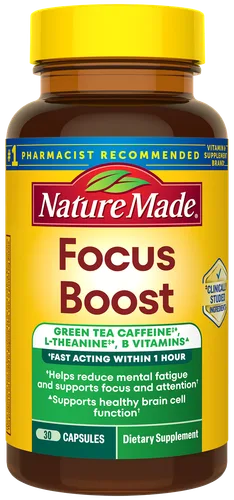
Nature Made Focus Boost Capsules Review
We don’t sell supplements. We help you make decisions and get the best price.
Lowest prices
We may earn a commission from some store links. How we choose.
Finding the lowest prices at the stores now. This takes a few seconds.
Study, Trial or Testing Result Summary
Members Only35 human studies · 16 improved
2 of these 35 human studies gave the ingredient by drip, not by mouth.
There are no controlled trials of this product or its ingredients for long-term regularity. Niacin, at a dose close to the studied intake, was linked to less constipation in two large diet surveys. People eating the most niacin had about 24 percent lower odds of chronic constipation [1], and intakes below 18 milligrams a day were linked to more constipation [2]. No supplement was tested. Vitamin B6, at about the studied dose, improved stool frequency in small two-week trials, but always mixed with fiber or other ingredients [3][4]. One trial in pregnant women found no benefit [5]. Higher dietary vitamin B1 was linked to more frequent stools [6] and lower odds of constipation [7], though another survey found no clear link [1]. Caffeine here is far below the studied dose. At higher doses it sped the first bowel movement after bowel surgery in reviews [8][9], but some trials found no benefit [10][11]. Pantothenic acid was only tested as an injection after surgery [12]. The only vitamin B12 study was about diarrhea [13]. L-theanine has no studies for this goal. Animal and cell studies are never counted.
See all 35 studies →Hide the studies
- In a genetic study of 268,606 people, genes linked to vitamin B1 handling were tied to how often people have bowel movements, and among 98,449 UK Biobank participants higher dietary thiamine intake was linked to more frequent stools, though no supplement was tested.Genetic dissection of stool frequency implicates vitamin B1 metabolism and other actionable pathways in the modulation o…
- In nine trials of 2746 preterm infants, caffeine compared with placebo did not change constipation or most other gut side effects, though one trial found fewer reflux symptoms at 2 weeks.Gastrointestinal effects of caffeine in preterm infants: a systematic review and Bayesian meta-analysis.
- In eight trials of 1269 women after cesarean delivery, caffeinated coffee shortened time to defecation by about 3.4 hours and time to first flatus by about 5 hours, but did not significantly change time to first bowel movement; certainty of evidence was low to very low.Coffee intake after cesarean section and postoperative gastrointestinal recovery: a systematic review and meta-analysis.
- In eight trials of 610 patients after colorectal surgery, caffeine shortened time to first bowel movement and to first solid food, but time to first flatus and hospital stay did not differ significantly.Caffeine intake enhances bowel recovery after colorectal surgery: a meta-analysis of randomized and non-randomized studi…
- In four studies of 341 patients after surgery, coffee shortened time to first bowel movement, first flatus and tolerance of solid food, with no complications attributed to coffee.Effect of Caffeine Intake on Postoperative Ileus: A Systematic Review and Meta-Analysis.
- In four randomized trials of 312 patients after colorectal surgery, coffee or caffeine shortened time to first bowel movement by about 10 hours, cut hospital stay by about one day and lowered laxative use.The effect of coffee/caffeine on postoperative ileus following elective colorectal surgery: a meta-analysis of randomize…
- In a review of eight studies in adults, four found caffeine may reduce constipation and four found no improvement or more constipation, so results were conflicting.The Effectiveness of Caffeine in Reducing Constipation in Adults: A Systematic Review.
- In 103 women after cesarean section, drinking three cups of coffee shortened time to first defecation (20.7 vs 29.1 hours) and first flatus (8.6 vs 11.3 hours) compared with no treatment.Can coffee consumption be used to accelerate the recovery of bowel function after cesarean section? Randomized prospecti…
- In 99 adults recovering from keyhole bowel surgery, drinking a 4-oz cup of caffeinated or decaffeinated coffee three times daily did not shorten the time to first bowel movement compared with warm water.Does coffee affect bowel recovery following minimally invasive colorectal operations? A three-armed randomized controlle…
- In 90 patients analysed after laparoscopic colon surgery, caffeinated coffee did not speed first bowel movement compared with water (3.75 vs 4.14 days), while decaffeinated coffee did (3.0 days).Effect of Coffee on the Length of Postoperative Ileus After Elective Laparoscopic Left-Sided Colectomy: A Randomized, Pr…
- In 60 adults after keyhole colon surgery, caffeine at 100 mg or 200 mg three times daily did not shorten the time to first bowel movement compared with placebo (about 68 hours in all groups).Caffeine for intestinal transit after laparoscopic colectomy: randomized clinical trial (CaCo trial).
- In 58 adults after keyhole colon surgery, caffeine 100 mg three times daily brought the first stool about 18 hours earlier than placebo, though other measures such as time to first gas and hospital stay did not differ significantly.Does caffeine enhance bowel recovery after elective colorectal resection? A prospective double-blinded randomized clinic…
- In 50 adults with constipation-predominant irritable bowel syndrome, two jelly drinks a day with 1.8 mg pyridoxine plus inulin and curcumin for 2 weeks increased bowel movement frequency and stool consistency score and reduced pain and bloating, while the diet-only group improved only in pain and bloating.[Dry jelly concentrate with vitamins and dietary fiber in patients with IBS with constipation: a comparative controlled …
- In 49 adults with constipation-predominant irritable bowel syndrome, two drinks a day with 2 mg pyridoxine plus inulin and menthol for 2 weeks improved stool frequency, stool consistency, pain, bloating and quality of life, but 10 of 25 drinkers developed heartburn.[Using a multicomponent functional food in IBS patients with constipation a comparative controlled study].
- In a small trial of 36 pregnant women with nausea, a 25 mg pyridoxine plus doxylamine tablet over 5 days showed no significant difference from ondansetron in constipation, and the study did not show a constipation benefit for vitamin B6.Ondansetron compared with doxylamine and pyridoxine for treatment of nausea in pregnancy: a randomized controlled trial.
- In 36 women after cesarean section, drinking coffee brought first bowel movement about 2 hours sooner and first defecation about 4 hours sooner than drinking water.Effect of caffeine on postoperative bowel movement and defecation after cesarean section.
- In 23 lactose intolerant adults with ongoing gut symptoms, 30 days of probiotics plus vitamin B6 reduced bloating and improved constipation compared with placebo in a crossover trial.Effects of Bifidobacterium longum and Lactobacillus rhamnosus on Gut Microbiota in Patients with Lactose Intolerance and…
- In 60 orthopedic surgery patients given intravenous dexpanthenol (a pantothenic acid derivative) on the second and third days after surgery, the time to first bowel movement got shorter as the dose went up compared with saline, though the study was small and preliminary.A pilot study of the effect of pantothenic acid in the treatment of post-operative ileus: results from an orthopedic sur…
- In a randomized open-label trial of 50 middle-aged Korean adults, an 8-week Auricularia auricula-judae functional food did not significantly change constipation outcomes, although participants' vitamin B1 intake from other meals rose.Effects of the Intestinal Status and Clinical Factors of Korean Middle-Aged People Through the Consumption of Functional…
- In a survey of 13,941 U.S. adults, each extra 100 mg of daily caffeine was not linked to constipation overall, but among people with high cholesterol intake, it was linked to a lower risk of constipation defined by stool frequency.Association Between Caffeine Intake and Stool Frequency- or Consistency-Defined Constipation: Data From the National Hea…
- In a large survey of American adults, higher dietary intake of B vitamins was linked to lower constipation risk for niacin, folate and choline, while vitamin B1 showed only a subgroup interaction with alcohol use rather than a clear overall effect.Evaluating the link between the dietary intake of vitamin B and constipation: a population-based study.
- In a survey of 13,816 U.S. adults, higher daily caffeine intake from food and drink was linked to lower odds of constipation, with the association seen in younger and middle-aged adults.Exploring the connection between caffeine intake and constipation: a cross-sectional study using national health and nut…
- In a large survey of US adults, moderate caffeine intake (about 100 mg per unit) was linked to less chronic constipation, while higher intake was linked to more constipation.Association Between Caffeine Intake and Bowel Habits and Inflammatory Bowel Disease: A Population-Based Study.
- In a large survey of American adults, higher dietary vitamin B1 intake was associated with lower odds of chronic constipation (odds ratio 0.87 per unit increase), but this observational link does not prove that thiamine causes relief.The association between dietary vitamin B1 intake and constipation: a population-based study.
- In a US survey of adults, daily niacin intake of 0-18 mg was linked to higher constipation risk compared with 18-27 mg per day, suggesting low niacin intake is associated with more constipation; this is an observational association, not a trial.Association of niacin intake with constipation in adult: result from the National Health and Nutrition Examination.
- In a survey of 1,991 children and adolescents with disabilities, vitamin B1 intake was often inadequate and better Mediterranean diet scores were linked to fewer gastrointestinal symptoms including constipation, but thiamine itself was not tested as a treatment for constipation.Mediterranean diet is associated with better gastrointestinal health and quality of life, and less nutrient deficiency i…
- In a study of 190 people with and without Parkinson's disease, lower caffeine intake was linked to a gut metabolite pattern, but caffeine's direct effect on constipation was not studied.Faecal metabolite deficit, gut inflammation and diet in Parkinson's disease: Integrative analysis indicates inflammatory…
- In a prospective study of 151 gastric bypass patients, 27 had thiamine deficiency, and bowel movement frequency improved after thiamine treatment in those with constipation; no dose or duration was reported and there was no placebo group.Constipation in patients with thiamine deficiency after Roux-en-Y gastric bypass surgery.
- In a cross-sectional survey of 103 people with an ileostomy or colostomy, dietary vitamin B12 intake was recorded, but no supplement was given and bowel regularity or constipation relief was not tested as an outcome.A Cross-sectional Study of Nutritional Status, Diet, and Dietary Restrictions Among Persons With an Ileostomy or Colosto…
- In a survey of 100 intensive care patients who usually consumed a median of 338 mg of caffeine daily, 29% reported withdrawal symptoms, with constipation among the listed symptoms; no effect of caffeine on constipation was measured.Caffeine consumption and withdrawal among patients in the intensive care unit.
- In a survey of 85 Singaporean women with recurrent urinary infections, those who drank caffeine had lower quality of life scores, and the study did not measure caffeine's effect on bowel regularity.Premenopausal women with recurrent urinary tract infections have lower quality of life.
- In a US national survey, shift workers and day workers had similar bowel movement patterns and constipation rates, and caffeine intake did not differ between the groups.Bowel Health in U.S. Shift Workers: Insights from a Cross-Sectional Study (NHANES).
- In a survey of U.S. adults aged 20 to 65, those with moderate daily caffeine intake (about 109 to 229 mg) had lower odds of constipation than those with the lowest intake, though higher intake gave no extra benefit.Association between caffeine intake and constipation in a U.S. population aged 20 to 65 years: Results from NHANES 2007 …
- In a survey of 265 university students during Ramadan fasting, people drank less caffeine and some with constipation improved, but the study did not test caffeine's effect on constipation.Daily practices, study performance and health during the Ramadan fast.
- In a quasi-experimental study of 21 adults with chronic diarrhoea and low vitamin B12, injected vitamin B12 settled diarrhoea in 16 people (76.2%), most within two days; the abstract does not state the dose or treatment length.CHRONIC DIARRHOEA: NOT A RARE PRESENTATION OF VITAMIN B 12 DEFICIENCY.
Review Totals and Summary
Members OnlyWhat buyers say
No written reviews read yet.
Biohacker Summary
Members Only0 of 10 recommend it
Caffeine is listed as a smaller ingredient in this product, yet it is what nearly the whole panel talked about, and most of them use it or recommend it for focus, alertness, mood and training. Several suggest 100 to 150 milligrams, and two of them pair it with L-theanine to smooth out jitteriness and anxiety, while one uses it with other focus supplements for long stretches of mental work. Many advise keeping it to the morning or stopping by noon or lunch because late caffeine can disrupt sleep, and others warn that it can raise stress, restlessness or a fast heart rate, that it affects people differently, and that it is no fix for brain fog. One panelist stopped caffeine for a year, and one advised cutting it out in the three months before conception. Vitamin B1, niacin, vitamin B12 and vitamin B6 are smaller ingredients in this product, and only one or two panelists spoke about each, mostly in favor.
See all 10 biohackers →Hide the biohackers
Dave Asprey · Caffeine · uses
- Loves coffee, has the caffeine molecule tattooed on his arm, drinks it every morning, and says it does amazing things for your brain and for how long you can live, but it can't clear most brain fog on its own.
- Created Danger Coffee, a mineral-enriched, lab-tested, mold-free coffee that delivers rich flavor and clean caffeine without all the junk, and recommends it to others.
- Dave Asprey's lab proved that caffeine is a flow hack and the only known substance to actually make you flow prone. Coffee will make you more flow prone.
- Dave explains why the 1:2 ratio of caffeine to L-theanine beats coffee alone for working memory, accuracy, and calm, sustained concentration.
- States that his entire career started on caffeine and he uses it every morning, but notes it's like a loan from your future self, leading to an afternoon crash.
- Dave Asprey's company used caffeine, which is a safe ingredient, but they stopped using it because it doesn't provide the type of results and change in the skin that newer ingredients do.
- States that caffeine is one of his superpowers and increases the rate of ketone formation, which fuels neurons.
- Once I’ve hydrated and taken my creatine, I reach for Danger Coffee for caffeine and essential minerals in one cup.
- Uses caffeine, noting it blocks adenosine to increase norepinephrine and dopamine signaling, fueling the prefrontal cortex for focus. He mentions it got him through business school and is part of his longevity journey.
- Does not believe caffeine is a nootropic, considering it just a stimulant.
- Recommends niacin, a form of vitamin B3, as one of the two most important raw materials for NAD+ production, found in foods like beef liver, chicken, turkey, and fish, or from supplements.
- States that Vitamin B12 is extremely important for every kind of brain function and recommends ensuring B12 levels are optimal, around 500, not just barely above normal.
- Dave Asprey recommends niacin, a form of vitamin B3, as one of the two most important raw materials for NAD+ production, found in foods like beef liver, chicken, turkey, and fish.
- Notes that niacin has been a standard longevity ingredient since the 1990s.
Thomas DeLauer · Caffeine · neutral
- Explains that caffeine from green tea mobilizes fatty acids, which can be converted into ketones, providing a ketone boost, especially in a fasted or low-carb state.
- Warns that treating brain fog with caffeine without addressing underlying inflammation is ineffective and likely to make the situation worse.
- Notes that caffeine significantly increased fat metabolism and fat oxidation during exercise, especially at lower intensities, and that adding coffee around an exercise bout led to more calories and fat burned.
- Says that caffeine significantly increased fat metabolism and that at low intensity cardio or exercise caffeine works better at mobilizing and utilizing fat.
- Recommends Vitamin B12 for mental health and mood, explaining its role in myelination and neurotransmitter production. They specifically recommend a liposomal and micellar form of methylcobalamin B12 for better absorption and to avoid toxicity.
- Might have some caffeine before fasted training.
- Recommends caffeine as a must on the fasting day to create a low-grade energy demand that forces the body to favor lipolysis.
- Uses niacin as part of their detoxification protocol, taking enough to flush about half an hour before a sauna session.
- Recommends drinking 150 to 200 mg of caffeine immediately before a 20-minute nap to enhance alertness and performance, as the caffeine peaks when the nap has cleared adenosine.
- States that caffeine is probably the most studied ergogenic aid with a profound effect on fat mobilization, suggesting that simple is better.
- Mentions that people try cutting out caffeine when dealing with sleep issues, but it's not always the root cause.
- Warns that consuming more than 50-60 mg of caffeine in the first hour after waking stacks a stimulant on top of the body's natural cortisol-driven alertness, leading to a sharp spike and mid-morning crash, and building tolerance faster.
- Warns against conventional cereal, describing it as extruded, sugared, and then sprayed with vitamins that were destroyed during its making.
- Mentions that a single serving of sardines provides vitamin B12 at something like three to four times the daily needs.
Andrew Huberman · Caffeine · uses
- Used caffeine, taking 400 milligrams, to improve his mood and physical vigor during mundane tasks like swimming, noting that it made life not so bad and allowed him to rip through the water.
- Mentions caffeine in a discussion about supplement use.
- Discusses caffeine timing as a tool related to sleep.
- He recommends caffeine, in coffee or tea form, or in tablet or capsule form at lower dosages than found in coffee and tea, as a reasonable way to explore stimulant-based approaches for enhancing cognitive function and focus.
- Huberman states that caffeine can improve focus and concentration, with a general useful range of 100 to 400 milligrams, and most people do well with 100 to 200 milligrams prior to focused work.
- Discusses caffeine as a tool for improving attention, noting its impact on focus and sleep.
- Mentions that coffee and tea produce caffeine, which were likely defense chemicals, and that plants learned it was better to alter consciousness than kill predators outright.
- Discusses caffeine and its health benefits.
- Recommends caffeine as a tool to increase motivation and dopamine.
- Huberman explains that regular ingestion of caffeine at safe levels of about 100 to 250 mg increases the number of D2 and D3 dopamine receptors, making circulating dopamine more potent.
- States that a deficiency in vitamin B12 can be terrible and lead to chronic fatigue-like syndromes, as many parts of mitochondria require B vitamins.
- Recommends taking methyl B12 as part of methylated B vitamins to lower homocysteine levels and reduce cardiovascular risk.
- Has been taking AG1 for over 10 years, once and often twice every day, to ensure he gets all necessary vitamins, minerals, probiotics, and adaptogens, considering it a nutritional insurance policy.
- Does not supplement B6 due to evidence that overs-supplementing vitamin B, especially B6, is problematic because of peripheral nerve damage.
Dr. Rhonda Patrick · Caffeine · neutral
- Explains that caffeine can activate AMPK, a cellular energy sensor involved in fat burning and glucose regulation, which helps muscle cells take up glucose and promotes using fatty acids for energy.
- Recommends pairing caffeine with L-theanine to enhance alertness and focus while mitigating anxiety and jitteriness, suggesting a dose of 100 to 150 mg of caffeine.
- Recommends pairing coffee with L-theanine to enhance cognitive performance, noting that L-theanine can help balance caffeine’s stimulatory effects.
- Recommends cutting out caffeine in the three months before conception for both men and women, as it affects sperm.
- Recommends caffeine for alertness and focus, especially when combined with L-theanine to smooth out the response and maintain cognitive benefits, suggesting a practical dose of 100-150 mg.
- Recommends cutting down or eliminating caffeine when actively trying to conceive.
- Warns that a very high dose of caffeine, around 350 mg pre-workout, may blunt some of creatine's performance benefit due to opposite effects on muscle relaxation.
- Self-administers 350 mg of caffeine in a bolus right after returning from mass and his workout, and before eating, noting that he likes dark roast Starbucks.
- The newest literature on Caffeine dose and its link to multiple cardiometabolic disease risk reduction shows that even the ≥400 mg group was healthier than 0 mg.
- Explains that caffeine works by blocking adenosine, a molecule that builds up and makes one feel tired, and that timing coffee intake is about leveraging adenosine biology for peak cognitive alertness.
- Warns that Vitamin B12 enhances light's melatonin-suppressing effects and should be avoided too close to bedtime.
- Explains that alcohol consumption can lead to a deficiency in thiamine (Vitamin B1), which is essential for nerve function and brain health, by impairing its absorption and inhibiting its utilization.
- Notes that thiamine, a type of B vitamin, was used in combination with intravenous vitamin C and hydrocortisone in a study for sepsis patients, which decreased the risk of organ failure and death.
- Notes that studies suggest intravenous vitamin C alone or in combination with other treatments like thiamine can decrease the risk of organ failure and mortality in patients diagnosed with sepsis.
Siim Land · Caffeine · recommends
- Recommends stopping caffeine earlier to improve sleep.
- Notes that polyphenolic compounds in coffee, both decaf and regular caffeinated, can influence cellular stress pathways and have been seen to increase autophagy activity in mice, with regular coffee appearing more potent due to caffeine's additional energetic stress.
- Recommends moving caffeine intake earlier in the day because having it too late can disrupt sleep, especially for slow metabolizers.
- Recommends not having caffeine after lunch, noting that 400 mg 4 hours before bed reduced deep sleep by approximately 30 minutes in a trial, although he personally has a fast caffeine metabolism.
- Warns that combining a large dose of glycine with caffeine can amplify negative experiences, as caffeine independently increases arousal and can cause restlessness, anxiety, and increased heart rate.
- States that regular coffee promotes visceral fat loss, and going from low or zero intake to moderate intake increases fat loss due to caffeine and polyphenols.
- Suggests that higher caffeine intake might be useful for older people because caffeine raises cortisol, and consuming it in the morning contributes to circadian regulation.
- States that caffeine has proven benefits for increasing exercise performance when used correctly and at the right time.
- States that caffeine raises blood pressure, but mostly if one is not used to consuming it, and habitual caffeine consumers develop tolerance to these effects.
- Quotes a tweet suggesting that without caffeine, civilization would be 100 years behind.
- Created Microvitamin, a supplement that bundled all the supplements he was taking, to help fund his a med trial.
- States that vitamin B12 deficiency is the most common reason for premature graying of hair and recommends fixing B12 status if it is deficient, as it gives a greater likelihood of reversing gray hair.
- Suggests that in the mornings, NAD supplements like niacinamide can help kickstart the circadian rhythm.
- Recommends Niacinamide for skin protection, explaining it works partly through NAD metabolism that the body uses against DNA damage and is found in protein sources.
Ben Greenfield · Caffeine · stopped
- Came off caffeine for a year after his separation.
- Quit caffeine in the same year he quit testosterone replacement therapy and alcohol.
- Uses caffeine, such as coffee or green tea, in his morning fasted fat-burning session to slightly increase the oxidation of fats.
- Advises against relying on caffeine for morning energy, suggesting that natural sugar-based stimulants combined with hydration and meditation can provide sufficient wakefulness.
- Recommends Caffeine, noting that it can improve focus, mood, and training, help control appetite, raise calories burned, and reduce fatigue.
- Notes that 3 mg/kg of caffeine increases fat oxidation by 31%, and 5 mg/kg increases it by 51% compared to a placebo.
- Caffeine on its own isn’t particularly impressive as an ergogenic aid, but when combined with taurine, there are significant increases in power production.
- Mentions that caffeine can help mitigate the negative effects of a caloric deficit on lean muscle mass and metabolism.
- Has talked before about caffeine as a supplement that seems to assist with sleep deprivation.
- Warns that energy drinks can deliver large doses of caffeine quickly, which may overstimulate the heart and cause abnormal heart rhythms and electrocardiogram changes, especially in children.
- States that Nrf2 activators, when combined with something like niacin, may have a good effect on plaque progression.
- Recommends getting vitamin B12 tested and supplementing if deficient, as B12 deficiency can cause damage to the myelin coating around nerves, including cochlear nerves, and improve tinnitus severity scores.
- Mentions nicotinamide as an ingredient found in many NAD products and notes that niacinamide and nicotinamide are structurally the same.
- Believes the niacinamide approach, along with the NAMPT/salvage pathway angle, is underrated and deserves more attention.
Dr. Eric Berg · Vitamin B1 · recommends
- States that taking Vitamin B1 might help with swollen legs and ankles.
- States that expensive NAD+ supplements only turn into $5 niacin in the body and that research has shown niacin can actually raise NAD levels in the blood 5 to 8 times their baseline levels.
- Dr. Eric Berg states that vitamin B1 supports the nerve function and energy production involved in the brain's response to changes in hearing, which plays a major role in tinnitus.
- Dr. Berg suggests that supporting vitamin B1 intake may help address the stress behind bloating.
- Recommends cheap flush niacin, stating that it outperforms expensive NAD supplements and even IV drips in raising NAD levels in the blood.
- Dr. Berg lists pyridoxine hydrochloride as a synthetic vitamin to avoid.
- Recommends taking the fat-soluble version of vitamin B1, benfotiamine, to support blood flow to the nerves and counter complications of diabetes.
- Notes that Vitamin B1 is intimately involved in the nervous system and may be behind sciatica and carpal tunnel syndrome.
- Recommends taking the active form of vitamin B6, pyridoxal-5-phosphate (P5P), for its benefits to the nervous system, including building the myelin sheath and protecting sensory nerve integrity.
- Notes that Vitamin B6 is intimately involved in the nervous system and may be behind sciatica and carpal tunnel syndrome.
- Recommends taking the natural form of vitamin B12, methylcobalamin, to support nerve regeneration, myelin production, and nerve growth factors.
- Notes that Vitamin B12 is intimately involved in the nervous system and may be behind sciatica and carpal tunnel syndrome.
- Recommends vitamin B1 as a way to lower blood sugar for better sleep.
- States that cheap niacin, which creates a flush, ends up more in the blood than expensive NAD versions, suggesting it is more effective for unhealthy individuals.
Dr. Mark Hyman · Caffeine · warns
- Discusses with patients their caffeine consumption, suggesting that too much caffeine can artificially increase their stress response.
- Explains that pellagra, which killed 100,000 Americans, was a niacin deficiency, a B vitamin.
- Recommends stopping caffeine by noon.
- States that caffeine's effect on ADHD depends on the person, as it can help focus but also activate irritation or stress, and its impact is related to individual caffeine metabolism.
- Optimized a child's nutrient status with vitamin B6, as the child had low B6 levels.
- States that vitamin B12 is a nutritional deficiency that impacts mental health.
- Warns that drinking coffee first thing in the morning before eating layers caffeine on top of already elevated stress hormones, providing unsustainable energy and setting up for an afternoon crash.
- Notes that caffeine is one of the things that drives the hormone imbalance causing PMS.
- Recommends vitamin B6 with folate and B12 as supplements with strong evidence for PMS.
- Recommends vitamin B12 with vitamin B6 and folate as supplements with strong evidence for PMS.
- Believes that if functional testing is done to replete deficiencies like vitamin D and B12 before someone stops their medication, withdrawal symptoms can be completely eliminated.
- Mentions that repletion of vitamin B12 can help safely withdraw someone from meds and that simple vitamin B12 deficiencies are important to address in a depression workup.
- States that drinking coffee on an empty stomach, which is how most people do it, is probably not the best thing as it gives a jolt of caffeine and adrenaline before eating.
- Warns that caffeine, alcohol, and spicy foods can be potent triggers for hot flashes, and excess caffeine should be avoided.
Bryan Johnson · Caffeine · uses
- Drinks coffee when starting to fade, ensuring the last cup is between 10 and 12 hours before bed so caffeine doesn't affect sleep.
- Used 300 mg of caffeine in the morning as part of their jet lag recovery.
- Uses 300 mg of slow release caffeine in the morning as part of a jet lag recovery protocol.
- Notes that coffee affects the gut, which then affects the brain, and that it is the coffee bean, not the caffeine, doing most of the work.
- Notes that the culture in DC involves running on caffeine, along with alcohol and sleep deprivation, leading to poor nutrition and an unhealthy environment.
- Warns that caffeine has a 6-hour half-life, so consuming it later in the day will leave a significant amount in the body at bedtime, recommending consumption earlier in the day.
- States that Blueprint essential capsules and soft gels are packed with key vitamins and minerals needed for strong bone health.
- Recommends consuming no caffeine past noon due to its 6-hour half-life, suggesting that if sleep is nailed, caffeine might not be needed.
- Warns against stimulants like caffeine for sleep, advising to have the last cup of coffee before noon if going to bed at 10:00 p.m.
- Advises that if one is going to drink caffeine, they should try to have it earlier in the day and experiment to find the right time that doesn't disrupt their sleep.
- Has stopped all caffeine, as it has helped him improve his sleep.
- Recommends Niacinamide as a supplement for skin health, noting it is in the Blueprint stack.
- He uses Niacinamide, found in serums or moisturizers, morning and night, and takes 15 mg in Blueprint Essential Capsules.
Peter Attia · Caffeine · uses
- States that he needs two to three times the normal dose of any medication or drug to feel an effect, including caffeine, and can drink four cups of coffee without feeling anything.
- Mentions data suggesting caffeine might be more helpful in the luteal phase to help with fatigue components.
- Uses caffeine in combination with Alpha GPC, MCT, and Theanine, often adding it to coffee for long periods of cognitive work.
- Finds Alpha GPC works well with caffeine, and he puts a product containing Alpha GPC, MCT, and caffeine into his coffee for long periods of cognitive work.
- Peter Attia's AVIA Skincare vitamin C serum also contains niacinamide, which is useful to apply to the skin right after washing.
- Mentions that experimenting with the timing of caffeine is a great idea for sleep.
- Warns that decaffeinated coffee can contain significant amounts of caffeine and advises cutting off all coffee, including decaf, by 11 a.m. for better sleep quality.
- Explains that caffeine is problematic because it blocks adenosine receptors, leading to a 'caffeine crash' when it wears off and adenosine floods the receptors, causing sleepiness.
- States that caffeine does not wake him up, which contributed to his belief that he did not have an addiction gene.
- States that caffeine does not wake him up.
- Warns that constantly consuming caffeine and Red Bull to turn up the sympathetic dial is a sign that the sympathetic system isn't working as it should, possibly due to overstimulation from stress.
- Notes that deficiencies in certain vitamins and minerals, such as B12, can be a cause of hair loss in women.
- Used to prescribe niacin to many patients, primarily to raise HDL, lower APO B, triglycerides, LDL, and LP(a), but stopped after clinical trials showed minimal or disappointing effects on reducing cardiovascular events.
- Notes that niacin lowers LP little a but was not shown to have clinical benefit in outcome studies, and they are not currently using it.
RAL Summary
Members OnlyTier 4 for Regularity: Long-Term Relief
The evidence is mostly diet surveys and short trials of mixed products, and no reviews could be counted. That supports only the emerging tier.
- Emerging: not enough evidence to rank higher yet.
Where the evidence disagrees: 13 of the 35 human studies found no effect.
More Details
Members OnlyBody systems · Combine with · Possible side effects
Body systems: Digestive system, Nervous system
Possible side effects: In one trial of a vitamin B6 drink with inulin and menthol, 10 of 25 drinkers got heartburn. No other major side effects were reported.
Supplement Facts
Thiamin 1.2 mg · Niacin 16 mg · Vitamin B6 1.7 mg
| Thiamin | 1.2 mg | |
| Niacin | 16 mg | |
| Vitamin B6 | 1.7 mg | |
| Vitamin B12 | 2.4 mcg | |
| Pantothenic Acid | 5 mg | |
| L-Theanine | 97 mg | † |
| Caffeine | 40 mg | † |
Other ingredients: Microcrystalline Cellulose, Hypromellose, Less than 2% of Magnesium Stearate, Stearic Acid, Silicon Dioxide.
Directions: Adults, take 1 capsule daily with water.
Barcode (UPC) 031604006907 · Label source: Reverseagelab · Report a label change
Show entire label

More regularity: long-term relief products
Members OnlyThe highest ranked for the same goal
Read more
Our articles on this subject
- Magnesium Glycinate vs Citrate: What the Studies ShowArticle · Oct 30, 2026
- Psyllium vs Metamucil: Same Fiber, Different ExtrasArticle · Nov 1, 2026
Graded November 6, 2026 by the Reverse Age Lab evidence engine, from human studies, real reviews and our biohacker panel. How we grade. Is this medical advice? No. Rala organizes the published evidence; go over any change with your doctor, especially if you take meds.
Privacy policyConsumer health dataAffiliate disclosureTermsDo Not Sell or Share My Personal InformationCookie settings