
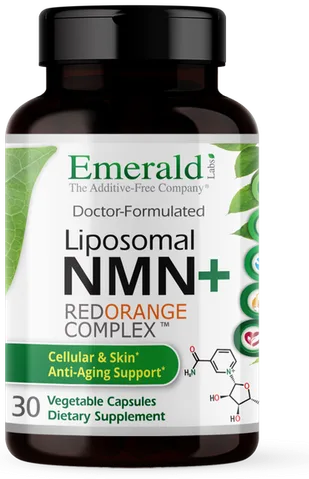
Emerald Labs Liposomal NMN+ RedOrange Complex Review
Emerald Labs Liposomal NMN+ RedOrange Complex is a dietary supplement sold as a vegetable capsule. Each container holds 30 servings, and one serving is one capsule. The label lists two main ingredients per serving: RedOrange Complex (BIONAP) at 100 mg and Liposomal NMN at 250 mg. The label names the NMN as liposomal. The other ingredients printed are the vegetable capsule, made of hypromellose from non-GMO pine bark, and water. The directions on the label read: Adults, take one capsule daily, with or without food, or as directed by a Healthcare Practitioner. That means the capsule can be taken at a mealtime or away from one, and the label points to a healthcare practitioner for any other instructions. With one capsule per day, a full container covers 30 days of the printed serving. The label gives no other ingredient amounts beyond the two main ones and the capsule materials. If you are comparing it on the shelf, the facts to check are the capsule form, the 30 count, the 100 mg and 250 mg amounts, and the printed daily direction.
We don’t sell supplements. We help you make decisions and get the best price.
Lowest prices
We may earn a commission from some store links. How we choose.
We hold no current store prices for it yet: check the store.
- AmazonPrice at AmazonCheck price at Amazon (opens in a new tab)
Also at: Walmart · Target. Some links earn us a commission; price comes first, and a commission only decides the order of prices within 2%. As an Amazon Associate we earn from qualifying purchases.
Study, Trial or Testing Result Summary
Members Only28 human studies · 16 improved
Both ingredients are at the dose that worked in studies. Red orange extract at 100 milligrams a day for 8 weeks improved skin response to sunlight, moisture, elasticity, dark spots and wrinkle depth in 110 adults [1]. In 60 older adults it raised a key cell antioxidant balance and slightly lowered an inflammation marker [2]. It also lowered a blood marker of oxidative damage in traffic police officers [3] and faded age spots [4]. NMN reliably raises blood levels of a cell energy molecule that falls with age, though most blood sugar and cholesterol measures did not change [5]. At 250 milligrams a day in older adults it raised this molecule and shortened walking time, but the main balance test did not change [6], with similar small gains in older men [7]. In middle-aged adults, a blood-based biological age score held steady while it rose with placebo [8]. Pooled studies disagree: one found faster walking [9], another found no gain in muscle, grip strength or walking speed in adults over 60 [10]. No study measured biological age reversal with this product. Animal and cell studies are never counted.
See all 28 studies →Hide the studies
- Across 12 trials with 513 adults, NMN raised blood NAD levels, but most blood sugar and cholesterol measures did not differ from control.Efficacy of oral nicotinamide mononucleotide supplementation on glucose and lipid metabolism for adults: a systematic re…
- Across 9 trials with 412 middle-aged and older adults, NMN improved walking speed and lowered a liver enzyme (ALT), with the biggest insulin resistance benefit at small doses.Effects of Nicotinamide Mononucleotide Supplementation on Muscle and Liver Functions Among the Middle-aged and Elderly: …
- In trials of adults averaging over 60, NMN did not significantly improve muscle mass, grip strength, walking speed or chair-stand performance compared with placebo.The Effect of Nicotinamide Mononucleotide and Riboside on Skeletal Muscle Mass and Function: A Systematic Review and Met…
- A review of 147 studies, mostly animal, found NAD-raising compounds including NMN mostly showed favourable effects on age-related disorders, but human evidence is limited and there are possible risks.NAD+ therapy in age-related degenerative disorders: A benefit/risk analysis.
- This review found no human trials of NMN for Alzheimer's disease, only mouse studies; the human benefits reported were for nicotinamide riboside.Supplementation with NAD+ Precursors for Treating Alzheimer's Disease: A Metabolic Approach.
- A review of 33 human studies found oral NMN and nicotinamide riboside reliably raised NAD-related blood markers, but effects on health and function were mixed and often null.NAD⁺ supplementation for anti-aging and wellness: A PRISMA-guided systematic review of preclinical and clinical evidence…
- In 110 Asian and Caucasian adults, 100 mg a day of red orange extract for 56 days improved skin reaction to UV light, antioxidant capacity, moisture, elasticity, radiance, dark spots and wrinkle depth.Photoprotective and Antiaging Effects of a Standardized Red Orange (Citrus sinensis (L.) Osbeck) Extract in Asian and Ca…
- In 80 healthy middle-aged adults taking 300, 600 or 900 mg NMN daily for 60 days, blood NAD and six-minute walking distance rose, and blood biological age stayed unchanged while it rose with placebo.The efficacy and safety of β-nicotinamide mononucleotide (NMN) supplementation in healthy middle-aged adults: a randomiz…
- In 80 healthy middle-aged adults taking NMN for 60 days, higher blood NAD was linked to higher red blood cell measures, but this was an association analysis, not an aging reversal result.Association between blood nicotinamide adenine dinucleotide levels and blood laboratory parameters at baseline and after…
- In 65 healthy adults, 14 days of nicotinamide mononucleotide or nicotinamide riboside raised blood NAD levels comparably, while nicotinamide did not.The differential impact of three different NAD+ boosters on circulatory NAD and microbial metabolism in humans.
- In 60 older adults, red orange extract for 8 weeks raised the ratio of reduced to oxidized glutathione by 89% and lowered the inflammation marker TNF-alpha by 2.5%, with better wellbeing scores and good tolerance.Antioxidant Efficacy of a Standardized Red Orange (Citrus sinensis (L.) Osbeck) Extract in Elderly Subjects: A Randomize…
- In 60 older adults, 250 mg daily of nicotinamide mononucleotide for 12 weeks raised blood NAD levels, shortened 4-metre walking time and improved sleep scores versus placebo, but did not change the stepping test, the main outcome.Ingestion of β-nicotinamide mononucleotide increased blood NAD levels, maintained walking speed, and improved sleep qual…
- In 36 healthy middle-aged adults, 12 weeks of 125 mg twice daily raised serum nicotinamide levels, but arterial stiffness did not differ significantly from placebo.Nicotinamide adenine dinucleotide metabolism and arterial stiffness after long-term nicotinamide mononucleotide suppleme…
- In 32 overweight or obese adults aged 55 to 80, 1000 mg of MIB-626 beta-NMN once or twice daily for 14 days raised blood NAD levels compared with placebo and was well tolerated, but no aging outcome was measured.MIB-626, an Oral Formulation of a Microcrystalline Unique Polymorph of β-Nicotinamide Mononucleotide, Increases Circulat…
- In 30 overweight or obese adults over 45, 4 weeks of 1000 mg twice daily raised blood NAD and lowered body weight, blood pressure and LDL cholesterol more than placebo, but did not change muscle strength or insulin sensitivity.Nicotinamide Adenine Dinucleotide Augmentation in Overweight or Obese Middle-Aged and Older Adults: A Physiologic Study.
- In 14 healthy men given a single NMN dose by mouth or under the tongue, the sublingual route produced higher levels of two NAD breakdown products within 60 minutes, while NMN, NAM and NAD levels did not differ between routes.Sublingual NMN administration increases early circulating terminal catabolites 2PY and 4PY compared with oral administra…
- In 11 untrained men taking 1200 mg daily for 7 days before a hard leg workout, the supplement dampened inflammation signals in muscle but also blocked the usual rise in muscle mitochondria.Anti-inflammatory effects of nicotinamide mononucleotide (NMN) in human skeletal muscle after BFR-exercise.
- Healthy older men took 250 mg of nicotinamide mononucleotide daily for 6 or 12 weeks; their blood NAD levels rose significantly versus placebo, and walking speed and left-hand grip strength showed small improvements that need confirming, with no change in body composition.Chronic nicotinamide mononucleotide supplementation elevates blood nicotinamide adenine dinucleotide levels and alters m…
- In 33 people with type 2 diabetes and 28 healthy volunteers, 50 mg a day of red orange extract for 2 months raised blood thiol levels and lowered free radicals in those with high oxidative stress, but did not change total antioxidant status.Evaluation of oxidative stress in diabetic patients after supplementation with a standardised red orange extract.
- In traffic police officers, one month of a standardized red orange extract lowered a blood marker of oxidative damage in non-smokers and restored blood thiol levels to normal, and it reduced smoking-related chromosome damage.Protective effects of a standardised red orange extract on air pollution-induced oxidative damage in traffic police offi…
- In a one-day placebo-controlled study, a combined metabolic activator with 1 g of nicotinamide mononucleotide boosted NAD-related blood products, though less than nicotinamide or niacin.The acute effect of different NAD+ precursors included in the combined metabolic activators.
- In 11 healthy middle-aged Japanese men taking 250 mg of NMN daily for 8 weeks, NAD levels in blood immune cells rose and the drug was well tolerated; in 3 men with excess insulin after sugar loading, insulin spikes were modestly reduced.Safety and efficacy of long-term nicotinamide mononucleotide supplementation on metabolism, sleep, and nicotinamide aden…
- In 10 healthy Japanese men given single doses of 100, 250 or 500 mg of nicotinamide mononucleotide, no significant clinical changes occurred, though breakdown products rose with dose and no aging measure was tested.Effect of oral administration of nicotinamide mononucleotide on clinical parameters and nicotinamide metabolite levels i…
- In laboratory tests using patient-derived tumor samples and mice, NMN restored the function of aged immune T cells and improved response to immunotherapy for early triple-negative breast cancer; this has not been tested directly in people.Interferon-induced senescent CD8+ T cells reduce anti-PD1 immunotherapy efficacy in early triple-negative breast cancer.
- In laboratory tests, a red orange extract showed strong antioxidant activity, and when applied to the skin of healthy volunteers it reduced redness caused by UVB sun exposure, with a stronger effect than the vitamin E comparator.In vitro antioxidant activity and in vivo photoprotective effect of a red orange extract.
- In healthy volunteers, 100 mg of red orange extract daily for 15 days reduced skin redness caused by UV lamp exposure and lowered the melanin content of age spots from 27% to 7% during supplementation.Protective effect of red orange extract supplementation against UV-induced skin damages: photoaging and solar lentigines…
- In aging mice, NMN supplementation restored NAD levels and reduced age-related leakage of the blood-brain barrier; this has not been tested in people.NAD+ rescues aging-induced blood-brain barrier damage via the CX43-PARP1 axis.
- In mice, early NMN treatment restored NAD in heart valves, reduced valve inflammation, and slowed calcification, while later treatment was less effective; this has not been tested in people.Senescence-associated metabolic alterations aggravate calcific aortic valve disease.
Review Totals and Summary
Members Only24 reviews · 94% positive
No written reviews read yet.
Biohacker Summary
Members Only5 of 10 recommend it
The panel is split on nicotinamide mononucleotide, the main ingredient: three of the seven who spoke about it currently recommend or use it, one is neutral, and three stopped or warn against it. Those in favor take it to raise NAD levels, for energy, and for mitochondrial function, with doses of 500 mg in the morning, 250 to 500 mg, and one panelist citing research that used 600 to 900 mg a day, while another takes only 10 mg for focus. One panelist mentioned pairing it with a related niacin form and another uses a version combined with resveratrol. Two panelists stopped after concerns about a buildup of nicotinamide and a rise in homocysteine, one warned that high doses can cause a methylation problem, and another questioned whether the expensive forms are worth the cost since they may break down in the gut. Another panelist is not taking it and notes that the evidence is mostly from animal studies, with long-term human safety still unknown.
See all 8 biohackers →Hide the biohackers
Dave Asprey · Nicotinamide Mononucleotide · recommends
- Recommends NMN (nicotinamide mononucleotide) as a precursor to NAD+, suggesting clinical research used between 600 and 900 mg a day for measurable increases in NAD levels and improvements in energy and performance.
- Recommends supplementing with NMN (nicotinamide mononucleotide) to raise NAD+ levels and keep the cleanup machinery running smoothly.
- Dave Asprey recommends NMN (nicotinamide mononucleotide) as a precursor to NAD+, noting it converts one step faster and tends to provide more immediate noticeable results, with clinical research using between 600 and 900 mg daily.
- Recommends supplementing with NMN (nicotinamide mononucleotide) to raise NAD+ levels and keep the cleanup machinery running smoothly, especially when other signals are in place.
- Mentions NMN as a nicotinamide mononucleotide and NAD precursor, noting it's no longer available over the counter in the U.S. due to pharmaceutical interventions.
- Takes nicotinamide mononucleotide, along with niacin, actual NAD, and True Niagen.
- Takes nicotinamide mononucleotide as part of his NAD-boosting regimen.
- Recommends Nicotinamide Mononucleotide (NMN) as an effective NAD+ precursor that offers benefits over niacin and niacinamide, and suggests taking it along with niacinamide and NR for optimal NAD boosting.
- Notes that NMN, or nicotinamide mononucleotide, is a precursor to NAD+ and gained popularity for its potential to counteract age-related NAD+ decline, with human studies showing positive effects on age-related complications.
Ben Greenfield · Nicotinamide Mononucleotide · warns
- Warns that taking high-dose NR or NMN can lead to a buildup of nicotinamide and a methylation problem, and that studies show increasing the dose of NR beyond a certain point does not increase NAD+ levels but does increase methyl nicotinamide.
- States that Nicotinamide Adenine Dinucleotide (NAD+) status is one of the "biggest" smallest molecules to consider for performance, longevity, and well-being, highlighting its paramount necessity to mitochondrial function, energy production, and aging.
- Believes there is merit in molecules like Vitamin B3, nicotinamide riboside, or NMN, which are known biogenesis boosters.
- Uses 10 mg of Nicotinamide Mononucleotide from Troscriptions in the morning for cognitive enhancement.
Siim Land · Nicotinamide Mononucleotide · stopped
- Used to take NMN to increase NAD levels and slow down aging, but now prefers Nicotinamide.
- Mentions nicotinamide mononucleotide (NMN) as a potential cheaper energy supplement if he wanted to increase energy levels.
- Is currently taking NMN, either 250 or 500 milligrams, experimenting with it alongside Nicotinamide Riboside.
- Mentions that Nicotinamide Mononucleotide (NMN) is getting pulled from the market because it's being turned into a drug, which they find absurd.
Peter Attia · Nicotinamide Mononucleotide · stopped
- Stopped taking NMN after seeing his homocysteine level go up to 15 from a typical 7, which he believes was a reflection of the pathway where NMN is cleaved by CD38, increasing nicotinamide and its methylation, potentially depleting the one-carbon cycle.
- Discusses nicotinamide mononucleotide (NMN) as an NAD precursor that has been shown in some studies to lead to benefits associated with healthy aging and lifespan extension in mice, though these results are not always reproducible.
- States that oral Nicotinamide Mononucleotide is likely not absorbed intact because it has a charged phosphate group that generally cannot cross cells.
- Discusses a study where a high dose of nicotinamide mononucleotide (NMN) was tested in overweight or obese postmenopausal pre-diabetic women, finding improved muscle insulin sensitivity.
Thomas DeLauer · Nicotinamide Mononucleotide · recommends
- Is a big fan of nicotinamide mononucleotide (NMN) and feels it helps with energy manufacturing from an insulin resistance perspective.
- Warns that NMN and NR, which cost about 100 times more than nicotinamide and niacin, are likely broken down into the cheaper forms in the gut, suggesting no good reason to buy the expensive versions.
- States he will take Nicotinamide Mononucleotide (NMN) now and then for spurts, but is not currently taking it, though he plans to go back on it in February or March.
- Suggests considering Nicotinamide mononucleotide (NMN) as it has more promising research, even if still in animal models, compared to Resveratrol.
- Has become a big proponent of nicotinamide mononucleotide as a supplement for longevity, specifically using the Verso brand which combines it with trans-resveratrol.
- Recommends Nicotinamide Mononucleotide (NMN) for improving physical performance, stamina, and efficiency, and also for potential longevity benefits, citing personal experience and correlating research.
- Recommends nicotinamide mononucleotide (NMN) to support NAD levels, which in turn activate sirtuins, the longevity genes, and suggests using the Verso brand.
- Recommends Nicotinamide mononucleotide (NMN) for longer-term effects and to enhance the benefits of fasting, with Verso as the preferred brand.
- Takes Verso nicotinamide mononucleotide (NMN) with his post-workout meal, preferring it over nicotinamide riboside (NR) because it's one step closer to the necessary conversion process.
- Started personally experimenting with taking nicotinamide mononucleotide as a precursor to NAD, specifically mentioning the brand Verso, which also includes trans-resveratrol.
Dr. Mark Hyman · Nicotinamide Mononucleotide · uses
- Uses nicotinamide mononucleotide (NMN) as one of his favorite forms of niacin for mitochondrial function.
- Takes NMN (nicotinamide mononucleotide), a precursor to NAD, to theoretically increase NAD levels in his cells and keep his sirtuins and epigenome properly regulated for longevity.
- States that NMN, or nicotinamide mononucleotide, is an NAD booster used in his lab, which cells convert into NAD, leading to a spike in NAD and phenomenal effects on the body's protective mechanisms.
- States he uses nicotinamide mononucleotide (NMN) and finds it helpful for mitochondrial function.
Dr. Rhonda Patrick · Nicotinamide Mononucleotide · neutral
- Mentions nicotinamide mononucleotide as an NAD booster, but notes that the data for such boosters is mostly from animal studies and their long-term human effectiveness and safety are still unknown.
- Explains that NMN (nicotinamide mononucleotide) is the immediate precursor to NAD and is converted to NAD within one step in the cell.
- Is currently not supplementing with nicotinamide mononucleotide (NMN).
- Rhonda Patrick mentions that nicotinamide mononucleotide delayed aging in animal models.
Bryan Johnson · Nicotinamide Mononucleotide · uses
- Takes 500 mg of NMN (Nicotinamide Mononucleotide) in the morning.
RAL Summary
Members OnlyTier 4 for Healthy Aging
Tier 3 needs over 50 reviews and tier 2 over 100, but only 34 reviews were counted, and the NMN studies disagree, so the facts support tier 4. So it is graded Tier 4, lower than the rules alone gave.
- Emerging: not enough evidence to rank higher yet.
Where the evidence disagrees: 3 of the 28 human studies found no effect.
More Details
Members OnlyBody systems · Combine with · Possible side effects
Body systems: Skin, Immune system, Muscular system, Metabolic system
Combine with: NMN is often paired with trans-resveratrol because both are linked to sirtuin pathways, with NMN raising NAD+ and resveratrol acting on the same signaling. It is also often paired with TMG (betaine), since making and using NAD+ can draw on methyl groups, and TMG supplies them. Quercetin is often paired with it as well, because it may slow the breakdown of NAD+ by CD38, helping NAD+ last longer.</br>
Possible side effects: No major side effects reported; red orange extract was well tolerated in older adults.
Supplement Facts
RedOrange Complex™ 100 mg · Liposomal NMN™ 250 mg
| RedOrange Complex™ (BIONAP) | 100 mg | † |
| Liposomal NMN™ | 250 mg | † |
Other ingredients: Vegetable capsule (hypromellose (from non-GMO pine bark), water).
Directions: Adults, take one (1) capsule daily, with or without food, or as directed by a Healthcare Practitioner.
Barcode (UPC) 743650003761 · Label source: Reverseagelab · Report a label change
Show entire label

More healthy aging products
Members OnlyThe highest ranked for the same goal
Read more
Our articles on this subject
- NMN vs NR: Which NAD+ Booster Has Better Evidence?Article · Nov 20, 2026
- NMN vs NAD: What Is the Difference and Which Should You Take?Article · Nov 13, 2026
Graded November 22, 2026 by the Reverse Age Lab evidence engine, from human studies, real reviews and our biohacker panel. How we grade. Is this medical advice? No. Rala organizes the published evidence; go over any change with your doctor, especially if you take meds.
Privacy policyConsumer health dataAffiliate disclosureTermsBrand and legal noticesDo Not Sell or Share My Personal InformationCookie settings