
GNC SuperFoods Coconut Oil Review
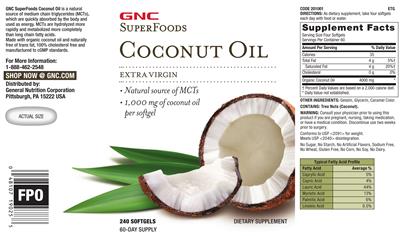
Coconut Oil by GNC SuperFoods is a single-ingredient dietary supplement in softgel form, listed in the NIH Dietary Supplement Label Database with a label dated March 25, 2014. According to the label, each serving of four softgels provides 4000 mg of organic coconut oil, along with 50 calories, 5 grams of total fat, 5 grams of saturated fat and 1 gram of protein. The container lists 60 servings and a net content of 240 softgels. The label presents the product for energy from medium chain triglycerides, describing MCTs as hydrolyzed more rapidly and metabolized more completely than long chain fatty acids. It states the product is a natural source of medium chain triglycerides with no artificial flavors or artificial sweeteners, and describes the oil as organic extra virgin. The label also lists a typical fatty acid profile, with lauric acid at 38.75 percent, myristic acid at 13.00 percent, caprylic acid at 5.30 percent and palmitic acid at 7.50 percent, among others. The other ingredients are gelatin, medium chain triglycerides, vegetable glycerin and titanium dioxide. The allergen statement reads contains tree nuts (coconut), and gelatin is noted as animal-derived. The page states that the label's use claim has no graded research: the HelloPharmacist data holds insufficient reliable evidence to rate coconut oil for diabetes, high cholesterol, obesity or lichen planus, so the evidence for this product's stated use is described as not established. Its safety information is rated well documented. The most commonly reported side effects are diarrhea, cramping and nausea, while the rarer but serious risk is allergic reaction, which can range from hives to anaphylaxis. Pregnancy and breastfeeding are both rated likely safe in food amounts, with insufficient reliable information for medicinal amounts. The page lists 86 drugs with a documented interaction, all rated minor, mainly antidiabetes drugs such as a med, glipizide and a med, and describes the effect as theoretical. The page compares the 4000 mg amount with other recent coconut products in its database and notes that none of these figures is a recommended dose. The label advises consulting a physician if pregnant, nursing, taking medication or having a medical condition, and to discontinue use two weeks before surgery. The brand is GNC SuperFoods, with the maker listed as General Nutrition Corporation in Pittsburgh, Pennsylvania.
We don’t sell supplements. We help you make decisions and get the best price.
Lowest prices
We found no store selling it right now.
Study, Trial or Testing Result Summary
Members OnlyHuman studies
This product gives 4000 milligrams of organic coconut oil in four softgels per serving. No human studies on coconut oil for energy were provided for this review, so there is no research finding to report for this goal, and no study references can be cited. Coconut oil is often marketed as a quick energy source, and the softgels also list medium chain triglycerides among the other ingredients. However, that amount is not stated, and it is listed with the capsule ingredients rather than as an active ingredient. No study evidence was supplied on whether that small amount has any effect. No reviews of this softgel product were counted. The available customer comments mostly describe the jar form of the oil used for cooking, coffee, hair and skin. Those comments do not tell us how the softgels work. No biohacker statements were available. For now, any claim that this product raises energy rests on marketing and general belief rather than on studies or reviews of this product. Members looking for proven energy support should treat it as unproven until human trials of this form and dose are available. Animal and cell studies are never counted.
Review Totals and Summary
Members Only4 reviews
Customers mostly like this product for its versatility and its quality as a plain organic oil. Many reviewers use one jar for several jobs: cooking, baking, smoothies, coffee, hair masks, skin care, oil pulling and general household use. One reviewer called it something they "use for everything." Reviewers often praise the natural, raw scent and the texture. Some call the aroma pleasant and fresh. Buyers also like that it is organic and cold-pressed, and several say the large jug lasts a long time and is good value for the money. One shopper said the big jug was "worth the money" for how much they use it. People who add it to morning coffee before a workout say it tastes good and gives them an energy lift. That matches how GNC markets the oil. Reviews of the softgel version are short and positive. They call it a good product for the money and mention good quality. Criticism is mild and uncommon. One reviewer said it works fine in cooking and smoothies but is not very different from other coconut oils they have tried. This suggests some buyers see it as a dependable commodity with no special edge. One Amazon reviewer said they are simply "not a coconut person." That reflects taste preference more than a product defect. The retail pages also show a few practical points. The oil is solid at cooler room temperatures. Brown specks of coconut fiber can show up, which GNC says are natural. I did not find clear complaints about these in the reviews I read. I also saw no recurring complaints about rancidity, leaks or side effects in the pages I could access. The amount of feedback is limited. Individual listings carry only a handful to a few dozen reviews, and some are very short, like a one-line Spanish "muy bueno." Treat the themes above as directional, not statistically strong. In short, buyers see an affordable, pleasant-tasting, multipurpose organic coconut oil that lasts, and a few find it ordinary.
Biohacker Summary
Members Only6 of 10 recommend it
Coconut oil is a smaller ingredient in this product, and the panel is split but leans toward approval. Three of the ten recommend it and two say they use it, mostly for cooking, as a healthy fat, and for a brain energy boost, with one using a tablespoon in rice cooking water. Many also mention uses on the skin, in the mouth, or as oil pulling, and one pairs it with tea tree oil and xylitol as a mouthwash. Cautions are common: one panelist stopped eating it after their LDL particle number dropped without it, another saw LDL and ApoB rise by 30 percent, and others warn it can clog pores or that small amounts are fine for most people but overuse is a concern.
See all 9 biohackers →Hide the biohackers
Andrew Huberman · Coconut Oil · recommends
- Recommends coconut oil as a barrier to maintain moisture and prevent the tongue from falling off during prolonged saltwater exposure.
- Notes that Beyond Meat reformulated their product by taking out coconut oil and other ingredients after a study showed benefits, indicating their responsiveness to health concerns.
- Andrew Huberman mentions coconut oil as a fat source he consumes.
- Notes that Dr. Whitman will discuss coconut oil as a tool.
- Andrew Huberman asks how much coconut oil people can ingest before they develop diarrhea or get tired of it.
- Huberman recommends using coconut oil for oil pulling three times a week due to its antimicrobial properties, but not daily to avoid disrupting the oral microbiome.
Dr. Mark Hyman · Coconut Oil · warns
- Warns that coconut oil can be helpful but is comedogenic, so people prone to acne should be careful.
- Includes 1/4 cup melted coconut oil in a bread recipe and uses it to grease parchment paper.
- Recommends swapping lotion for organic coconut oil and using it with Himalayan salt to exfoliate.
- Says that small amounts of coconut oil are fine for most people.
- Mentions that when he increased coconut oil in his diet, his LDL cholesterol and ApoB went up by 30%, attributing this to his genetics and the swap from olive oil to coconut oil and coconut yogurt.
- Recommends replacing industrial oils with coconut oil for cooking at home.
- Recommends coconut oil as a great fat for breakfast.
- Dr Hyman recommends coconut oil as a saturated fat that some people can do fine with.
- Recommends extra virgin coconut oil.
- Does not recommend coconut oil for APOE4 positive individuals, suggesting they stay away from saturated fats.
Ben Greenfield · Coconut Oil · recommends
- Recommends coconut oil-based lubricants for conception, noting they are low in toxins and typically have an appropriate pH for sperm motility.
- Recommends using coconut oil as a healthy oil for cooking, noting that it's often available and can be requested in restaurants or stocked at home.
- Eats a tremendous amount of coconut oil as part of his low carb, high healthy fat diet.
- Recommends coconut oil as a healthy fat for muscle building.
- Ben Greenfield recommends eating more stable fats like olive oil, avocado oil, coconut oil, tallow, and grass-fed butter to protect against oxidative stress.
- Recommends using coconut oil for cooking instead of processed seed oils.
- Ben Greenfield used to use coconut oil for oil pulling to clean his mouth upon waking.
- Clarifies that coconut oil is not among the problematic oils.
- Uses 1 shot of coconut oil in his DIY elemental smoothie.
- Ben asks if coconut oil or coconut products impact short-chain fatty acids, and the guest confirms they do, suggesting it could be included in a carnivore diet to elevate short-chain fatty acid levels.
Dr. Eric Berg · Coconut Oil · recommends
- Recommends combining coconut oil with tea tree oil and xylitol to create a mouthwash, stating these ingredients are antibacterial and may support plaque reduction.
- Dr. Eric Berg recommends using coconut oil as a cooking oil.
- Recommends coconut oil as an ingredient in a DIY sunscreen recipe.
- Recommends coconut oil as one of the healthiest zero-carb, zero-sugar food choices.
- Warns that coconut oil is just a Band-Aid for dry skin, tackling the symptom rather than the root cause.
- Recommends consuming a tablespoon of coconut oil to stop the growth of candida.
- Lists coconut oil as one of the healthier fats.
- Recommends virgin, cold-pressed coconut oil as much better than refined coconut oil.
- Mentions that restaurants do not use coconut oil for frying, implying it is a healthier alternative.
- Recommends MCT oil from coconuts due to its lauric acid, which can also help with anti-fungal effects.
Dr. Rhonda Patrick · Coconut Oil · stopped
- Used to cook with coconut oil over 10 years ago but stopped, finding that cutting it out significantly dropped their LDL particle number.
- Believes that consuming a tablespoon of coconut oil after low glycemic load carbs would be perfectly fine, noting that it's an outlier due to its MCT content.
- Warns against overconsuming coconut oil, especially for those on a ketogenic diet, as it is a c16 saturated fat that can increase APOB.
- Mentions that Mary Newport showed people do better with their cognitive decline using coconut oil, though it may not be the best way for everyone.
- Previously used coconut oil for oil pulling but has since stopped, finding xylitol more effective for her oral health.
- Mentions that coconut oil can be used to achieve ketosis for cognition, but notes it may not be the best way for everyone.
- Dr. Rhonda Patrick uses 4 tablespoons of melted coconut oil in her low-carb lemon tart crust.
Thomas DeLauer · Coconut Oil · uses
- Says he adds a tablespoon of coconut oil to the cooking water with the rice to help form protective crystals and build a lower glucose structure.
- Recommends coconut oil for high heat frying.
- Uses coconut oil strategically for a brain boost, noting its medium-chain saturated fats provide clean and fast fuel for the brain.
- Recommends coconut oil, stating that its consumption for hundreds or thousands of years in the tropics indicates it is not bad for you, despite past warnings about saturated fat.
- Recommends using quality virgin coconut oil, specifically unrefined, and notes it can also be used for low or medium heat cooking.
- Suggests that coconut oil, which contains lauric acid, can help mitigate viral load due to its potent antimicrobial effect.
- Used to consume coconut oil for four or five years for weight loss and energy, but found it negatively affected his glucose and led to higher total cholesterol compared to his current diet.
- Recommends eating coconut oil, noting that people in Tahiti have been eating it for thousands of years and should continue to do so.
- No longer eats a lot of coconut oil, especially refined coconut oil, because data shows it causes problems.
- States that while he doesn't have a problem with coconut oil, he would much rather have tallow than coconut oil nowadays.
Dave Asprey · Coconut Oil · uses
- Sometimes uses coconut oil for cooking.
- Recommends adding 1 tablespoon of C8 MCT oil to coffee every morning, explaining it's a coconut-based fat that helps burn fat, provides energy, and turns into ketones for brain fuel.
- Lists coconut oil as a good fat.
- Recommends MCT oil, an extract of coconut, as a great source of clean burning fats for mitochondrial health.
- Notes that some people in the longevity movement used coconut oil because they saw a study supporting its use.
- Dave Asprey recommends coconut oil as a better choice than the seven deadly seed oils, especially if you want something that doesn't come from a cow.
- Recommends coconut oil as a natural healthy source of saturated fat that is profoundly good for you.
- Confirms that coconut oil is an acceptable lubricant.
- Blends a small amount of coconut oil with puer and green tea and Kerrygold to magnify the effects of the tea.
- States he still puts C8 MCT oil in his coffee, explaining that it's a rare form found in coconuts that can prevent or reverse Alzheimer's disease by providing ketones as an energy source for neurons.
Siim Land · Coconut Oil · neutral
- Mentions coconut oil as a natural sunscreen, but notes it's insufficient as a primary sunscreen due to its low SPF.
- Warns that while coconut oil is antibacterial, it can clog pores, leading to pimples, and advises rinsing it off in a few minutes if used.
- Uses extra virgin coconut oil for oil pulling, taking a teaspoon and swishing it for at least five minutes.
- Is considering taking coconut oil and mixing it with essential oils to kill off serratia, using it as a mouthwash.
- Coconut oil's antibacterial properties make it suitable for a face wash, but avoid leaving it on for prolonged periods.
- Recommends using coconut oil for frying food, mentioning it as a fat with a high smoking point.
- Says they would only use MCT oil to prolong the fast as to not break it prematurely, and mentions coconut oil as an option for fats during a fast.
- Suggests that a small amount, like one teaspoon, of 100% fat such as MCT oil or coconut oil, may not entirely stop autophagy as they elevate ketone bodies and may promote chaperone-mediated autophagy, but it's a gamble.
- Lists coconut oil as a food that can boost autophagy.
- Recommends using a little bit of coconut oil in stubborn regions where skin is most loose, noting its antibacterial and moisturizing properties that soften the skin.
Peter Attia · Coconut Oil · neutral
- Discusses work done with MCT oil, noting that a caprylic triglyceride molecule improved mini mental status exam scores in a 2008 study and that Dr. Mary Newport's husband improved with coconut oil and MCT oil.
- Discusses the "ridiculous" literature surrounding coconut oil, particularly the "pure poison" article, and the general issues with nutritional epidemiology.
- Would consume a tablespoon of coconut oil or something else throughout the day.
- Sheds light on saturated fat in the literature and the types of studies done specifically on coconut oil, in response to an article claiming coconut oil is poison.
RAL Summary
Members OnlyTier 4 for Energy
The review summary mostly describes a jar or jug of coconut oil used for cooking, coffee, hair and skin, not these softgels, and the review count is zero, so these reviews are set aside. Its reviews are set aside, so it is graded on its studies alone. Promising, but human evidence is thin and there are 0 reviews.
- Emerging: not enough evidence to rank higher yet.
- No human studies on this goal for its ingredients.
More Details
Members OnlyBody systems · Combine with · Possible side effects
Body systems: Digestive system, Metabolic system
Combine with: If the goal is energy support, pair coconut oil with B-complex vitamins (B12, B6, riboflavin) and magnesium to support mitochondrial energy metabolism, plus L-carnitine or CoQ10 to help fat utilization. For true cellular and DNA repair or longevity, look to targeted compounds instead: NMN or nicotinamide riboside (NAD+ precursors), resveratrol or pterostilbene, quercetin and fisetin (senolytic support), alpha-lipoic acid, and omega-3 fish oil (EPA/DHA). Add vitamin D3/K2, vitamin C, and glutathione or NAC for antioxidant and DNA-protective support. Take coconut oil in moderation and monitor LDL cholesterol.
Possible side effects: No major side effects reported.
Supplement Facts
organic Coconut Oil 4000 mg
| Calories | 50 | |
| Total Fat | 5 g | |
| Protein | 1 g | |
| organic Coconut Oil | 4,000 mg | † |
Other ingredients: Gelatin, Medium Chain Triglycerides, Vegetable Glycerin, Titanium Dioxide.
Barcode (UPC) 048107130343 · Label source: NIH label database · Report a label change
Show entire label
More energy products
Members OnlyThe highest ranked for the same goal
Read more
Our articles on this subject
Graded November 4, 2026 by the Reverse Age Lab evidence engine, from human studies, real reviews and our biohacker panel. How we grade. Is this medical advice? No. Rala organizes the published evidence; go over any change with your doctor, especially if you take meds.
Privacy policyConsumer health dataTermsDo Not Sell or Share My Personal InformationCookie settings