
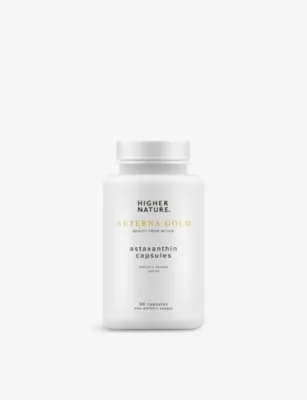
Higher Nature Aeterna Gold Astaxanthin Capsules Review
Higher Nature was born back in 1994 and is the brainchild of nutritionists Celia and Brian Wright. Focussing on quality ingredients and formulas developed on the latest scientific, the duo started selling supplements from their Sussex home. Believing that good skin starts from within, the brand blends the Aeterna Gold Astaxanthin capsules with astaxanthin that naturally occurs in plants to protect them from UV light and to help combat free radicals that are responsible for creating the signs of ageing. The product listed on this page is Higher Nature Aeterna Gold Astaxanthin 30 capsules. The listed ingredients are extra virgin olive oil, astaxanthin, antioxidant d-alpha tocopherol, modified corn starch, glycerol, carrageenan and sodium carbonate. The page provides an allergen note stating that for allergens, see ingredients in bold. Storage guidance says to store in a cool, dry place. The country of origin is listed as the United Kingdom. The page notes that for hygiene reasons this product cannot be exchanged or refunded unless faulty. The page shows the product as out of stock, with a message that the product is currently unavailable and a prompt to shop similar products from the Higher Nature category. No price, rating, or written customer review is shown on this page.
We don’t sell supplements. We help you make decisions and get the best price.
Lowest prices
We may earn a commission from some store links. How we choose.
Finding the lowest prices at the stores now. This takes a few seconds.
Study, Trial or Testing Result Summary
Members Only12 human studies · 6 improved
This product gives 4 milligrams of astaxanthin a day, the same amount that helped in several eye studies. In a placebo-controlled trial of 64 children with screen-related eye strain, 4 milligrams daily for 12 weeks reduced eye strain and improved depth perception, but did not improve sharpness of vision [1]. In 60 healthy adults, a higher amount of 9 milligrams daily for 6 weeks protected visual sharpness after screen work in people aged 40 and over, but not in younger people [2]. Some of the longer studies used astaxanthin together with lutein, zeaxanthin and other nutrients, so they cannot show what astaxanthin does alone. In people with age-related macular changes, such a blend with 4 milligrams kept vision stable over 2 years [3], and another blend improved central retina function over a year [4]. A blend with other plant pigments also preserved eye focusing after screen work [5]. A review of nine trials found modest benefits for eye fatigue and the eye's protective pigment, but no consistent slowing of nearsightedness [6]. Overall the evidence is promising but small, and much of it tests blends rather than astaxanthin on its own. Animal and cell studies are never counted.
See all 12 studies →Hide the studies
- A review of nine randomized trials found carotenoids including astaxanthin modestly improved macular pigment and eye fatigue, but did not consistently slow nearsightedness progression.Nutritional Supplementation for Myopia Prevention and Control: A Systematic Review of Randomized Controlled Trials.
- In 64 children aged 10-14 with digital eye strain, 4 mg of astaxanthin daily for 84 days reduced eye strain scores more than placebo and improved depth perception and pupil reflex, but not visual acuity.Astaxanthin (AstaReal®) Improved Acute and Chronic Digital Eye Strain in Children: A Randomized Double-Blind Placebo-Con…
- In 60 healthy adults, 9 mg of astaxanthin daily for 6 weeks protected corrected visual acuity after screen work in people aged 40 and over, but not in younger people, and did not change functional visual acuity or pupil constriction.Effects of diet containing astaxanthin on visual function in healthy individuals: a randomized, double-blind, placebo-co…
- In 44 healthy adults with screen-related eye fatigue, 6 weeks of a combined anthocyanin, astaxanthin and lutein supplement preserved focusing function after screen work and eased focusing difficulty more than placebo.Effects of anthocyanin, astaxanthin, and lutein on eye functions: a randomized, double-blind, placebo-controlled study.
- In 43 dry eye patients, an 8-week antioxidant blend including astaxanthin improved tear stability, tear production and tear oxidative stress versus placebo, but not dry eye symptoms or visual acuity.A randomized, double-blind, placebo-controlled study of oral antioxidant supplement therapy in patients with dry eye syn…
- In 27 people with early age-related macular degeneration, a year of a supplement containing 4 mg astaxanthin plus other nutrients improved central retinal function compared with no supplement.Carotenoids and antioxidants in age-related maculopathy italian study: multifocal electroretinogram modifications after …
- In healthy screen workers, 8 weeks of 6 mg astaxanthin with lutein and zeaxanthin preserved eye-hand coordination after screen work and raised macular pigment, but did not clearly change smooth eye tracking.Effects of Astaxanthin, Lutein, and Zeaxanthin on Eye-Hand Coordination and Smooth-Pursuit Eye Movement after Visual Dis…
- In adults aged 40-70 with memory complaints, 12 weeks of a supplement with astaxanthin, vitamin E and grape extract improved episodic memory, but the abstract reports no group differences in the remaining outcomes, including eye health.An Examination into the Effects of a Nutraceutical Supplement on Cognition, Stress, Eye Health, and Skin Satisfaction in…
- In a 2-year open-label randomized study of 145 people with age-related macular changes, those taking astaxanthin 4 mg with lutein, zeaxanthin and other nutrients kept their visual sharpness stable and scored better than the untreated group at 24 months.Carotenoids in Age-related Maculopathy Italian Study (CARMIS): two-year results of a randomized study.
- In 35 cataract surgery patients taking 6 mg of astaxanthin daily for 2 weeks, antioxidant activity in the eye's aqueous fluid changed in women but the link to growth factor levels was not clearly altered, with no placebo group for comparison.Effects of astaxanthin on VEGF level and antioxidation in human aqueous humor: difference by sex.
- In a retrospective study of people with intermediate age-related macular degeneration, six months of a supplement containing astaxanthin was followed by measured changes in choroidal blood flow compared with a control group, but the abstract does not state a clear improvement in vision.Choroidal Changes in Blood Flow in Patients with Intermediate AMD after Oral Dietary Supplement Based on Astaxanthin, Br…
- In an uncontrolled study of 60 middle-aged and elderly people with mild-to-moderate dry eye, 6 mg astaxanthin taken twice daily for about 30 days significantly improved dry-eye symptoms and signs, though visual acuity did not change.Benefits and Safety of Astaxanthin in the Treatment of Mild-To-Moderate Dry Eye Disease.
Review Totals and Summary
Members Only25 reviews
Buyers are broadly positive about these capsules. Most take them for eye health, and several say they have noticed a difference, though the reviews are short and mostly personal accounts. **What buyers say it did for them:** Eyes are the main theme. One person says "My eye sight has improved since being on this suppliment," and a long-term user reports "All my floaters go away." Another has seen fewer floaters after only a week but is cautious: "dare not speak too soon." One reviewer says it "really helped heal the issue" when her husband had a bleed in the retina. Another says it "seems to help with dry eye syndrome." Beyond eyes, one reviewer credits it with helping aging skin and with a noticeable difference in "hair growth, strength and shine." Another recommended it to a friend for prostate problems. Others take it for "general health." **What they complain about:** There are no complaints in these reviews. The only note of caution is from the person who had taken it for just a week and did not want to overstate early results. **Taste, smell, pill size or form:** The reviews say nothing about taste, smell or capsule size, so there is nothing to report on these. Some reviews mention the Astaxanthin with Blackcurrant combination, and one reviewer refers to "Astaxanthin and Blackcurrant capsules." **Value for money:** Price is not discussed directly. One buyer was pleased enough to put the product on a regular subscription and plans to keep taking it. Another says the company's research and safety checks give "confidence to continue purchasing." Neither reviewer says whether the price felt good or poor. **Who it seems to suit:** The strongest fit is people who want support for their eyes, especially those bothered by floaters or dry eyes. A working artist says her eyesight is "still as it was many years ago." Long-term users, some taking it "for many years" and others "for some time," seem happy to stay on it. Couples are among them: one reviewer takes it with her husband. People who value a trusted brand also come across well, as one reviewer says Higher Nature "tick all the boxes" on trust and quality. Some also take it for skin and hair, though that comes from a single reviewer. **Who it did not suit:** No reviewer reports that it failed to work or that it disagreed with them. That may reflect how few and how short the reviews are, so it does not show the product works for everyone. Results described here are individual experiences, and the one-week user was still waiting to see whether the improvement would last. **Note on scope:** These comments are about the capsules only. Reviews of any other forms of this product were left out.
Biohacker Summary
Members Only8 of 10 recommend it
Astaxanthin is the only ingredient here, and the panel leans clearly in its favor: four of the ten recommend it, three more say they use it, and the other two are neutral. The most common reasons are skin protection and sunburn prevention, eye health, joint comfort, and its role as an antioxidant that may help with inflammation and aging. Two panelists give a dose of 12 milligrams a day, one suggests taking it with collagen and vitamin C an hour or so after a workout, and another says it needs a week or two of preloading to be felt in the joints. One panelist stopped after trying it, and cautions came from one who warned that synthetic astaxanthin, the kind used to color farm-raised salmon, lacks credible safety studies, and from another who said the data on eye disease are still emerging.
See all 10 biohackers →Hide the biohackers
Dr. Mark Hyman · Astaxanthin · recommends
- Mentions astaxanthin as a carotenoid that helps reduce oxidative stress.
- Mentions astaxanthin as a carotenoid that helps reduce oxidative stress.
- Astaxanthin, a powerful carotenoid antioxidant, reduces neuroinflammation, scavenges free radicals, activates the Nrf2 anti-inflammatory antioxidant pathway to maintain blood-brain barrier integrity, and suppresses NF-kappa B to reduce inflammatory molecules.
- States that astaxanthin is a naturally occurring supplement that can help safely address oxidative stress and inflammation at the source, playing a major role in mitigating the effects of inflammation and impacting mitochondrial function and other cell signaling pathways related to aging.
- Is excited to talk about astaxanthin and how it helps to combat some of the key hallmarks of aging, including inflammaging, mitochondrial dysfunction, and cell signaling.
- Dr. Hyman recommends AX3 Bio-Pure Astaxanthin.
Siim Land · Astaxanthin · neutral
- Notes that Astaxanthin is one of several supplements with human evidence.
- Astaxanthin is a carotenoid found in salmon and algae that can protect the skin against UV damage. Two systematic reviews of clinical trials have shown that astaxanthin supplementation improves skin elasticity, skin moisture, and photoaging.
- Takes 12 milligrams of astaxanthin a day.
- Recommends astaxanthin as an underrated carotenoid and powerful antioxidant for skin anti-aging, UV protection, eye health, inflammation, and lipids, citing studies that show improvements in skin moisturization and elasticity, reduced digital eye strain, and improvements in cardiovascular disease risk factors like hs-CRP and HDL.
- States that astaxanthin is a powerful antioxidant and carotenoid that protects the skin against UV radiation, which is the number one cause of skin photoaging.
- Recommends astaxanthin as an antioxidant for skin health, highlighting its stronger antioxidant potential (60 to 6,000 times stronger than vitamin C) and good absorption through the skin due to being fat-soluble.
- States that he is personally not stopping to take astaxanthin because there are other benefits he is interested in, such as protecting the skin against UV radiation, protecting the eyes, and improving traditional health biomarkers like CRP and cholesterol.
- Discusses astaxanthin's longevity effects, noting that recent studies show no effects on mouse lifespan unless given in very large doses to male mice, but that it has other benefits from human trials.
- States that Astaxanthin can protect the skin against UV damage and postpone photoaging.
- States that astaxanthin has other benefits from human trials, including skin UV protection, skin elasticity, lower inflammation, lower lipids, and eye protection, and that the new study on life extension effects does not change their opinion on its worth.
Ben Greenfield · Astaxanthin · uses
- States that Astaxanthin has been beaten out in terms of numbers for anti-aging efficacy, but they still love it and couldn't live without it.
- Takes astaxanthin for her skin.
- Ben Greenfield recalls Dr. Kaufmann saying astaxanthin might be the top-ranked supplement for longevity.
- Dr. Kaufmann still loves astaxanthin and couldn't live without it, despite other supplements having higher efficacy numbers in her ranking system.
- Uses astaxanthin on flights as an antioxidant.
- Mentions that Keon uses astaxanthin to stabilize the oil in their omega softgel capsules.
- Says that his concoction included 2 milligrams of microencapsulated astaxanthin, which is microencapsulated to ensure bioavailability in the small intestine.
- Mentions that natural astaxanthin is captured in their fish oil product, along with active vitamin A and D, and various other oils.
- Mentions Astaxanthin as a stalwart in the longevity and age-reversal space.
- Uses astaxanthin, described as an edible sunscreen with good antioxidative effects for the skin, as part of the Gut to Glow supplement when traveling.
Thomas DeLauer · Astaxanthin · recommends
- Believes Astaxanthin is probably one of the only simple over-the-counter supplements that has made a dent in how their joints feel, and notes that it needs to be preloaded for a week or two.
- Believes astaxanthin is super underrated, noting that people take it as an internal sunscreen because it reduces oxidative stress at the skin level, darkens the skin, and significantly prevents sunburn.
- Recommends taking astaxanthin with collagen and vitamin C for a compounded effect, noting it's great for the skin and should be taken an hour or so after a workout to avoid blunting antioxidant effects.
- Recommends taking astaxanthin, a carotenoid that protects the skin and has antioxidant effects similar to those from the sun, and may help prevent sunburn.
- Recommends Astaxanthin as a very good antioxidant for those following a ketogenic protocol, noting it has tremendously helped with joint stiffness for him.
- Explains that astaxanthin is what makes salmon pink and acts as an antioxidant, protecting the fatty acids in the fish from going rancid.
- Discusses astaxanthin as a supplement that shows interesting preliminary evidence for brain health, noting its affordability and availability.
- Recommends taking astaxanthin, an antioxidant found in capsule form, sockeye salmon, and krill oil, to restore skin antioxidants, protect from sun exposure, and potentially help with insulin resistance, suggesting a dose of 6 to 12 milligrams.
- Personally adds astaxanthin when exposed to a lot of sun or engaging in significant endurance work, such as increasing running mileage, for its powerful antioxidant properties that aid aerobic exercise and its skin-protecting qualities as an internal sunscreen.
- Highlights research indicating astaxanthin improves antioxidant capabilities in red blood cells and may negate brain aging effects in rats by restoring BDNF and glutathione, recommending 8 to 12 milligrams per day.
Dave Asprey · Astaxanthin · uses
- Dave Asprey states that he takes astaxanthin to help prevent sunburn.
- States that astaxanthin has great data for both men and women regarding fertility and the future health of a baby, and that he personally takes 12 milligrams every day.
- Takes astaxanthin to support his eyes.
- Recommends Astaxanthin as a fat-soluble free radical scavenger that gets through the blood-brain barrier.
- Takes astaxanthin, which contributes to his ability to spend eight hours in the sun without getting sunburned.
- States there are good arguments for having large amounts of astaxanthin for vision.
- Recommends supplements like lutein and astaxanthin, which are scientifically shown to improve eye resilience and ability to see.
- Dave takes about 12 to 16 milligrams of Astaxanthin a day and likes to get more sources of it in his supplements.
- Takes astaxanthin for eyesight and used to give his dog formula to astaxanthin for mitochondrial function.
- Takes an enormous amount of astaxanthin daily, around 20 milligrams a day with a fatty substance, because it acts as an internal sunscreen, is eye protective, and can supercharge mitochondria by conducting electrons in the mitochondrial membrane.
Dr. Eric Berg · Astaxanthin · recommends
- Recommends astaxanthin, found in salmon, shrimp, lobster, and certain algae, as a potent antioxidant that can increase the expression of the FOX3 longevity gene.
- Identifies astaxanthin as the pink pigment in wild caught salmon, describing it as a powerful antioxidant that helps protect neurons from damage caused by omega-6 fatty acids, refined carbohydrates, and sugars.
- Warns that synthetic astaxanthin, used to color farm-raised salmon, has no credible safety studies and, like other synthetic antioxidants, could increase the risk of cancer.
- Describes astaxanthin as one of the most powerful antioxidants, noting its anti-diabetic, anti-inflammatory, and anti-cancer properties.
- Mentions that krill oil contains astaxanthin, which not only has health benefits but also preserves the oil, preventing it from turning rancid like fish oil.
- Explains that astaxanthin is a powerful fat-soluble carotenoid, 20 times more powerful than beta carotene, 100 times more powerful than alpha tocopherol, and 1000 times more powerful than vitamin C. He recommends consuming it with fats like coconut oil, olive oil, or avocado, and notes it helps with liver detoxification and prevents chronic degeneration in the eyes, brain, heart, and skin.
Peter Attia · Astaxanthin · stopped
- Has tried astaxanthin in the past as part of his personal longevity regimen.
- Discusses Astaxanthin, noting it's available over the counter and alleged to have various health benefits, though he cannot assess the strength of the evidence. He mentions it's used to turn farm-grown salmon pink.
- States that astaxanthin, an over-the-counter food dye, also showed a significant lifespan-extending effect in male mice, but not in females, in a recently submitted paper.
Andrew Huberman · Astaxanthin · recommends
- Discusses astaxanthin as a supplement for maintaining long-term eye health.
- Describes astaxanthin as an interesting compound that seems to increase ocular blood flow and has also been shown to have positive effects on skin elasticity, moisture, and quality.
- Discusses astaxanthin as a compound that, along with lutein and zeaxanthin, is being explored for its potential to help with age-related macular degeneration, though he notes that the data are still emerging.
- Mentions that astaxanthin is a carotenoid found in krill and crustaceans that gives them their red pigment, and that farm-raised salmon are given astaxanthin.
- Mentions Astaxanthin as a compound that may assist in supporting visual health and possibly improve vision.
- Notes that several studies have shown Astaxanthin has a notable effect on fertility in males, seeming to at least double the pregnancy rate when men take it, particularly in previously infertile men.
- Huberman explains that Astaxanthin, a red-pink pigment found in seafood, is structurally similar to beta-carotene and has been shown to offset age-related vision disruption, notably increase ocular blood flow, improve male fertility in previously infertile men, and positively affect skin elasticity and moisture.
- Notes that astaxanthin is used as a supplement and in prescription form to try and rescue some age-related vision loss.
- Notes that supplementing with astaxanthin can be beneficial for slowing the progression of age-related macular degeneration, though the degree of offset is slight but robust. He personally is not taking astaxanthin at this time.
Bryan Johnson · Astaxanthin · uses
- Mentions astaxanthin as an ingredient in his 'bag of goodies', indicating he uses it.
Dr. Rhonda Patrick · Astaxanthin · neutral
- Dr. Rhonda Patrick mentions that astaxanthin has been shown in animal studies to activate the longevity gene foxo3 and in human studies to decrease markers of oxidative stress and improve blood lipid markers.
- Dr. Patrick explains that astaxanthin is a potent antioxidant that protects DHA and other polyunsaturated fatty acids from oxidation, and has been shown in clinical trials to lower inflammation, decrease DNA damage, and increase HDL, all of which are relevant to degenerative diseases.
- Mentions astaxanthin as a potential longevity vitamin, a marine carotenoid found in salmon and krill.
- Dr. Rhonda Patrick mentions that salmon roe is high in astaxanthin, an antioxidant shown in animal studies to activate the longevity gene FoxO3, and in human studies to decrease markers of oxidative stress and improve blood lipid markers.
- Dr. Rhonda Patrick explains that astaxanthin is a carotenoid unique to krill oil that acts as a potent antioxidant, protecting DHA and other polyunsaturated fatty acids from oxidation, and has benefits such as lowering inflammation, decreasing DNA damage, and increasing HDL.
RAL Summary
Members OnlyTier 4 for Eye Health
The review summary quotes buyer comments even though no written reviews were read and none were counted, and some of those comments are about a different product (Astaxanthin with Blackcurrant capsules), so the reviews should be set aside. Its reviews are set aside, so it is graded on its studies alone. Human studies support Astaxanthin (6 of 12 human studies showed an improvement), but there are not yet enough reviews to confirm it (0).
- Emerging: not enough evidence to rank higher yet.
Where the evidence disagrees: 1 of the 12 human studies found no effect.
More Details
Members OnlyBody systems · Combine with · Possible side effects
Body systems: Eyes and vision
Combine with: For eye support, pair astaxanthin with lutein and zeaxanthin (or meso-zeaxanthin), plus omega-3 fish oil (EPA/DHA), which helps absorption of this fat-soluble carotenoid and adds anti-inflammatory benefits. Take it with a fat-containing meal. Bilberry or blackcurrant extract, vitamin C, vitamin E, zinc and vitamin A or beta-carotene can further support retinal antioxidant defenses. If the broader goal is cellular and DNA repair, add NAD+ precursors (NMN or nicotinamide riboside), resveratrol or pterostilbene, alpha-lipoic acid, CoQ10 or ubiquinol, and magnesium. Consult a healthcare professional first, especially if you take meds, meds or hormone-related drugs.
Possible side effects: No major side effects reported.
Supplement Facts
AstaPure Pure Astaxanthin 4 mg
| AstaPure Pure Astaxanthin | 4 mg | † |
Other ingredients: Extra virgin Olive Oil, Capsule, Glycerol, Carrageenan, Sodium Carbonate, Astaxanthin, D-Alpha-Tocopherol.
Directions: Directions: Adults, take 1 capsule a day, with a meal. Do not exceed recommended daily intake.
Barcode (UPC) 05031013106477 · Label source: NIH label database · Report a label change
Show entire label

More eye health products
Members OnlyThe highest ranked for the same goal
Read more
Our articles on this subject
Graded November 6, 2026 by the Reverse Age Lab evidence engine, from human studies, real reviews and our biohacker panel. How we grade. Is this medical advice? No. Rala organizes the published evidence; go over any change with your doctor, especially if you take meds.
Privacy policyConsumer health dataAffiliate disclosureTermsDo Not Sell or Share My Personal InformationCookie settings