
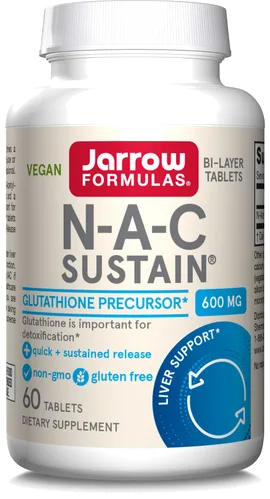
Jarrow N-A-C Sustain 600 mg, Dietary Supplement, 60 Tablets Review
Jarrow Formulas NAC Sustain features N-Acetyl-L-Cysteine (NAC), an antioxidant amino acid and a precursor to glutathione. Glutathione is important for detoxification. The advanced bi-layer Sustain tablets combine 1/3 Quick Release with 2/3 Sustained Release formats to release NAC over time. This bottle contains 60 tablets, providing up to a 2 months supply. Designed to support general wellness and immune health, this N-A-C supplement utilizes NAC SUSTAIN Bilayer Release Technology delivering 600 mg of N-Acetyl L-Cysteine per serving. As a direct precursor to glutathione, the N-Acetyl L-Cysteine in this Jarrow NAC supplement helps support the body's natural antioxidant defenses, supports healthy detoxification processes, and helps maintain overall glutathione status in the body. The formula is vegan, non-GMO, and gluten-free. For suggested use, adults take 1 tablet 1 to 2 times a day, preferably on an empty stomach with fruit juice or as directed by a qualified healthcare professional. Prolonged or elevated intake may alter liver function tests without affecting actual liver function, so users should inform their physician that they are ingesting NAC if undergoing liver function tests. Consumers are advised to consult a healthcare professional before using this product if they are pregnant, nursing, under the age of 18, taking medication, or have a medical condition, and to discontinue use if adverse reactions occur. The product should be kept out of the reach of children and stored in a cool, dry place.With consistent daily intake, the body begins absorbing and utilizing the active ingredients, allowing nutrient levels to build toward effective concentrations. Once steady levels are established, the formula works alongside the body's natural processes, and over time, compounding benefits take hold to provide sustained, balanced support. For nearly five decades since 1977, Jarrow Formulas has formulated supplements around published science, utilizing clinically studied ingredient forms at the doses research actually used, bioavailable active forms, enhanced-absorption delivery systems, and verifiable purity.
We don’t sell supplements. We help you make decisions and get the best price.
Lowest prices
We may earn a commission from some store links. How we choose.
Study, Trial or Testing Result Summary
Members Only58 human studies · 23 improved
15 of these 58 human studies gave n-acetylcysteine by drip or inhaler, not by mouth.
This product provides 600 milligrams of N-acetylcysteine per tablet, which meets the full studied dose of 400 to 1200 milligrams a day when taken once or twice daily. Across 58 human studies for respiratory health, 23 showed an improvement and 23 showed no effect. Large reviews of people with chronic bronchitis or chronic obstructive lung disease found that N-acetylcysteine and other mucus-thinning medicines reduced flare-ups, hospital stays, and days of disability, and helped improve chronic bronchitis symptoms, though they had little effect on lung function or survival [1][2][3][4]. Individual trials also show mixed results depending on the condition and severity. In a six-month trial of 259 people with chronic bronchitis, taking 200 milligrams twice daily kept 40 percent of patients free of flare-ups compared with 19 percent on a placebo [5]. A one-year trial of 120 high-risk patients taking 600 milligrams twice daily kept 51.3 percent free of flare-ups compared with 24.4 percent on a placebo. However, a two-year trial of 968 people with mild to moderate chronic obstructive lung disease found that 1200 milligrams daily did not reduce flare-ups or improve lung function [6], and a pooled analysis of nine trials found no benefit for lung scarring disease. Animal and cell studies are never counted.
See all 58 studies →Hide the studies
- In 38 trials with 10,377 people with chronic bronchitis or COPD, mucolytics (including N-acetylcysteine) taken for two months to three years made people more likely to stay free of flare-ups and reduced days of disability, with little effect on lung function.Mucolytic agents versus placebo for chronic bronchitis or chronic obstructive pulmonary disease.
- In 7 trials with 2,753 COPD patients, mucolytic agents reduced flare-ups overall, and N-acetylcysteine 1200 mg a day shortened flare-up duration but ranked behind erdosteine and carbocysteine and did not reduce hospitalization.Efficacy and safety profile of mucolytic/antioxidant agents in chronic obstructive pulmonary disease: a comparative anal…
- In 12 trials with 2,691 COPD patients, high and low doses of N-acetylcysteine reduced how many people had flare-ups, especially with use of 6 months or more, but did not change flare-up rate or lung function measures.The effect of N-acetylcysteine on exacerbations of chronic obstructive pulmonary disease: A meta-analysis and systematic…
- In 5 trials with 564 people with idiopathic pulmonary fibrosis, N-acetylcysteine slowed the decline in percent predicted vital capacity and walking distance but did not improve forced vital capacity, gas diffusion, or death rates.Efficacy of N-Acetylcysteine in Idiopathic Pulmonary Fibrosis: A Systematic Review and Meta-Analysis.
- In 6 trials with 181 cystic fibrosis patients followed up to 3 months, oral N-acetylcysteine gave only a small, statistically uncertain gain in lung function (2.3% of predicted), and inhaled forms showed no benefit.Systematic review of N-acetylcysteine in cystic fibrosis.
- In a pooled analysis of 9 trials in idiopathic pulmonary fibrosis, N-acetylcysteine showed no effect on lung capacity or death over one year compared with placebo, unlike pirfenidone and nintedanib.Systematic Review and Network Meta-analysis of Idiopathic Pulmonary Fibrosis Treatments.
- In 20 studies of people with COPD or chronic bronchitis, N-acetylcysteine reduced flare-ups compared with placebo and made symptom or quality-of-life improvement more likely in chronic bronchitis patients.N-acetylcysteine Treatment in Chronic Obstructive Pulmonary Disease (COPD) and Chronic Bronchitis/Pre-COPD: Distinct Met…
- Across 23 placebo-controlled trials in people with stable chronic obstructive pulmonary disease, mucolytics (including N-acetylcysteine) reduced flare-ups and hospital stays but did not improve lung function, quality-of-life scores or survival.Efficacy and safety of mucolytics in patients with stable chronic obstructive pulmonary disease: A systematic review and…
- A Canadian guideline based on a systematic review recommends N-acetylcysteine for specific stable COPD patients at high risk of flare-ups, alongside other add-on treatments.2023 Canadian Thoracic Society Guideline on Pharmacotherapy in Patients With Stable COPD.
- A review of eight controlled trials in tuberculosis found glutathione and N-acetylcysteine added to standard care improved lung function, sped up sputum clearing of the bacteria and protected the liver, with mostly mild side effects.Glutathione and N-acetylcysteine in TB management.
- In 968 people with mild-to-moderate chronic obstructive pulmonary disease, 1200 mg of N-acetylcysteine daily for two years did not significantly reduce flare-ups or improve lung function compared with placebo.Effect of high-dose N-acetylcysteine on exacerbations and lung function in patients with mild-to-moderate COPD: a double…
- In 333 hospitalized people with respiratory disease and abnormal mucus, 1200 mg daily of intravenous N-acetylcysteine for 7 days thinned sputum and eased coughing it up better than placebo, and was as good as ambroxol.Intravenous N-acetylcysteine in respiratory disease with abnormal mucus secretion.
- In 286 primary care patients with chronic bronchitis or chronic obstructive pulmonary disease, taking 600 mg of oral N-acetylcysteine once daily for three years did not reduce flare-ups, improve quality of life or slow lung function decline compared with placebo.Fluticasone and N-acetylcysteine in primary care patients with COPD or chronic bronchitis.
- In 264 people with idiopathic pulmonary fibrosis, acetylcysteine over 60 weeks did not slow the decline in lung capacity compared with placebo, and it did not reduce deaths or flare-ups.Randomized trial of acetylcysteine in idiopathic pulmonary fibrosis.
- In a six-month double-blind placebo-controlled trial of 259 people with chronic bronchitis, taking 200 mg of acetylcysteine twice daily reduced flare-ups, and 40% of those taking it stayed free of flare-ups compared with 19% on placebo.Oral acetylcysteine reduces exacerbation rate in chronic bronchitis: report of a trial organized by the Swedish Society …
- In 182 people with idiopathic pulmonary fibrosis, 600 mg acetylcysteine three times daily added to standard therapy for one year preserved vital capacity and lung diffusing capacity better than placebo, with no difference in mortality.High-dose acetylcysteine in idiopathic pulmonary fibrosis.
- In 155 people with idiopathic pulmonary fibrosis, one year of high-dose N-acetylcysteine with standard drugs led to less decline in vital capacity and diffusing capacity than placebo, with the greatest benefit in people with less advanced disease.Lung function in idiopathic pulmonary fibrosis--extended analyses of the IFIGENIA trial.
- In people with idiopathic pulmonary fibrosis, a combination of a med, azathioprine, and N-acetylcysteine led to more deaths and hospitalizations than placebo, with no clear benefit, and the combination arm was stopped early at about 32 weeks.Read the study on PubMed (22607134) →
- In 140 adults with moderate or advanced lung tuberculosis, 1200 mg of oral acetylcysteine twice daily added to standard treatment for 16 weeks improved recovery of lung function over the following months, though it did not speed clearance of the infection.Adjunctive N-Acetylcysteine and Lung Function in Pulmonary Tuberculosis.
- In 140 adults with lung tuberculosis, 1200 mg of oral acetylcysteine twice daily for four months raised antioxidant glutathione levels and lowered an inflammatory signal (TNF-alpha), but it slowed clearance of the germ from sputum.N-acetylcysteine modulates markers of oxidation, inflammation and infection in tuberculosis.
- In 135 people with severe COVID-19, a high-dose N-acetylcysteine infusion over 20 hours did not reduce the need for mechanical ventilation, intensive care admission or deaths compared with placebo.Double-blind, Randomized, Placebo-controlled Trial With N-acetylcysteine for Treatment of Severe Acute Respiratory Syndr…
- In 121 people with stable COPD, taking N-acetylcysteine granules (1.2 g per day) for half a year improved the balance of immune cells linked to inflammation compared with placebo.N-Acetylcysteine Improves Inflammatory Response in COPD Patients by Regulating Th17/Treg Balance through Hypoxia Inducib…
- In 120 people with stable chronic obstructive pulmonary disease taking 600 mg twice daily for one year, small airway function improved and flare-ups fell compared with placebo, though breathlessness and walking distance did not change.High-dose N-acetylcysteine in stable COPD: the 1-year, double-blind, randomized, placebo-controlled HIACE study.
- Over one year, 600 mg of N-acetylcysteine twice daily cut flare-ups of chronic lung disease in high-risk Chinese patients (51.3% stayed flare-free versus 24.4% on placebo), but it had no significant effect in low-risk patients.Benefits of high-dose N-acetylcysteine to exacerbation-prone patients with COPD.
- In 110 people with amyotrophic lateral sclerosis followed for 12 months, acetylcysteine given under the skin did not significantly improve survival or slow disease progression, including lung function, compared with placebo.Randomized, double-blind, controlled trial of acetylcysteine in amyotrophic lateral sclerosis.
- In 100 people with COPD and chronic bronchitis, 900 mg of N-acetylcysteine twice daily for 3 months did not improve respiratory health status compared with placebo.Efficacy and Safety of N-Acetylcysteine for Chronic Obstructive Pulmonary Disease and Chronic Bronchitis.
- In 90 people with reflux-related laryngitis, adding N-acetyl cysteine to a med gave the best results after 3 months, while N-acetyl cysteine with placebo did not significantly change the reflux symptom index, though the reflux finding score improved in all groups.The effect of N-acetyl cysteine on laryngopharyngeal reflux.
- In 76 Chinese patients with a lung scarring disease, adding pirfenidone to N-acetylcysteine (1800 mg daily in both groups) slowed lung function decline at 24 weeks but not at 48 weeks, and it lengthened time to disease progression while causing more rash and side effects.Double-Blind Randomized Trial of Pirfenidone in Chinese Idiopathic Pulmonary Fibrosis Patients.
- In 55 people with stable chronic obstructive pulmonary disease, taking 600 mg of oral N-acetylcysteine twice daily for two months lowered hydrogen peroxide in exhaled breath, a sign of less airway oxidative stress, compared with placebo.Long-term oral n-acetylcysteine reduces exhaled hydrogen peroxide in stable COPD.
- In 50 adults hospitalized for an asthma flare, 600 mg of N-acetylcysteine twice daily for 5 days added to standard treatment did not improve wheezing, cough, breathlessness, or morning peak flow compared with placebo.Effects of N-acetylcysteine on asthma exacerbation.
- In 48 patients with weakened heart pumping having heart bypass surgery without a heart-lung machine, intravenous acetylcysteine (a 100 mg/kg bolus then 40 mg/kg per day for 24 hours) limited a rise in lung blood resistance and fewer developed acute lung injury, but it did not improve other lung measures or shorten ventilator use.Effect of N-acetylcysteine on pulmonary function in patients undergoing off-pump coronary artery bypass surgery.
- In 46 adults with acute respiratory distress syndrome, 70 mg per kg N-acetylcysteine every 8 hours for 10 days restored red blood cell glutathione and shortened the days of acute lung injury, though mortality was not different from placebo.A trial of antioxidants N-acetylcysteine and procysteine in ARDS. The Antioxidant in ARDS Study Group.
- In 42 hospitalized people with severe COPD flares and thick sputum, 200 mg of N-acetylcysteine three times daily did not improve breathlessness, sputum ease, or lung function more than placebo, and did not reduce later flare-ups over 6 months.N-acetylcysteine in patients with COPD exacerbations associated with increased sputum.
- In 42 people having liver transplant surgery, inhaled acetylcysteine before and during surgery was linked to fewer lung complications after the operation and lower lung and blood markers of inflammation than in controls who inhaled sterile water.N-Acetylcysteine inhalation improves pulmonary function in patients received liver transplantation.
- In 38 patients having lung surgery, oral N-acetylcysteine at 200 mg three times daily did not prevent breathing and lung complications compared with placebo.Peroral N-acetylcysteine as prophylaxis against bronchopulmonary complications of pulmonary surgery.
- In a pilot of 24 adults with bronchiectasis, 2,400 mg per day of N-acetylcysteine for 6 weeks lowered sputum neutrophil elastase by 47% relative to placebo and improved lung capacity and some quality-of-life measures, though the study was stopped early and analyzed per protocol in 17 people.Evaluation of high dose N- Acetylcysteine on airway inflammation and quality of life outcomes in adults with bronchiecta…
- In 22 people with stable chronic obstructive pulmonary disease, adding inhaled N-acetylcysteine to inhaled terbutaline for one week improved symptoms such as sputum difficulty and coughing compared with placebo, and 17 of 22 felt greater improvement.Effects of inhaled N-acetylcysteine in combination with terbutaline.
- In 22 patients with early septic shock, intravenous N-acetylcysteine improved oxygenation and lung compliance at 24 hours compared with placebo, lowered an inflammatory signal (IL-8), and shortened ventilator use and ICU stay in survivors.Does N-acetyl-L-cysteine influence cytokine response during early human septic shock?
- In 8 people, a single 1,800 mg oral dose of N-acetylcysteine taken 45 minutes before heavy exercise reduced respiratory muscle fatigue compared with placebo.Effects of N-acetylcysteine on respiratory muscle fatigue during heavy exercise.
- In 4 healthy adults, a single intravenous infusion of 150 mg per kg of N-acetylcysteine delayed diaphragm fatigue (21 vs 13 minutes) and reduced the drop in diaphragm twitch strength compared with placebo.Effect of N-acetylcysteine on human diaphragm strength and fatigability.
- In people undergoing lung resection, a preoperative 240 mg per kg N-acetylcysteine infusion raised plasma thiols but did not reduce postoperative inflammation or oxidative damage compared with placebo.Systemic inflammation and oxidative stress post-lung resection: Effect of pretreatment with N-acetylcysteine.
- In people with mild-to-moderate COVID-19, a combination containing N-acetyl-L-cysteine shortened time to full recovery by about 3 to 4 days compared with placebo, alongside better inflammation and antioxidant markers.Combined Metabolic Activators Accelerates Recovery in Mild-to-Moderate COVID-19.
- In 120 people with pneumoconiosis, 200 mg of acetylcysteine three times daily for 12 weeks was followed by better lung function and fewer cough and breathlessness symptoms, but this control arm was compared with acupuncture plus acetylcysteine rather than placebo, so the acetylcysteine effect alone is unclear.[Randomized Controlled Clinical Trials for Acupuncture Treatment of Pneumoconiosis].
- In 84 people with severe pneumonia treated for 10 days, adding N-acetylcysteine to linezolid improved lung function and blood oxygen levels, shortened cough and sputum duration, and lowered inflammatory markers more than linezolid alone.Effect of linezolid combined with N-acetylcysteine on lung function, blood gas and inflammation in patients with severe …
- In 7 of 30 ambulatory asthmatics, a 10% acetylcysteine inhaled aerosol lowered FEV1 by more than 10%, and adding isoproterenol reversed this drop in most of them.Controlled trial of bronchodilator-mucolytic aerosols, combined and separate.
- In 13 people with mild COPD, 1,800 mg per day of N-acetylcysteine for 4 days raised blood glutathione but did not improve exercise tolerance compared with placebo.Oral N-acetylcysteine and exercise tolerance in mild chronic obstructive pulmonary disease.
- In 10 people with inoperable lung cancer receiving radiotherapy, adding N-acetylcysteine was feasible but time-consuming, and side effects and tumour responses were similar to a control group.N-acetylcysteine in combination with radiotherapy in the treatment of non-small cell lung cancer: a feasibility study.
- In a small double-blind crossover study of nine people with chronic bronchitis, 200 mg of acetylcysteine three times daily for four weeks did not change lung function, mucus clearance, or sputum thickness compared with placebo.Effect of oral N-acetylcysteine on mucus clearance.
- In 8 healthy never-smokers, inhaled N-acetylcysteine nearly abolished exhaled hydrogen peroxide 30 minutes after use, but levels rose again 3 hours later, so the effect was short-lived and partly reversed.Effect of inhaled N-acetylcysteine on hydrogen peroxide exhalation in healthy subjects.
- In 8 healthy men, an intravenous N-acetylcysteine infusion did not significantly change oxygen uptake kinetics or average exercise tolerance compared with saline, though individual responses varied widely.Influence of N-acetylcysteine administration on pulmonary O₂ uptake kinetics and exercise tolerance in humans.
- In an open-label 48-week trial of 81 people with idiopathic pulmonary fibrosis, adding inhaled acetylcysteine twice daily to pirfenidone led to faster lung function decline than pirfenidone alone, with similar side effects in both groups.Pirfenidone plus inhaled N-acetylcysteine for idiopathic pulmonary fibrosis: a randomised trial.
- In 17 nonsmokers with a lung scarring disease, 600 mg of oral N-acetylcysteine three times daily for 5 days significantly raised antioxidant glutathione levels in the airway wash fluid, but not in the lung lining fluid.The effect of oral N-acetylcysteine on lung glutathione levels in idiopathic pulmonary fibrosis.
- In a Korean nationwide cohort of people newly diagnosed with idiopathic pulmonary fibrosis, N-acetylcysteine use was linked to lower mortality in the 2002-2008 group, but it was not clearly linked to better survival in the later 2012-2018 group, where antifibrotic drugs were the main factor linked to lower mortality.Longitudinal Changes in Clinical Features, Management, and Outcomes of Idiopathic Pulmonary Fibrosis. A Nationwide Cohor…
- In 2,272 adults on a breathing machine for at least 48 hours across five intensive care units, those who received nebulized N-acetylcysteine with or without hypertonic saline had fewer ventilator-free days by day 28 (median 18 versus 21) than those who did not, and the authors judged the treatment unlikely to help.Empowering Respiratory Therapists to Restrict Nebulized 3% Saline and N-Acetylcysteine During Mechanical Ventilation.
- In a nested case-control study of 212 people, lower blood levels of an N-acetylcysteine-related albumin marker were found in those who later developed lung cancer, but this observational finding does not show that taking N-acetylcysteine changes risk.Agnostic Cys34-albumin adductomics and DNA methylation: Implication of N-acetylcysteine in lung carcinogenesis years bef…
- In people with idiopathic pulmonary fibrosis who had short telomeres, taking immunosuppressive drugs, including a med, azathioprine and N-acetylcysteine, was linked to more deaths, lung transplants, hospitalizations or lung function decline.Telomere Length and Use of Immunosuppressive Medications in Idiopathic Pulmonary Fibrosis.
- This paper reports the quality control of lung function tests (spirometry) in a 3-year trial of 523 people with chronic bronchitis-type lung disease who took either acetylcysteine or placebo; it does not report whether acetylcysteine improved breathing, so no treatment effect is shown.Quality control of spirometry: a lesson from the BRONCUS trial.
- In lab tests, N-acetylcysteine protected immune cells (lymphocytes) from damage caused by harmful oxidant molecules, and cells from patients given the drug were less sensitive to that damage. The abstract does not report people counts, doses, or duration, and it does not report respiratory outcomes.Thiol containing antioxidant drugs and the human immune system.
Review Totals and Summary
Members Only6,055 reviews · 94% positive
This Jarrow N-A-C Sustain 600 mg dietary supplement, in tablet form, has garnered approximately 6055 ratings across various stores, with a strong overall positive reception. A significant 83% of all starred reviews are 4 or 5 stars, indicating high customer satisfaction. **What buyers say it did for them** Many customers report positive effects from taking these sustained-release NAC tablets. Reviewers frequently mention benefits related to immune support, with one user stating it helped them "through long covid." Others find it effective for mitigating hangovers, noting it "helps mitigate a hangover the next morning." The sustained-release formula is often praised for being "gentle on the stomach," preventing discomfort sometimes associated with immediate-release NAC. Some users also report improved sleep quality, with one reviewer noting it "helps me sleep," and others mention overall wellness, antioxidant support, and liver health. **What they complain about** While most feedback is positive, some customers did not experience the desired benefits. A few reviewers stated they found "absolutely no benefit to me" or "did not see any benefits from this product" for their intended purpose. A minor complaint from one customer was that shipping "took a week to get here." The product is also described as "A bit pricier" by some, though often with a caveat about its quality. **Taste, smell, pill size, and form** Experiences with the tablets' taste and size vary. Some reviewers noted a "slightly sweet taste," while another found "No taste" at all. The characteristic NAC smell is present for some, which one user found reassuring, indicating potency. Regarding size, some found the tablets "easy to swallow" and "Tablet size is fine," while another described the "Size of tablet is bigger not easy to swallow." The sustained-release form is a key feature and widely appreciated, with customers loving "the slow release" and praising its "sustained release delivery" for a gradual dose. **Value for money** Many customers perceive this product as offering good value, especially considering its quality and sustained-release mechanism. Despite being "A bit pricier," reviewers often feel it is "worth it for the quality and slow-release effect." Several users consider it "top of the line" among NAC supplements, highlighting its effectiveness and quality ingredients. **Who it seems to suit and who it did not** This Jarrow NAC supplement appears well-suited for individuals seeking immune system support, hangover mitigation, or improved sleep quality. It is particularly favored by those who prefer a sustained-release formula due to its gentleness on the stomach. Many users, including those recommended by pulmonologists, cardiologists, and pharmacists, find it highly effective. However, it may not suit everyone, as some users reported "did not see any benefits from this product" for their specific needs, and a few found the tablet size challenging to swallow.
Biohacker Summary
Members Only6 of 10 recommend it
Our biohacker panel has not discussed this product’s ingredients yet.
RAL Summary
Members OnlyTier 3 for Lungs and Breathing
This product is placed in Tier 3 because 96 percent of its 1,230 reviews are positive and human studies offer some support, with 23 of 58 trials showing respiratory improvements such as fewer flare-ups in chronic bronchitis and chronic obstructive lung disease.
Where the evidence disagrees: 23 of the 58 human studies found no effect.
More Details
Members OnlyBody systems · Combine with · Possible side effects
Body systems: Respiratory system, Immune system
Combine with: To further support respiratory health, consider combining N-Acetyl Cysteine (NAC) with Vitamin C, a powerful antioxidant that works synergistically with glutathione (which NAC helps produce) to protect lung cells from oxidative stress and support immune function. Quercetin, a flavonoid with anti-inflammatory and a med properties, can also be beneficial for airway health. Additionally, Omega-3 fatty acids may help reduce inflammation in the respiratory tract, and Vitamin D is crucial for overall immune system support, which is vital for maintaining healthy lungs.
Possible side effects: Some reviewers report that the tablets can cause unwanted drowsiness or sleepiness.
Supplement Facts
N-Acetyl-L-Cysteine 600 mg
| N-Acetyl-L-Cysteine | 600 mg | † |
Other ingredients: Carbomer, microcrystalline cellulose, calcium phosphate, beet root powder (color), stearic acid (vegetable source), magnesium stearate (vegetable source), silicon dioxide and coating (hydroxypropylmethylcellulose, microcrystalline cellulose, stearic acid [vegetable source]).
Directions: Adults take 1 tablet 1-2 times a day, preferably on an empty stomach with fruit juice or as directed by your qualified healthcare professional.
Label source: Jarrow · Report a label change
Show entire label
More lungs and breathing products
Members OnlyThe highest ranked for the same goal
Read more
Our articles on this subject
Graded October 28, 2026 by the Reverse Age Lab evidence engine, from human studies, real reviews and our biohacker panel. How we grade. Is this medical advice? No. Rala organizes the published evidence; go over any change with your doctor, especially if you take meds.
Privacy policyConsumer health dataAffiliate disclosureTermsDo Not Sell or Share My Personal InformationCookie settings